
How to Deal with Difficult Tenants Legally: A Maryland Landlord’s Guide
What if the very steps you take to protect your rental property actually end up handing your tenant a winning lawsuit against you? It's a nightmare scenario that many Maryland property owners face when they aren't sure how to deal with difficult tenants legally. You've invested significant capital into your assets, so it's natural to feel frustrated when a resident ignores their lease obligations. We understand the stress of losing monthly income while worrying about property damage. In our local courts, legal compliance isn't just a hurdle; it's your strongest shield against professional difficult tenants.
Discover the precise legal steps to resolve tenant conflicts and protect your Maryland investment without risking a lawsuit. You'll learn how to navigate the 2024 security deposit caps and meet the strict 10 day notice requirements for non payment. We'll also preview current filing fees in Baltimore City and surrounding counties, ensuring you have the professional oversight needed to restore your peace of mind and secure a compliant tenant or a vacated property.
Key Takeaways
- Identify the specific 2026 updates to the Maryland Landlord-Tenant Act that affect your rights and responsibilities as a private property owner.
- Establish a professional paper trail and use tactical communication to resolve conflicts before they escalate into a courtroom battle.
- Navigate the exact court timeline for how to deal with difficult tenants legally through Failure to Pay Rent and Breach of Lease filings.
- Protect your investment from expensive legal traps like retaliatory eviction claims and the heavy penalties associated with illegal "self-help" measures.
- Discover how a dedicated property management partner provides relief by acting as a buffer and utilizing expert screening to prevent issues before they start.
Understanding the Maryland Legal Landscape for Landlords
You aren't just managing a property; you're navigating a complex legal framework that shifts every year. The Maryland Landlord-Tenant Act serves as the foundation for your rental operations, but 2026 has introduced significant shifts that favor tenant protections. If you're wondering how to deal with difficult tenants legally, you must first accept that the courts prioritize procedural perfection. Even a minor clerical error in a notice can result in a dismissed case, leaving you with a non-paying resident and mounting legal costs. Your initial lease agreement is your primary defensive tool here. It must be specific, written, and compliant with the latest state statutes to hold up in a summary ejectment hearing.
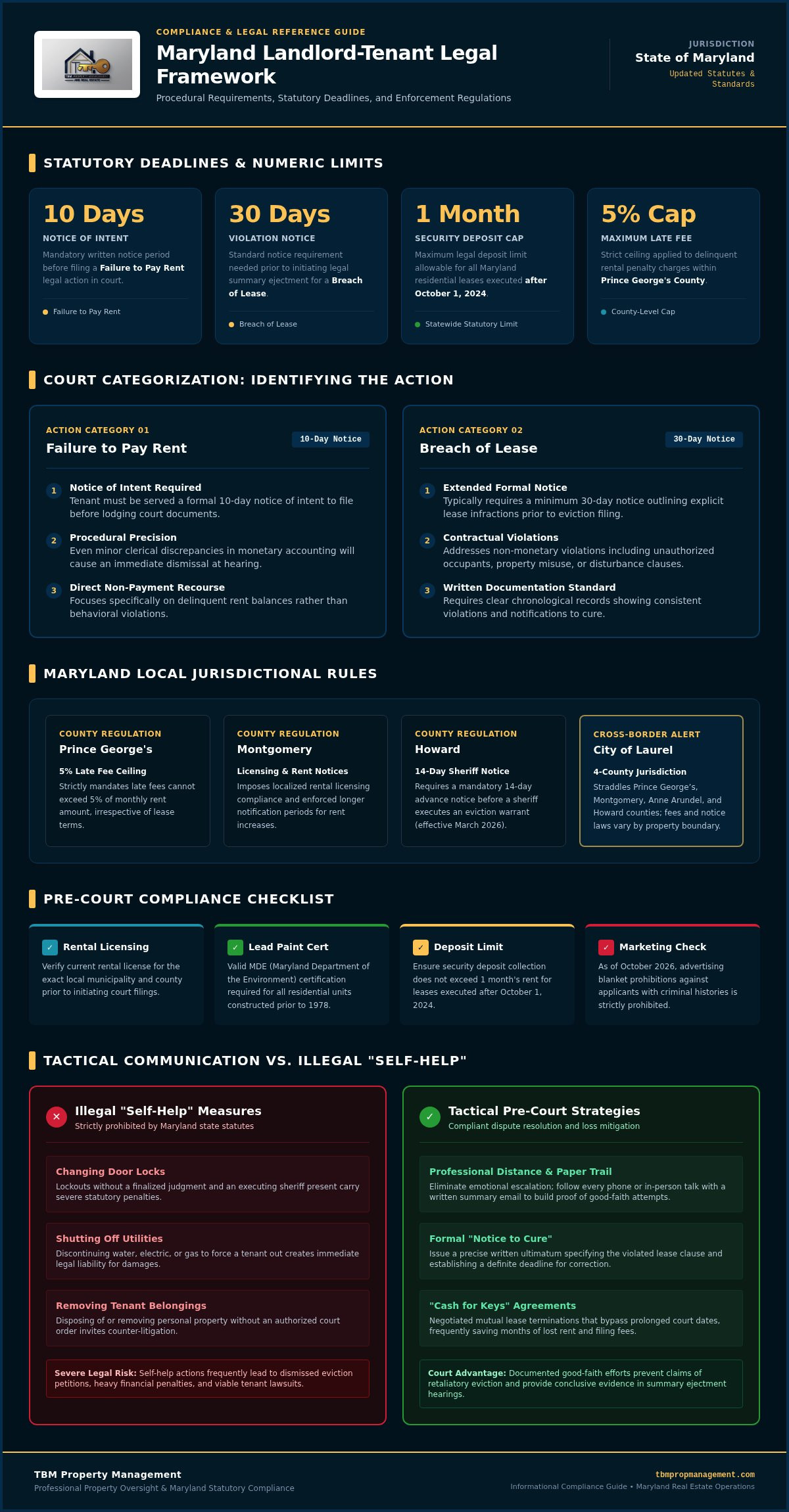
It's vital to understand that "self-help" evictions are strictly prohibited in Maryland. While the Eviction process in the U.S. follows a general structure, Maryland's specific statutes are increasingly protective of tenants. You cannot change locks, shut off utilities, or remove a tenant's belongings without a court order and a sheriff present. Attempting these shortcuts often leads to heavy financial penalties and potential lawsuits that could eclipse months of lost rent. Instead, you must categorize the difficulty correctly. Is it a Failure to Pay Rent, which requires a 10 day notice of intent to file, or a Breach of Lease, which usually requires a 30 day notice? Distinguishing between these categories early determines your entire legal timeline.
Maryland vs. Local County Rules
Maryland's laws provide a baseline, but local jurisdictions often add their own layers of complexity. In Prince George’s County, for example, you must strictly adhere to the 5% cap on late fees. If you own property in Montgomery County, you'll face unique licensing requirements and longer notice periods for rent increases. Landlords in Laurel face a particularly tricky situation because the city straddles four different counties: Prince George’s, Montgomery, Anne Arundel, and Howard. Depending on which side of the city line your property sits, your filing fees and notice requirements will change. For instance, Howard County now requires a 14 day notice before a sheriff executes a warrant, a rule that went into effect in March 2026.
The 2026 Compliance Checklist
Before you step into a courtroom, ensure your documentation is airtight. As of October 2026, new regulations prohibit advertising that you won't consider applicants with criminal histories, so review your marketing materials immediately. Your checklist should include:
- Rental Licensing: Verify that your license is current for the specific jurisdiction where the property is located.
- Lead Paint Certification: Ensure properties built before 1978 have valid MDE certifications to avoid immediate case dismissal.
- Security Deposit Limits: Confirm you haven't charged more than one month's rent, which became the legal cap for leases signed after October 1, 2024.
Staying compliant with these details provides the peace of mind you need to manage your investment effectively.
Tactical Communication: Resolving Issues Without the Court
Dealing with a tenant who ignores your calls or violates lease terms is emotionally draining. If you're wondering how to deal with difficult tenants legally, start by stripping emotion out of the equation. We recommend the "Professional Distance" strategy. By treating every interaction as a purely business transaction, you protect yourself from making impulsive decisions that could be framed as harassment in court. Every phone call or face-to-face conversation must be followed by a written summary sent via email. This establishes a chronological paper trail that proves you've made a good faith effort to resolve the issue.
Before jumping into a lawsuit, consider using a "Notice to Cure." This serves as a final, formal warning that clearly outlines the lease violation and provides a specific deadline for the tenant to fix it. In some cases, a "Cash for Keys" agreement is a faster, cheaper alternative to the standard eviction process. While it feels counterintuitive to pay a non-compliant tenant to leave, it often saves you thousands in lost rent and legal costs. The Maryland Attorney General's Landlord-Tenant Guide provides a solid foundation for understanding these rights, but remember that your specific lease terms will dictate your leverage in these negotiations. If these conversations feel too confrontational, hiring a partner for full-service property management can provide the professional buffer you need to restore your peace of mind.
Documenting Lease Violations
Success in a Maryland courtroom depends on your ability to prove your claims with objective data. Use regular property inspections to gather evidence of unauthorized occupants, pets, or neglected maintenance. High quality, date-stamped photos are essential. In a Maryland rent escrow case, admissible evidence is defined as relevant documentation, such as date-stamped photographs or certified inspection logs, that directly proves or disproves a specific claim regarding the property's condition or lease compliance. Keep a detailed log of every violation to ensure your case is bulletproof.
The Art of the Formal Letter
When communication fails, your formal notices must be precise. For a "Failure to Pay Rent" notice, Maryland law requires a 10 day written notice of intent to file for eviction. Don't just drop this in a mailbox. Send all formal notices via both first-class mail and certified mail with a return receipt requested. This dual-method approach ensures the tenant cannot claim they never received the warning. Set clear deadlines that mirror Maryland statutory requirements to show the court you've followed the letter of the law.
The Legal Process: Filing for Eviction in Maryland
When tactical communication fails to produce results, you must move the conflict to the District Court. Understanding how to deal with difficult tenants legally through the formal eviction process requires a clear distinction between a Failure to Pay Rent filing and a Breach of Lease action. Most landlords prefer the Failure to Pay Rent route because it utilizes summary ejectment procedures, which are generally faster. However, if the issue involves property damage or unauthorized occupants rather than money, you must file a Breach of Lease. Maryland also grants tenants a Right of Redemption. This "Pay to Stay" rule allows them to stop the eviction at any point before the sheriff arrives by paying all rent, late fees, and court costs. You can only foreclose this right if you've already obtained three judgments against them within the previous 12 months, or four judgments if the property is in Baltimore City.
Step 1: Filing the Complaint
To begin, you must accurately complete the Failure to Pay Rent form, known as DC-CV-082. As of September 2026, the filing fee is $50, though it increases to $60 for properties located in Baltimore City. Precision is your best friend here. If you miscalculate the late fees, which are capped at 5% of the monthly rent, or fail to provide a valid rental license number, the judge may dismiss your case on the spot. Many private owners lose their cases because they forget to include the $5 service fee for mail and posting. Ensure your ledger is updated to the cent before you walk into the clerk's office.
Step 2: The Court Hearing and Judgment
The Show Cause hearing is your opportunity to present your ledger and lease to the judge. Tenants often attempt to delay the process by claiming the property is in an unfit condition, which can trigger a rent escrow case. You can find detailed procedural guidance on the Maryland Courts Housing Cases portal. If the judge rules in your favor, you'll receive a Judgment for Possession. You aren't done yet. You must then file a Warrant of Restitution, which costs $40 statewide, plus an additional $10 court fee in Baltimore City. This warrant is the legal document that authorizes the sheriff to schedule the actual eviction, finally bringing you the relief of a vacated property.
Avoiding Common Legal Traps for Maryland Landlords
When you're frustrated by a resident's behavior, it's tempting to take matters into your own hands. However, reacting emotionally often leads to expensive legal traps that can jeopardize your entire portfolio. If you're searching for how to deal with difficult tenants legally, you must avoid "self-help" evictions at all costs. In Maryland, changing locks, removing a tenant's belongings, or shutting off essential utilities like water or heat is a disaster that invites heavy statutory penalties. Similarly, you must be wary of "retaliatory eviction" claims. If a tenant recently complained to a housing inspector or joined a tenant organization, the court may view any subsequent eviction filing as a retaliatory act, which is a valid defense in our state's District Court.
You also need to stay vigilant regarding Fair Housing Act compliance. Ensure that your interactions and enforcement of lease terms are consistent across all residents to avoid accusations of discrimination based on protected classes. Even handling abandoned property requires a strict adherence to the rules. In Maryland, property left behind after a sheriff-led eviction is generally considered abandoned, but you should always verify local county ordinances to ensure you aren't liable for disposing of a tenant's assets too quickly. To safeguard your property from these complexities, you can get a complimentary analytical report to identify potential vulnerabilities in your current management strategy.
The Dangers of Verbal Agreements
Many well-meaning landlords fall into the trap of "handshake deals" regarding late rent. While being empathetic is part of the job, verbal promises can unintentionally waive your right to evict for that period. If you decide to offer a grace period, you must legally document the payment plan in writing to ensure it doesn't reset your eviction clock or invalidate existing notices. Accepting even a small portion of overdue rent in Maryland can legally waive your right to pursue a summary ejectment for the remainder of that month's balance unless a specific written waiver is signed by both parties. Always keep your communication formal and documented.
Navigating the Rent Escrow Defense
Difficult tenants often use the rent escrow defense to stop an eviction. This happens when a tenant pays their rent to the court instead of you, claiming the property has serious defects that affect life, health, or safety. To win here, you must prove your property meets Maryland’s strict habitability standards, which include providing adequate heat, light, and plumbing. Proactive maintenance coordination and regular property inspections are your best defenses. By keeping detailed logs of all repairs and inspections, you can demonstrate to a judge that you've met your obligations as a landlord, effectively neutralizing the escrow claim.
How Professional Management Eliminates Tenant Stress
Are you tired of losing sleep over a resident who refuses to follow the rules? The emotional burden of asset oversight often feels overwhelming, especially when you are unsure how to deal with difficult tenants legally without triggering a lawsuit. This is where a dedicated partner makes the difference. TBM Property Management acts as a stabilizing force, providing a professional buffer between you and your tenant. We handle the high-pressure conversations, the late-night maintenance calls, and the rigorous rent collection processes that typically cause landlords the most anxiety. By removing yourself from the direct line of conflict, you restore your peace of mind and protect your professional reputation.
Our approach is rooted in 12+ years of local Maryland real estate expertise. We believe the best way to handle a difficult tenant is to prevent them from moving in at all. Our comprehensive tenant screening process uses specific methodologies to spot red flags that often go unnoticed by self-managed owners. If a conflict does reach the court, our seasoned team coordinates the legal filings, ensuring every document is filed correctly in the local District Court. This mastery of the legal landscape speeds up resolutions and minimizes the time your property sits non-performing.
From Stress to Passive Income
Does your current management strategy actually save you money, or is it costing you in hidden legal fees and extended vacancies? Full-service property management often pays for itself by maintaining a high standard of tenant relations and property care. We conduct regular property inspections in Anne Arundel and Howard counties to catch lease violations before they become expensive repairs. For a deeper look at how we secure your ROI, explore our guide to Full-Service Property Management in Laurel, MD. We focus on protecting your monthly income so you can enjoy the benefits of passive ownership.
Get Your Free Rental Analysis
If you have inherited a difficult tenant or find yourself stuck in a cycle of non-payment, the first step toward relief is a clear assessment of your situation. We specialize in transitioning problematic tenancies into professional management frameworks, often resolving conflicts through structured communication rather than immediate litigation. We offer a specialized look at your property's current health to help you decide on the best path forward. Stop struggling with the complexities of self-management alone. You can request your complimentary rental analysis from TBM today to start your journey toward a stress-free investment.
Secure Your Peace of Mind and Property Value
Protecting your Maryland rental investment requires more than just patience; it demands a precise understanding of the state's evolving legal framework. By mastering tactical communication and adhering to the strict notice requirements of the District Court, you turn a stressful situation into a manageable business process. Knowing how to deal with difficult tenants legally is the difference between a successful resolution and a costly, dismissed case. You don't have to navigate these complexities alone. With 12+ years of Maryland property expertise, TBM Property Management provides the professional buffer you need to restore order to your portfolio.
Our dedicated local management team in Laurel, MD, specializes in comprehensive tenant screening and placement to stop problems before they begin. We focus on consistent property inspections and rent collection so you can return to enjoying passive income without the emotional burden of asset oversight. You've invested significant capital into your properties, and you deserve a partner who protects that value with mastery and dedication. Stop the stress and let TBM handle your difficult tenants legally today. Your investment is safe in our hands.
Frequently Asked Questions
Can I legally evict a tenant for not paying rent in Maryland?
Yes, you can legally evict for non-payment using a "Failure to Pay Rent" filing in the District Court. You must first provide a 10 day written notice of your intent to file. The process involves a summary ejectment hearing where you'll present your ledger to a judge. Understanding how to deal with difficult tenants legally means following these procedural steps perfectly to avoid a case dismissal during your hearing.
How long does the eviction process take in Prince George's County?
The timeline in Prince George’s County typically ranges from four to eight weeks, though court backlogs can extend this period. You start with the mandatory 10 day notice, followed by a court hearing usually scheduled within two to three weeks of your filing. If you win, you must wait four days to file a Warrant of Restitution. The sheriff then schedules the eviction based on their current availability and weather conditions.
What should I do if a tenant is damaging my property in Laurel?
If a resident is causing damage, you should file a Breach of Lease action. You must provide a 30 day written notice before filing, unless the damage poses a clear and imminent danger, which reduces the notice to 14 days. Since Laurel spans multiple counties, ensure you file in the correct jurisdiction. High quality, date stamped photos are essential evidence to prove the extent of the damage during your District Court hearing.
Is it legal to change the locks on a difficult tenant in Maryland?
No, changing the locks is a form of "self-help" eviction and is strictly illegal in Maryland. You cannot shut off utilities or remove belongings to force a tenant out. These actions can lead to significant lawsuits and statutory penalties against you. The only legal way to regain possession is through a court ordered warrant executed by the sheriff. Professional property management helps you navigate this process without risking these dangerous legal traps.
How much notice must I give a tenant to move out in Montgomery County?
For a month-to-month tenancy, you must provide 60 days' written notice to terminate the agreement. If the tenant is on a year-to-year lease, the requirement increases to 90 days' notice before the end of the current lease year. Montgomery County has specific licensing and notice requirements that differ from state minimums. Always send these notices via certified mail to ensure you have proof of delivery for any future court proceedings you might face.
What happens if a tenant refuses to leave after the lease expires?
When a resident stays past their move out date, they're considered a "Tenant Holding Over." You must file a specific complaint in District Court to regain possession of your property. The filing fee is $56, or $66 in Baltimore City, plus a $40 service fee per defendant. You must prove that you provided the proper 60 day notice to terminate the tenancy. Don't accept rent after the lease expires without a written agreement.
Do I need a lawyer for a landlord-tenant hearing in Maryland?
While individuals can represent themselves in District Court, it's often wise to have professional assistance. Corporations and limited liability companies are generally required to be represented by an attorney in Maryland courts. Tenants often have access to free legal counsel through the state's "Access to Counsel in Evictions" program. Having an expert who knows how to deal with difficult tenants legally ensures your documentation meets the judge's strict standards for evidence.
How can I legally collect unpaid rent after a tenant moves out?
First, you can deduct unpaid rent from the security deposit, provided you send an itemized list of deductions to the tenant within 45 days of the tenancy ending. If the deposit doesn't cover the full balance, you can file a separate civil suit for a money judgment. This allows you to pursue wage garnishments or bank attachments. TBM Property Management specializes in rent collection and financial reporting to help you recover these funds efficiently.