
Maryland Eviction Process: 2026 Legal & Tactical Guide
What if the property that was supposed to secure your future has instead become a source of constant stress and financial drain? It's a scenario many owners face when a tenant stops paying rent or violates their lease terms, making the maryland eviction process for landlords feel like an impossible maze. We understand how exhausting it is to watch your rental income disappear while you worry about "professional tenants" who know how to stall the legal system. You shouldn't have to feel like a stranger in your own investment, and you certainly shouldn't have to navigate the shifting landscape of local regulations without a clear plan.
Regaining control of your asset is the first step toward reclaiming your property and your confidence. This guide provides a comprehensive roadmap through the 2026 legal requirements, though it's important to note this information is for educational purposes and doesn't constitute legal advice. We'll walk you through the mandatory 10 day notice periods for non payment, the specific filing fees for Maryland District Courts, and the tactical steps required to secure a judgment for possession. By following this structured path, you can minimize financial losses and focus on protecting your asset in jurisdictions from Prince George's to Anne Arundel County.
Key Takeaways
- Identify the specific legal grounds for eviction, including the mandatory 10-day notice period required for non-payment of rent.
- Navigate the maryland eviction process for landlords with a structured roadmap that covers everything from court filings to the final warrant of restitution.
- Understand how local jurisdiction rules in Prince George’s, Montgomery, and Howard Counties can impact your timeline and documentation requirements.
- Avoid costly "self-help" mistakes and legal pitfalls that can reset your eviction clock or result in retaliatory claims.
- Discover how professional tenant screening and proactive management act as your first line of defense against difficult rental situations.
Legal Grounds for Eviction in Maryland
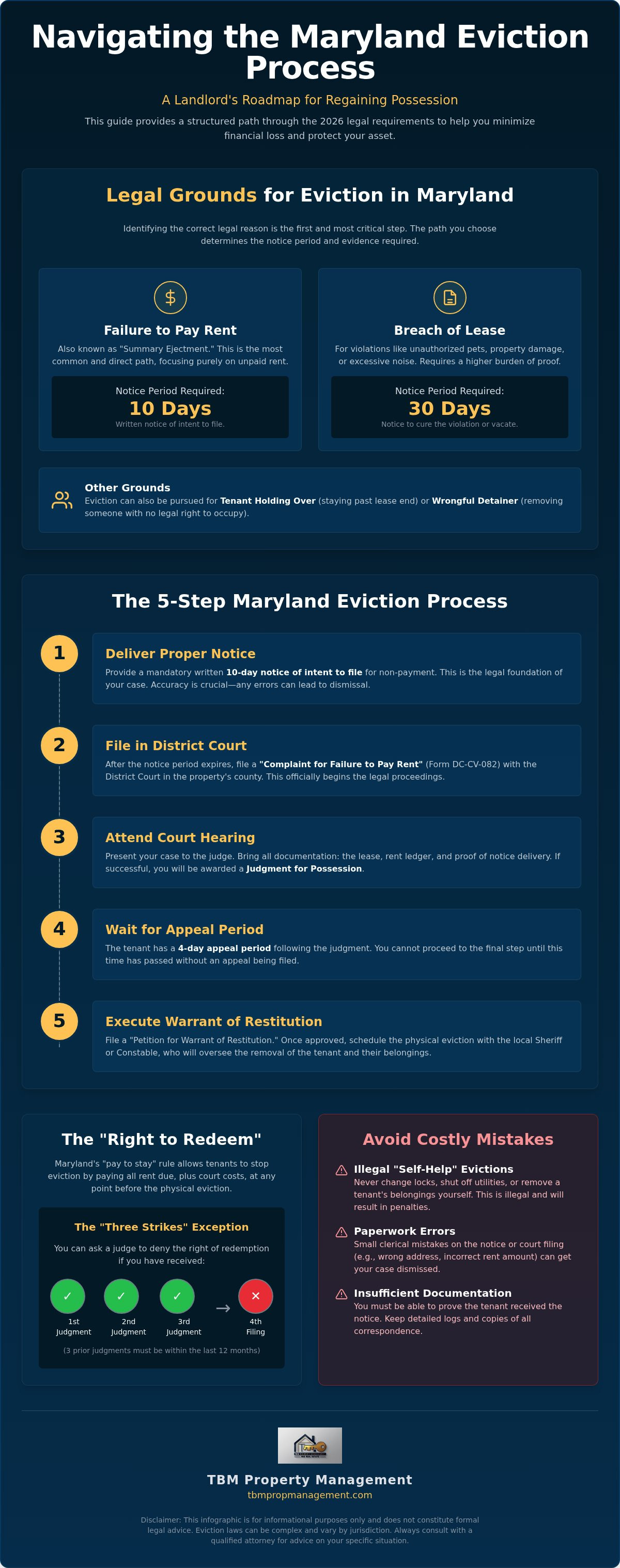
Understanding why you're seeking possession is the foundation of the maryland eviction process for landlords. You need a solid legal footing before filing a single form with the District Court. In Maryland, the law recognizes four primary reasons for removing a tenant, each with its own set of rules and timelines. Identifying the correct ground early prevents your case from being dismissed on a technicality, saving you from the frustration of starting over while your rental income remains at a standstill.
The most frequent path is Failure to Pay Rent, often referred to as Summary Ejectment. It's a straightforward process focused on the financial ledger. Breach of Lease occurs when a tenant violates specific rules, such as keeping unauthorized pets or having extra occupants not listed on the lease. If a tenant stays past their lease expiration date without your consent, they are Tenant Holding Over. Finally, Wrongful Detainer applies when you need to remove someone who has no legal right to the property at all, such as a squatter or a guest who refuses to leave. The Eviction Process varies based on these grounds, so you must choose the one that fits your situation perfectly.
Summary Ejectment vs. Breach of Lease
Landlords often wonder which route is more efficient. Summary Ejectment is typically the "fastest" legal path because it focuses on a clear, documented failure to pay. You don't have to prove behavior; you just have to prove the math. Conversely, a Breach of Lease filing carries a much higher burden of proof. You'll need evidence, like photos of property damage or witness statements about noise violations. While a breach case requires a 30 day notice period, non payment cases in 2026 only require a 10 day written notice of intent to file. If your tenant has stopped paying and is also violating lease terms, filing for non payment is usually the more direct way to regain possession.
The "Right to Redeem" Explained
Maryland law provides a safety net for tenants known as the "Right to Redeem," or the "pay to stay" rule. This allows a tenant to stop the eviction at almost any point, even when the sheriff is at the door, by paying all past due rent, late fees, and court costs. However, this isn't an infinite pass. If you've won three previous rent court judgments against the same tenant within the last 12 months, you can ask the judge to deny the right of redemption on the fourth filing. This "three strikes" rule is a vital tool for owners in Prince George’s or Montgomery County dealing with "professional tenants" who chronically delay payments. Please note that this guide is for informational purposes only and does not constitute formal legal advice.
The Maryland Eviction Process: Step-by-Step
How long will it take to get your property back? This is the question that keeps most property owners awake at night. The maryland eviction process for landlords is a strictly timed sequence where missing a single deadline can set your progress back by weeks. If you follow the rules of the District Court of Maryland with precision, you can move from a state of frustration to a state of resolution. The journey typically follows these five critical stages:
- Step 1: Deliver the mandatory written 10-day notice for non-payment.
- Step 2: File a formal Complaint for Failure to Pay Rent in the District Court.
- Step 3: Present your case at the court hearing to secure a Judgment for Possession.
- Step 4: Wait for the four-day appeal period to expire before requesting a Warrant of Restitution.
- Step 5: Schedule and complete the physical eviction with the local Sheriff or Constable.
Proper Notice: The Foundation of Your Case
In 2026, Maryland law requires all landlords to provide a written 10-day notice of intent to file for eviction before any non-payment case can proceed. If you rush to court without this document, or if the notice contains even a small clerical error in the address, the judge will likely dismiss your case. Documentation is everything. You must be able to prove the tenant received the notice, so keeping a detailed log of delivery and a copy of the specific letter is essential. Are you feeling overwhelmed by the paperwork? Many owners find that hiring leasing and management services provides the buffer they need to ensure every notice is legally perfect.
Navigating the District Court Hearing
Preparation is the only way to counter the "professional tenant" who knows how to use the system. When you arrive for the Maryland eviction court process, you must bring your original lease, a clear rent ledger showing every payment and late fee, and proof of your rental license. Tenants in Prince George’s or Montgomery County often raise defenses regarding property maintenance to delay the proceedings. If you have records of regular inspections and timely repairs, you can easily disprove these claims. Once the judge rules in your favor, a four-day appeal window begins for residential properties. You cannot file for the final warrant until this period passes, so use this time to coordinate with the sheriff’s office and plan your next steps for the property turnover.
County-Specific Nuances: PG, Montgomery, and Howard
Do you know exactly where your property line falls? For owners in Laurel, this isn't just a trivia question; it's a legal necessity. Because Laurel stretches across Prince George's, Anne Arundel, and Howard counties, the maryland eviction process for landlords changes depending on which side of the street your rental sits. Each jurisdiction maintains its own specific set of hurdles that can derail an otherwise valid case if you aren't prepared for the local climate.
In Prince George’s County, the court is particularly strict about rental licenses and lead certificates. If your paperwork isn't current, the judge will likely dismiss your Failure to Pay Rent filing before you can even present your ledger. Montgomery County goes even further, often requiring specific "just cause" considerations for certain lease terminations and providing additional layers of tenant mediation that can extend your timeline significantly. Howard and Anne Arundel counties tend to follow state standards more closely, but their Sheriff’s offices have unique scheduling rhythms that require a proactive approach to master.
Rental Licensing: The Hidden Barrier to Eviction
You cannot win a non-payment case in most Maryland jurisdictions without a valid, up-to-date rental license. This hidden barrier often catches self-managed landlords by surprise during their hearing. Prince George’s and Montgomery counties utilize their own digital portals for registration, and failing to navigate these correctly means you lose your right to seek a judgment for possession. We take this burden off your shoulders by ensuring every property we manage meets local mandates long before a legal issue arises. Our team handles the heavy lifting of compliance so you never have to worry about a technicality costing you months of rent.
Working with the Local Sheriff’s Office
What happens after you win your judgment? The physical eviction is the final, most stressful step. In the Laurel area, you must coordinate closely with the specific county Sheriff to set a date. On that morning, the responsibility falls on you to provide a professional locksmith and a crew of movers to clear the property within a strict timeframe. It's also vital to watch the forecast. Sheriffs will often postpone evictions due to extreme weather or precipitation, forcing a complete reschedule of the logistics. Having a dedicated partner to manage these moving parts transforms a chaotic day into a controlled, professional transition, restoring your peace of mind while protecting your investment.
Common Landlord Mistakes and Legal Risks
Have you ever felt so frustrated with a non-paying tenant that you considered changing the locks yourself? While it's tempting to take immediate action when your income is at stake, doing so can turn your investment into a legal liability. The maryland eviction process for landlords is strictly procedural; any attempt to bypass the court system through "self-help" measures will likely result in a judgment against you. Even a small procedural error can reset your timeline, leaving you to deal with the same problem for several more months.
Retaliatory eviction is another significant risk that owners often overlook. If you initiate an eviction shortly after a tenant makes a legitimate complaint about property conditions or joins a tenant organization, the court may view your actions as illegal retaliation. Similarly, you must be cautious about accepting partial payments. If you accept even a small portion of the overdue rent after filing your case, you might inadvertently "cure" the breach. This often forces you to start the entire process over, beginning with a new 10-day notice. Our team specializes in rent collection strategies that prevent these common traps, ensuring your rights remain protected throughout the process.
The Danger of Illegal Lockouts
Tenants can claim significant damages for illegal evictions, including moving costs, temporary housing, and even emotional distress. You must never cut off "essential services" like water, heat, or electricity to pressure a tenant to leave. Regardless of how much rent is owed, the only legal way to regain possession is through the sheriff's office after receiving a warrant of restitution. It's about protecting your long-term ROI by staying within the lines of the law and avoiding costly litigation that can arise from a single moment of frustration.
Documentation and Evidence Standards
Your rent ledger is your most powerful weapon in court, but it must be bulletproof. Maryland judges frequently dismiss cases if the math is inconsistent or if you've added fees that aren't specifically authorized in your lease agreement. Beyond finances, you should maintain records of regular property inspections to document non-monetary lease violations, such as property damage or unauthorized occupants. This level of detail proves you're a diligent owner who follows high standards of professional oversight, making it much harder for a tenant to mount a successful defense during your hearing.
How Professional Management Streamlines Possession
Do you feel like you've spent more time in a courtroom than on your own property lately? The emotional and financial toll of a difficult tenant is heavy, but you don't have to carry it alone. Professional management transforms the maryland eviction process for landlords from a chaotic legal battle into a controlled, professional procedure. By acting as a steady buffer between you and your tenant, we handle the friction and the paperwork while you focus on your long-term goals. Our goal is to stabilize your investment and restore the peace of mind you deserve.
The TBM Screening Advantage
Success in rental property ownership starts long before a lease is signed. Our team brings 12+ years of local real estate expertise to every application, allowing us to identify "red flag" applicants that others might miss. We verify income, credit scores, and prior landlord references with a level of scrutiny that self-managed owners often don't have the time to perform. This proactive approach is your best defense against future court dates. If you want to build a portfolio of reliable residents, our tenant placement services ensure your property is occupied by individuals who value your investment as much as you do.
When rent is late, we don't wait for the situation to spiral. Our early intervention strategies involve immediate communication and firm rent collection protocols that often resolve payment issues before they require a judge’s intervention. If a court filing becomes necessary, we manage the legal heavy lifting. From filing the specific Failure to Pay Rent forms to appearing in the District Courts of Prince George’s or Montgomery County, we stand in your place. This ensures that every step of the maryland eviction process for landlords is executed with professional precision, minimizing the time your property sits without generating income.
Restoring Your ROI and Peace of Mind
The cost of a single DIY eviction error can far outweigh the investment in professional management. Between lost rent, court fees, and the potential for tenant lawsuits, the financial stakes are high. We provide a clear cost-benefit advantage by accelerating the turnover process. Once possession is regained, our maintenance coordination team steps in immediately to get the unit rent-ready. This rapid transition minimizes your vacancy period and gets your cash flow back on track. We act as your dedicated partner, offering supportive guidance through every stressful legal transition. If you're ready to see how professional oversight can protect your assets in Laurel and beyond, contact us today for a complimentary rental analysis of your property.
Reclaiming Your Investment with Confidence
The maryland eviction process for landlords doesn't have to be a source of constant anxiety. By mastering the 10-day notice requirements and navigating the unique licensing hurdles in Prince George's or Montgomery County, you can protect your assets from the risks of "professional tenants." Success in property ownership is built on a foundation of precision, documentation, and proactive intervention. You don't have to face these legal complexities alone, especially when errors can be so costly to your bottom line.
Since 2012, we've been a trusted partner for Laurel, MD investors, offering over 12 years of local real estate expertise. Our comprehensive tenant screening process acts as your first line of defense, significantly reducing the likelihood of ever needing to set foot in a courtroom. If you're ready to move from a state of frustration to a state of ease, we're here to provide the stabilizing force your portfolio needs. Let TBM Property Management handle the stress; contact us today for a complimentary rental analysis.
Your investment represents your future. With the right support and professional oversight, you can ensure it remains a source of security rather than stress.
Frequently Asked Questions
How long does the eviction process take in Maryland in 2026?
The timeline for the maryland eviction process for landlords typically spans two to three months from the initial notice to the final lockout. This includes the mandatory 10-day notice period, the time required to secure a court date, and the four-day appeal window following a judgment. Scheduling with the local sheriff can add several weeks to the end of the process depending on current backlogs in counties like Prince George's or Montgomery.
Can I evict a tenant in Maryland without a written lease?
Yes, you can evict a tenant without a written lease because Maryland law recognizes oral agreements as valid month-to-month tenancies. You still must follow the standard legal procedures, including providing proper written notice before filing for possession in District Court. Without a written lease, the court generally defaults to state-mandated rules regarding notice periods and security deposits, so having detailed records of rent payments becomes even more critical for your case.
What is a Warrant of Restitution and when do I need one?
A Warrant of Restitution is the final legal order that authorizes a sheriff or constable to physically remove a tenant and their belongings from your property. You need this document after you've won a Judgment for Possession and the four-day appeal period has expired. In 2026, the statewide fee for this warrant is $40.00, though Baltimore City adds a specific $10.00 surcharge for these filings. This is the final step in regaining control.
Do I need a lawyer for a Failure to Pay Rent case in Maryland?
You aren't legally required to hire a lawyer if you're an individual landlord, but corporations and limited liability companies must be represented by an attorney in Maryland courts. Many owners choose to work with a professional partner to manage the maryland eviction process for landlords to ensure documentation is perfect. We act as a buffer and handle the heavy lifting of court appearances, which often saves owners from the stress of self-representation.
Can a tenant stop an eviction by paying at the last minute?
Most tenants have a "right of redemption" that allows them to stop an eviction by paying all past-due rent and court costs before the sheriff completes the lockout. However, this right isn't unlimited. If you've received three prior judgments against the same tenant within the last 12 months, you can ask the judge to deny this right on the fourth filing. This "three strikes" rule is a vital tool for dealing with chronic non-payment.
What happens to a tenant’s property after an eviction in Maryland?
The handling of a tenant's property varies significantly by county. In many jurisdictions, the sheriff oversees the removal of belongings to the nearest public right-of-way, where they are considered abandoned. However, specific rules in areas like Baltimore City may require property to remain inside the unit. It's your responsibility to provide the labor for the move, so coordinating with a professional crew is essential to ensure the transition is handled efficiently and legally.
How much does it cost to file for eviction in Prince George’s County?
In Prince George’s County, the current fee to file a "Failure to Pay Rent" case is $50.00 as of March 2026. If you're filing for a "Breach of Lease" or "Tenant Holding Over," the filing fee increases to $56.00. You should also budget for the $40.00 Warrant of Restitution fee required later in the process. These costs are subject to change by the District Court, so verifying the current schedule before filing is always wise.
Can I evict a tenant for complaining about repairs?
No, attempting to evict a tenant specifically because they complained about necessary repairs or reported code violations is considered a retaliatory eviction. Maryland law strictly prohibits this behavior and can result in the court awarding damages to the tenant. To avoid the appearance of bias, ensure you have clear grounds for any filing and maintain a detailed history of your property inspections and maintenance responses. This documentation proves you're acting as a professional, diligent owner.