
Maryland Security Deposit Laws: 2026 Compliance Guide
Would your rental business survive a court order to pay three times the value of a security deposit plus your tenant's legal fees? For many property owners in Anne Arundel and Howard counties, this nightmare scenario is a constant worry. You likely feel the weight of managing your assets while trying to keep up with the rapid legislative changes from the Renters' Rights and Stabilization Act. It's frustrating to feel like the rules are shifting, especially when you're just trying to protect your property from damage.
By mastering the latest maryland security deposit laws for landlords, you can transform this high-liability task into a predictable, stress-free business process. This 2026 compliance guide provides the professional-grade clarity you need to handle escrow accounts and move-out inspections with total confidence. We will walk you through the current 3.47% interest rate requirements, the strict one-month deposit limit, and the essential documentation strategies that shield you from local court disputes. You'll learn how to distinguish between ordinary wear and tear and actual damage, ensuring your transition between tenants is both legal and profitable.
Key Takeaways
- Learn about the mandatory one-month maximum for security deposits to ensure your rental agreements remain fully compliant with the latest legislative shifts.
- Discover how to navigate maryland security deposit laws for landlords by accurately calculating the 3.47% interest rate required for 2026 and meeting strict 30-day escrow deadlines.
- Master the 45-day return window and the specific requirements for itemized damage lists to protect your investment from the threat of triple-damage lawsuits.
- Understand how professional property inspections provide the objective documentation needed to distinguish between normal wear and tear and deductible tenant damage.
- Explore how professional management services act as a legal shield, automating complex compliance tasks so you can focus on growing your portfolio with peace of mind.
Understanding Maryland Security Deposit Laws: Why Compliance is Your Best Defense
Maryland Code, Real Property § 8-203 isn't just a set of rules; it's the legal framework that dictates how you handle your tenant's money. When you spend time Understanding Landlord-Tenant Law, you see that these regulations exist to balance the power between owners and renters. For landlords in Laurel and Howard County, compliance acts as a professional shield. It protects your investment from the high-stakes risks of the 2026 regulatory environment. If you view these laws as a burden, a single administrative error could quickly turn into a financial catastrophe. These rules are designed to protect you against non-payment of rent, lease breaches, and physical property damage, but only if you follow them to the letter.
What Qualifies as a Security Deposit in Maryland?
Do you know exactly which funds the state considers part of the deposit? In Maryland, any money you hold to secure the performance of a lease is legally a security deposit. This includes pet deposits and payments labeled as "last month's rent." If you are charging an extra $500 for a tenant's dog, that money counts toward the total deposit amount. However, application fees are typically treated as non-refundable processing costs rather than deposits. Distinguishing between these is vital. If you accidentally exceed the legal limit by mislabeling a deposit as a fee, you've already stepped into a non-compliance trap that could trigger legal action.
The Financial Risks of Mishandling Tenant Funds
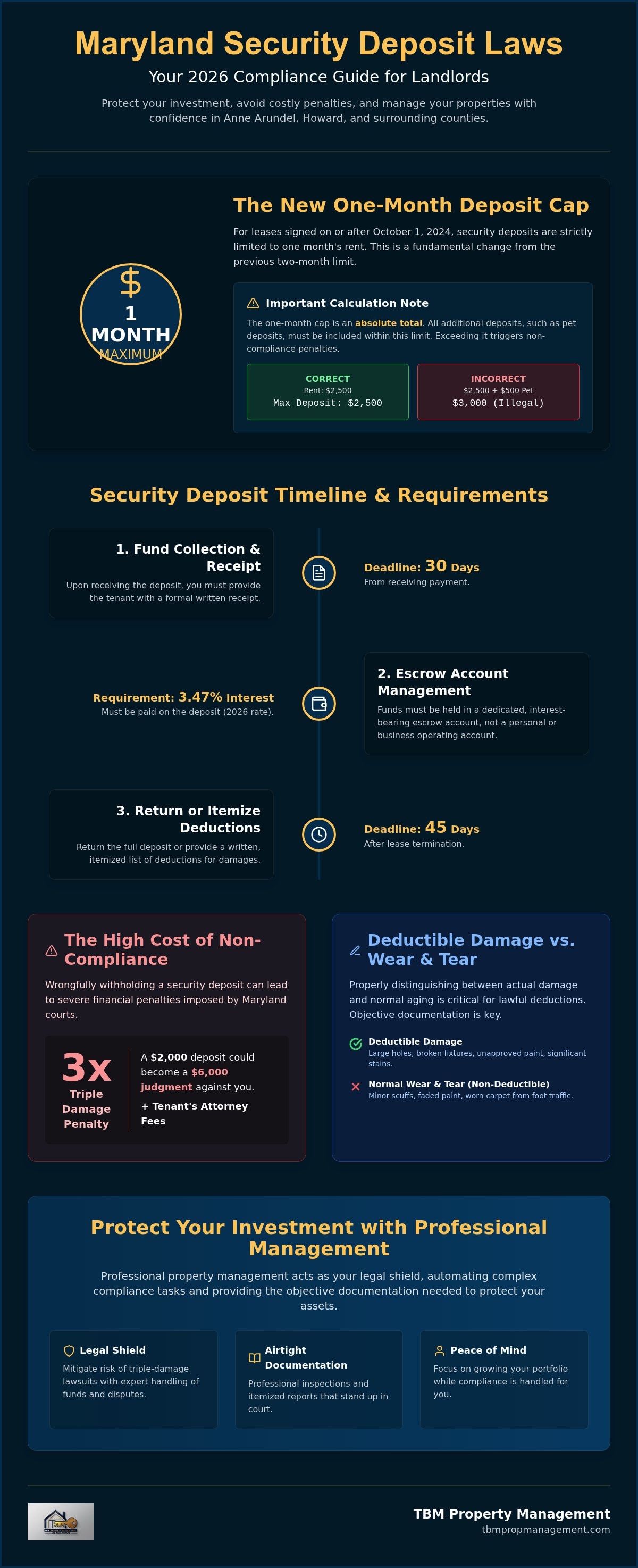
Why is the margin for error so slim? Maryland courts are known for being protective of tenant rights. If a judge finds you "wrongfully" withheld a deposit, you could be ordered to pay three times the original amount. This is the dreaded triple damage penalty. Imagine a $2,000 deposit turning into a $6,000 judgment, plus the tenant's attorney fees. It's a heavy emotional and financial burden for any self-managed landlord in Montgomery or Prince George’s County. The stress of documenting every scratch versus ordinary wear and tear can be overwhelming without a dedicated system. Mastering maryland security deposit laws for landlords is the only way to ensure your move-out process remains streamlined and dispute-free. By following professional-grade methodologies, you remove the subjectivity that often leads to costly lawsuits in the local District Court.
Maximum Limits and Mandatory Disclosures: The New One-Month Rule
The Renters’ Rights and Stabilization Act of 2024 fundamentally changed the financial landscape for rental properties across the state. If you've been managing properties for years, you likely remember the long-standing two-month limit. However, for all leases signed on or after October 1, 2024, the rules have shifted. As we move through 2026, it's vital to recognize that the standard security deposit is now strictly capped at one month’s rent. This landmark change is a core component of Maryland Real Property § 8-203. Are you still using lease templates that reference the old limits? Continuing to do so could leave you vulnerable to lawsuits before a tenant even moves in.
Calculating the One-Month Cap for 2026 Leases
Let's look at the math to ensure your compliance is airtight. If your monthly rent is $2,500, the maximum security deposit you can legally collect is exactly $2,500. This is a hard ceiling that includes all "deposit" funds. It's a common mistake to assume pet deposits can be charged on top of this limit. In reality, if you require a $500 pet deposit, that amount must be factored into the one-month total. Collecting $2,500 for rent plus a $500 pet deposit would put you at $3,000, which exceeds the legal limit and triggers potential penalties. While there are rare exceptions allowing a two-month deposit for tenants receiving specific government-administered utility assistance, these cases are the exception, not the rule. For most landlords in Prince George’s and Anne Arundel counties, simplicity is the safest path to protection.
Mandatory Receipt Disclosures and Landlord Obligations
Compliance doesn't end with the dollar amount. You're legally required to provide a written receipt for the security deposit within 30 days of receiving it. This isn't just a professional courtesy; it's a mandate. Failing to provide this receipt carries an immediate $25 fine, but the real risk lies in the missing disclosures. Your receipt must explicitly inform the tenant of their "Right to Inspect." Specifically, you must state that the tenant has the right to be present during both the move-in and move-out inspections to document the property's condition. If you find these administrative details overwhelming, our leasing services can handle the entire disclosure and documentation process for you.
Do you know the specific wording required for your 2026 receipts? Under current maryland security deposit laws for landlords, you must also notify the tenant of their right to receive an itemized list of damages and the return of their deposit plus interest within 45 days of the lease ending. This transparency builds trust and sets a professional tone for the entire tenancy. By providing these disclosures upfront, you're not just following the law; you're building a defensive paper trail that protects your investment in the event of a future dispute.
Handling the Funds: Escrow Accounts and Interest Requirements
Once you've collected a deposit, the clock starts ticking on your financial responsibilities. Maryland law is explicit: you must deposit these funds into a Maryland banking institution within 30 days of receipt. These aren't your funds to use for property upgrades or tax payments. They belong to the tenant, held in trust by you. This is why the People's Law Library guide to security deposits is such a critical resource for independent owners. It highlights the absolute necessity of keeping these funds in an interest-bearing escrow account. If you fail to use a Maryland-based bank, you're technically in violation of state law, even if the money is safe in an out-of-state account.
The most common mistake we see is the "commingling" trap. You can't simply drop a security deposit into your personal savings or your general business operating account. Mixing tenant funds with your own money is a major red flag for Maryland courts. It suggests a lack of professional oversight and can make it nearly impossible to prove you've handled the money correctly during a dispute. To stay compliant with maryland security deposit laws for landlords, you should maintain a dedicated account for each property or a master escrow account with detailed sub-accounting for every tenant.
For 2026, the interest requirements are specific and mandatory. If you hold a deposit of $50 or more for at least six months, you must pay simple annual interest. The verified rate for 2026 is 3.47%. While this might seem like a small administrative detail, failing to credit this interest correctly can lead to the same triple-damage penalties discussed earlier. If you decide to sell your rental property, the responsibility doesn't just disappear. You must transfer the deposit and all accrued interest to the new owner, and notify the tenant of the transfer in writing to ensure a seamless transition of liability.
Escrow Account Management in Prince George’s and Montgomery Counties
Managing escrow in local hubs like Laurel or Silver Spring requires a diligent eye on the calendar. Tracking interest accrual over a multi-year tenancy is a complex task that many self-managed landlords find overwhelming. If you're tired of the paperwork, transitioning to professional property management shifts the liability of fund handling to a seasoned partner. We use professional-grade accounting systems to ensure every penny of interest is tracked and every escrow deadline is met with precision, giving you back your peace of mind.
Surety Bonds: An Alternative to Cash Deposits
Some tenants may ask to use a surety bond instead of a traditional cash deposit. A surety bond is essentially an insurance policy where the tenant pays a non-refundable premium to a third party, who then guarantees payment to the landlord for damages. It's important to remember that as a landlord, you have the absolute right to reject a bond and insist on cash. If you do accept a bond, you must provide specific disclosures. These include informing the tenant that the bond is not insurance for them and that they are still liable for any damages that exceed the bond amount. Clear communication here prevents confusion when it's time for the tenant to move out.
Deductions and Returns: Navigating the 45-Day Deadline
The 45-day deadline is the most critical milestone in the move-out process. Once the tenancy ends, you have a strict window to return the deposit plus the required 3.47% interest. If you plan to withhold any portion of the funds, you must provide a written, itemized list of damages. This list isn't just a courtesy; it's a legal mandate that must include the actual costs incurred for repairs. Missing this deadline by even a single day can strip you of your right to make any deductions, leaving you vulnerable to those triple-damage claims. It's a high-stakes timeline that requires your full attention from the moment a tenant hands over the keys.
The Move-Out Inspection Process
How do you handle the inspection without a dispute? Under maryland security deposit laws for landlords, you're required to inform tenants of their right to be present during the final walkthrough. If the tenant requests to be there, you must notify them of the date and time via certified mail. Documentation is your best defense here. Having a history of regular property inspections makes this much simpler. By documenting the home's condition throughout the lease, you create an objective timeline. This removes the "he-said, she-said" arguments that often derail security deposit returns in Prince George's County courts. Always take high-resolution photos and videos to back up your findings.
Legal vs. Illegal Deductions
Distinguishing between ordinary wear and tear and excessive damage is where many disputes begin. Ordinary wear and tear includes things like faded paint, worn carpet in high-traffic areas, or minor scuffs on floorboards. These are your responsibility as an owner. Excessive damage, such as large holes in the drywall, deep pet stains, or broken windows, are valid deductions. You can also deduct for unpaid rent or utility bills. However, you shouldn't charge for professional carpet cleaning just as a standard fee; it must be tied to actual damage. Always back your claims with photos and paid invoices from contractors rather than simple estimates.
If a tenant abandons the property or is evicted, the rules don't disappear. You still need to send the itemized list to their last known address within the 45-day window to protect yourself from future litigation. If the stress of documenting damage and meeting tight deadlines feels like too much, our professional property inspections can take the weight off your shoulders and ensure your investment remains protected.
Protecting Your Investment with Professional Security Deposit Management
Managing the fine details of security deposits can feel like a full-time job. Between calculating the 3.47% interest rate and meeting the strict 45-day return deadline, the administrative burden is significant. Why carry the stress of potential triple-damage lawsuits on your own? For landlords in Laurel and throughout Anne Arundel County, TBM Property Management acts as a stabilizing force. We automate the entire lifecycle of the security deposit, ensuring every step aligns with current maryland security deposit laws for landlords. By shifting these complex tasks to a seasoned partner, you move from the role of a stressed manager to a protected investor who can focus on portfolio growth.
The move-out process is often the most friction-filled part of being a landlord. However, starting the relationship correctly makes all the difference. Our professional tenant placement services ensure that high-quality renters are placed in your property from day one. This proactive approach reduces the likelihood of damage disputes and lease breaches. When you have a reliable system for screening and placement, the eventual return of a security deposit becomes a routine administrative task rather than a legal battleground.
The TBM Approach to Escrow and Compliance
Our methodology for managing tenant funds is designed for total legal security. We maintain professional-grade escrow accounts that handle interest-bearing requirements across multiple jurisdictions, including Prince George’s and Montgomery counties. You won't have to worry about the commingling trap or banking nuances ever again. To provide the highest level of transparency, we leverage Property Meld for all repair documentation. This system creates a clear, time-stamped paper trail of maintenance coordination and costs. These detailed reports, combined with our rigorous move-in and move-out inspections, provide the third-party documentation needed to stand up to any scrutiny in Maryland Landlord-Tenant court.
Next Steps for Maryland Landlords
Are your current lease agreements and escrow practices ready for 2026? The recent legislative shifts mean that an annual lease audit is no longer optional; it is essential for your protection. We invite you to take advantage of our local expertise with a complimentary rental analysis and compliance review. Our team will examine your current processes to ensure you are meeting all requirements of the maryland security deposit laws for landlords. With over 12 years of local experience in Howard and surrounding counties, we have the mastery needed to keep your investment safe. Let TBM handle your Maryland rental compliance today so you can enjoy the peace of mind that comes with professional oversight.
Secure Your Rental Portfolio for 2026 and Beyond
The 2026 landscape for Maryland landlords is more complex than ever, but it doesn't have to be overwhelming. By prioritizing the new one-month deposit limit and adhering to strict escrow interest requirements, you're already ahead of most self-managed owners. Success in this industry comes down to your documentation during the move-out process and meeting that unwavering 45-day return deadline. When you master maryland security deposit laws for landlords, you transform a source of potential anxiety into a routine, profitable business process.
TBM Property Management offers over 12 years of Maryland property expertise and specialized local knowledge of Prince George’s and Montgomery counties to act as your legal shield. Our comprehensive compliance systems remove the guesswork from asset oversight, providing the professional-grade results and emotional relief you deserve. Protect your rental investment with TBM Property Management today. You've worked hard to build your rental portfolio; let us provide the dedicated partnership and security needed to help your investment thrive for years to come.
Frequently Asked Questions
What is the maximum security deposit allowed in Maryland in 2026?
The maximum security deposit allowed in Maryland is strictly limited to one month's rent for most leases signed after October 1, 2024. If you charge more than this amount, you're in direct violation of state regulations. While there are narrow exceptions for tenants receiving specific utility assistance, the standard rule for landlords in Howard and Anne Arundel counties is a single month's rent. This limit includes all deposit types, such as pet deposits.
How long does a landlord have to return a security deposit in Maryland?
You must return the security deposit plus any accrued interest within 45 days after the tenancy ends. This deadline is non-negotiable and starts the moment the tenant vacates the property. If you're deducting for damages, you must send an itemized list of those costs within this same 45-day window. Missing this deadline often forfeits your right to withhold any funds, even if legitimate damage exists. Professional management ensures these dates are never missed.
Can a Maryland landlord charge a non-refundable pet deposit?
No, Maryland law does not recognize "non-refundable" deposits. Any money collected to secure the performance of a lease, including funds for pets, is legally a security deposit and must be refundable. If you wish to charge for the presence of a pet, you should consider a non-refundable pet fee or monthly pet rent instead. Remember that any deposit amount, regardless of the label, counts toward the one-month legal cap for your rental property.
What happens if a landlord misses the 45-day return deadline?
If a landlord misses the 45-day deadline, they may lose the legal right to withhold any portion of the deposit for damages. Additionally, the tenant can sue in court for up to three times the amount of the deposit plus reasonable attorney's fees. This "triple damage" penalty is a common pain point in Maryland Landlord-Tenant disputes. Following maryland security deposit laws for landlords is the only way to avoid these expensive and stressful court judgments.
Does a landlord have to pay interest on a security deposit in Maryland?
Yes, you are required to pay simple annual interest on deposits of $50 or more that have been held for at least six months. For 2026, the verified interest rate is 3.47%. This interest must be calculated from the date the deposit was received and returned with the principal amount. Tracking these rates across multi-year tenancies can be complex, but it's a mandatory step for staying compliant with Maryland's strict financial regulations for owners.
What is considered "ordinary wear and tear" in Maryland rentals?
Ordinary wear and tear refers to the natural deterioration of a property that occurs during normal occupancy. Examples include faded paint, minor carpet thinning in high-traffic areas, or small scuffs on baseboards. You cannot deduct these costs from the security deposit. Conversely, excessive damage like large holes in drywall, broken appliances, or deep carpet burns are deductible. Using professional inspections helps provide the objective documentation needed to distinguish between these two categories during tenant move-outs.
Can I use a security deposit for the last month’s rent?
You cannot automatically use a security deposit to cover the last month's rent unless your lease agreement explicitly allows it. The deposit is specifically intended to protect against property damage, lease breaches, or unpaid rent discovered after the tenant vacates. If a tenant fails to pay their final month, you can deduct that amount from the deposit, but the tenant shouldn't assume the deposit replaces their final payment. Clear communication prevents these common misunderstandings between parties.
Is a move-out inspection mandatory in Maryland?
A move-out inspection is mandatory if the tenant notifies you by certified mail of their desire to be present. You must then notify the tenant of the inspection date, which should occur within five days before or after the lease ends. Even if the tenant doesn't request to be present, conducting a thorough, documented inspection is vital for your defense. Mastering maryland security deposit laws for landlords requires having a standardized inspection process to protect your investment.