
Risk of Renting to Friends or Family in Maryland: 2026 Guide
What if the person you trust most becomes the person you have to pursue for late rent or confront about property damage? The risk of renting to friends or family isn’t that every arrangement will fail. It’s that familiarity can make it harder to set boundaries, enforce lease terms, or handle a dispute without hurting the relationship.
It’s understandable to want to help someone close to you, and a thoughtful rental arrangement can work. The key is to treat it like a business agreement from the start. This 2026 guide explains the financial, legal, and personal risks of renting to someone you know, then shows how clear expectations and consistent procedures can help protect both your property and your relationship.
You’ll learn why written terms, fair tenant screening, and a consistent approach to rent and maintenance matter in Maryland, even when the tenant is a friend or relative. We’ll also look at when independent management can keep routine decisions professional and ease the stress of handling everything yourself.
Key Takeaways
- Understand how the risk of renting to friends or family can affect cash flow, property care, and personal boundaries, without assuming the arrangement is bound to fail.
- Compare a documented tenancy, postponing the decision, and independent management to find an approach that fits your comfort level and workload.
- Use a consistent pre-move-in checklist for screening, written lease terms, property condition, rent records, and communication expectations.
- Review Maryland and applicable county requirements before setting lease terms or handling tenancy issues.
- Consider how TBM Property Management’s Full-Service Property Management, with the 1st Month FREE offer, can help separate rental decisions from personal relationships in Anne Arundel, Prince George's, Montgomery, and Howard counties.
Why renting to friends or family can put both the relationship and your rental at risk
Renting to someone you know can feel simpler than finding a tenant you’ve never met. You may already trust them, know their circumstances, and want to offer a helping hand. But that familiarity can make it uncomfortable to discuss money, upkeep, or rules. The risk of renting to friends or family comes from mixing personal expectations with landlord responsibilities, not from choosing a tenant you know.
Expectations can diverge without either person realizing it. A tenant may see a delayed payment as a favor you’ll understand, while you may be counting on rent to meet property expenses. A small maintenance concern may go unreported because the tenant doesn’t want to bother you. Or your request to address it may feel personal. A close relationship doesn’t remove the need to understand the rental rules that apply to your Maryland property.
How landlord and personal roles can collide
A casual conversation can sound clear in the moment but leave important details open to interpretation. “Pay me at the beginning of the month” may not establish a specific due date. “Let me know if anything breaks” may not explain how quickly to report a leak or who handles routine upkeep. When those details aren’t settled, each person may act on a different assumption.
Then comes the difficult part: addressing the gap. You might hesitate to follow up about rent or document a repair because you don’t want to seem harsh. Your friend or relative may hear a routine landlord request as criticism or a change in how you feel about them. A friendly relationship can continue, but a tenancy also creates distinct responsibilities. Keep the rental role separate by putting expectations in writing and responding to property issues consistently, rather than negotiating each one through personal history.
Why familiarity is not a substitute for a rental process
Knowing someone socially can tell you about their character, but it may not reveal their rental history, payment habits, or expectations as a tenant. That doesn’t make a friend or relative an unsuitable renter. It means familiarity alone isn’t a complete basis for a rental decision. Applying the same process and standards to every applicant gives you a clearer way to assess the arrangement fairly.
In Maryland, landlord-tenant rules still matter when the parties are related or close friends. The legal framework covers rights and responsibilities created by a tenancy; Understanding Landlord-Tenant Law offers a broad overview. For an actual rental, check current Maryland and applicable county requirements rather than relying on informal assumptions. A missed step can add compliance concerns to an already sensitive conversation.
Familiarity can build trust, but it can’t replace clear rental expectations. A consistent process helps both parties understand the arrangement before move-in and make decisions with fewer surprises. Problems aren’t inevitable; clarity gives the relationship and the property a stronger starting point.
The financial, property, and Maryland compliance risks to understand
Once someone moves in, a personal understanding becomes a practical arrangement with consequences for your rental’s income, condition, and legal responsibilities. Consider those responsibilities before a difficult moment arises, rather than while trying to preserve a relationship under pressure.
Financial uncertainty when rent expectations are informal
Unclear payment terms can make it difficult to plan. If you haven’t agreed on the due date, payment method, or how a change in rent would be handled, a late or reduced payment may be interpreted differently by each person. A relative might assume a temporary adjustment is understood, while you may still need the full rent to cover property expenses. Keep a clear record of payments and any agreed changes.
Before offering the rental, compare the proposed arrangement with your own financial obligations. Ask yourself whether you could manage the property if rent arrived late or an informal reduction continued longer than expected. This isn’t a prediction that the tenant will fall behind. It’s a way to make sure generosity doesn’t depend on money you need for other commitments.
Property condition and landlord obligations in Maryland
Trust doesn’t show the property’s condition at move-in or establish what happened later. If a tenant waits to mention a leak, or you disagree about who was expected to handle upkeep, memories can differ. Record the home’s condition, save maintenance messages, and keep a clear timeline of reported concerns and follow-up. Written records help you make decisions based on what was agreed and observed, rather than personal impressions.
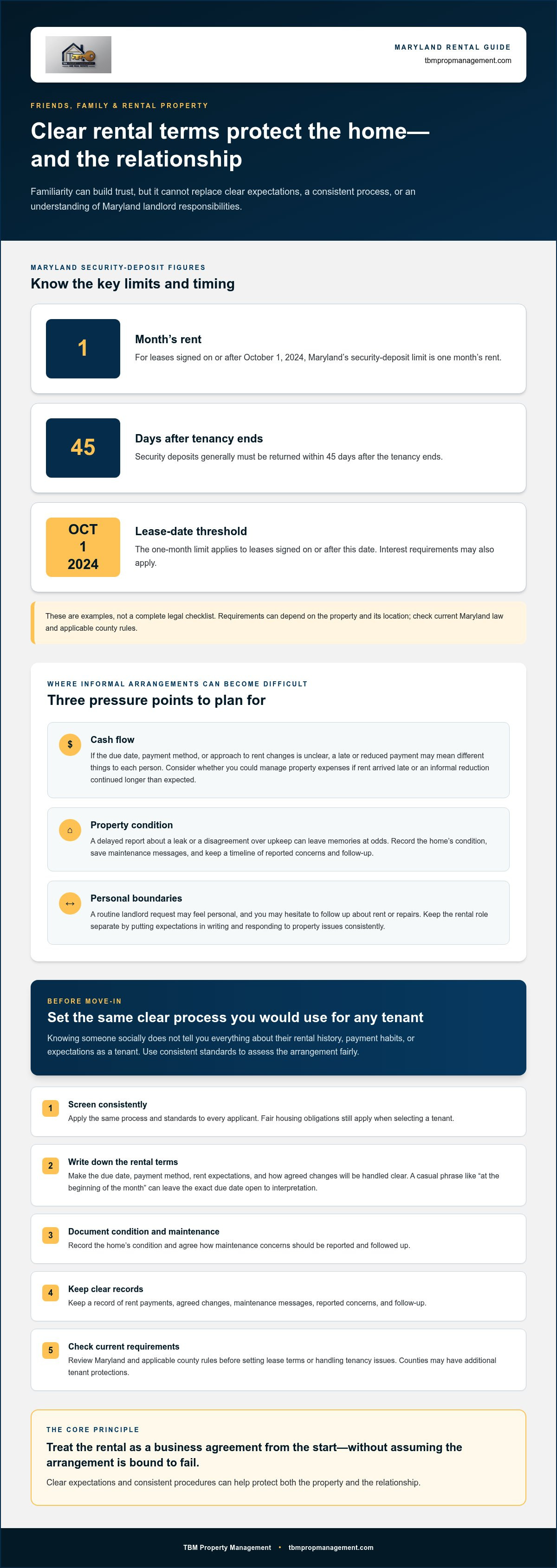
Landlord responsibilities remain part of the arrangement. Maryland’s current rules include security-deposit requirements: for leases signed on or after October 1, 2024, the state limit is one month’s rent, and deposits must generally be returned within 45 days after the tenancy ends. Interest requirements may also apply. These are examples, not a complete legal checklist.
Requirements can depend on the property and its location, so check current Maryland law and applicable county rules before setting procedures or responding to a dispute. Counties may have additional tenant protections. Fair housing obligations also apply when selecting a tenant; a personal connection doesn’t make consistent, lawful decision-making less important.
Personal pressure can make follow-through harder. You may put off documenting a repair, clarifying a payment, or enforcing an agreed term because you don’t want the conversation to feel confrontational. That delay can create uncertainty for both parties. Keep business records factual and routine, and address concerns promptly and respectfully. If a situation becomes a legal dispute, get advice specific to the current rules and facts.
If an independent process would help separate rental administration from family or friendship, TBM’s Full-Service Property Management supports rent collection and maintenance coordination for owners in its Maryland service counties. The service currently includes a 1st Month FREE offer.
Renting to someone you know versus using a more independent approach
You don’t have to choose between helping someone close to you and protecting your rental. The better question is which arrangement lets you make clear decisions, keep useful records, and follow through without turning every property issue into a personal negotiation. This comparison can help you decide whether to proceed, pause, or separate management from the relationship.
| Approach | Boundaries | Administrative effort | Documentation | Potential relationship strain |
|---|---|---|---|---|
| Documented tenancy managed directly | Clearer if both people agree to keep rental discussions professional. | You handle communication, records, and follow-through. | You prepare and maintain the lease, payment records, and property notes. | Can arise if enforcing terms feels personal. |
| Delay the decision | Creates space to discuss expectations without an immediate commitment. | Little rental administration while you assess the fit. | You can outline terms before deciding whether to proceed. | May ease pressure, though the decision could still be sensitive. |
| Independent management | A separate management process handles routine rental matters. | Some administrative work shifts to a property manager. | Management supports a more organized process for rental records and communication. | May reduce direct negotiation, but can’t prevent every disagreement. |
When a direct landlord-tenant arrangement may be workable
A direct arrangement may suit you if you can discuss rent, repairs, and house rules plainly, and both parties are willing to use written terms and consistent procedures. Consider how you’d respond if circumstances changed, such as a payment arriving late or a maintenance concern needing prompt attention. Trust and verbal reassurance can support a good relationship, but they don’t establish whether the tenancy fits your property or finances.
When pausing or separating management may make sense
If you’re already uncomfortable discussing rent, upkeep, or boundaries, pause before agreeing to a move-in date. Use the time to decide whether you can handle those conversations directly or would prefer an independent process. A property manager can handle routine rental administration, which may reduce the need to negotiate each issue personally. It doesn’t remove your responsibilities or guarantee that conflict won’t occur.
Decision rule: choose the arrangement that allows expectations to be applied consistently, even when the tenant is someone you care about. TBM Property Management serves owners in Anne Arundel, Prince George's, Montgomery, and Howard counties. Its Full-Service Property Management currently includes a 1st Month FREE offer. Learn how independent property management may fit your situation.
A practical checklist for reducing the risks before move-in
A clear process helps both parties understand what they’re agreeing to before the keys change hands. Use this sequence to organize the practical decisions, then verify any legal requirements that apply to the property and its location. The goal isn’t to assume a friend or relative will cause problems. It’s to make expectations clear and consistent from the start.
- Assess the arrangement. Consider whether the proposed rent and terms work with your financial obligations, and whether you’re comfortable addressing late payment, repair concerns, or rule violations if they arise. If you’re not ready to have those conversations, pause before agreeing to move-in.
- Apply consistent screening. Use the same fair, relevant screening process you would use for other applicants rather than treating personal familiarity as a substitute. A process may include reviewing credit, background, and employment information. Apply current fair housing rules, including any restrictions on how applicant information may be considered. TBM’s tenant placement and screening process can help owners keep rental decisions consistent.
- Put agreed terms in writing. Record the rent amount, payment date and method, lease term, maintenance responsibilities, and house rules. Make sure everyone understands how to communicate about changes or concerns. Before finalizing lease language, deposits, disclosures, or formal notices, verify current Maryland and applicable county requirements rather than assuming a familiar arrangement follows different rules.
- Document the property at move-in. Create a dated record of the home’s condition, including existing wear or damage. Keep relevant photographs, inspection notes, and written communications together. This gives both parties a shared reference if a question about condition or upkeep comes up later.
- Agree on communication and recordkeeping. Decide how rent payments will be recorded and where maintenance concerns should be reported. Set a practical expectation for sharing updates, such as promptly reporting a leak or other urgent property concern. Keep messages and payment records factual, organized, and accessible.
Separate preparation from legal verification. Written terms, consistent screening, a move-in condition record, and organized payment communications are sound practices. Whether a particular lease provision, deposit procedure, disclosure, or notice is legally required can depend on current state and local rules. Before acting, review an up-to-date Maryland landlord-tenant rights guide and verify requirements for the property’s jurisdiction. Don’t rely on a checklist from another state or on what either person remembers from a past rental.
These steps can reduce avoidable misunderstandings, but no checklist can guarantee that disagreements won’t happen. If you’d prefer help keeping rental decisions and personal relationships separate, TBM’s Full-Service Property Management currently includes the 1st Month FREE offer.
How Maryland property management can help keep the relationship separate
If managing rent, repairs, and tenant communication yourself could make family gatherings or friendships uncomfortable, an independent management process may help establish a professional boundary. A property manager can handle defined rental tasks through a consistent process, so you don’t have to personally lead every conversation about the property. This can reduce administrative stress, though it can’t eliminate disagreements or guarantee a particular rental outcome.
TBM Property Management serves residential property owners in Anne Arundel, Prince George's, Montgomery, and Howard counties in Maryland. Its services include tenant placement, tenant screening, leasing, rent collection, property inspections, and maintenance coordination. Owners can choose Tenant Placement & Leasing Only, Full Service, or Full Management (Premium Service), depending on the support they want.
What an independent management process can take off your plate
Tenant placement and screening provide a consistent way to evaluate prospective tenants rather than relying on personal familiarity alone. TBM’s tenant screening includes credit checks, background checks, and employment verification. Applying a structured process doesn’t mean a friend or relative should automatically be ruled out. It helps keep the decision focused on relevant rental criteria and consistent procedures.
Once a tenancy begins, rent collection and maintenance coordination can reduce the amount of routine landlord-tenant administration you handle directly. Property inspections and leasing services can also support the practical oversight of a rental. If a maintenance request needs attention, a defined point of contact and process can help keep the conversation focused on the property rather than on your personal relationship.
Management is not a substitute for clear agreements or compliance with applicable requirements. You remain the property owner, and individual situations can still require your judgment. The value is a more structured process for everyday tasks, not a promise that late payments, damage, or conflict can’t occur.
TBM’s Full Service plan costs 7%-9% of monthly rent, with a minimum of $99 per month. It includes tenant placement functions, rent collection, monthly owner statements, semi-annual inspections, and maintenance coordination. Full Management (Premium Service) costs 9%-11% of monthly rent, with a minimum of $150 per month, and adds eviction coordination and handling. Both property management plans currently include the 1st Month FREE offer. Tenant Placement & Leasing Only is priced at 1st Month’s Rent.
A local next step for Maryland rental owners
TBM is led by owner/operator Tanika Belfield-Martin, a licensed associate broker with over 13 years of real-estate experience. For owners considering support, her Maryland experience brings a local perspective to tenant placement and ongoing property oversight. TBM serves Anne Arundel, Prince George's, Montgomery, and Howard counties.
If you’re researching full-service property management in Laurel, Maryland, connect that decision to your goal: keeping rental administration consistent while preserving room for a personal relationship outside the tenancy. Full-Service Property Management through TBM currently includes the 1st Month FREE offer. Details about TBM’s property management services include tenant placement, leasing, rent collection, inspections, and maintenance coordination.
Choose a rental approach that supports the relationship
Before making a commitment, consider what you’ll need to feel comfortable as both a property owner and a friend or relative. The risk of renting to friends or family doesn’t mean you must say no. It’s a reason to choose a process you can follow calmly and consistently, even if expectations need to be reinforced later.
If you’re uncertain, give yourself room to decide. Talk through the arrangement before setting a move-in date, and consider whether you’d rather have someone else handle routine rental administration. A clear boundary now can make it easier to preserve the personal relationship while making decisions that serve your property.
For Maryland owners who want an independent perspective, TBM Property Management offers tenant placement and ongoing management support. Review your property management options and learn about the current 1st Month FREE offer for Full-Service Property Management. A thoughtful next step can help you move forward with greater clarity and confidence.
Frequently Asked Questions
Is it a bad idea to rent to friends or family?
Not necessarily. Renting to someone close can work if both parties are comfortable discussing money and responsibilities directly. The risk of renting to friends or family increases when a personal favor replaces a clear rental decision. Before agreeing, consider how you’d respond if the person asked to change payment timing or keep a pet you hadn’t discussed. If you can’t address those topics openly, take time before committing.
Can I charge a friend or relative less than market rent?
You can agree on a different rent amount, but a below-market arrangement can affect rental income and may have tax implications that depend on your circumstances. Before setting the rent, compare expected income with your property costs and consider how you’ll record any later change. Review current tax guidance for your situation or consult a qualified tax professional. A personal discount doesn’t by itself change landlord responsibilities.
Do I need a written lease when renting to someone I know?
A written lease is strongly advisable, and Maryland landlords who rent five or more dwelling units must use one. If a landlord with fewer than five units doesn’t use a written lease, the tenancy is presumed to be for one year. Include the agreed terms, and review current state and local rules before signing. Maryland residential leases must also include the latest Tenants’ Bill of Rights.
Could renting to a family member affect my homeowners or landlord insurance?
It could, depending on your policy, how the property is used, and the details of the tenancy. Don’t assume a homeowners policy automatically covers a rental or that a family relationship changes the coverage. Before the tenant moves in, review the policy language and explain the intended occupancy and rental arrangement to your insurer. Keep the information accurate so you can understand what coverage applies to your situation.
Can renting to a relative affect my mortgage or property tax situation?
It may, depending on your mortgage terms, property use, ownership structure, and applicable tax rules. For example, the implications may differ if you rent only part of your home or lease a separate property. Review your loan documents and verify current tax guidance for your circumstances before setting rent or changing how the property is used. Don’t assume a family tenancy automatically exempts you from ordinary financial or reporting considerations.
What if a friend or family member stops paying rent?
Respond as a landlord, keeping payment records and communications organized rather than relying only on verbal conversations. Maryland’s current process for nonpayment includes a 10-day Pay or Quit notice before eviction proceedings. Verify the requirements that apply to your property before serving a notice, and follow the formal legal process. Don’t change locks, remove belongings, or try to force the tenant out yourself.
For help keeping rental decisions and personal relationships separate, contact TBM Property Management about Full-Service Property Management in Anne Arundel, Prince George's, Montgomery, and Howard counties. The service currently includes the 1st Month FREE offer.