
Small Apartment Building Management in Laurel, MD: An Owner’s Guide
A small apartment building may need less paperwork than a larger property, but it still needs consistent attention. Tenant messages, rent collection, repairs, and inspections can create a steady stream of work, even in a building with only a few units. Owners searching for small apartment building management laurel md need an approach that covers daily responsibilities without adding unnecessary complexity.
If you’re unsure whether to self-manage, get help with tenant placement, or use full-service management, start by identifying what takes up your time. The right level of support depends on your workload, the tasks you want to delegate, and how involved you want to remain. This guide explains how to assess your building’s needs, compare management approaches, and connect tenant placement with ongoing management.
As you consider small apartment building management laurel md, look closely at rent collection, tenant screening, inspections, and maintenance coordination. TBM Property Management is based in Laurel and brings more than 12 years of local real estate expertise to rental property oversight across the region. A clear plan can make ownership easier while keeping you informed about the details that matter.
Key Takeaways
- A small building can still involve ongoing leasing, tenant communication, rent collection, and maintenance tasks. Map the workload before choosing how to manage it.
- Small apartment building management laurel md should fit your property’s day-to-day needs and the level of owner involvement you want.
- Compare self-management and professional support across tenant contact, leasing, inspections, collections, and maintenance coordination to see where help would make the biggest difference.
- Prepare for a smoother management transition by organizing leases, tenant contacts, property details, maintenance history, and rent records.
- Tenant placement and ongoing management address different needs. Coordinated support can cover both as your building’s needs change.
Small Apartment Building Management in Laurel, MD: Identify the Work Behind Ownership
Owning a compact multifamily property doesn’t necessarily mean managing a simple workload. Small apartment building management means coordinating the rental operations that keep a building occupied and its day-to-day responsibilities moving. For owners researching small apartment building management laurel md, the work can include marketing vacancies, placing tenants, communicating with residents, collecting rent, inspecting the property, and coordinating maintenance. These activities are part of the broader practice of property management, applied to a smaller building and its particular needs.
A few units can still generate recurring tasks. One tenant may have a question while another lease is approaching its end. Rent needs to be tracked, or a repair may require follow-up. Workload depends not just on unit count, but also on occupancy, tenant turnover, property condition, and how much time the owner can set aside. In Laurel and nearby Prince George’s County, choose an approach that fits your location and availability instead of assuming every building has the same operating demands.
Professional oversight can help when recurring tenant, leasing, collection, inspection, and maintenance tasks are difficult to handle consistently alongside your other responsibilities. The goal isn’t to hand over ownership decisions. It’s to decide which operational duties need reliable support and which you prefer to manage yourself. That’s the central question behind small apartment building management laurel md: what support will make ownership more manageable while keeping you appropriately involved?
What responsibilities come with managing a small rental building?
Think of the work as a repeating cycle, rather than a single task. Leasing includes preparing for a vacancy and coordinating the next tenancy. Tenant communication means receiving questions and tracking follow-ups. Rent collection requires monitoring payments, while inspections and maintenance coordination help you keep track of property condition and needed work.
- Tenant placement addresses finding and screening a renter for a vacancy.
- Ongoing management continues after move-in through leasing administration, rent collection, inspections, communication, and maintenance coordination.
These needs are connected, but not identical. An owner who only needs help filling a vacancy may need placement support, while someone seeking assistance with recurring operations may consider ongoing management. When messages, payment tracking, or repair follow-ups get delayed, small administrative tasks can pile up and become harder to organize.
When does self-management become difficult to sustain?
Ask yourself how much time you can reliably devote to tenant-facing work, how easily you can reach the property, and whether you’re comfortable coordinating leasing and maintenance. A vacancy can add marketing and placement tasks; a repair can require updates and follow-through. Multiple lease cycles may also make the calendar busier than expected. If you want broader context on the responsibilities involved, explore this full-service property management guide.
How Small-Building Property Management Works in Laurel
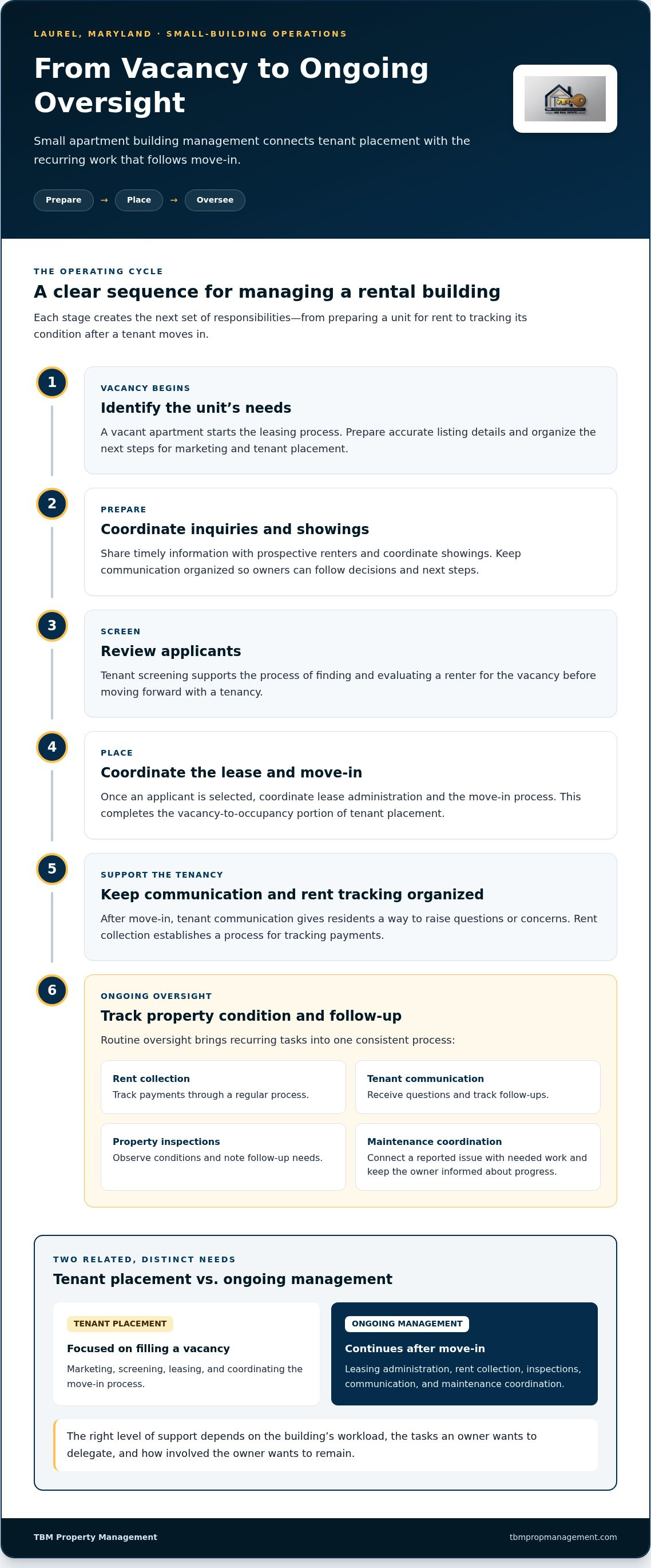
For a small rental building, management is a connected operating cycle: prepare a unit for rent, place a tenant, support the tenancy, and track the property’s condition. In Laurel, a clear process helps owners see how each step leads to the next, rather than handling vacancies, payments, and repairs as disconnected tasks. Small apartment building management in Laurel, MD, can be arranged around the support an owner needs at each point in that cycle.
From vacancy to an occupied apartment
When a unit becomes available, the work begins with preparing accurate listing details and coordinating inquiries and showings. Next comes reviewing applicants through tenant screening, then coordinating the lease and move-in process. Organized communication matters at every stage: prospective renters need timely information, and owners need a clear record of decisions and next steps.
Tenant placement can be a focused service, distinct from monthly management. It supports the vacancy-to-move-in process; ongoing management continues after a tenant takes possession. Owners who need help with marketing, screening, and leasing can learn more about tenant placement services and how leasing support fits into the rental cycle.
Ongoing oversight after a tenant moves in
Once the tenancy begins, routine oversight helps keep responsibilities visible. Rent collection establishes a regular process for tracking payments, while tenant communication gives residents a clear way to raise questions or report concerns. Regular property inspections provide opportunities to observe conditions and note follow-up needs. If a repair arises, maintenance coordination connects the reported issue with the work required and keeps the owner informed about progress.
Ongoing small-building management brings rent collection, tenant communication, inspections, and maintenance coordination into one consistent operating process. That consistency is especially useful when one issue affects several tasks, such as a repair that requires arranging access, updating a tenant, and recording the outcome for the owner.
Before management begins, agree on how information will be shared: what updates you’ll receive, how decisions requiring your input will be communicated, and how routine activity will be reported. Clear expectations help preserve owner visibility without requiring you to personally track every message or follow-up.
Rental operations also sit within a broader framework of state and local requirements. Specific rules can change and may depend on the property or situation, so verify current guidance with authoritative Maryland and Laurel government sources before acting on a legal question. A management process can help keep records and responsibilities organized, but it shouldn’t replace checking the requirements that apply to your property.
With more than 12 years of local real estate expertise, Laurel-based TBM Property Management provides tenant placement, leasing, rent collection, inspections, and maintenance coordination. Owners considering coordinated support can explore Laurel-area property management services to see how these recurring operations can be managed together.
Compare Self-Management and Professional Management for a Laurel Apartment Building
Choosing between self-management and professional support isn’t about which approach is best for every owner. It’s about matching responsibilities to your available time, preferred involvement, and comfort handling tenant-facing work. For small apartment building management Laurel MD owners should weigh the everyday workload against the visibility and control they want to retain.
| Responsibility | Self-management | Professional management |
|---|---|---|
| Owner time | You schedule and follow up on recurring tasks yourself. | Agreed operational duties are handled by a manager, with owner involvement shaped by the arrangement. |
| Tenant contact | You receive questions and coordinate responses directly. | A manager can serve as a point of contact for agreed tenant communication. |
| Leasing | You prepare for vacancies, respond to inquiries, and coordinate screening and leases. | Leasing and tenant placement can be included as agreed responsibilities. |
| Rent collection | You track payments and follow up as needed. | Rent collection can be handled as part of the management arrangement. |
| Inspections | You arrange property visits and keep notes on observed conditions. | Inspections can be coordinated, with findings communicated to you. |
| Maintenance | You receive repair requests and organize follow-up yourself. | A manager can coordinate maintenance while communicating decisions and updates as agreed. |
Which tasks should shape the management decision?
Start with the work that competes for your attention. Can you respond consistently to tenant requests, follow up on rent, manage vacancy activity, and visit the property when needed? Consider how far you live from your Laurel building and whether coordinating maintenance fits your schedule. A nearby owner with flexible time may prefer direct control; an owner farther away may value delegated coordination.
Make two lists: duties you want to retain, such as approving larger decisions or reviewing records, and duties you’d prefer someone else to handle. This helps define a proportionate arrangement rather than treating full-service management as an all-or-nothing choice. Monthly management fees are recurring and based on a percentage of rent collected, while tenant placement and leasing fees are one-time charges. Review how the fees relate to the responsibilities included in the arrangement.
How can owners preserve visibility while delegating work?
Delegating tasks doesn’t have to mean stepping away from your property. Before management begins, discuss communication frequency, reporting, approval responsibilities, and how issues will be escalated. Clarify which routine actions can proceed under the agreement and which decisions need your input. These expectations help prevent uncertainty for both the owner and manager.
As you compare options, broader evaluation criteria can help you understand how professional support fits your goals. This Maryland professional property management guide offers additional context. TBM Property Management’s Laurel-based team provides rental oversight, including leasing, rent collection, inspections, and maintenance coordination. Explore Laurel-area property management support to learn how defined responsibilities can be delegated while maintaining clear communication.
Choose and Prepare Small Apartment Building Management in Laurel, MD
A smooth management handoff starts with a clear picture of what your building needs and what you want to keep overseeing. For small apartment building management in Laurel, MD, preparation doesn’t need to be complicated. Organized records and direct conversations can clarify priorities, reduce avoidable confusion, and set a practical foundation for day-to-day operations.
Work through these steps before responsibilities transfer:
- Clarify your priorities. Identify the tasks taking the most time, any recurring concerns, and the responsibilities you want to delegate or retain.
- Gather property and tenancy records. Collect current leases, tenant contact details, rent records, property information, inspection notes, and maintenance history.
- Discuss the scope of support. Set expectations for leasing, tenant placement, rent collection, inspections, tenant communication, and maintenance coordination.
- Plan the transition. Review who handles open requests, upcoming lease activity, and routine owner updates once the agreed responsibilities begin.
What information helps establish a clear starting point?
Accurate records help make the building’s current condition and tenancy details easier to understand. Gather the essentials, then note anything that needs attention so it doesn’t get lost among routine tasks.
- Current leases and tenant contact details
- Rent and payment records
- Property details and recent inspection notes
- Maintenance history, open repair requests, and known issues
Separate urgent or unresolved matters from ongoing responsibilities. For example, an open repair request belongs on the handoff list, while regular inspections belong in the continuing management plan. This distinction gives everyone a clearer starting point and helps surface questions early.
How should owners set expectations for management?
Discuss how often you want updates, what information reports should cover, and how the manager will communicate with tenants. Be specific about rent collection, inspection coordination, vacancy preparation, and maintenance follow-through. Also agree on decision-making: which actions can be handled within the management arrangement, which require your approval, and how you’ll be contacted when an issue needs your input.
Clear expectations protect your visibility as an owner. Delegation doesn’t have to mean giving up involvement; it can mean assigning defined responsibilities while keeping you informed about the building. Put the agreed scope, communication approach, reporting, and owner approval process in writing before the transition begins. Avoid relying on assumptions, especially where an existing tenant concern or unfinished repair needs follow-up.
For owners in Laurel, TBM Property Management brings more than 12 years of local real estate expertise to rental property oversight, including leasing, tenant placement, rent collection, inspections, and maintenance coordination. Explore Laurel property management support to discuss an approach that fits your building’s needs.
How TBM Property Management Supports Laurel-Area Rental Owners
Small apartment building management in Laurel, MD, doesn’t have to mean choosing between handling every detail yourself and stepping away from your property. TBM Property Management is based in Laurel and provides full-service rental property management for owners who want coordinated support with leasing and rental operations. Its service area includes Prince George’s, Howard, Anne Arundel, and Montgomery counties.
TBM brings more than 12 years of local real estate expertise to its work with rental property owners. Owners can shape a management approach around their building’s needs, the tasks they want handled, and the level of involvement they wish to maintain.
Match TBM’s management services to building needs
A vacancy and an occupied rental call for different kinds of support. Tenant placement, tenant screening, and leasing services address the process of preparing for a new tenancy. Once an apartment is occupied, rent collection, property inspections, and maintenance coordination support ongoing operations. Owners can define which responsibilities they want handled instead of assuming every arrangement must look the same.
That distinction can help a small-building owner make a practical choice. If the main challenge is filling a vacancy, placement and leasing may be the priority. If recurring tasks are taking up time across occupied apartments, full-service management can bring several responsibilities together. Owners can also set expectations for updates and decide where they want to stay directly involved, so delegated work and owner visibility fit alongside each other.
TBM’s services connect the key stages of rental oversight: finding and screening tenants, coordinating leasing, collecting rent, inspecting properties, and coordinating maintenance. Owners have a point of support for these recurring responsibilities while retaining involvement in decisions that matter to them.
Take the next step with a Laurel property management team
Start by outlining your building, the work you currently handle, and the tasks creating the most pressure. Note immediate priorities, such as an upcoming vacancy or an open maintenance concern, as well as routine needs like tenant communication, rent collection, and inspections. This gives the management discussion a clear focus and helps identify support that fits your situation.
Use that outline to start a focused conversation with TBM Property Management about your property, priorities, and the responsibilities you’d like support with. Discuss your Laurel rental property.
Set a Management Plan That Can Grow With Your Building
Your rental building’s needs can shift as tenants, vacancies, and maintenance priorities change. Treat your management approach as something you can review, not a decision you have to get perfect once and never revisit. Start by choosing the responsibility that currently takes the most attention, then decide whether you want to keep handling it or would benefit from defined support.
That simple next step can make small apartment building management laurel md feel more manageable: you’ll have a clearer sense of what you need, what you want to stay involved in, and where a coordinated approach could reduce the daily administrative load. A conversation can help turn those priorities into a practical plan for your property.
TBM Property Management is ready to discuss your Laurel rental property. Discuss your Laurel rental property with TBM, and take the next step toward ownership that feels more organized and easier to manage.
Frequently Asked Questions
How many units are considered a small apartment building?
There isn’t one universal unit count that defines a small apartment building. Owners often use “small” to describe a compact multifamily property, but the work involved depends on more than the number of apartments. A building with few units may still have frequent turnover or repair needs, while another may require less attention. Focus on occupancy, property condition, tenant needs, and the time you can devote to operations.
Is professional management worthwhile for a small apartment building?
It can be worthwhile if recurring management tasks take more time or attention than you want to give them. Consider the value of having support with tenant communication, rent collection, vacancy activity, inspections, and maintenance coordination, then weigh that against your preferred involvement and management costs. For small apartment building management laurel md owners should base the decision on their building’s workload, not unit count alone.
Can a property manager handle tenant placement without managing the building monthly?
Yes. Tenant placement can be a distinct service from ongoing monthly management. An owner might use placement support for a vacant apartment, then continue managing the tenancy independently. That can suit someone who is comfortable with regular operations but wants help coordinating the vacancy process. Tenant placement addresses a specific leasing need; ongoing management covers responsibilities that continue after a renter moves in.
What records should I prepare before a property manager takes over?
Prepare the documents that show what’s happening now: signed leases and addenda, recent rent records, tenant contact details, inspection notes, and maintenance requests or invoices. Include a short status note for unresolved items, such as a repair waiting for follow-up or a lease discussion already underway. This context helps prevent an open issue from being mistaken for a new request after responsibilities change hands.
How much does small apartment building management cost in Laurel, MD?
There isn’t one fixed cost for every Laurel building. Monthly management fees are recurring and based on a percentage of rent collected; tenant placement and leasing fees are one-time charges. Compare the scope of work, how charges are assessed, and which leasing or management tasks are covered. Review the fees for the specific responsibilities in the management arrangement rather than relying on a general estimate.
What happens if a tenant moves out while a small building is professionally managed?
The manager can coordinate the next steps for the vacancy as part of the management responsibilities. That may include arranging listing preparation, responding to prospective-tenant inquiries, coordinating showings, screening applicants, and handling lease coordination. For example, if a move-out date is approaching while a repair is still pending, the owner and manager can clarify how that work fits into preparing the apartment for a new tenancy.
Can an owner stay involved after hiring a property manager?
Yes. Owners can remain involved by agreeing in advance on how updates, reports, and decisions will be handled. For example, you might want regular rent and property updates while retaining input on specific maintenance decisions or leasing matters. Put those expectations in the management agreement, including how the manager will seek your direction when an issue falls outside routine responsibilities. Delegating operations can still leave you informed and engaged.