
State of Maryland Tenant Rights: The 2026 Landlord Compliance Guide
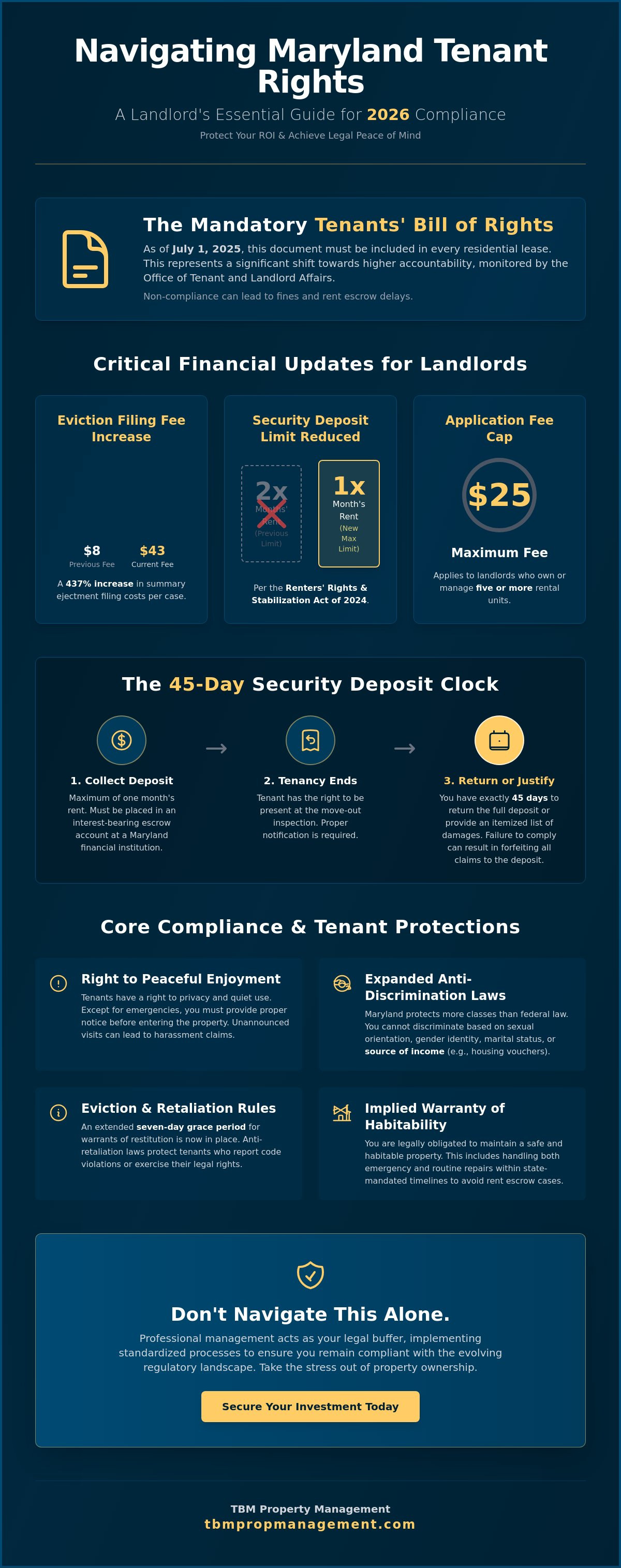
Did you know that filing for a summary ejectment in Maryland now costs $43 per case, which is a sharp increase from the previous $8 fee? If you own rental property in Howard or Prince George’s County, these rising administrative costs and the strict new limits on security deposits can quickly eat into your profits. We understand it feels overwhelming to keep up with the state of maryland tenant rights while trying to manage your investment. It’s stressful to worry that a simple oversight in your lease could lead to a costly legal dispute or a rent escrow case.
We are here to take that stress away by providing a clear roadmap for 2026. This guide will show you how to navigate the current legal landscape with confidence so you can protect your ROI and achieve legal peace of mind. We will cover the mandatory Tenants’ Bill of Rights required since July 1, 2025, the $25 application fee cap for landlords with five or more units, and the updated right of first refusal rules that now apply to small residential properties statewide.
Key Takeaways
- Master the mandatory 2025 Maryland Tenants' Bill of Rights to ensure your lease remains fully compliant with the latest Office of Tenant and Landlord Affairs standards.
- Navigate the updated one-month security deposit limit and strict 45-day return window to protect your property from costly tenant disputes and legal penalties.
- Clarify your maintenance obligations under the Implied Warranty of Habitability to ensure both emergency and routine repairs are handled within state-mandated timelines.
- Protect your investment by understanding the state of maryland tenant rights regarding new eviction filing surcharges and the extended seven-day grace period for warrants of restitution.
- Learn how standardized management processes can take the stress away by acting as a professional legal buffer between you and the evolving regulatory landscape.
Understanding the State of Maryland Tenant Rights Framework in 2026
The rental market in Maryland changed fundamentally on July 1, 2025, when the state mandated that every residential lease include the new Maryland Tenants’ Bill of Rights. This document is not just a formality. It represents a significant shift toward higher accountability for property owners across the state. Understanding the state of maryland tenant rights is the first step in moving from a place of legal uncertainty to a position of total control. While the foundational principles of U.S. Landlord-Tenant Law provide a baseline, Maryland's specific statutes in 2026 are often more rigorous and tenant-focused than federal requirements.
You cannot rely solely on state law if your property is in Montgomery or Prince George’s County. These jurisdictions often implement local rent stabilization or specific licensing requirements that go beyond the state framework. The Maryland Department of Housing and Community Development (DHCD) now monitors compliance through the Office of Tenant and Landlord Affairs. This office tracks every eviction filing through a public dashboard, making your management history more transparent than ever. Integrating these rules into your real estate management maryland strategy ensures you don't face unexpected fines or rent escrow delays that can stall your cash flow.
The Core Principle: The Right to Peaceful Enjoyment
Peaceful enjoyment is defined as a tenant's right to use the property without unreasonable interference. It is a legal standard that protects a tenant's privacy and quiet use of their home. Many landlords accidentally violate this right by entering the property for non-emergency inspections without giving proper notice. Unless there is an active emergency like a burst pipe, you must respect the tenant's space. Frequent, unannounced visits or showing the property to prospective buyers without coordination are fast tracks to a harassment claim in the Maryland District Court.
Anti-Discrimination and Fair Housing Compliance
Maryland law protects more groups than federal law alone. You cannot discriminate based on sexual orientation, gender identity, marital status, or source of income. This means you can't refuse a tenant simply because they use a housing voucher to pay their rent. We recommend standardizing your screening process to avoid the trap of "disparate impact." This legal concept occurs when a policy seems neutral but unfairly excludes a protected class. By using a uniform set of criteria for every applicant, you protect yourself from expensive discrimination lawsuits and build a more stable tenant base.
Security Deposits and Lease Agreement Obligations
One of the most critical updates to the state of maryland tenant rights involves the financial ceiling on security deposits. Under the Renters' Rights and Stabilization Act of 2024, landlords can no longer charge more than one month's rent as a security deposit. This is a significant drop from the previous two-month limit. If you own five or more units, you must also adhere to the $25 cap on application fees. Missing these details doesn't just frustrate applicants; it creates immediate legal exposure. We make it easy to stay compliant by updating your lease templates to reflect these 2026 standards before a tenant even signs.
Returning the deposit requires precision. You have exactly 45 days from the end of the tenancy to return the funds or provide an itemized list of damages. If you fail to meet this deadline, you may lose the right to withhold any portion of the deposit, regardless of the property's condition. Maryland law also requires you to keep these funds in an interest-bearing account at a Maryland financial institution. For more detailed breakdowns of these calculations and interest rates, the Maryland People's Law Library offers excellent resources on current escrow requirements.
The Move-In/Move-Out Inspection Requirement
Maryland law gives tenants the right to be present during the move-out inspection. You must notify them of their right to request this inspection when they move in or when they give notice to vacate. Using professional property management laurel md helps standardize this process. We find that high-resolution photos and signed written reports are the best defense against deposit disputes. Without a clear move-in report, proving that damage occurred during the tenancy becomes nearly impossible in court. This documentation protects your investment from the financial risk of rent escrow or legal pushback.
Receipts and Written Records
Do you provide a written receipt for every rent payment? If a tenant pays in cash, Maryland law mandates an immediate receipt. Even for electronic payments, maintaining a clear paper trail is essential for your protection. Landlords should retain records of lease agreements and payment histories for at least three years. While Maryland allows electronic record-keeping, ensuring these files are backed up and accessible is your responsibility. If you feel overwhelmed by the administrative burden of these requirements, you might want to see how our full-service management can take the stress away.
Maintenance Standards and the Implied Warranty of Habitability
Managing maintenance is often the most stressful part of owning a rental, but it’s also where the law is most rigid. The "Implied Warranty of Habitability" is a non-negotiable standard within the state of maryland tenant rights framework. This legal principle means that by simply offering a property for rent, you’re promising it’s fit for human living. If a property has serious defects like structural instability, lack of sewage disposal, or persistent mold, the tenant has a right to seek a legal remedy. We take the stress away by ensuring your property meets these standards before a tenant even moves in, protecting your investment from the start.
One of the biggest financial risks you face is a rent escrow filing. If a tenant provides written notice of a serious defect and you fail to fix it within a reasonable timeframe (usually 30 days), they can pay their rent into a court-managed account instead of to you. This can freeze your cash flow for months while you navigate the District Court system. Additionally, you must stay compliant with the Maryland Lead Poisoning Prevention Program. For any property built before 1978, you’re required to register the unit with the Maryland Department of the Environment and provide a lead-free or limited lead-safe certificate at every tenant turnover. Missing this step can lead to extraordinary fines and total loss of your legal standing in an eviction case.
Essential Services: Heat, Water, and Electricity
Maryland law considers a lack of heat or water a threat to life/safety, requiring immediate action. During the winter months, most local jurisdictions require you to maintain a minimum temperature of at least 65 to 68 degrees. If a furnace fails or a water main breaks, you don't have the luxury of a 30-day window. You must act within 24 hours to restore these essential services. Landlords are also liable for utility interruptions if they fail to pay bills they’re responsible for under the lease, which can lead to claims of constructive eviction.
Handling Repair Requests Professionally
The best way to prevent a dispute is to have a seamless, written system for maintenance requests. Using professional tools like property meld allows you to track compliance and response times with digital precision. This creates a verified paper trail that proves you’ve acted in good faith if a tenant ever claims the state of maryland tenant rights were violated. We find that keeping tenants informed during major renovations or long-term repairs prevents the frustration that leads to legal action. Our commitment to excellence means we handle the coordination with licensed contractors, ensuring repairs are done right the first time.
Notice Periods, Eviction Procedures, and Anti-Retaliation Laws
Ending a tenancy or addressing non-payment shouldn't feel like a legal gamble. In the state of maryland tenant rights framework, the rules for termination are very specific. For a month-to-month lease, you must typically provide 60 days' written notice before the end of the rental period. Fixed-term leases are different, as they usually expire on a set date, but you still need to communicate clearly to avoid a "holdover" situation. We make it easy by tracking these dates for you, ensuring that every notice is served correctly and on time.
If a tenant stops paying, the "Failure to Pay Rent" process is your primary legal recourse. Maryland law allows for a "Right of Redemption," often called the "pay to stay" rule. This means a tenant can stop an eviction at any point before the sheriff arrives by paying all past-due rent, late fees, and court costs. However, this right is limited. If you've won three or more rent judgments against that tenant in the previous 12 months, you can ask the court to deny the right of redemption. This is a powerful tool for landlords dealing with chronic non-payment, but it requires meticulous record-keeping to prove the history of judgments.
Defining "Retaliatory Action" is where many self-managed owners stumble. You cannot raise the rent, decrease services (like parking or utilities), or threaten eviction simply because a tenant complained to a government agency or joined a tenant organization. Maryland courts generally look at any adverse action taken within six months of a tenant's complaint as potentially retaliatory. To avoid this, every management decision should be backed by a clear, non-discriminatory business reason. If you're stressed about handling a difficult tenant, you can contact our team for a free rent analysis to see how professional management protects your investment.
Proper Notice for Entry and Inspections
While Maryland state law doesn't have a single "one-size-fits-all" hourly requirement for entry, 24 hours is the widely accepted standard for "reasonable notice." However, local variations are critical. For example, in Montgomery County, you must provide notice in writing unless it's an emergency. Emergencies, such as a fire or an active water leak, allow for immediate entry without notice. For routine inspections or repairs, always coordinate with the tenant to maintain the "peaceful enjoyment" we discussed earlier.
The Dangers of 'Self-Help' Evictions
Changing the locks, removing a tenant's belongings, or cutting off the electricity are known as "self-help" evictions. These actions are strictly illegal and carry massive financial liabilities. If you take the law into your own hands, a judge can order you to pay the tenant's actual damages, court costs, and attorney fees. It's a high-risk move that offers zero ROI. We ensure a stress-free transition by following the court-ordered path, coordinating with the District Court and the local sheriff to handle evictions the right way.
How Professional Management Mitigates Compliance Risks
Are you tired of worrying about whether your lease agreement meets the latest 2026 legislative updates? Managing a rental property in 2026 requires more than just collecting a check; it demands a deep understanding of the state of maryland tenant rights, which have become increasingly complex. When you partner with us, you gain a dedicated expert who acts as a legal buffer between you and these shifting regulations. By understanding what is a property manager in today's market, you see that we don't just coordinate repairs. We protect your entire financial investment from accidental non-compliance by standardizing your management processes.
Compliance begins long before a tenant moves in. Our extraordinary screening process is designed to prevent legal friction before it starts. By utilizing a uniform set of criteria for every applicant, we eliminate the risk of disparate impact claims that can lead to expensive discrimination lawsuits. We ensure that every lease we sign includes the mandatory 2025 Maryland Tenants' Bill of Rights and adheres to the one-month security deposit limit. This proactive approach reduces the likelihood of "Failure to Pay Rent" filings and keeps your cash flow steady and predictable.
Boutique Service with Professional-Grade Protection
With over 12 years of industry experience, we bring a high standard of service to property owners in Anne Arundel, Prince George’s, Montgomery, and Howard counties. We offer a boutique feel where you're a partner, not just a number. Our commitment to excellence includes providing a FREE rent analysis report that helps you price your property competitively while remaining compliant with local rent stabilization rules. We take the stress away by handling all tenant disputes, legal notices, and property inspections, ensuring your management is seamless and professional as Maryland's Full Property Management Service.
Next Steps for Stress-Free Ownership
Choosing professional property management is the most effective strategy for maximizing your ROI while minimizing your legal exposure. You don't have to handle the complex landscape of the state of maryland tenant rights alone. Whether you're struggling with maintenance coordination or the financial risk of rent escrow, our team is ready to step in and provide the relief you need. Contact TBM Property Management today for a consultation on your Maryland rental portfolio. Let us show you how we make property ownership easy, profitable, and entirely stress-free.
Secure Your Investment with Expert Compliance
The landscape of the state of maryland tenant rights is more detailed than ever following the implementation of the Renters’ Rights and Stabilization Act of 2024. Staying ahead of these changes requires constant vigilance and a commitment to excellence. You've seen how strict security deposit limits and the mandatory Tenants’ Bill of Rights have redefined the landlord-tenant relationship. Overlooking these details doesn't just cause stress; it puts your entire rental portfolio at financial risk. We understand that managing these requirements while trying to grow your ROI feels overwhelming.
With over 12 years of specialized expertise in Anne Arundel, Prince George's, Montgomery, and Howard Counties, we are here to provide the relief you deserve. We take the stress away by handling everything from rigorous tenant screening to seamless maintenance coordination. Why navigate these complex legal waters alone when you can have a dedicated local partner by your side? Let TBM Property Management take the stress out of compliance; contact us today! You can achieve total peace of mind and watch your investment thrive under professional-grade protection.
Frequently Asked Questions
Is a written lease required in the state of Maryland?
Yes, Maryland law requires a written lease for any rental agreement lasting 12 months or longer. If you don't have a written contract for a long-term stay, you lose the ability to clearly define responsibilities in court. We recommend a written lease for every tenant to ensure your management process remains standardized and legally sound from day one.
How much notice must a Maryland landlord give before entering a property?
You should provide at least 24 hours of notice before entering a tenant's home for non-emergency reasons. While the state doesn't have a single hourly statute, 24 hours is the legal benchmark for "reasonable notice." In Montgomery County, this notice must be in writing to comply with local ordinances, though emergencies like fires allow for immediate entry.
Can a tenant withhold rent for repairs in Maryland?
No, tenants cannot unilaterally withhold rent for repairs; they must follow the formal rent escrow process through the District Court. If a tenant stops paying without a court order, you can file for Failure to Pay Rent. Understanding the state of maryland tenant rights regarding escrow is vital to avoid having your cash flow frozen for months during a legal dispute.
What is the maximum security deposit a landlord can charge in Maryland?
The maximum security deposit you can charge is one month’s rent under the Renters’ Rights and Stabilization Act of 2024. This is a major change from the previous two-month limit that landlords used for years. Charging more than this amount can result in a penalty of up to three times the extra amount charged, plus attorney fees.
How many days does a landlord have to return a security deposit in Maryland?
Landlords have exactly 45 days after the tenant moves out to return the security deposit plus any required interest. If you withhold any portion for damages, you must provide a detailed, itemized list of costs within that same 45-day window. Missing this deadline often leads to a court ordering you to pay three times the amount withheld as a penalty.
What happens if a landlord retaliates against a tenant in Maryland?
If a landlord retaliates, they may face lawsuits for actual damages, court costs, and legal fees. Retaliation includes raising rent or decreasing services within six months of a tenant's formal complaint to a housing agency or their participation in a tenant organization. We take the stress away by ensuring all your management actions are documented and based on clear, non-discriminatory business reasons.
Are Maryland landlords required to provide receipts for rent payments?
Yes, you must provide a written receipt immediately if a tenant pays rent in cash. For all other payment methods, you're required to provide a receipt if the tenant asks for one. Keeping these records for at least three years is a best practice that protects you during audits or if a tenant claims they paid when they didn't.
What are the specific tenant rights in Prince George's County vs. the rest of Maryland?
Prince George’s County has unique rent stabilization laws that cap annual rent increases, which is a stricter standard than many other parts of the state. Landlords here must also hold specific county-level licenses and follow distinct eviction prevention protocols. Navigating the state of maryland tenant rights alongside these hyper-local rules is why professional expertise in your specific community is so valuable.