Upgrades That Increase Rental Value in Maryland: A 2026 Landlord’s Guide
The most expensive upgrade may be the wrong one for your Maryland rental. A polished kitchen can catch a renter’s eye, but unresolved maintenance issues or features that don’t fit the neighborhood may matter more. Choosing upgrades that increase rental value maryland landlords can prioritize starts with matching the improvement to the property, its condition, and the renters it’s meant to attract.
It’s understandable to want improvements that help a home stand out without spending more than the local market can support. No single upgrade guarantees higher rent. Instead, weigh tenant appeal, durability, upkeep, and how the home compares with similar nearby rentals. Start with what the property needs, then decide whether an elective improvement is likely to make a practical difference.
This guide compares visible updates, everyday amenities, and efficiency improvements, with a focus on how to prioritize them without relying on unsupported rent-increase promises. You’ll also find a practical sequence for planning updates, from addressing condition concerns to preparing the home for leasing. For landlords in Laurel and nearby Maryland counties, TBM Property Management’s property inspections and maintenance coordination can help organize that process.
Key Takeaways
- Compare upgrades by tenant appeal, upkeep, durability, and fit for your property instead of assuming every improvement supports higher rent.
- Use the comparison of cosmetic updates to identify changes that may matter most to renters looking at similar homes in your neighborhood.
- Evaluate upgrades that increase rental value maryland landlords are considering against the home’s condition, likely tenant benefit, disruption, and comparable listings.
- Follow a practical sequence: inspect the property, compare local rentals, prioritize needs, schedule improvements, and review leasing readiness.
- Property inspections and maintenance coordination can help organize improvements before leasing.
Which Maryland rental upgrades can strengthen tenant appeal and rental value?
Before choosing a project, decide what the property needs most: stronger tenant appeal, improved condition, or better alignment with nearby rentals. An upgrade can make a home more attractive without automatically supporting a higher asking rent. The most useful upgrades that increase rental value maryland landlords consider address a real property need and fit the home’s local comparison set.
Rental value isn’t a single number. Comparable homes help indicate what rent may be reasonable, while the property’s condition, tenant demand, and readiness for leasing affect how appealing it is to prospective renters. A fresh finish may help a home show well, for example, but it won’t resolve a maintenance concern. No upgrade guarantees a particular rent increase or shorter vacancy.
Upgrade value depends on local comparables and property fit, not just on the project itself. Start with similar rentals in the same neighborhood and property category. Compare their condition and features with yours, noting what your home already offers and where it falls short.
What does rental value mean for a Maryland property?
Think of rental value as the fit between the rent you can reasonably seek, the condition you’re offering, and the home’s appeal to its likely renter. Leasing readiness matters too. Unresolved repairs or worn finishes can affect a renter’s impression, even when the property has desirable features.
Compare like with like. A single-family home may not be a useful benchmark for an apartment, and a newly updated rental may not be a fair comparison for one with older finishes. Look at nearby listings that resemble your property in type, size, condition, and features. This makes it easier to distinguish a genuine opportunity from an upgrade that only looks appealing in isolation.
Why do Maryland location and renter needs matter?
Laurel, Anne Arundel, Prince George’s, Montgomery, and Howard counties include varied communities and rental properties. Statewide assumptions can therefore mislead. A feature that fits one home or neighborhood may add little value to another. Compare local rentals rather than assuming renters across these counties prioritize the same improvements.
Property type matters, too. Consider whether you’re updating a single-family home, townhome, or apartment, and weigh the project against the features and condition of similar nearby rentals. This article compares four broad categories: cosmetic updates such as paint, flooring, lighting, and curb appeal; kitchen and bath improvements; efficiency upgrades; and functional improvements that support everyday use. The goal isn’t to renovate everything, but to identify what best fits your property and its leasing context.
Which rental upgrades should Maryland landlords compare first?
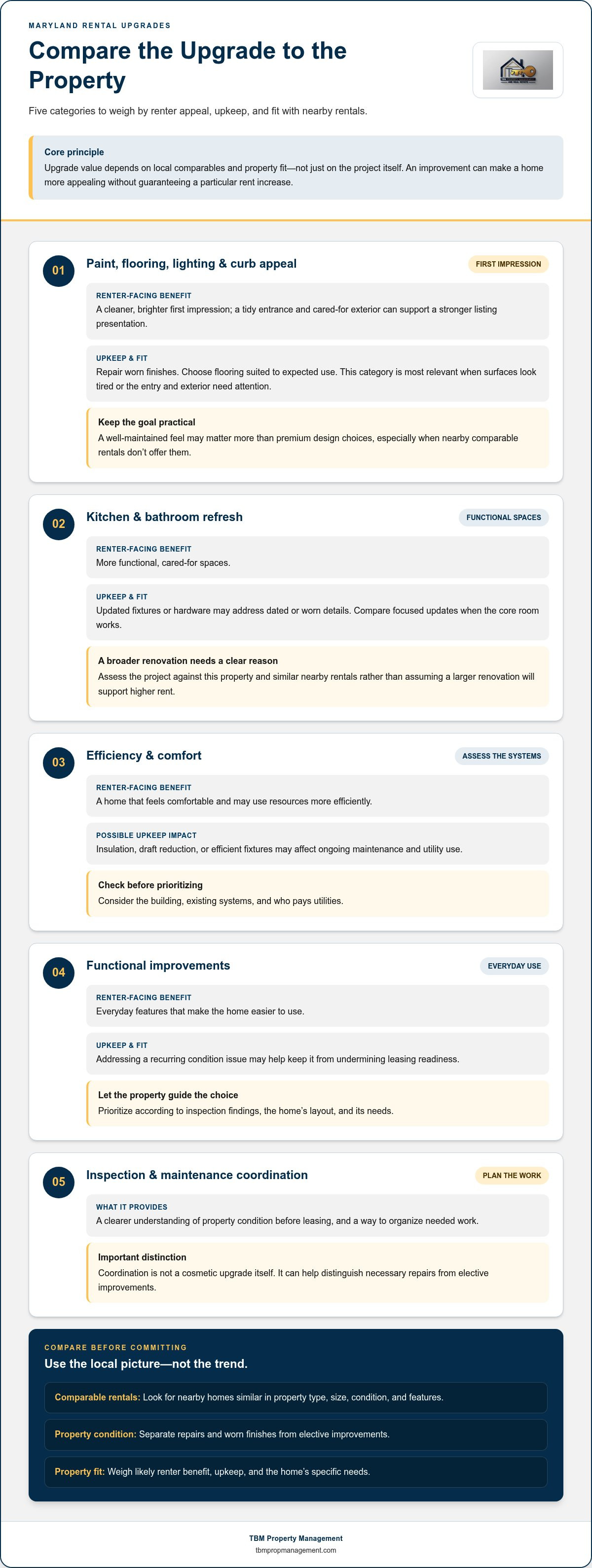
Compare improvements by what renters will notice, what condition they address, and how well they fit the property. Start with the home as it is, not with a trend or the assumption that a larger renovation will command more rent. These categories can help you decide where to focus first.
| Upgrade type | Renter-facing benefit | Upkeep impact | Property fit |
|---|---|---|---|
| Paint, flooring, lighting, and curb appeal | A cleaner, brighter first impression | Repairing worn finishes can reduce visible signs of neglect; choose materials suited to expected use. | Most relevant when surfaces look tired or the entry and exterior need attention. |
| Kitchen and bathroom refresh | More functional, cared-for spaces | Updated fixtures or hardware may address dated or worn details without changing the room’s layout. | Compare focused updates when the core room works; broader renovations need a clear property-specific reason. |
| Efficiency and comfort | A home that feels comfortable and may use resources more efficiently | Insulation, draft reduction, or efficient fixtures may affect ongoing maintenance and utility use. | Consider only after assessing the building, existing systems, and who pays utilities. |
| Functional improvements | Everyday features that make the home easier to use | Addressing a recurring condition issue may help prevent it from undermining leasing readiness. | Prioritize according to inspection findings and the property’s layout and needs. |
| Inspection and maintenance coordination | Clearer understanding of property condition before leasing | Helps organize needed work; it is coordination, not a cosmetic upgrade itself. | Useful when owners need to distinguish repairs from elective improvements. |
Which cosmetic upgrades can improve first impressions?
Start with clean, consistent paint, working lighting, and flooring that is intact and suitable for the home. A tidy entrance and cared-for exterior can also support a stronger listing presentation. Focus first on repairing worn finishes. Premium design choices may add little if comparable rentals nearby don’t offer them. Often, the most effective cosmetic update makes the home feel maintained rather than lavish.
When are kitchen, bath, or efficiency improvements worth comparing?
Compare focused kitchen and bath changes, such as replacing worn hardware or fixtures, separately from major layout or system work. A targeted refresh may address what renters see without expanding the project beyond the property’s needs. For broader home-improvement context, the Cost vs. Value Report offers project comparisons, but its figures aren’t a rent forecast for an individual Maryland rental.
Efficiency improvements also depend on the home. Draft reduction, insulation, or efficient fixtures may be worth evaluating when the property’s condition supports them. Savings aren’t guaranteed, and actual results depend on the building and its use. For owners organizing inspection findings into next steps, property inspections and maintenance coordination can help clarify which work to address before leasing.
How can Maryland landlords tell whether an upgrade is worth prioritizing?
An attractive upgrade may improve a listing without producing a matching rent increase. That doesn’t make the project pointless, but it does mean you should weigh its tenant benefit alongside the property’s condition, maintenance needs, and nearby rental options. First separate essential repairs from optional improvements. Address a defect or recurring problem before making a cosmetic enhancement the priority.
Local comparable rentals provide context, not a guaranteed outcome. Use them to understand what similar homes offer, not as proof that adding the same feature will raise your rent or reduce vacancy.
What should landlords compare before approving a project?
Look for evidence that the improvement solves a real problem or meets a renter-facing need. Check whether similar nearby rentals already have the feature, whether your property has a visible defect or usability issue, and whether the change fits its likely renter profile. Consider upkeep and disruption as well. A finish that needs frequent attention or a project that interferes with leasing may need closer review.
Use this simple matrix to organize the decision. It doesn’t assign scores or promise returns; it helps clarify what to address first.
- Condition issue: Does the work address damage, a recurring maintenance concern, or a basic functional problem? If so, handle it before elective upgrades.
- Tenant benefit: Will the change improve everyday use or correct something renters are likely to notice?
- Comparable fit: Do similar homes in the same neighborhood and property category offer this feature or finish?
- Durability and upkeep: Is the proposed choice suited to regular rental use, and what ongoing maintenance might it require?
- Disruption: Could the work affect current occupants or delay the property’s readiness for leasing?
A project with a clear condition benefit and a strong match to comparable homes may take priority over a personal design upgrade with little practical use. Property inspections can help owners distinguish maintenance needs from elective improvements, while maintenance coordination can help organize a plan for completing the work.
How can owners avoid over-improving a Maryland rental?
Match finish quality to the home’s overall condition and the standards of comparable rentals nearby. If similar properties have clean, functional kitchens, a full redesign may not be the first move. Worn fixtures or damaged surfaces may be more relevant. Aim for consistency, safety, and reliable function before choosing highly personal finishes or premium details that stand apart from the neighborhood.
Use current local listings and leasing evidence, comparing homes with a similar property type, size, and condition. Revisit the comparison as the market and property change. This gives you a grounded way to prioritize upgrades that increase rental value maryland owners are considering, without treating any feature as a guaranteed rent boost.
How should you plan rental improvements across Maryland counties?
A clear sequence makes upgrade planning easier to manage and helps keep urgent work from getting lost among optional updates. Whether your rental is in Laurel, Anne Arundel, Prince George’s, Montgomery, or Howard County, ground decisions in the property’s condition and its own neighborhood. County and municipal requirements can differ, so verify current requirements before starting work that may need approval.
What is a practical sequence for planning upgrades?
Use these steps to move from inspection to a focused improvement plan:
- 1. Inspect. Document the property’s condition, including visible wear, maintenance concerns, and features that affect everyday use. Separate urgent repairs from elective upgrades.
- 2. Compare. Review current listings and recently leased homes nearby that resemble yours in property type, size, condition, and features. Keep the comparison local rather than relying on broad county or statewide assumptions.
- 3. Prioritize. Rank possible work by condition, likely renter benefit, durability, and the property’s leasing needs. A repair that resolves a recurring issue may come before a cosmetic enhancement.
- 4. Schedule. Organize the work around occupancy and leasing needs. Check applicable county and municipal requirements before beginning work that may require approval, and keep necessary maintenance distinct from elective improvements.
- 5. Review. After work is complete, record what changed and reassess the property’s condition and listing presentation. Use updated local comparisons to inform future decisions, not to assume a specific rent outcome.
For a practical framework for organizing maintenance, see the Maryland rental maintenance guide. It can help you keep property concerns and planned work in clearer order.
How can landlords keep improvements organized?
Maintain a simple property record with inspection notes, completed work, product details, and relevant documentation. That history can make it easier to track recurring issues, plan future maintenance, and distinguish essential work from optional upgrades. If an inspection reveals a concern, address it before elective updates compete for attention.
Local context matters across TBM Property Management’s service areas, but each property still needs its own comparison set. A rental in Laurel may differ from a similar property elsewhere in Prince George’s, Montgomery, Howard, or Anne Arundel County. For broader oversight context, read the full-service Maryland property-management guide.
Want a more organized approach to rental readiness? Explore property management and maintenance coordination for support with inspections, leasing preparation, and organizing property work.
How can Maryland property management help turn upgrade plans into leasing readiness?
A thoughtful upgrade plan needs a clear handoff from identifying property needs to preparing the rental for leasing. Inspections can help owners spot condition issues before committing to elective improvements, while maintenance coordination helps organize necessary work and follow-up. The goal is a cared-for home that’s ready to present, not a promise that any one project will raise rent.
How do inspections and maintenance coordination support an upgrade plan?
A property inspection gives owners a structured view of the home’s condition. It can help distinguish a repair concern, such as a worn or malfunctioning feature, from an optional enhancement chosen mainly for appearance. That distinction helps keep essential maintenance from being overlooked while owners weigh possible upgrades.
Once priorities are clear, maintenance coordination can help organize the work and track follow-up. This supports an orderly plan without confusing coordination with renovation or construction work. Keeping inspection notes and work records together also gives owners a useful reference as the property moves toward leasing and future maintenance needs arise.
These steps can make it easier to prepare a rental for listing. A clean, functional presentation supports marketing, while tenant placement and leasing help connect a ready property with prospective renters. For more on preparing for the leasing process, see the tenant placement and leasing guide.
What should landlords do after comparing upgrade options?
Choose a short list based on three practical inputs: the property’s condition, comparable rentals in its neighborhood, and the needs of its likely renter profile. Then consider leasing readiness alongside the work itself. For example, an elective finish update may need to wait if an unresolved maintenance concern affects how the home functions or shows.
For owners considering upgrades that increase rental value maryland, the next step is to connect improvement decisions with ongoing oversight. Inspections, maintenance coordination, tenant placement, and leasing can support an organized path from property review to marketing. The right priorities will still depend on each home and its local rental context.
TBM Property Management serves Laurel, Anne Arundel, Prince George’s, Montgomery, and Howard counties. If you’d like support coordinating property oversight and leasing, discuss Maryland rental management.
Make your next rental improvement a confident choice
The strongest upgrades that increase rental value maryland landlords consider are the ones that fit the property’s condition, renter profile, and nearby comparison set. Start with essential repairs, then weigh optional improvements by tenant benefit, durability, upkeep, and leasing readiness. No project can promise a specific rent increase, so let local evidence guide your priorities.
A clear plan can make property decisions feel more manageable. Inspections help identify condition concerns, while maintenance coordination can organize follow-up work before leasing. TBM Property Management brings more than 12 years of local real estate experience and serves Laurel, Anne Arundel, Prince George’s, Montgomery, and Howard counties.
Ready to bring property oversight and leasing needs into one plan? Explore local Maryland property management support. With practical priorities and local guidance, you can prepare your rental thoughtfully and move forward with confidence.
Frequently Asked Questions
Which upgrades increase rental value the most in Maryland?
No single upgrade leads for every Maryland rental. The most useful choice depends on the home’s condition, property type, likely renter, and comparable rentals nearby. Start by correcting maintenance issues that affect function or presentation, then compare optional improvements such as flooring, lighting, or updated fixtures. The upgrades that increase rental value maryland landlords prioritize should fit the property and local market, not simply follow a popular renovation trend.
Do kitchen or bathroom upgrades increase rent on a Maryland rental?
Kitchen or bathroom improvements may strengthen tenant appeal, but they don’t guarantee higher rent. First identify what needs attention: a worn fixture or damaged surface may call for a targeted refresh, while a major renovation requires a clear reason tied to the property and nearby rentals. Compare the room’s condition and features with similar local listings before choosing the scope. A functional, well-maintained space may matter more than premium finishes.
Are energy-efficient upgrades worth it for Maryland landlords?
They can be worth evaluating if the property’s condition and systems make the improvement suitable. Insulation, draft reduction, efficient fixtures, or appliances may support comfort or reduce resource use, but savings aren’t automatic. Consider the building, existing equipment, who pays utilities, and the work required. Compare the expected tenant benefit and maintenance implications with other property needs before deciding. Avoid assuming an efficiency upgrade will produce a specific financial return.
How much should I spend upgrading a Maryland rental?
Set a project budget around the property’s documented needs and your available resources, rather than a general rule or promised rent increase. Separate essential repairs from optional improvements, then compare the proposed work with similar rentals and the home’s overall condition. Consider durability, ongoing upkeep, and disruption as well as the initial scope. If the benefit is unclear or the finish exceeds neighborhood standards, revisit the plan before committing.
Should I upgrade a rental before finding a new tenant?
Address condition concerns that affect function, safety, or a renter’s first impression before presenting the home. Optional updates may also make sense before marketing if they fit the property and comparable rentals, but not every project needs to happen before a new tenant is found. Weigh the likely benefit against disruption and readiness needs. A property inspection can help clarify which work should come first and what can reasonably wait.
Can a property manager help choose rental upgrades in Maryland?
Yes. A property manager can use inspection findings, leasing experience, and local rental comparisons to help owners distinguish maintenance needs from elective improvements. Maintenance coordination can also help organize work and follow-up, while leasing and tenant placement provide context for preparing the home for prospective renters. The manager doesn’t need to promise a rent outcome for this support to be useful. Decisions should still reflect each property’s condition and neighborhood.
Do rental upgrade priorities differ between Maryland counties?
They can, because rental properties, neighborhoods, and comparable homes vary across Maryland. Avoid assuming that renters in Laurel, Anne Arundel, Prince George’s, Montgomery, and Howard counties all value the same features. Compare properties of similar type, size, and condition in the rental’s own neighborhood, and account for applicable local requirements before planning work. This property-specific approach offers more useful guidance than applying one countywide upgrade list to every home.