
7 Costly Mistakes New Landlords Make in PG County (and How to Avoid Them)
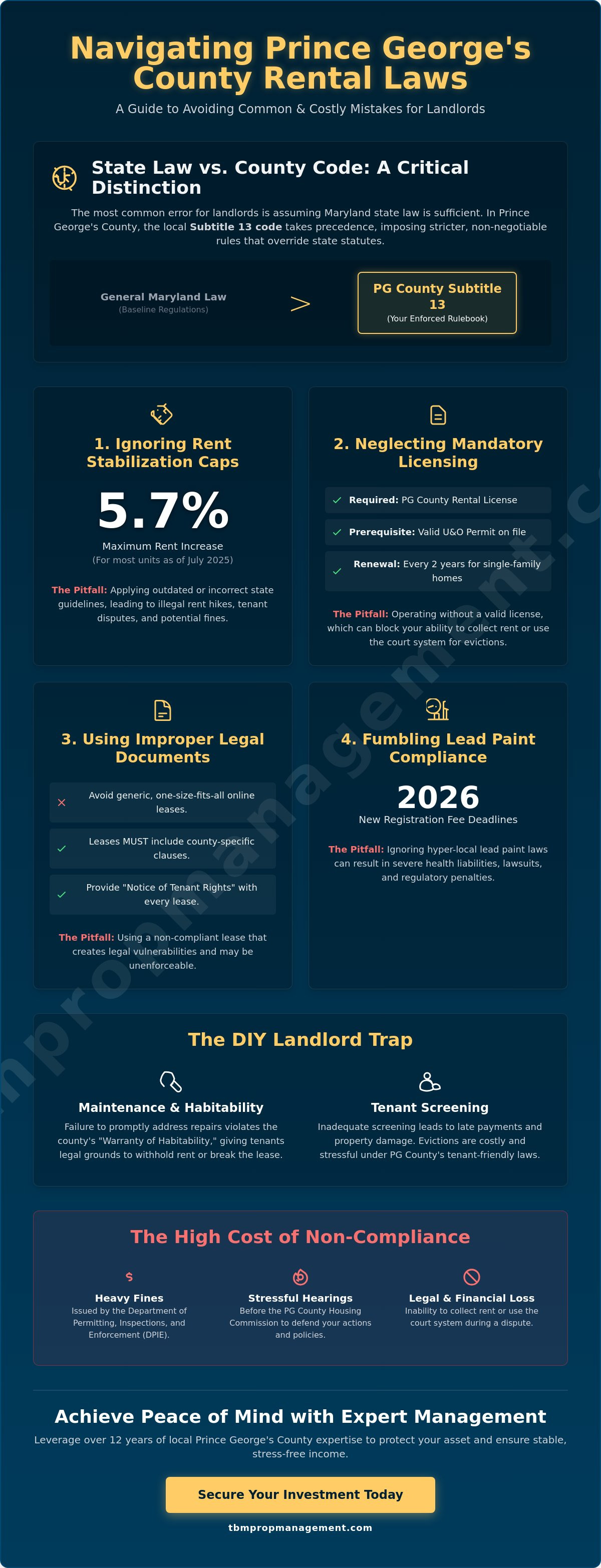
Did you know that as of July 2025, the maximum rent increase for most units in Prince George's County is capped at exactly 5.7%? If you're relying on general Maryland statutes to manage your property, you're already at risk of non-compliance. Many new investors believe that standard state laws apply across the board, but the reality is that Prince George's County operates under its own rigorous Subtitle 13 code. Falling into the common mistakes new landlords make in pg county can quickly turn a promising investment into a legal headache. It's understandable to feel stressed by the pressure of managing an asset while trying to decode shifting local ordinances.
You deserve to enjoy the benefits of your investment without the constant fear of disputes or fines. This article promises to clarify the specific rental laws and operational traps that often catch owners off guard. We'll explore seven critical areas, from security deposit limits to the new 2026 lead paint registration fees, so you can achieve full compliance and secure reliable tenant placement. By the end of this read, you'll have a clear roadmap for transitioning from a frustrated self-manager to a confident property owner with a stable, stress-free income stream.
Key Takeaways
- Understand how Subtitle 13 of the PG County Code creates stricter local requirements that override general Maryland state laws.
- Avoid the common mistakes new landlords make in pg county by securing mandatory licenses and adhering to the updated 2026 lead paint registration fees.
- Learn the specific 2025 rent stabilization limits and security deposit rules to keep your investment profitable and legally sound.
- Discover why professional tenant screening and maintenance coordination are essential for upholding the county's "Warranty of Habitability."
- Gain peace of mind by leveraging local expertise to manage the complexities of rent collection and property inspections.
Understanding the Prince George's County Landlord-Tenant Code
Are you concerned that a simple paperwork error could jeopardize your entire investment? It's a common fear for property owners in Maryland. The regulatory landscape here is unique because Subtitle 13 of the Prince George's County Code serves as the primary framework for your daily operations. While many property owners believe that following state-level statutes is sufficient, Prince George's County enforces stricter local ordinances that often catch the unwary off guard. These rules aren't just suggestions; they are legal mandates overseen by the Director of the Department of Permitting, Inspections, and Enforcement (DPIE).
One of the most frequent mistakes new landlords make in pg county is assuming that "good intentions" will shield them from compliance violations. If a dispute reaches a local official, claiming you didn't know the specific county code rarely provides a valid defense. The county expects absolute adherence to Subtitle 13, regardless of your experience level. This is why transitioning from a DIY approach to professional oversight can provide such immediate relief. You shouldn't have to spend your weekends decoding legal jargon just to keep your rental business afloat.
Why Local Knowledge is Your Best Defense
Why does local knowledge matter so much? In Prince George's County, local ordinances frequently override state-level defaults. This creates a significant risk for anyone using generic lease templates found online. Those "one-size-fits-all" documents often fail to include mandatory county disclosures or specific clauses required by Subtitle 13. Understanding the broad principles of Landlord-tenant law is a great starting point, but it won't save you if your lease lacks the specific language required by our local jurisdiction. At TBM, we've spent over 12 years navigating these specific local waters. We ensure your documents aren't just legal at the state level, but fully compliant with the hyper-local requirements of Prince George's County.
The Role of the PG County Housing Commission
The Prince George's County Housing Commission holds substantial authority in resolving landlord-tenant disputes through an administrative hearing process. When a tenant files a formal complaint, you may find yourself facing a board to defend your actions regarding repairs, deposits, or lease terms. These hearings are stressful, time-consuming, and potentially expensive if you're found in violation. However, most of these conflicts are entirely preventable. Maintaining a professional Maryland landlord tenant rights awareness allows you to address issues before they escalate to a commission level. By staying proactive and following the established code, you transform your rental property from a source of anxiety into a reliable, passive asset.
Common Compliance Mistakes: Licensing and Lead Paint
Are you certain your property is legally ready for a tenant? Many investors overlook the fact that Prince George's County requires a specific rental license for all non-owner-occupied units. Operating without one isn't just a minor oversight; it's a violation that can lead to heavy fines and even prevent you from using the court system during a dispute. This is one of the most common mistakes new landlords make in pg county, yet it's entirely preventable with the right guidance. You deserve the peace of mind that comes from knowing your asset is fully protected.
To stay compliant, you must familiarize yourself with the Prince George's County Housing Code. This code mandates that every landlord provides a "Notice of Tenant Rights" alongside every lease agreement. Skipping this document, or failing to register your property, creates a legal vulnerability that can be used against you during an administrative hearing. Why take that risk when professional Leasing Services can handle the complex paperwork for you?
Securing Your Prince George’s County Rental License
Applying for your license happens through the DPIE portal. Before you begin, you must have a valid Use and Occupancy (U&O) permit on file. This permit proves your property meets local safety and zoning standards. For single-family homes, these licenses are valid for a 2-year period. Keeping track of renewal dates is critical. If your license expires, your legal right to collect rent could be challenged. It's a simple administrative task, but the consequences of forgetting it are severe.
Lead Paint Compliance: A Non-Negotiable Step
Does your rental property date back to the 1970s or earlier? If your home was built before 1978, you face additional state-level requirements under the Maryland Lead Risk Reduction in Housing Act. You must register these properties with the Maryland Department of the Environment (MDE). As of January 1, 2026, the fee for this registration and its biennial renewal increased to $75. Beyond registration, you must pass a lead dust inspection at every tenant turnover. Keeping these inspection certificates on file is vital for your defense. They protect you from liability and demonstrate your commitment to tenant safety. Managing these rotating deadlines can feel like a heavy burden, but it's a necessary part of protecting your financial future in the local market.
Financial Pitfalls: Security Deposits and Rent Caps
Financial management in Prince George’s County is no longer as simple as collecting a check. Recent legislation has introduced strict boundaries that can lead to costly litigation if ignored. For example, failing to return a security deposit within the mandatory 45-day window can result in a judge awarding the tenant up to three times the amount withheld. These are the kinds of mistakes new landlords make in pg county that turn a passive income stream into an active financial liability. You deserve to see a return on your investment without the constant threat of legal penalties.
You must also stay ahead of the Permanent Rent Stabilization and Protection Act of 2024. This law fundamentally changed how you can adjust your income. For the period between July 1, 2025, and June 30, 2026, the maximum rent increase for standard regulated units is capped at 5.7%. If you attempt to raise the rent beyond this limit without a valid exemption, you aren't just making a mistake; you're violating county law. We understand that these shifting percentages can feel overwhelming, but staying compliant is the only way to ensure long-term stability.
Managing Security Deposits and Escrow Accounts
Maryland law requires you to hold security deposits in a separate, interest-bearing account. In Prince George’s County, the deposit cannot exceed two months' rent or $50, whichever is greater. You must provide a receipt and, upon lease termination, an itemized list of damages if you intend to withhold any funds. If you fail to provide this list within 45 days, you forfeit your right to keep any portion of the deposit. This applies even if the tenant caused significant damage. Additionally, remember that late fees are capped at 5% of the total monthly rent. Charging more is a common trap that can invalidate your claims in court.
Navigating Local Rent Increase Limitations
Adjusting your rent requires more than just a new lease agreement. You must provide tenants with proper written notice, typically 60 days in advance, before any increase takes effect. While the current cap for most units is 5.7%, senior housing is restricted even further to 2.7%. Some properties, such as those with a certificate of occupancy issued on or after January 1, 2000, may be exempt from these specific caps. Confirming your property's status is essential before you send out renewal notices. Don't let a simple math error lead to a housing commission hearing.
The DIY Trap: Maintenance and Tenant Screening
Do you feel the weight of every maintenance call and the nagging worry that you chose the wrong tenant? For many new owners, the "do-it-yourself" approach feels like a cost-saving measure. In reality, it often becomes a source of immense emotional and financial pressure. Relying on a "gut feeling" during an interview is one of the most dangerous mistakes new landlords make in pg county. Without a standardized, professional vetting process, you risk inviting a tenant who may ignore lease terms or fail to pay rent, leaving you to manage the fallout alone.
Beyond finding the right person, you must uphold the Prince George's County "Warranty of Habitability." This local mandate requires you to keep the property in a state that is safe and fit for human habitation. If you fail to address essential repairs promptly, tenants have the right to initiate a Rent Escrow process in the local courts. This allows them to pay their rent into a court-held account instead of your pocket until the issues are resolved. It's a stressful, public, and avoidable situation that can cripple your cash flow and damage your reputation as a provider.
Professional Screening vs. The DIY Approach
How do you separate a great applicant from a potential liability? A professional approach goes far beyond a simple conversation. It involves comprehensive credit, criminal, and eviction history checks that comply with both state laws and the federal Fair Housing Act. Avoiding discrimination lawsuits requires a strict, documented screening criteria that many self-managing landlords lack. If you want to ensure your property is occupied by qualified individuals, leveraging expert tenant placement services is the most effective way to secure your investment's future.
Streamlining Repairs with Modern Tools
Maintenance doesn't have to be a source of constant interruptions. Modern property management uses automated coordination to ensure that every repair request is tracked and resolved with professional speed. By utilizing tools like property meld, you can ensure that 24-hour emergency repair standards are met without you having to pick up the phone at midnight. Regular property inspections also play a vital role here; they allow you to catch minor leaks or structural issues before they turn into expensive, escrow-triggering disasters. When you stabilize your maintenance routine, you transform your rental from a second job into a true passive asset. If you're ready to step back from the daily grind of repairs, our team is here to provide the Full-Service Property Management you need to finally find relief.
Achieving Relief with TBM Property Management
You've worked hard to build your portfolio, but the weight of compliance can often feel like it's overshadowing your success. From the intricacies of Subtitle 13 to the shifting 2025 rent stabilization caps, the mistakes new landlords make in pg county are often rooted in a lack of support rather than a lack of effort. You don't have to carry the burden of asset oversight alone. Professional management isn't just about outsourcing tasks; it's about reclaiming your time and mental space. By partnering with a dedicated expert, you ensure that every legal requirement is met and every tenant interaction is handled with professional care.
Our Full-Service Property Management model is designed to act as a stabilizing force for your investment. We don't just collect rent; we provide a comprehensive shield against the operational pitfalls discussed in this guide. Whether it's managing the strict 45-day security deposit deadline or coordinating 24-hour emergency repairs, our systems are built to eliminate the common mistakes new landlords make in pg county. We treat your property with the same dedication and high standards you'd expect from a long-term partner. This partner-based relationship ensures that your asset is protected while you remain informed through detailed financial reporting and regular property inspections.
Why Laurel Landlords Trust TBM
With over 12 years of mastery in the Laurel and Prince George's County markets, we understand the hyper-local nuances that generic firms often overlook. We offer a complimentary analytical report to help you see exactly where your property stands in the current market. This report identifies opportunities for value-driven improvements and ensures your rent is positioned competitively within the 5.7% local cap. We act as your primary defense against legal disputes and maintenance disasters, allowing you to focus on your long-term financial goals instead of daily frustrations. Our team works diligently to exceed standard expectations, providing a specialized, high-touch feel with professional-grade results.
Your Next Steps to Stress-Free Ownership
Is it time to move from the stress of DIY management to the ease of professional partnership? The transition is simpler than you might think. When you focus on choosing professional property management, you're choosing a path toward reliable, passive income. We invite you to reach out for a free rental analysis today. Let us show you how our specialized, high-touch approach can turn your rental property back into the asset you always intended it to be. You've done the heavy lifting of investing; now, let us handle the heavy lifting of management.
Secure Your Investment’s Future Today
Managing a rental property in Prince George's County doesn't have to feel like a second full-time job. By mastering local licensing requirements and staying ahead of shifting rent stabilization caps, you protect your asset from unnecessary legal risks. Most of the common mistakes new landlords make in pg county stem from a lack of specialized local knowledge, but you now have the tools to avoid those pitfalls. It's time to transition from the stress of self-management to a state of professional ease.
Ready to see how your property stacks up? Get Your Free Stress-Free Rental Analysis from TBM Property Management today. Our team brings over 12 years of local PG County expertise to your doorstep, providing a complimentary rental ROI analytical report to maximize your returns. We also utilize advanced tools like Property Meld for full-service maintenance coordination, ensuring your tenants stay happy and your property stays compliant. You've worked hard for your investment; let us help you protect it with the dedication and high standards you deserve.
Frequently Asked Questions
Do I need a rental license to rent out my house in Prince George’s County?
Yes, you must obtain a single-family rental license from the Department of Permitting, Inspections, and Enforcement (DPIE) for any non-owner-occupied property. This license is generally valid for a two-year period and requires a valid Use and Occupancy permit. Operating without this license is one of the most frequent mistakes new landlords make in pg county and can lead to significant fines or legal complications during tenant disputes.
What is the maximum security deposit a landlord can charge in Maryland in 2026?
You cannot charge a security deposit that exceeds the equivalent of two months' rent or $50, whichever is greater. If you accidentally charge more than this limit, the tenant may be entitled to recover up to three times the extra amount plus reasonable attorney’s fees. It's essential to calculate this precisely and provide a written receipt to ensure you remain in full compliance with state and county regulations.
How much can I increase rent each year in PG County?
Under the Permanent Rent Stabilization and Protection Act of 2024, annual increases are strictly capped. For the period from July 1, 2025, through June 30, 2026, the maximum increase for standard regulated units is 5.7%. Units in age-restricted senior housing are capped at 2.7%. You must also provide tenants with at least 60 days' written notice before any rent adjustment can legally take effect.
Does a landlord have to provide a receipt for rent in Prince George’s County?
Yes, you are legally required to provide a written receipt for any rent payment made in cash. While it isn't mandatory for check or money order payments unless the tenant requests it, maintaining a consistent receipting process is a hallmark of professional rent collection. This documentation protects both parties by creating a clear, indisputable financial trail that can prevent future misunderstandings or legal disagreements regarding payment history.
What happens if I don’t return the security deposit within 45 days?
If you fail to return the security deposit or provide a detailed, itemized list of damages within 45 days of lease termination, you forfeit your legal right to withhold any portion of the funds. In such cases, a tenant can sue for up to three times the withheld amount plus legal costs. This strict deadline is a common trap, but professional property management ensures these timelines are always met with precision.
Are there limits on application fees for rentals in PG County?
Maryland law generally limits non-refundable application fees to $25. If the fee exceeds this amount and you don't end up renting the unit to the applicant, you must return the unused portion. This fee should only cover the actual cost of tenant screening, such as credit and criminal background checks. Keeping these fees transparent and compliant helps you avoid early friction with potential residents and local housing authorities.
Can I evict a tenant in PG County without going to court?
No, "self-help" evictions are strictly illegal in Prince George's County and throughout Maryland. You cannot change the locks, shut off essential utilities, or remove a tenant's belongings without a formal court order and the presence of the Sheriff. Attempting to bypass the court-ordered eviction process is one of the most costly mistakes new landlords make in pg county and can result in significant damages awarded to the tenant.
What is the "Warranty of Habitability" in Prince George’s County?
The "Warranty of Habitability" is a legal obligation requiring landlords to maintain a property that is safe and fit for human habitation. This includes providing essential services like heat, running water, and electricity, while ensuring the structure is free from serious defects. If you fail to uphold these standards, a tenant can file for Rent Escrow, which allows them to pay rent into a court-held account until necessary repairs are completed.