
Maryland Landlord Tenant Rights: The Definitive 2026 Landlord Guide
Did you know that a simple mistake like charging a two-month security deposit could now trigger a costly legal dispute under Maryland's updated rental laws? Managing a rental property in Howard or Prince George’s County is already stressful enough without the constant worry of shifting regulations. You want to be a fair landlord while protecting your investment, but the complex landscape of landlord tenant rights maryland can often feel like a moving target.
We know how overwhelming it feels to keep up with the Renters' Rights and Stabilization Act of 2024, but you don't have to navigate these changes alone. This guide is designed to take the stress away by providing a clear roadmap for professional compliance. You'll learn exactly how to handle the new one-month security deposit limit, the mandatory Tenants' Bill of Rights addendum, and the specific protocols required to protect your property and your peace of mind in 2026.
Key Takeaways
- Learn why the 2026 Renters' Rights and Stabilization Act makes understanding landlord tenant rights maryland more critical than ever for protecting your investment.
- Discover how to strictly adhere to the new one-month security deposit limit and escrow rules to avoid severe financial penalties and legal disputes.
- Protect your property from liability by mastering the latest MDE lead-based paint requirements and mandatory habitability standards for every change in occupancy.
- Navigate the updated 10-day notice requirement for Failure to Pay Rent filings while steering clear of common "retaliatory eviction" legal traps.
- Find out how professional property management takes the stress away by acting as a proven shield against complex county-level ordinances and compliance errors.
Understanding Maryland Rental Laws: The 2026 Landscape
How well do you really know the legal contract you signed with your tenant? Under the Maryland Residential Lease Act, the relationship between a property owner and a renter is a formal exchange of rights and duties. It isn't just about providing a roof; it's about adhering to a strict set of rules that have grown significantly more complex in 2026. Understanding landlord tenant rights maryland is no longer optional for the casual investor. With the implementation of the Renters' Rights and Stabilization Act, the state has shifted its focus toward proactive tenant education and tighter oversight.
The primary governing bodies, including the Department of Housing and Community Development (DHCD) and the Maryland Attorney General, now enforce regulations that can feel overwhelming for a solo landlord. We see many owners struggle with the emotional burden of staying compliant. This constant stress takes the joy out of property ownership. If you feel like you're constantly playing catch-up with new laws, you're not alone. Our goal is to stabilize your investment by acting as your dedicated legal partner.
Foundational knowledge of Landlord-tenant law is the first step toward a profitable rental. In Maryland, the law favors those who are prepared and punishes those who rely on outdated information. Whether you're a seasoned pro or a new owner, the 2026 landscape requires a higher level of diligence than we've seen in the last decade. We make it easy for you to stay protected while keeping your tenants satisfied.
State vs. Local Ordinances: Why Location Matters
Do you know if your property is subject to county-specific rent caps? In Montgomery and Prince George’s counties, local ordinances are often much stricter than the state baseline, requiring unique licensing and specific lease disclosures. Conversely, Howard County and Anne Arundel County align more closely with statewide standards, yet they still maintain local health and safety codes you must follow. Local laws generally preempt state law when they offer more stringent protections for the tenant. This fragmented legal map is why so many owners find self-management so draining.
The Legal Risks of DIY Management
Many landlords mistakenly believe that "handshake deals" or oral leases will hold up if things go south. In reality, failing to have a comprehensive written lease is a recipe for a courtroom disaster. You can explore the common pitfalls in our guide on proper management vs DIY. A single mistake in your landlord tenant rights maryland compliance, such as missing a mandatory addendum, can lead to your case being dismissed and your investment suffering. With over 12 years of local expertise, we ensure your paperwork is ironclad, taking the stress away so you can focus on your life.
Lease Agreements and Security Deposit Regulations
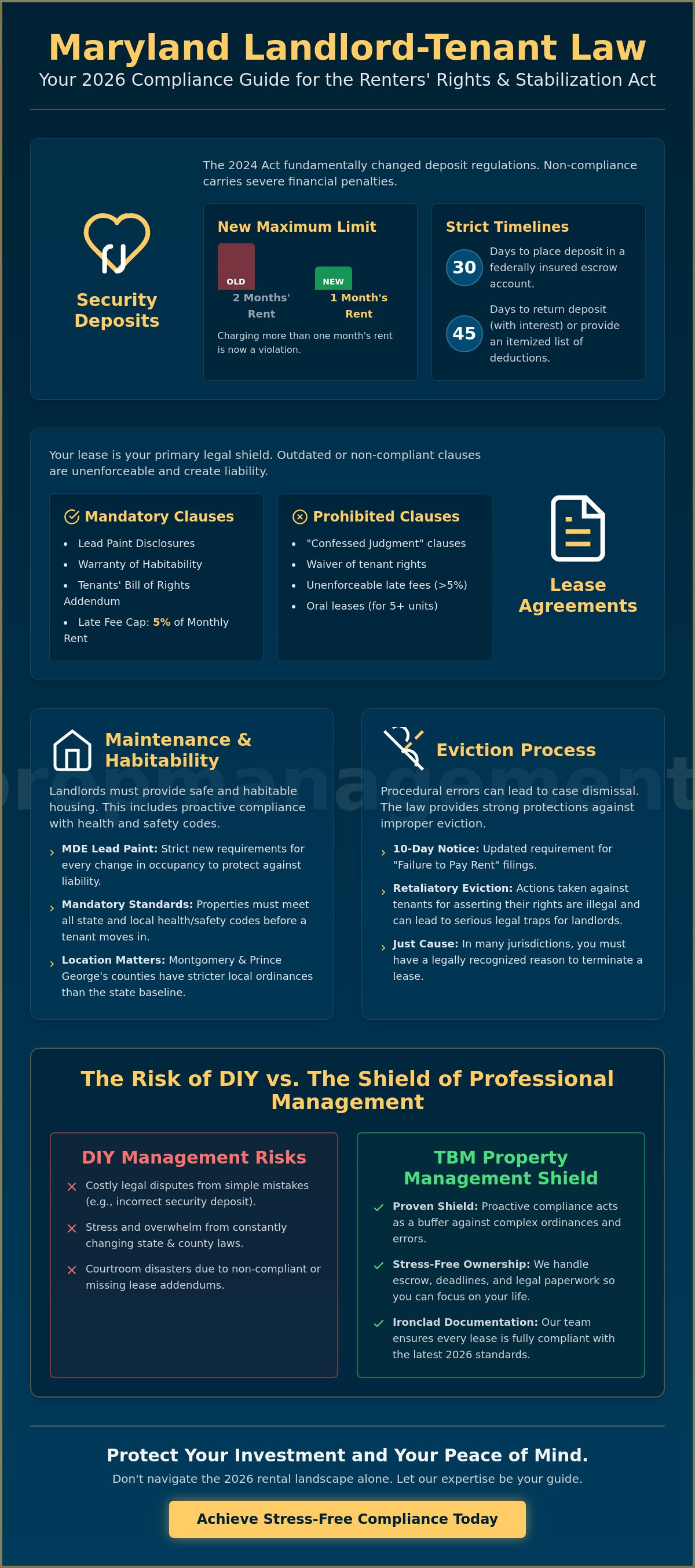
How much are you currently holding for a security deposit? If it's more than one month's rent, you're likely out of compliance with current 2026 standards. The Renters' Rights and Stabilization Act of 2024 fundamentally changed the financial entry point for tenants. Today, a landlord cannot require a security deposit exceeding one month's rent. This is a major shift from previous years, and failing to adjust can lead to expensive legal headaches. We take the stress away by ensuring every lease we manage reflects these updated landlord tenant rights maryland.
Once you collect that deposit, it cannot sit in your personal savings account. Maryland law requires you to place these funds in a federally insured escrow account within 30 days of receipt. When the tenancy ends, the clock starts ticking immediately. You have exactly 45 days to return the deposit plus any accrued interest. If you withhold any portion for damages, you must provide a detailed, itemized list of costs sent via first-class mail. For a deeper dive into these specific timelines, the Maryland People's Law Library offers an excellent breakdown of the statutory requirements. We make it easy for our clients by handling these complex interest calculations and escrow management automatically, ensuring you never miss a deadline.
Essential Clauses for Every Maryland Lease
Your lease is your primary shield. In Maryland, certain clauses are mandatory, while others are strictly forbidden. For example, you must include disclosures regarding lead paint and a warranty of habitability. Late fees are legally capped at 5% of the monthly rent; anything higher is unenforceable in a Maryland court. You should also be aware that "confessed judgment" clauses are prohibited in residential leases. If you own five or more rental units, Maryland law mandates that your lease must be in writing. Keeping these documents up to date is a commitment to excellence that protects your investment in counties like Howard and Montgomery.
Application Fees and Holding Deposits
Are you charging more than $25 to process a rental application? In Maryland, that's the legal limit for a non-refundable fee. If you collect more than $25 for a background check or credit report, any unused portion must be returned to the applicant within 15 days of their request. Managing these small but critical details is where many DIY landlords trip up. Our professional tenant placement services handle these logistics seamlessly, ensuring you stay on the right side of the law from the very first interaction. If you're unsure if your current application process is compliant, we'd be happy to provide a professional rent analysis to help you get started on the right foot.
Maintenance, Habitability, and Lead-Based Paint
Are you worried about a sudden maintenance emergency turning into a legal battle? In Maryland, every residential lease includes an implied "Warranty of Habitability." This means you're legally required to provide a home that's safe, clean, and fit for human life. From ensuring functional heat during a Howard County winter to providing clean running water, your duty to repair is non-negotiable. If you're confused about where your duties end and tenant responsibilities begin, the Maryland Attorney General's Guide to Landlord-Tenant Rights is a vital resource for staying compliant with 2026 standards.
While you have a duty to maintain the property, you also have the right to access it. However, landlord tenant rights maryland require you to respect your tenant's privacy. Generally, you should provide 24 to 48 hours of notice before entering for non-emergency repairs or inspections. We take the stress away by using advanced technology like Property Meld to coordinate these visits. This system makes it easy for tenants to report issues and for you to track every repair, creating a digital paper trail that protects you in court.
The Rent Escrow Process: What Landlords Fear
What happens if a tenant claims you aren't making necessary repairs? They might file for rent escrow. This doesn't mean they stop paying rent; instead, they pay the rent into a court-managed account until the issue is fixed. To win an escrow case, a tenant must prove a "serious defect" exists, such as a lack of heat, light, electricity, or a structural threat to their safety. We've found that performing regular, documented property inspections is the best way to prevent these filings. By catching small issues before they become "serious defects," you maintain a positive relationship with your tenant and keep your rental income flowing directly to you.
Maryland Lead Paint Requirements (MDE)
If your investment property was built before 1978, you're subject to strict Maryland Department of the Environment (MDE) regulations. You must register your property annually and pay the required fee to stay compliant. Every time a new tenant moves in, you're required to have a fresh lead inspection performed by an accredited professional to obtain a "Full Risk Reduction" certificate. Failing to provide this certificate, or the mandatory "Notice of Tenant's Rights," can result in massive fines and the inability to use the court system for evictions. Our team has over a decade of experience managing these MDE renewals in Anne Arundel and Prince George’s counties, ensuring your property meets every safety standard without you ever having to lift a finger.
The Eviction Process and Protection from Retaliation
Has a tenant stopped paying rent, leaving you to cover the mortgage out of your own pocket? We understand the immense pressure this creates. In Maryland, the eviction process is strictly regulated to ensure fairness, but it requires precise timing from the landlord. For a Failure to Pay Rent (FTPR) filing, you must provide a written 10-day notice before you can even step into a courtroom. This window gives the tenant a chance to catch up, but it also serves as the first mandatory step in protecting your landlord tenant rights maryland.
One of the biggest legal traps is the "retaliatory eviction." If a tenant has recently exercised their rights, such as reporting a lead paint violation or requesting a repair under the Warranty of Habitability discussed earlier, any attempt to evict them shortly after can be viewed as retaliation. Courts take this very seriously. Even if you have a valid reason for the eviction, the timing alone could cause a judge to rule against you. We take the stress away by ensuring all communications are documented and every action is legally sound, shielding you from these expensive accusations.
Maryland also grants tenants a "Right to Redeem," often called the "pay to stay" rule. This allows a tenant to stop an eviction at any time before the sheriff arrives by paying all past-due rent and late fees. However, this right isn't infinite. In most cases, if a landlord has won three or more FTPR judgments against a tenant in the previous 12 months, the court may deny the right to redeem. Understanding landlord tenant rights maryland is the only way to ensure your eviction remains legal and effective. Never attempt a "self-help" eviction by changing the locks or turning off utilities. These actions are strictly illegal and will likely result in the court awarding the tenant significant damages at your expense.
Types of Eviction in Maryland
- Failure to Pay Rent: Requires a 10-day written notice before filing.
- Breach of Lease: Used when a tenant violates specific lease terms, such as unauthorized pets or smoking. This typically requires a 30-day notice.
- Tenant Holding Over: Occurs when a tenant remains after the lease expires. Notice periods vary, but 60 days is common for most residential tenancies in 2026.
If your property is in Laurel or elsewhere in Prince George’s County, be prepared for specific local court procedures that may differ slightly from Anne Arundel. Our team stays on top of these hyper-local nuances to ensure your filing is never rejected on a technicality.
How to Respond to a Tenant Dispute
When a conflict arises, your first instinct might be frustration. We recommend a professional, empathetic approach to de-escalate the situation before it reaches the District Court. Mediation is often a faster, cheaper alternative to a trial. Always keep meticulous records of every text, email, and phone call. If you're tired of the late-night calls and the stress of legal filings, let us handle the heavy lifting with our full-service property management solutions.
Achieving Stress-Free Compliance in 2026
Are you still feeling the weight of these legal requirements on your shoulders? We understand that the ever-changing nature of landlord tenant rights maryland can make even the most seasoned investor feel uneasy. Staying ahead of these regulations is a full-time job, but you don't have to do it alone. We take the stress away by serving as your dedicated legal and operational shield, ensuring your investment remains profitable and protected from costly courtroom errors.
Our team brings over 12 years of hands-on expertise specifically within the Anne Arundel, Prince George’s, Montgomery, and Howard County markets. We've seen how a single compliance mistake can derail a landlord's financial goals. That's why we focus on a relief-oriented approach that prioritizes your peace of mind. If you want a deeper look at the specific checklists we use to keep our clients safe, our Maryland Tenant Rights Compliance Guide is an invaluable resource for protecting your portfolio in 2026.
The TBM Advantage: Local Expertise in Laurel
In cities like Laurel, local ordinances can change quickly, often layering additional rules on top of state law. We handle the heavy lifting for you by managing complex MDE lead paint registrations and ensuring your lease agreements are always updated with the latest 2026 standards. We don't just wait for tenants to complain; we implement a proactive inspection schedule to guarantee your property consistently meets the warranty of habitability. This diligent approach prevents the rent escrow issues we discussed in previous sections. Curious about how your property’s value matches up with these new regulatory costs? Request our FREE rent analysis report to see how we can optimize your returns while keeping you fully compliant.
Your Next Steps for a Protected Portfolio
Protecting your investment starts with a clear, actionable plan. You can begin securing your property today by following these three steps:
- Review your current lease: Ensure you aren't holding security deposits that exceed the new one-month rent limit.
- Verify certifications: Confirm your lead paint certifications are current and properly filed with the Maryland Department of the Environment.
- Audit your notices: Make sure your Failure to Pay Rent forms include the mandatory 10-day notice period required by landlord tenant rights maryland.
If this list feels overwhelming, it's time to partner with a team that goes above and beyond. Contact TBM Property Management today. We make it easy to transition from a state of constant worry to a state of total security, providing the extraordinary service you and your tenants deserve.
Protect Your Maryland Investment for a Profitable Future
Owning a rental property should be a source of stability, not a constant source of anxiety. We've explored how the 2026 legal landscape requires a proactive approach to security deposits, habitability standards, and the eviction process. Understanding landlord tenant rights maryland is the foundation of your success; however, staying compliant shouldn't consume your personal time. By mastering these regulations, you protect your portfolio from expensive lawsuits and build better relationships with your tenants.
With over 12 years of local expertise in Anne Arundel, Prince George’s, Montgomery, and Howard counties, we're here to help you succeed. From comprehensive tenant screening to detailed maintenance coordination, we handle every detail so you don't have to. Let TBM Property Management take the stress out of compliance, contact us today! We make it easy to grow your wealth while keeping your investment secure and your peace of mind intact. You've worked hard for your property; let us work hard to protect it.
Frequently Asked Questions
Is a written lease required in Maryland?
Yes, a written lease is mandatory if you manage five or more rental units. Even if you only own one property, you must provide a written lease if the tenant requests one. We recommend using written agreements for every property in Anne Arundel and Howard counties to ensure your expectations are clear and legally enforceable from day one.
What is the maximum late fee a landlord can charge in Maryland?
The maximum late fee you can legally charge is 5% of the monthly rent amount. It's vital to include this specific cap in your lease documents to avoid issues in court. Charging a fee higher than 5% is a violation of state law and could lead to a judge dismissing your Failure to Pay Rent filing entirely.
How much can a landlord charge for a security deposit in 2026?
As of 2026, you cannot charge more than one month's rent for a security deposit. This limit was established by the Renters' Rights and Stabilization Act of 2024 to make housing more accessible. Staying updated on these changes to landlord tenant rights maryland is essential for protecting your investment and avoiding unnecessary legal disputes during the move-in process.
Can a tenant withhold rent for repairs in Maryland?
No, a tenant cannot simply stop paying rent because they're unhappy with the property's condition. If there's a serious defect that affects life, health, or safety, they must use the formal rent escrow process. This requires them to pay their full rent into a court-managed account until a judge decides the matter, ensuring you aren't left without documented income.
What happens if a landlord does not return the security deposit within 45 days?
If you fail to return the deposit or provide an itemized list of deductions within 45 days, you may lose your right to withhold any part of the funds. In more serious cases, a court can award the tenant up to three times the withheld amount plus attorney's fees. We take the stress away by managing these strict timelines for you.
Are landlords required to provide receipts for rent payments?
You are legally required to provide a written receipt every time a tenant pays rent in cash. For other payment methods, such as checks or electronic transfers, you only have to provide a receipt if the tenant asks for one. We make it easy for our clients by providing digital records of all payments automatically through our management portal.
How much notice must a landlord give a tenant to move out in Maryland?
For most standard residential leases in 2026, you must provide at least 60 days of written notice before the lease ends if you don't intend to renew. This timeframe can change depending on your specific county or the type of lease you have. We always verify local rules in Prince George’s and Montgomery counties to ensure your notice is legally valid.
What is considered a "retaliatory eviction" under Maryland law?
A retaliatory eviction happens if you try to evict a tenant because they complained about a code violation, filed a lawsuit against you, or joined a tenant union. If you take adverse action within six months of their complaint, the court may assume you're acting in retaliation. Mastering landlord tenant rights maryland helps you handle disputes professionally without triggering these expensive legal traps.