
Analyzing Rental Property ROI in Prince George's County: The 2026 Investor’s Guide
With a 5.7% rent increase cap and a median home price of $462,040, is your investment still the wealth-building asset you intended it to be? Analyzing rental property ROI in prince george's county has become a high-stakes balancing act between rising maintenance costs in older homes and the strict requirements of the Permanent Rent Stabilization and Protection Act of 2024. You likely feel that the "hidden" time-costs of self-management are slowly eroding your profits and your peace of mind. We understand that the burden of asset oversight can be overwhelming, but it doesn't have to stay that way.
This guide will help you master the local math to transform your rental from a source of daily stress into a high-yield wealth engine. We promise to provide the clarity you need to navigate current licensing fees and the $1.0000 county tax rate with confidence. You'll get a spreadsheet-ready ROI formula and a deep dive into neighborhood-specific trends from Laurel to Bowie. By the end, you'll have a clear path toward professional-grade results and the relief that comes from expert property oversight.
Key Takeaways
- Understand the 2026 market landscape where median home prices and new rent stabilization laws create a unique environment for local landlords.
- Master a spreadsheet-ready formula for analyzing rental property ROI in prince george's county that accounts for local appreciation and the "Maryland Multiplier."
- Identify hidden ROI killers like DPIE licensing fees and lead-based paint compliance requirements for older properties in the region.
- Discover why neighborhoods like Laurel and Bowie offer distinct strategic advantages for investors seeking transit-oriented growth or long-term suburban stability.
- Learn how professional management coordination and tenant placement services can actually increase your net profit by reducing vacancy and mitigating legal risks.
The 2026 Prince George’s County Rental Market Landscape
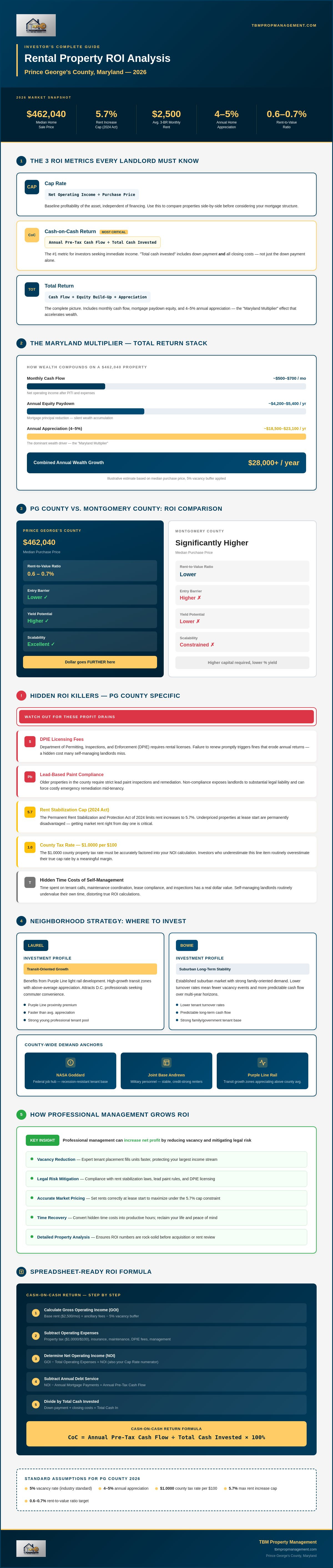
Prince George's County continues to stand out as a premier destination for real estate investors in the D.C. metro area. As of June 2026, the median home sale price has reached $462,040, yet it remains significantly more accessible than nearby Montgomery or Howard Counties. This lower entry point, combined with strong rental demand, creates a unique opportunity for those focused on analyzing rental property ROI in prince george's county. While other regions struggle with stagnant yields, the "Affordability Gap" drives a steady stream of D.C. professionals toward the county's more reasonably priced single-family rentals.
To truly understand your potential profit, you must look beyond the monthly rent check. We typically evaluate performance through three specific lenses:
- Cap Rate: Your net operating income divided by the property's purchase price. This provides a baseline for the asset's natural profitability.
- Cash-on-Cash Return: This measures the annual cash flow relative to the actual amount of cash you've invested. It's the most critical metric for investors seeking immediate income.
- Total Return: A comprehensive look that includes monthly cash flow, equity build-up through mortgage paydown, and the 4% to 5% annual appreciation common in this region.
Macro Trends Driving Demand in Southern Maryland
The stability of the local market is anchored by massive federal job hubs. Facilities like NASA Goddard and Joint Base Andrews provide a recession-resistant tenant base that values proximity to work. Additionally, the continued development of the Purple Line light rail has created high-growth transit zones where property values are appreciating faster than the county average. Current Prince George's County demographics show a growing population of young families and professionals who prefer the space of a suburban home over a cramped city apartment, ensuring that average rents for three-bedroom homes stay strong at approximately $2,500 per month.
PG County vs. Montgomery County: A Comparative ROI Look
When you're analyzing rental property ROI in prince george's county, the comparison to Montgomery County is telling. While Montgomery County often requires a much higher initial capital outlay, the rent-to-value ratios in Prince George's County typically hover between 0.6% and 0.7%. This means your dollar goes further here. Lower entry prices don't just make it easier to acquire your first or fifth property; they often lead to higher percentage yields because the rent prices haven't capped out in the same way home purchase prices have. For an investor seeking a stabilizing force for their portfolio, the math in Prince George's County simply offers a more reliable path to wealth.
For investors looking to apply these wealth-building principles in other global hubs, you can learn more about MaddisonV Properties and their specialized guidance on the property market in Southwest London.
The Essential ROI Formula for Maryland Landlords
Analyzing rental property ROI in prince george's county requires more than just a back-of-the-napkin calculation. To build a truly high-yield wealth engine, you need a transparent framework that accounts for the specific economic realities of the Maryland market. The most reliable metric for most investors is the Cash-on-Cash return. This is calculated by taking your annual pre-tax cash flow and dividing it by the total cash you’ve actually invested, including your down payment and closing costs. While cash flow provides immediate relief, don't overlook the 'Maryland Multiplier.' With local appreciation rates consistently hitting 4% to 5%, your total wealth grows significantly faster than your monthly check might suggest.
We also recommend factoring in a 5% vacancy rate, which is the 2026 industry standard for this region. This buffer protects you from the emotional and financial strain of unexpected tenant turnover. Over time, the steady equity build-up from your mortgage paydown acts as a stabilizing force, turning a single property into a legacy asset. If the math feels daunting, our team can help you by providing a detailed property analysis to ensure your numbers are rock solid.
Calculating Gross Operating Income (GOI)
Your journey begins with an accurate assessment of market rent in areas like Laurel or Bowie. Beyond the base rent, which for a three-bedroom home currently averages around $2,500, you should account for ancillary income such as pet rent or parking fees. Gross Operating Income for a Maryland multi-unit property represents the total potential rental income plus ancillary fees, minus the projected losses from vacancies or credit issues. Staying current with Maryland landlord-tenant laws ensures you capture this income legally and ethically while maintaining high standards for your residents.
Operating Expenses: What Most New Investors Forget
Accurate expense tracking is where many self-managed investors struggle. For 2026, you should estimate county property taxes at $1.0000 per $100 of assessed value, plus the $0.1120 state rate. Insurance premiums for rental dwellings in Maryland have also seen adjustments, so getting a specialized quote is essential. Finally, we advise setting aside a 'Maintenance Reserve' of 10% to 15% for property maintenance coordination. This proactive approach prevents small repairs from becoming ROI-killing disasters. We've seen that investors who plan for these costs early experience far less stress when maintenance needs inevitably arise.
Hidden ROI Killers Specific to Prince George’s County
Managing a rental asset often feels like a full-time job because of the administrative hurdles unique to our region. When you're analyzing rental property ROI in prince george's county, you can't just look at the mortgage and the rent check. You have to account for the mandatory 2-year single-family rental license and the inspections that come with it. These aren't just paperwork; they require the property to meet strict housing codes. For properties built before 1978, lead-based paint compliance adds another layer of financial risk. Failing to meet Maryland's lead-safe standards can lead to legal liabilities that wipe out years of equity in a single court case. We've seen how these "hidden" costs can turn a promising investment into a source of constant anxiety.
Beyond physical property issues, the regulatory environment has shifted significantly. The Permanent Rent Stabilization and Protection Act of 2024 now limits most rent increases to 5.7% through June 2026. This cap means you have less room to absorb sudden spikes in operating costs. Mastery of Maryland Landlord-Tenant Rights is essential to avoid the "stress cost" of bad tenants or illegal lease clauses. Legal fees and the potential for extended eviction timelines can turn a profitable quarter into a deficit if you don't have a professional screening and management process in place to protect your interests.
The Cost of Non-Compliance
Fines for operating an unlicensed rental in PG County are steep and can be levied daily. Even worse, a failed inspection often stops your ability to collect rent legally until the issues are resolved. "Do-it-yourself" compliance often backfires because small details are easy to miss. We've seen owners attempt to handle DPIE inspections alone, only to face expensive remediation for minor electrical or egress issues that a professional would have caught early. This delay creates a direct hit to your monthly cash flow that is difficult to recover under current rent caps.
Maintenance Emergencies and 2026 Labor Rates
The D.C. metro area has some of the highest labor rates in the country for skilled trades. HVAC and plumbing repairs have seen significant price jumps in 2026. A single emergency call on a holiday weekend can cost more than your entire month's profit margin. Our approach to maintenance coordination focuses on preventative inspections to identify these issues before they become emergencies. By using our established network of vendors, we help control these repair spikes and provide the relief you need to focus on growing your portfolio instead of managing daily crises.
Strategic Neighborhood Analysis for Maximum Yield
Location is the single most important variable when analyzing rental property ROI in prince george's county. While the county-wide averages provide a solid baseline, your actual profit is found in the micro-markets. For instance, Bowie offers unparalleled suburban stability. It's a favorite for long-term investors because of its low turnover and consistent demand from families who value the established school systems. Conversely, College Park provides a high-density environment fueled by the University of Maryland. While College Park can yield higher monthly rents, it often requires more intensive management due to the student population and frequent turnover. Hyattsville and the Arts District have become the darlings of appreciation, offering a vibrant culture that attracts young professionals willing to pay a premium for walkable urban living.
The Laurel Advantage: A TBM Specialty
Laurel is a unique dual-market powerhouse. Its position exactly halfway between Baltimore and Washington, D.C., ensures a massive pool of potential tenants from both metropolitan hubs. We've found that property management in Laurel, MD is particularly effective for risk-averse investors. The proximity to Fort Meade provides a steady stream of highly qualified military and government contracting tenants. These renters typically prioritize security and stability, which translates to lower vacancy rates and fewer maintenance headaches for you. While search volume for apartments in the area is high, the real yield often lies in single-family homes where tenants stay longer and treat the property with more care.
Emerging Markets: The Purple Line Corridor
The most exciting shifts in 2026 are occurring along the Purple Line Corridor. Areas like New Carrollton and Long Branch are no longer just speculative plays. They're delivering actual rental premiums as the light rail nears full operational status. Transit-oriented development has transformed these neighborhoods, making them highly attractive to commuters who are priced out of D.C. proper. However, these emerging markets come with their own set of urban management challenges. Balancing high appreciation potential with the need for diligent tenant screening is critical here. Unlike the steady predictability of Bowie, New Carrollton requires a more proactive management style to capture the maximum ROI while mitigating the risks of an evolving neighborhood.
If you're unsure which neighborhood fits your financial goals, request your complimentary analytical report today to see the specific numbers for your target area.
How Professional Management Protects and Grows Your ROI
Many investors hesitate to hire a manager because they view the fee as a simple deduction from their bottom line. We call this the "Management Paradox." In reality, professional oversight often increases your net profit by closing the leaks in your cash flow that DIY owners frequently overlook. When you're analyzing rental property ROI in prince george's county, you must consider the cost of every day your property sits vacant. Utilizing professional tenant placement services ensures your unit is marketed aggressively and filled with qualified residents faster than a self-managed listing typically allows. A single month of vacancy often costs more than an entire year of professional management fees.
Rigorous tenant screening is your best defense against the devastating $10,000+ cost of a contested eviction. This figure accounts for lost rent, legal fees, and the physical restoration of the unit. By placing the right person from the start, we protect your yield and provide the security you deserve. We also use hyper-local data to ensure you're maximizing your annual rent increases within the 5.7% legal limit. This keeps your asset at the top of the market without triggering unnecessary turnover or violating the Permanent Rent Stabilization and Protection Act of 2024.
The TBM Approach: From Frustration to Relief
Restoring your "Time ROI" is a central part of our mission as a dedicated partner. Choosing professional property management means you're no longer the one answering emergency calls at midnight or chasing late payments. We standardize rent collection and provide transparent financial reporting that makes tax season simple and efficient. Our regular inspections act as an ROI preservation tool, catching small leaks or lease violations before they become expensive liabilities. This proactive stance is what separates a stressful side-hustle from a truly passive wealth engine.
Ready for a Stress-Free Investment?
Transitioning from a DIY approach to professional oversight is a straightforward process that begins with accurate data. We offer a complimentary property analysis report to help you see exactly where your portfolio stands in the current 2026 market. If you're tired of the daily burden of asset oversight, it's time to partner with a team that treats your property with mastery and high standards. We've spent over 12 years helping landlords in Laurel and across the county find the relief they need. Get your complimentary PG County rental analysis from TBM today.
Securing Your Financial Future in Prince George’s County
Analyzing rental property ROI in prince george's county requires a strategic shift from simply collecting rent to actively managing a complex financial asset. Success in the 2026 market demands a precise understanding of local rent caps and the "Maryland Multiplier" of appreciation. It isn't just about finding the right neighborhood like Laurel or Bowie; it's about protecting your yields from hidden killers like licensing non-compliance and rising maintenance labor rates. For investors planning for retirement, The Modern Medicare Agency offers the expertise needed to navigate medical coverage options for seniors, ensuring your personal future is as secure as your portfolio. We understand the weight of these responsibilities and the emotional burden they often bring.
With over 12 years of local Maryland real estate expertise, we act as a dedicated partner to provide the relief you need. We specialize in the hyper-local nuances of PG County licensing and inspections, ensuring your asset is protected while we treat it as our own. If you're ready to transition from a state of frustration to a state of ease, we're here to stabilize your investment and maximize your returns. Claim your complimentary rental property analysis and see your true PG County ROI potential. Your journey toward a high-yield, low-stress wealth engine starts with a single step toward professional-grade results.
Frequently Asked Questions
What is a good ROI for a rental property in Prince George's County?
A healthy cash-on-cash return for this region typically ranges between 6% and 8% for well-maintained single-family homes. When you're analyzing rental property ROI in prince george's county, you should also account for the 4% to 5% annual appreciation rate. This "Maryland Multiplier" often pushes the total return on your investment into the double digits over the long term.
How do property management fees in PG County affect my bottom line?
Professional management is a strategic expense that often pays for itself by reducing vacancy periods and preventing costly legal errors. While the fee is a monthly line item, it protects your ROI by securing qualified tenants through rigorous screening. It also provides you with the relief of knowing your asset is protected from the financial drain of self-management mistakes.
Is Laurel, MD a better investment than Bowie or Upper Marlboro?
Laurel offers a unique dual-market advantage due to its location between D.C. and Baltimore, which often results in higher tenant demand. Bowie typically provides more suburban stability and lower turnover rates for long-term investors. Both areas are strong choices; however, Laurel's proximity to Fort Meade provides a consistent pool of high-quality military and government contracting tenants.
What are the specific rental licensing requirements in Prince George's County for 2026?
All single-family rental properties must hold a valid 2-year license issued by the Department of Permitting, Inspections and Enforcement (DPIE). This requirement includes a mandatory safety inspection to ensure the property meets the county's housing code. Operating without this license can result in daily fines and legal inability to collect rent from your tenants.
Can professional property management help me avoid Maryland's strict lead paint penalties?
Yes, professional oversight is the most reliable way to ensure your pre-1978 property remains in full compliance with state lead-safe standards. We coordinate the necessary testing and certification renewals required by the Maryland Department of the Environment. This proactive approach acts as a stabilizing force, protecting you from massive fines and the emotional stress of potential legal liabilities.
How much should I budget for maintenance and repairs in an older PG County home?
We recommend setting aside a maintenance reserve of 10% to 15% of your gross monthly rent. Older homes in neighborhoods like Hyattsville often require more frequent HVAC and plumbing attention due to aging infrastructure. Having this reserve in place ensures that analyzing rental property ROI in prince george's county remains a positive experience rather than a series of financial surprises.
What happens if a tenant stops paying rent in Maryland?
You must follow a strict legal process that begins with a formal notice and a Failure to Pay Rent filing in the District Court. Professional rent collection services help you navigate these complexities while maintaining high standards of communication. Our rigorous tenant screening process is designed to prevent these situations from occurring by identifying reliable residents before they move in.
How does the Purple Line expansion affect rental ROI in 2026?
The Purple Line has created transit-oriented premiums in areas like New Carrollton, leading to faster appreciation and higher rent potential. Commuters are increasingly willing to pay a premium for properties within walking distance of these new light rail stations. This trend has made transit-corridor properties some of the most sought-after assets for investors looking to maximize their total return.