
Anne Arundel County Rental Property Registration: The 2026 Landlord’s Guide
What if your biggest liability as a landlord isn't a broken HVAC system or a late payment, but a missing piece of paper tucked away in a county database? For many owners, the thought of logging into the Land Use Navigator (LUN) portal or facing a surprise inspection brings a genuine sense of dread. You've worked hard to build your portfolio, and it's exhausting to feel like one administrative oversight could put your assets at risk. We understand that you want to focus on growth, not deciphering complex local codes.
That is why we created this definitive guide to anne arundel county rental property registration for 2026. Whether you're wondering if your duplex requires a Multiple Dwelling License or you need to register a short-term rental, we provide the clarity you've been looking for. This article offers a step-by-step checklist to ensure you meet every requirement without the headache. You will learn the specific differences between license categories, current fee structures, and how to keep your property legally protected so you can get back to what matters most.
Key Takeaways
- Identify whether your property requires a license under the 2026 legal definitions to ensure your investment stays fully compliant with local safety mandates.
- Differentiate between Multiple Dwelling Licenses for long-term leases and Short-Term Residential Rental (STRR) rules to avoid costly registration errors.
- Master the Land Use Navigator (LUN) portal with a clear roadmap designed to simplify the anne arundel county rental property registration process.
- Secure a passing grade on your county inspection by following a proactive checklist that focuses on the Property Maintenance Code and essential safety alarms.
- Shift the administrative burden of licensing and inspections to a local expert, allowing you to enjoy the rewards of ownership without the stress of paperwork.
Do You Need a Rental License in Anne Arundel County?
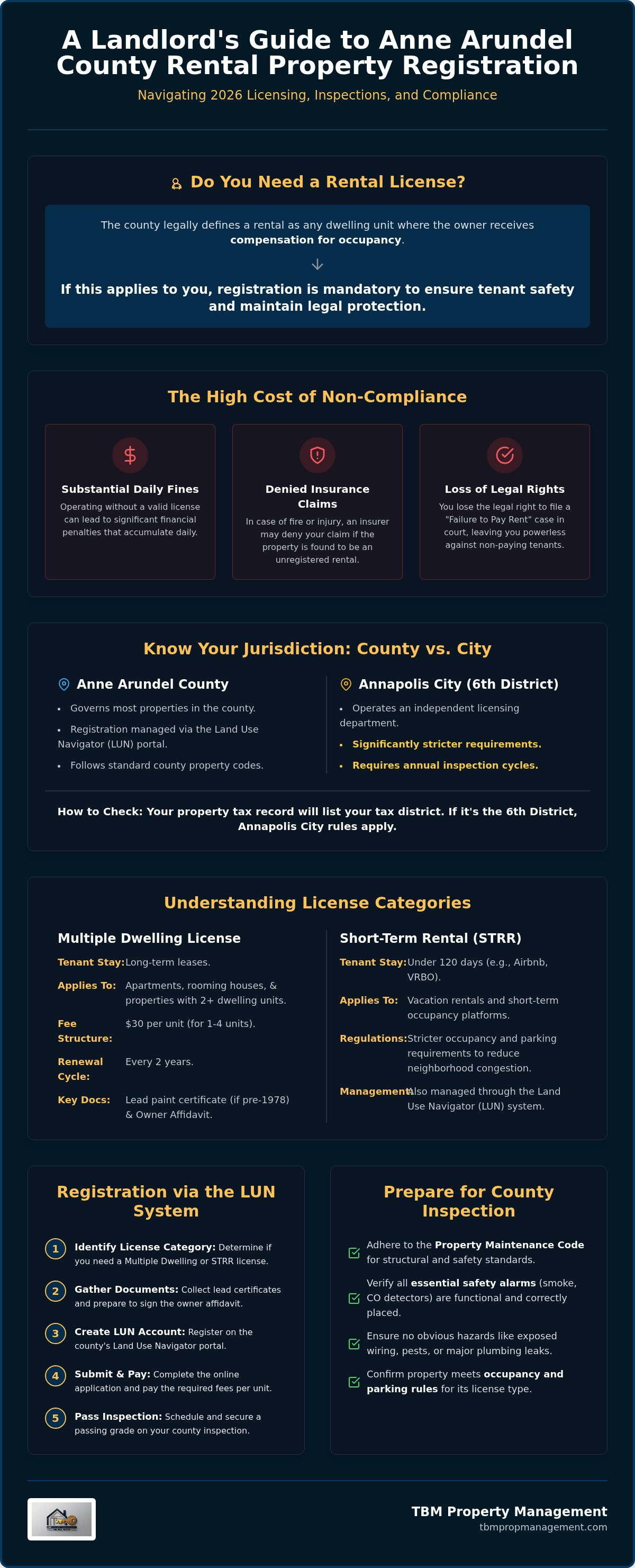
Are you wondering if your investment property actually requires a formal license? In Anne Arundel County, the legal definition of a rental property includes any dwelling unit where the owner receives compensation for occupancy. We know that the administrative side of landlording often feels like a second job you didn't ask for, but understanding these rules is the first step toward peace of mind. The county mandates this registration primarily to ensure tenant safety through standardized inspections, though it also serves to maintain community quality and track local housing data.
Operating without a valid license carries heavy risks that can jeopardize your financial future. You could face substantial daily fines or, more significantly, find that your insurance company denies a claim if a fire or injury occurs at an unregistered site. Legal protection is the ultimate goal here. The Multiple Dwelling License serves as the primary legal requirement for most landlords managing traditional residential leases within the county.
Mandatory Registration vs. Optional Programs
Is your registration mandatory or optional? While almost all rentals require a license, the specific type depends on the length of stay. Short-term residential rentals (STRR) cover stays under 120 days, while standard long-term leases fall under the Multiple Dwelling category. Some exemptions exist, such as properties occupied only by immediate family members or certain owner-occupied dwellings with only two total units. Crucially, if you don't have a current anne arundel county rental property registration, you lose the legal right to file a "Failure to Pay Rent" case in court. This leaves you powerless if a tenant stops paying, making compliance your strongest tool for asset protection.
Anne Arundel County vs. Annapolis City Jurisdictions
Do you know which jurisdiction governs your property? It's a common point of confusion because the City of Annapolis operates its own independent licensing department with significantly stricter requirements, including annual inspection cycles. Properties within the city limits must adhere to Annapolis-specific codes that often exceed general county standards. You can confirm your jurisdiction by checking your property tax record; if your tax district is listed as the 6th District, you fall under Annapolis City rules rather than the general anne arundel county rental property registration process. Identifying this early saves you from applying to the wrong agency and wasting precious time.
Understanding License Categories: Multiple Dwelling vs. Short-Term
Do you feel overwhelmed by the different license types available in the county? It is a common frustration for landlords who want to ensure their investments stay secure without getting tangled in red tape. The county categorizes licenses based on how long a tenant stays and how many units your property contains. For most traditional landlords, the Multiple Dwelling License is the standard requirement. However, if you are renting out individual rooms or managing a vacation rental, your anne arundel county rental property registration needs will look quite different. The 2026 updates have also introduced stricter occupancy limits and parking requirements to reduce neighborhood congestion, making it vital to select the correct category from the start.
All applications and renewals are managed through the Land Use Navigator (LUN) system, which serves as the central hub for property compliance. If the thought of tracking these varying requirements feels like a burden, our team at TBM provides full-service property management to handle the technical details for you.
Multiple Dwelling License Requirements
Does your property have two or more dwelling units? If so, you must obtain a Multiple Dwelling License. This applies to apartments and rooming houses, but it excludes owner-occupied dwellings with only two units. For 1 to 4 units, the current fee is $30 per unit. These licenses operate on a two-year renewal cycle, meaning you must stay vigilant about expiration dates to avoid penalties. To complete your registration, you will need to provide a valid lead paint certificate for properties built before 1978 and sign an owner affidavit confirming the property meets all safety codes. Failing to keep these documents updated can pause your ability to legally collect rent.
Short-Term Rental (STRR) Nuances
If you use platforms like Airbnb or VRBO, you fall under the Short-Term Residential Rental (STRR) rules. The county defines a short-term rental as any stay of 120 consecutive days or fewer. Under current 2026 regulations, a single host cannot register more than two units for short-term use. You are also responsible for collecting a 7% county lodging tax in addition to Maryland's 6% sales tax. For those living near the Naval Academy, remember that special event permits are often required for one-off rentals during high-traffic periods like Commissioning Week or Navy football Saturdays. Staying compliant with the $100 biennial registration fee ensures your listing remains active and legally protected from surprise enforcement actions.
Step-by-Step: Using the Land Use Navigator (LUN) System
Moving from understanding the law to clicking through a government portal can feel like a daunting leap. We recognize that your time is valuable and the last thing you need is a technical glitch delaying your compliance. The LUN system is now the mandatory portal for all AA County licensing. To begin, you will need to create a secure account using a valid email address and your primary contact information. Once logged in, look specifically for the 'Non-Trade Licenses' section, which is where the Anne Arundel County Multiple Dwelling License applications are housed. This centralized hub is designed to streamline your anne arundel county rental property registration, though it requires precision to navigate successfully.
Understanding the fee structure before you begin helps prevent surprises at the checkout screen. For the 2026 cycle, owners of 1 to 4 units will pay $30 per unit. If you manage a larger portfolio of 5 to 50 units, the cost is $120 plus $25 per unit. For those overseeing 51 units or more, the fee is $1,370 plus $18 per unit. Short-term rentals carry a flat $100 fee for a two-year term. Having these funds ready for electronic payment will ensure your application moves into the processing phase without delay.
Documents You Must Upload
Accuracy is everything when it comes to your digital paperwork. If your property was built before 1978, you must upload a current Maryland Lead Poisoning Prevention compliance certificate. The system also requires evidence of your trash collection and utility arrangements to prove the dwelling is habitable and managed responsibly. Finally, ensure you have clear proof of ownership and, if you live outside the county, the contact information for a local resident agent. This agent acts as your official point of contact for any legal notices or violation reports.
Common LUN Errors and How to Avoid Them
Why do so many applications get kicked back? The most frequent culprit is a simple address mismatch. Your property address must match the State Department of Assessments and Taxation (SDAT) record exactly, down to the suffix of the street name. We also suggest saving your payment confirmation receipt immediately, as processing glitches can sometimes occur during high-traffic periods. Once you submit, you can track your status within the portal. Your goal is to see the status move from 'Submitted' to 'Issued', which confirms your anne arundel county rental property registration is officially complete and your asset is protected.
Preparing for the County Inspection: A Compliance Checklist
Does the thought of a county inspector walking through your property make you feel defensive? It is natural to feel protective of your investment, especially when your anne arundel county rental property registration depends on their approval. The AA County Property Maintenance Code exists to ensure that every resident has a safe place to live, and meeting these standards protects you from liability just as much as it protects the tenant. For the 2026 cycle, inspectors are prioritizing smoke and carbon monoxide detector placement. You must install dual-sensor smoke alarms on every level of the home and inside every sleeping area. If your property uses gas or has an attached garage, carbon monoxide detectors must be functional and located within 15 feet of all bedroom doors.
Beyond safety devices, the exterior of your home serves as a primary indicator of your management standards. Inspectors look for peeling paint, sagging gutters, and signs of "blight" that could impact the neighborhood's character. Staying ahead of these repairs is a fundamental part of honoring Maryland Landlord Tenant Rights, as residents have a legal expectation of a habitable, well-maintained environment. If you want to ensure your property meets every code requirement before the county arrives, our team can manage your Property Maintenance Coordination to give you total confidence.
The 'Big Three' Safety Failures
Most inspection delays stem from three common areas. First is egress. Every window and door intended for exit must be fully functional; windows should stay open without the help of a prop, and doors must unlock from the inside without a key. Second is electrical safety. You must have GFCI outlets in all "wet" areas like kitchens and bathrooms, and any exposed wiring or overloaded breaker panels will trigger an immediate failure. Finally, your plumbing and sanitation systems must be flawless. You are required to provide consistent hot water at a minimum of 120 degrees Fahrenheit, and any active leaks in the supply or waste lines must be repaired before the inspector steps foot on the porch.
What Happens if You Fail?
If your property does not pass the initial review, do not panic. You will receive a 'Notice of Violation' that outlines the specific issues found. Typically, the county provides a 30-day window to complete these repairs. However, failing to get it right the first time results in re-inspection fees, which can quickly erode your rental margins. You should also be aware that the Health Officer or their representative has a legal 'Right of Entry' to inspect the premises to verify that life-safety violations are corrected. Navigating this process is much easier when your anne arundel county rental property registration is backed by proactive maintenance and professional oversight.
Stress-Free Compliance with TBM Property Management
Do you feel like the administrative weight of your rental portfolio is starting to overshadow the rewards of ownership? We know that the anne arundel county rental property registration process isn't just about paying a fee; it's about staying on top of shifting regulations, technical portal updates, and strict inspection timelines. At TBM Property Management, we believe that your investment should provide financial freedom, not a second full-time job. By stepping in as your dedicated partner, we remove the emotional burden of county paperwork and technical troubleshooting. Our team leverages over 12 years of local Maryland real estate expertise to ensure your properties remain compliant, protected, and profitable without you ever having to log into the Land Use Navigator yourself.
If you're still weighing your options, choosing professional property management is often the most effective way to insulate yourself from the stress of local bureaucracy. We handle the "paperwork headache" so you can focus on building your legacy.
Why Local Management Wins in Anne Arundel County
Why does a hyper-local focus matter for your bottom line? Our proximity to the Anne Arundel County Permit Center in Annapolis allows us to address licensing issues in person if the digital system creates roadblocks. When an inspection reveals a necessary repair, you shouldn't have to scramble for a reliable technician. We maintain an extensive network of vetted contractors who understand the specific nuances of the AA County Property Maintenance Code, ensuring that code-violation repairs are completed swiftly and correctly the first time. This proactive stance, combined with our continuous compliance monitoring, means you can rest easy knowing your license is always current.
From Registration to Revenue: The TBM Advantage
Our team seamlessly integrates the entire anne arundel county rental property registration cycle into our Full-Service Management. This means we handle everything from the initial application and fee payment to the coordination of mandatory lead paint testing and fire safety inspections. Our meticulous record-keeping provides a clear paper trail for legal adherence, protecting your ROI from unnecessary fines or eviction blocks. You can trade your paperwork headache for professional results today. Contact TBM today for a stress-free registration analysis and let us handle the heavy lifting for you.
Securing Your Investment for the Future
Managing a rental property in Anne Arundel County shouldn't feel like a constant battle against red tape. By now, you understand that staying current with your anne arundel county rental property registration is your most effective shield against liability and legal hurdles. Whether you are navigating the technical nuances of the Land Use Navigator or preparing for a rigorous safety inspection, your focus should always remain on the long-term value of your asset. Compliance isn't just a hurdle; it's the foundation of a professional and profitable rental business.
If the technical details and paperwork still feel like an unnecessary burden, our Laurel-based team is here to help. With over 12 years of Maryland rental expertise and an A+ rating for tenant screening and compliance, we provide the stabilizing force you need to grow your portfolio with confidence. You don't have to manage these complexities alone. Let TBM Handle Your Anne Arundel County Registration—Get Started Today. We are ready to turn your administrative stress into a streamlined, hands-off experience.
Frequently Asked Questions
How much does a rental license cost in Anne Arundel County for 2026?
For 2026, the cost for an anne arundel county rental property registration starts at $30 per unit for properties with 1 to 4 units. If you manage between 5 and 50 units, the fee increases to $120 plus $25 per unit. For larger portfolios over 50 units, the base fee is $1,370 plus $18 per unit. Short-term rentals carry a flat $100 registration fee for a two-year term.
Do I need a separate license for a basement apartment in AA County?
Yes, if the basement apartment is a self-contained dwelling unit with its own entrance and kitchen facilities, it typically requires a license. Properties with two or more units fall under the Multiple Dwelling License category. Ensuring your anne arundel county rental property registration includes every habitable unit on the property is vital for avoiding code violations and protecting your legal right to collect rent in Maryland.
What is the penalty for renting without a license in Anne Arundel County?
Renting without a license can lead to significant financial and legal consequences, including substantial daily fines. Perhaps the most critical penalty is that you cannot file a "Failure to Pay Rent" case in court without a valid license. This leaves you with no legal recourse if a tenant stops paying. Additionally, many insurance providers will deny claims if they discover the property was operating without the required county registration.
How long does the Land Use Navigator (LUN) application process take?
The timeline for the Land Use Navigator (LUN) process generally ranges from two to four weeks, though this depends heavily on your inspection schedule. Once you submit your digital application and pay the required fees, you must coordinate with the Department of Health and the Fire Marshal for site visits. Staying organized with your documentation helps prevent the back and forth delays that often frustrate self-managed landlords during the registration cycle.
Do single-family homes in Anne Arundel County require a rental inspection?
Single-family homes used for long-term rentals do not currently require a Multiple Dwelling License, as that mandate starts at two or more units. However, they must still comply with the county Property Maintenance Code. If you use a single-family home as a short-term rental for stays under 120 days, you must register it and pass the associated safety inspections to operate legally and avoid potential fines from the county.
Can I manage my own rental property in AA County if I live out of state?
You can manage your own property from out of state, but you are legally required to appoint a local "Resident Agent" who lives within the county. This agent serves as the official point of contact for receiving legal notices or violation reports from the county government. Many out-of-state owners find that hiring a local manager like TBM simplifies this requirement while ensuring the property is monitored for compliance around the clock.
Is lead paint testing required for rental registration in Anne Arundel County?
Yes, lead paint testing is a mandatory part of the registration process for any residential rental property built before 1978. You must provide a valid Maryland Lead Poisoning Prevention compliance certificate when submitting your application through the LUN portal. This state-mandated requirement is strictly enforced during the registration process to ensure the long-term safety of all residents and to protect landlords from significant legal liability related to lead exposure.
What is the difference between a Multiple Dwelling License and a Short-Term Rental License?
The primary difference lies in the length of the tenancy and the number of units. A Multiple Dwelling License is required for properties with two or more units intended for long-term residency. In contrast, a Short-Term Rental License is for transient stays of 120 consecutive days or fewer. Each category has its own fee structure and specific safety requirements that you must follow to remain fully compliant with current county regulations.