Average Cost of Rental Property Maintenance in Maryland: 2026 Landlord’s Guide
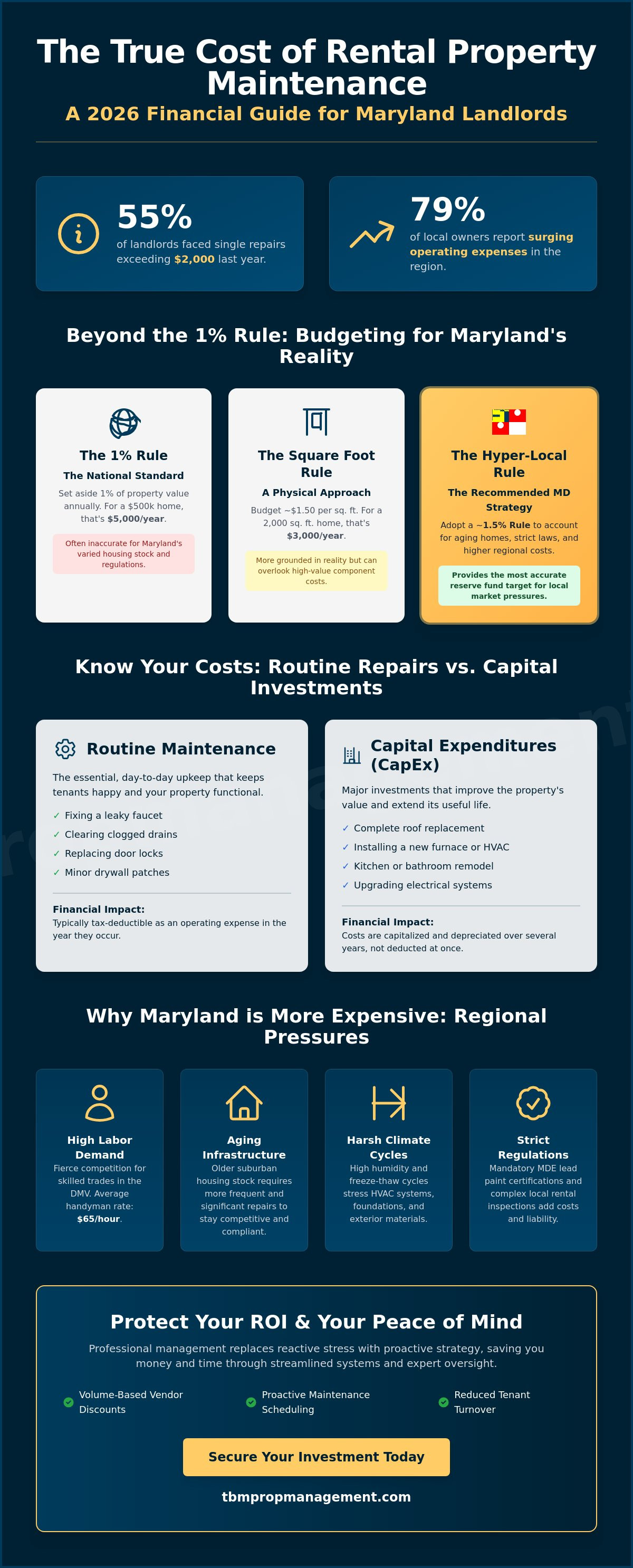
Did you know that 54.97% of Maryland landlords reported their most expensive repair in the last year exceeded $2,000? Understanding the average cost of rental property maintenance in Maryland is no longer just a suggestion; it's a survival skill for your portfolio in 2026. When you're managing properties in competitive markets like Anne Arundel County or Baltimore City, a single emergency call can quickly erase your monthly profit. It's exhausting to feel like you're constantly reacting to surprise bills while navigating the high labor costs of the DMV area. You deserve a strategy that replaces this friction with a sense of security and predictable growth.
We understand the weight of asset oversight in our region and are here to provide the relief you've been looking for. This guide offers a comprehensive breakdown of Maryland-specific maintenance costs, budgeting rules, and strategies to protect your investment's ROI. You'll learn how to apply a hyper-local 1.5% rule that accounts for aging inventory and strict state compliance laws like the Renters Rights and Stabilization Act. We'll walk you through current $65 per hour handyman rates, essential reserve fund targets, and proactive maintenance methodologies designed to keep your tenants satisfied and your stress levels low.
Key Takeaways
- Understand the critical distinction between routine repairs and long-term capital expenditures to ensure your 2026 cash flow remains stable and predictable.
- Master more accurate budgeting techniques beyond the 1% rule to determine the true average cost of rental property maintenance in Maryland for your specific property type.
- Navigate the complexities of Maryland’s regulatory environment by preparing for the costs of MDE lead paint certifications and mandatory local rental inspections.
- Protect your ROI from regional climate stressors like high humidity and freeze-thaw cycles through proactive sump pump and HVAC maintenance strategies.
- Learn how professional property maintenance coordination utilizes volume-based vendor discounts and streamlined technology to reduce your overall repair expenses and tenant turnover.
Understanding Rental Property Maintenance Costs in Maryland (2026 Outlook)
Are you finding that your rental income isn't stretching as far as it used to? With the median rent in Maryland reaching approximately $2,200 as of April 2026, many owners expect healthy margins, yet 79% of local landlords report that operating expenses have surged recently. Understanding the average cost of rental property maintenance in Maryland requires more than just a glance at your bank statement; it requires a strategic look at the unique economic pressures of the Baltimore-Washington corridor. High demand for skilled labor and aging suburban infrastructure mean that your budget needs to be more resilient than the national average. Because our region serves as a hub for federal and private sectors, the competition for reliable contractors is fierce, often driving prices above what you might see in more rural states.
Self-management often carries a heavy emotional price that isn't always reflected in a spreadsheet. When a tenant calls about a leaking pipe at midnight, the cost isn't just the plumber's invoice; it's the stress of coordination and the disruption to your peace of mind. We believe that 'headache-free' oversight should be viewed as a vital budget line item. Protecting your mental well-being is just as important as protecting your property's ROI, especially when navigating the strict compliance and inspection cycles required by Maryland jurisdictions. A proactive approach doesn't just save money; it creates a stabilizing force for your entire investment portfolio.
Routine Maintenance vs. Capital Improvements
Distinguishing between day-to-day repairs and long-term investments is essential for accurate financial reporting and maintaining your property's value. Routine maintenance includes minor tasks like clearing drain clogs, replacing door locks, or fixing a leaky faucet. These are typically deductible in the year they occur and are fundamental to your obligations under a Landlord-Tenant Law Overview. In contrast, capital improvements involve major projects that extend the life of the asset, such as roof replacements or installing a new furnace. CapEx is a multi-year investment in property longevity. Categorizing these correctly ensures you're maximizing your tax benefits while keeping your Maryland rental license in good standing during annual inspections.
2026 Inflation and Labor Trends in the DMV
Why does the average cost of rental property maintenance in Maryland feel so high in Prince George's and Montgomery Counties? These areas face a persistent shortage of specialized tradespeople, which drives up local service rates significantly. While the average handyman rate sits around $65 per hour, specialized HVAC or electrical contractors often charge much more for their expertise. Landlords should project a 3-5% annual increase in service call minimums through the end of 2026 as material volatility continues to impact the bottom line. If you aren't adjusting your reserves to meet these regional shifts, you risk falling behind on essential property oversight and facing much higher emergency repair bills later.
The 1% Rule vs. Maryland Reality: Budgeting for Your Investment
How do you know if you're saving enough for repairs or just guessing? Many landlords rely on the "1% Rule," which suggests setting aside 1% of the property's value annually. In a high-value market like Laurel, a $500,000 home would theoretically require a $5,000 yearly maintenance budget. While that sounds safe, it doesn't always reflect the average cost of rental property maintenance in Maryland for newer homes. If your asset is a modern build, you might find yourself over-funded for routine fixes while neglecting long-term capital needs. Conversely, the Square Footage Rule suggests allocating $1.50 per square foot. For a 2,000-square-foot townhome in Bowie, this creates a $3,000 annual fund, which often feels more grounded in physical reality than fluctuating property values.
We also see investors using the 50% Rule, which claims half of your gross income should cover all operating expenses, including taxes and insurance. For a property in Prince George's County renting at the median $2,200, that's $1,100 a month. While helpful for larger apartment complexes, this is often too aggressive for single-family rentals where the owner isn't responsible for every utility or lawn service. To find true stability, we recommend the "TBM Adjusted Budget." This hybrid approach balances property age, location, and tenant type to create a realistic roadmap. It transitions you from a state of frustration to a state of ease by ensuring your reserve matches the actual wear and tear of your specific neighborhood.
Which Budgeting Method Works for You?
The right strategy depends heavily on your property's history. A 1970s split-foyer in Silver Spring requires a much different financial cushion than a new build in Anne Arundel County. Older homes often face more frequent plumbing and electrical issues that fall under Maryland Landlord Repair Duties, which mandate the correction of serious defects. Using a hybrid approach allows you to fund your reserve based on income while adding a "buffer" for the specific aging components of your home. This prevents underfunding and protects your ROI when larger systems eventually fail.
Setting Up Your Maryland Maintenance Reserve
We suggest a minimum reserve of $2,000 to $3,000 for Maryland townhomes and single-family units. This covers the "Maintenance Shock" that happens when back-to-back repair requests arrive in a single month. If you're unsure how to manage these funds or track expenses, understanding what is a property manager can provide clarity on how professional oversight handles reserve accounting. Our team acts as a dedicated partner to ensure your funds are used efficiently. If you want to simplify your oversight, our property maintenance coordination services can help you maintain a predictable budget year-round.
Regional Factors Affecting Maryland Maintenance Expenses
Why does a standard repair in Maryland often carry a higher price tag than the same fix in a neighboring state? While we've discussed general budgeting rules, the average cost of rental property maintenance in Maryland is heavily influenced by what we call the "Maryland Regulatory Tax." This isn't a literal tax, but rather the cumulative cost of our state's rigorous safety standards and specialized licensing requirements. If you're managing a property in Silver Spring, your compliance checklist looks very different than one in Annapolis. These regional nuances require a dedicated partner who understands how to navigate local bureaucracies without overspending on unnecessary services.
Maryland’s geography is beautiful, but it’s hard on housing. Our position in the Chesapeake region creates a unique set of environmental stressors that can catch an unprepared landlord off guard. From the intense humidity of July to the punishing freeze-thaw cycles of January, your property's exterior and mechanical systems are under constant assault. If you don't account for these regional factors, you'll likely find your maintenance reserve depleted by mid-year. Understanding these local pressures is the first step toward achieving the relief and security you deserve as an investor.
Maryland Lead Paint and Compliance Costs
For properties built before 1978, Maryland Department of the Environment (MDE) regulations are a major budget driver. Achieving the "Full Risk Reduction" standard isn't optional; it's a legal necessity every time a tenant rotates. You must budget for specialized lead dust testing and turnover inspections conducted by accredited professionals. These requirements are part of your broader legal obligations, which you can explore further in our Maryland landlord tenant rights guide. Failing to keep up with these certifications doesn't just risk a fine; it can jeopardize your ability to collect rent or defend yourself in court.
Environmental Challenges in the Chesapeake Region
Is your basement protected? In Maryland, sump pump maintenance is a non-negotiable expense. Because so much of our local soil is prone to saturation, a failing pump can lead to thousands of dollars in water damage within hours. We recommend a proactive approach to prevent these disasters:
- Sump Pump Audits: A planned flush and test typically costs between $80 and $150, whereas an emergency replacement after a flood can exceed $5,000.
- HVAC Descaling: Maryland's humid summers force air conditioners to work overtime. Neglecting annual coil cleaning can reduce your system's lifespan by years.
- Seasonal Pest Barriers: Termites and rodents thrive in our climate. Consistent seasonal prevention is far cheaper than remediating a full-scale infestation.
By addressing these regional factors head-on, you simplify your property oversight and protect your long-term ROI. Whether it's Montgomery County's strict licensing or the specific plumbing needs of a Baltimore rowhome, staying ahead of these costs ensures your investment remains a source of stability rather than stress.
Common Repair Costs and Preventative Maintenance Strategies
Have you ever felt that sinking feeling when a tenant calls about a midnight flood? It's a common frustration for many; in fact, 54.97% of landlords in our region saw their most expensive repair exceed $2,000 last year. Staying ahead of the average cost of rental property maintenance in Maryland requires more than just a reactive mindset. It demands a structured approach that prioritizes prevention over panic. While a standard handyman in the DMV area averages about $65 per hour, specialized emergency calls for plumbing or electrical failures can escalate much faster. By implementing a seasonal checklist, you can catch 'silent' issues like slow pinhole leaks or foundational cracks before they transform into catastrophic expenses.
We believe that your investment should provide security, not a constant stream of repair bills. A reliable seasonal strategy helps stabilize your budget. In the spring, focus on gutter cleaning and downspout alignment to prevent the Chesapeake region's heavy rains from reaching your basement. During the fall, an HVAC tuning ensures your furnace survives the first Maryland frost without a costly breakdown. These small, disciplined steps keep your property in peak condition and ensure your tenants feel well-protected in their homes.
High-Ticket Maryland Maintenance Items
In our local market, certain systems demand more attention due to environmental factors. HVAC replacement remains the top concern for capital expenditures because Maryland's humid summers and freezing winters force these units to work harder than in other climates. Additionally, properties in Anne Arundel and Prince George's Counties often face storm-related roofing and siding damage that requires immediate oversight. We also see shorter water heater lifespans in areas with 'hard' water, where sediment buildup can lead to premature failure. A planned water heater flush typically costs between $80 and $150, which is a small price to pay when compared to an emergency replacement that can range from $2,000 to $5,000 including water damage remediation.
The Preventative Maintenance Framework
Consistency is the secret to a high-performing rental. We recommend sending monthly reminders to tenants about simple tasks like changing air filters and clearing dryer lint traps. These small actions extend the life of your appliances and reduce the frequency of service calls. Furthermore, every landlord should conduct an annual 'Big Four' inspection covering the roof, foundation, HVAC, and plumbing systems. Every $1 spent on preventative care typically saves $4 in emergency repairs. If you are tired of managing these details yourself, our property maintenance coordination services can take the burden off your shoulders and ensure your asset remains in elite condition year-round.
How Professional Management Reduces Maintenance Headaches and Costs
Managing repairs on your own often feels like a second full-time job. When you're constantly reacting to surprise invoices and tenant demands, it's easy to lose sight of your long-term investment goals. Professional oversight changes this dynamic by turning a chaotic process into a streamlined system. By partnering with a team that understands the average cost of rental property maintenance in Maryland, you gain access to a stabilizing force that protects both your ROI and your sanity. We offer a dedicated approach that replaces the emotional burden of asset oversight with a sense of security and trust. You no longer have to fear the phone ringing in the middle of the night; instead, you can rest easy knowing a professional team is already handling the situation.
One of the most significant advantages we provide is our 'Vendor Discount' network. Because we manage a high volume of local properties, we've built deep relationships with the region's best contractors. These professionals provide us with preferred pricing that individual landlords simply can't access on their own. Instead of paying retail rates for every service call, you benefit from our collective bargaining power. This ensures your maintenance dollars go further and your margins remain healthy even as labor costs in the DMV area continue to rise. Our goal is to move you from a state of frustration to a state of ease through value-driven services.
The Power of Professional Vendor Networks
It's tempting to hire a local 'handyman' for a quick fix, but DIY or unvetted labor often costs more in the long run. An unlicensed repair might save a few dollars today, but it can lead to failed inspections or even legal liability under Maryland's strict rental compliance laws. We meticulously vet every contractor in our network for insurance, quality, and reliability. This ensures every repair meets local building codes in jurisdictions like Prince George's and Montgomery Counties without you having to manage the paperwork or the personalities. We exceed standard expectations by acting as a protective barrier between you and the complexities of property upkeep.
Tech-Driven Maintenance: Efficiency and Transparency
We believe transparency is the foundation of a good partnership. That's why we use Property Meld to coordinate all maintenance requests. This specialized software allows us to track repair history, streamline tenant communication, and resolve issues faster than traditional methods. By reducing the time a repair stays open, we minimize the risk of secondary damage and keep your tenants satisfied. Fast resolutions are cheaper resolutions; it's that simple.
Our system includes automated follow-ups to ensure every job is completed to our high standards. You'll never have to wonder if a leak was actually fixed or if a tenant is still waiting for a response. This efficiency directly reduces your total repair spend by catching small issues before they escalate into major capital expenditures. If you're ready to stop worrying about 2 AM flood calls and start enjoying a more predictable budget, it's time to discover how TBM simplifies maintenance in Laurel and beyond. We act as your dedicated partner, ensuring your property remains a high-performing asset for years to come.
Take Control of Your Maryland Investment Strategy
You've seen how the average cost of rental property maintenance in Maryland is shaped by regional labor trends, strict compliance standards, and our unique Mid-Atlantic climate. By shifting from a reactive mindset to a proactive framework, you can protect your ROI. You'll eliminate the stress of surprise repair bills. Whether you're balancing the 1.5% rule or scheduling seasonal HVAC tunes, success comes down to consistent, detail-oriented oversight. We understand the emotional burden of managing these moving parts on your own, and we're here to provide the relief you deserve.
With over 12 years of Maryland real estate expertise, we act as your dedicated partner to simplify these complexities. Our advanced Property Meld integration and dedicated local vendor network ensure that your maintenance tasks are handled with professional-grade efficiency. Are you ready to replace the burden of self-management with a stabilizing, high-touch solution? We invite you to take the first step toward a more predictable and profitable future.
Get Your Free Rental Analysis and Maintenance Consultation
You've worked hard to build your portfolio. Let's work together to ensure it remains a source of security and pride for many years to come.
Frequently Asked Questions
Is rental property maintenance tax-deductible in Maryland?
Maintenance expenses are generally 100% tax-deductible in the year they occur. This includes routine fixes like painting, plumbing repairs, and pest control. Capital improvements, such as a new roof or HVAC system, must be depreciated over several years. You should always consult with a Maryland tax professional to ensure you're maximizing your specific deductions for your portfolio.
How much should I set aside for a maintenance reserve in PG County?
For a single-family home in Prince George's County, we recommend a minimum reserve of $3,000. This amount provides a safety net for the region's higher labor costs and aging suburban infrastructure. If you own an older property in areas like Hyattsville or Oxon Hill, increasing this to $5,000 ensures you can handle back-to-back repairs without dipping into your personal savings.
Does the 1% rule apply to expensive Maryland homes?
The 1% rule often fails when applied to high-value Maryland properties. If you own a $750,000 home in Bethesda, you likely won't spend $7,500 every year on routine maintenance. Instead, focus on the square footage rule or the age of the home's major systems. This approach provides a more realistic view of the average cost of rental property maintenance in Maryland for luxury or high-market-value assets.
What are the most common maintenance issues in Maryland rentals?
Maryland rentals frequently face issues related to high humidity and seasonal temperature shifts. Clogged condensate lines in AC units, failing sump pumps in saturated basements, and leaky faucets are the most common service calls we see. Regular property inspections help identify these silent problems before they cause significant structural damage or mold growth in your rental unit.
Who is responsible for repairs in a Maryland rental: landlord or tenant?
Landlords are responsible for maintaining the property's habitability and repairing normal wear and tear. This includes keeping plumbing, heating, and electrical systems in good working order. Tenants are typically responsible for repairs caused by their negligence or deliberate damage. Clear lease language and thorough move-in inspections are essential to avoid disputes over who pays for specific fixes.
How much does a Maryland lead paint inspection cost in 2026?
Lead paint inspection costs in 2026 vary based on the property size and the number of dust samples required by the MDE. While rates fluctuate, landlords should budget for both the technician's visit and the laboratory fees for sample analysis. Because these certifications are mandatory for properties built before 1978, it's a non-negotiable expense for many Maryland investors during tenant turnovers.
Can a Maryland landlord charge a tenant for maintenance repairs?
You can only charge a tenant for repairs if the damage exceeds normal wear and tear and was caused by their actions. For example, if a tenant's guest breaks a window, the tenant is liable for the cost. However, you cannot charge them for a failing water heater or a roof leak. Documenting the property's condition with photos before move-in is the best way to prove tenant liability.
What qualifies as an 'emergency' repair in Maryland?
An emergency repair in Maryland is any issue that threatens the tenant's safety, health, or the structural integrity of the building. This includes total loss of heat during winter, major water leaks, or electrical hazards. Maryland law requires landlords to address these serious defects promptly. Having a dedicated partner for maintenance coordination ensures these critical situations are handled immediately to protect your asset.