
Average Property Management Fees in Montgomery County: 2026 Landlord’s Guide
The lowest property management fee you find in Montgomery County is often the one that costs you the most in the long run. While a low percentage looks attractive on a spreadsheet, it frequently masks the true cost of compliance failures or high vacancy rates. You likely started your rental journey to build wealth, not to spend your weekends decoding complex DHCA regulations or chasing down late rent. It's frustrating when unpredictable monthly costs eat into your margins, leaving you to wonder if the average property management fees in montgomery county are actually worth the investment.
We understand the pressure of protecting a high-value asset in Maryland's competitive market. This 2026 guide provides the clarity you need to navigate local fee structures with confidence. You'll discover the real cost of professional oversight, from standard management percentages to those easily overlooked administrative fees. We'll also preview how a dedicated partner handles maintenance coordination and tenant screening to ensure your passive income remains truly passive. By the end of this guide, you'll know exactly how to choose a service that safeguards your property's value without the legal headache of self-management.
Key Takeaways
- Understand why the average property management fees in montgomery county typically range from 8% to 12% and what high-touch services this investment covers.
- Learn how to distinguish between recurring monthly oversight and one-time leasing fees to ensure your rental ROI remains predictable.
- Identify the specific Maryland compliance costs, including DHCA licensing and lead-paint inspections, that impact your bottom line.
- Compare the alignment of percentage-based models against the predictability of flat fees to find the best fit for your portfolio.
- Discover why choosing a dedicated local partner with deep regional roots provides better asset protection than a national call center.
Understanding the Property Management Fee Landscape in Montgomery County
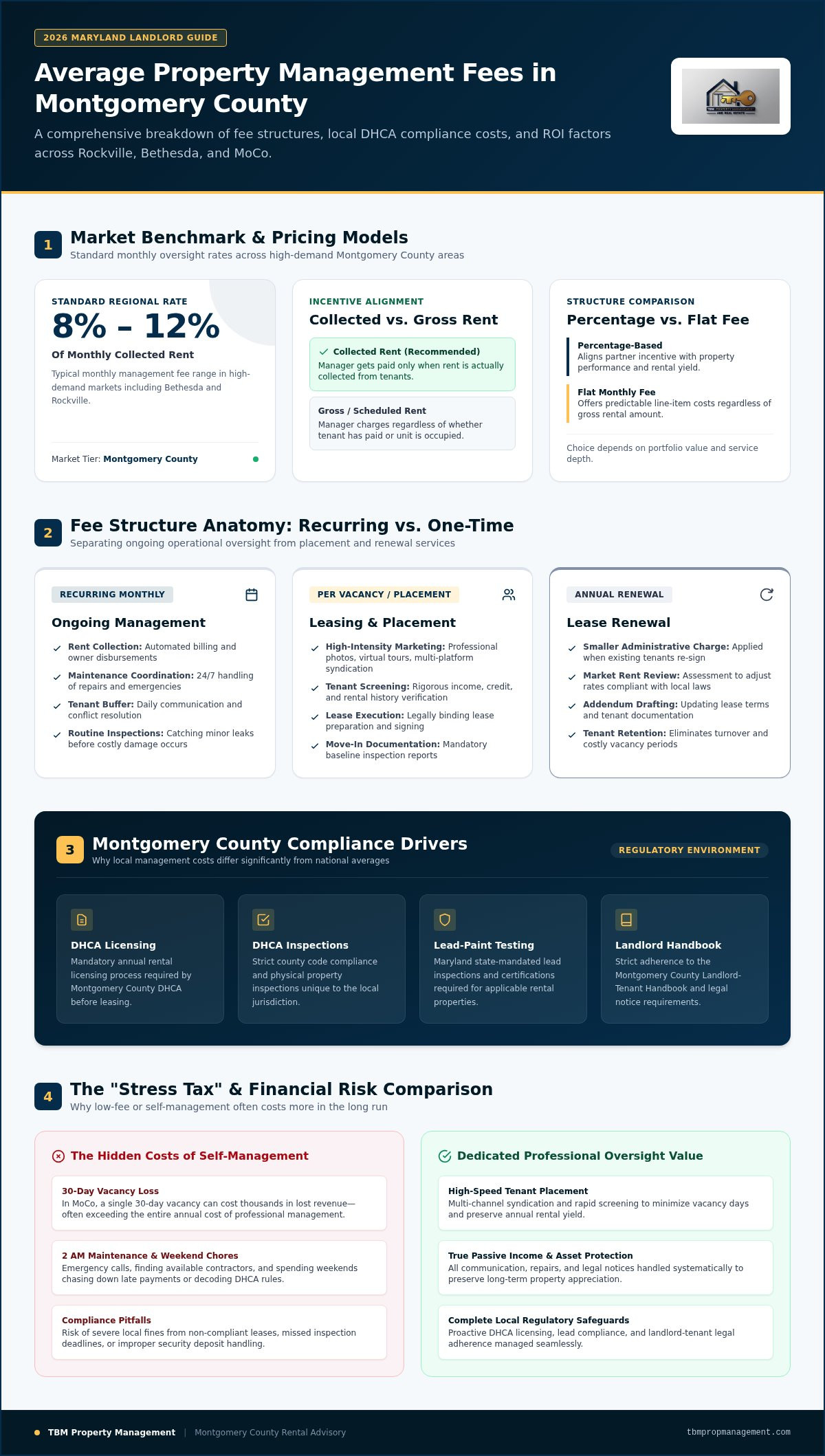
Managing a rental property in Maryland involves much more than simply depositing a monthly check. When you investigate the average property management fees in montgomery county, you are looking at the price of professional oversight that keeps your investment compliant and profitable. These fees generally cover the property management operational scope, which includes rent collection, maintenance coordination, and constant communication with tenants. In high-demand areas like Rockville and Bethesda, you will typically find monthly management fees ranging from 8% to 12% of the monthly rent.
Choosing a partner based solely on the lowest percentage can be a costly mistake. This "price vs. value" dilemma often surfaces when a low-cost provider fails to prioritize tenant retention, leading to high vacancy rates that far outweigh any initial savings. It's also essential to understand the difference between fees based on "gross rent" versus "collected rent." A fee structure based on collected rent ensures your manager is only paid when you are, which aligns their interests directly with your financial success.
Why Montgomery County Fees Differ from National Averages
Montgomery County is a premium market with high property values, which naturally impacts percentage-based pricing. Beyond the property value, the cost of compliance here is significantly higher than national averages due to unique local regulations. Managers must navigate specific Montgomery County DHCA licensing and rigorous inspection requirements that don't exist in other jurisdictions. A standard management fee is typically defined as a recurring percentage of the monthly rent collected from the tenant.
The True Cost of Self-Management in 2026
If you choose to manage the property yourself, you must account for the "stress tax" associated with the role. Handling 2 AM emergency maintenance calls or chasing down late payments takes a toll on your quality of life. The financial stakes are also high. In a competitive market like MoCo, a 30-day vacancy can cost you thousands in lost revenue, a sum that often exceeds the entire annual cost of professional management. Expert oversight doesn't just solve daily problems; it preserves the long-term appreciation of your asset by ensuring it remains in peak condition and occupied by high-quality tenants.
Typical Fee Structures: Management, Leasing, and Beyond
While the average property management fees in montgomery county are often quoted as a single percentage, the reality involves a combination of recurring and one-time costs. Understanding these layers helps you avoid "sticker shock" and ensures you're comparing apples to apples when interviewing potential partners. Most full-service agreements separate the daily oversight from the intensive work of finding a new resident, creating a structure that rewards tenant retention and long-term stability.
The Monthly Management Fee: What Are You Paying For?
This recurring fee is your investment in peace of mind. It covers the logistical heavy lifting of rent collection and automated owner disbursements, ensuring your cash flow remains consistent. Beyond the financial math, it provides a vital buffer between you and the tenant. Conflict resolution and daily communication are central to this service, fulfilling the promise of a stress-free ownership experience. Regular property inspections also fall under this umbrella. These visits allow a manager to catch small leaks or minor lease violations before they escalate into five-figure repairs or legal disputes.
Leasing and Placement Fees: Finding the 'Perfect Match'
When a property sits vacant, it costs you money every single day. The leasing or placement fee covers the high-intensity marketing required to attract premium applicants in a competitive market. This includes professional photography, virtual tours, and listing syndication across dozens of major platforms. In Maryland, the depth of tenant screening is critical for your ROI. A manager must verify income, credit, and rental history while remaining strictly compliant with the Montgomery County Landlord-Tenant Handbook. This administrative fee also covers the execution of the lease and the mandatory move-in inspection documentation.
Don't overlook the renewal fee, which is typically a smaller charge applied when a current tenant signs for another year. This fee compensates the manager for performing a new market analysis and renegotiating lease terms to keep your income optimized. Finally, there is the debate over maintenance markups. Some agencies add a percentage to contractor bills as an "oversight fee," while others prioritize total transparency. We believe you should always know exactly where your money is going, especially when it comes to preserving your asset's condition. If you're tired of hidden costs and unpredictable bills, a partner like TBM Property Management can help simplify your monthly financial reporting.
Flat Fee vs. Percentage-Based Models: Which Wins in MoCo?
The debate between flat fee and percentage-based models is more than just a math problem; it's about aligning your goals with your manager's actions. When you evaluate the average property management fees in montgomery county, you'll notice two distinct philosophies. The percentage model is the industry standard for a reason. It ensures that your manager only succeeds when you do. If the rent goes up, their compensation follows, which naturally incentivizes them to maximize your rental income. In contrast, a flat fee model offers predictability but can sometimes lead to a "robotic" service level where the manager isn't motivated to go the extra mile during a difficult market shift.
Property type also plays a significant role in this decision. If you own a single-family home in a premium neighborhood, the high-touch care required often makes the percentage model more appropriate. These properties demand more frequent inspections and detailed maintenance coordination than a small condo with a restrictive HOA. You don't want a manager who views your high-value asset as just another line item on a spreadsheet. Choosing a manager who adheres to the professional standards set by the National Association of Residential Property Managers ensures you are working with someone committed to ethical, transparent fee structures that protect your investment.
When the Percentage Model Makes More Sense
In high-demand areas like Silver Spring or Takoma Park, the percentage model is particularly effective. It encourages your manager to perform rigorous market analyses to ensure you're getting the best possible rate. When the market shifts, a percentage-based manager works harder to keep the unit filled because a vacancy stops their cash flow just as it stops yours. This shared risk creates a partnership rather than a distant service arrangement. Premium properties require this level of dedicated oversight to maintain their value and attract the caliber of tenants who expect professional, responsive management.
The Hidden Costs of 'Cheap' Management
Low-cost, flat-fee companies often rely on a volume-based business model that can lead to "hidden fee" traps. You might see an attractive base price, only to be hit with setup fees, administrative fees, or even "technology fees" for using their portal. Some agencies also push "Eviction Protection" plans that sound reassuring but contain significant fine print that limits your actual coverage. These small, recurring costs can quickly add up, making the "cheap" option more expensive than a full-service percentage model. Transparency in fee disclosure serves as the primary trust factor for TBM, ensuring you never encounter a surprise on your monthly statement.
Local Factors That Influence Your Management ROI
Your bottom line depends on more than just the percentage you pay each month. While you might compare the average property management fees in montgomery county, the real value lies in how a manager mitigates local risks. In Maryland, compliance isn't optional; it's the foundation of your profitability. A single oversight regarding licensing or lead paint can result in fines that dwarf an entire year's worth of management fees. We act as your protective shield, ensuring every box is checked so you don't have to worry about surprise legal bills or regulatory setbacks.
Navigating Montgomery County's Regulatory Maze
Do you know the specific requirements of Chapter 29 of the County Code? This local regulation dictates everything from security deposit interest to mandatory lease provisions. A seasoned manager handles the yearly rental facility license application on your behalf, ensuring you stay in the good graces of the Department of Housing and Community Affairs (DHCA). They also ensure every interaction follows the county's specific Landlord-Tenant Handbook requirements, which are often more stringent than state-wide rules.
Mastery of Maryland landlord tenant rights is essential for minimizing eviction costs and avoiding costly litigation. This includes staying ahead of lead-based paint compliance. Maryland law requires specific inspections and certificates for properties built before 1978, and failing to provide these can halt your ability to collect rent or evict a non-paying resident. We simplify this complex process, coordinating mandatory Maryland inspections so your asset remains protected and legally sound.
Maximizing ROI Through Strategic Maintenance
Maintenance is often the largest variable expense for any landlord. We focus on a proactive approach that prioritizes preventative care over reactive repairs. By utilizing advanced coordination tools like Property Meld, we reduce repair turnaround times and keep tenants satisfied, which directly impacts your long-term retention rates. When a resident feels heard and their home is well-maintained, they are far more likely to renew their lease.
Our deep roots in the community provide a financial asset you won't find with national firms. We've built local maintenance networks in Laurel and across Montgomery County that typically save our clients between 15% and 20% on repair costs. These aren't just random contractors; they're vetted partners who provide high-quality work at preferred rates because of our long-standing professional history. If you're ready to stop worrying about the complexities of MoCo compliance and start seeing a better return on your investment, contact TBM Property Management today for a comprehensive portfolio analysis.
Choosing a Partner: Beyond the Percentage
Choosing a property manager is about more than just comparing numbers on a spreadsheet. While knowing the average property management fees in montgomery county gives you a vital baseline, the cheapest option often becomes the most expensive when communication breaks down or a vacancy lingers. You need a partner who offers a reassuring, high-touch experience rather than a distant relationship with a national call center. Local "boots on the ground" in areas like Bethesda, Silver Spring, and Rockville ensure that your asset is physically inspected and professionally maintained by people who actually know the neighborhood. A distant manager can't spot a growing roof issue or a lease violation from a desk in another state.
Maryland's legal environment is complex, making your manager's tenant screening success rate a critical metric for your ROI. High-quality residents who pay on time and respect the property are the primary drivers of long-term wealth. When you interview a firm, ask for their specific track record in preventing evictions within Montgomery County. A professional fee should cover the diligent, detail-oriented work required to find these residents. It's about finding a partner who acts as a stabilizing force, alleviating the emotional burden of oversight while protecting your property's value.
Questions to Ask Before Signing a Management Agreement
Before you commit to a partnership, it's essential to dig into the fine print of the management agreement. Is the fee based on rent due or rent collected? This is a fundamental distinction; you should only pay for results, meaning your manager shouldn't earn their fee unless you've received your rent. You should also ask if they charge fees during vacancy periods. Some firms continue to bill even when the unit isn't producing income, which doesn't align their interests with yours. Finally, clarify the process for maintenance approvals. You should have a clear, agreed-upon dollar threshold for expenses that require your direct authorization. This ensures you remain in control of significant financial decisions without being bothered by every minor repair call.
The TBM Difference: Local Expertise Meets Professional Relief
At TBM Property Management, we've spent over 12 years mastering the nuances of the Prince George's and Montgomery County markets. We don't just collect rent; we act as a dedicated partner for landlords who want to grow their portfolios without the stress of daily management. We offer a complimentary analytical report to help new clients understand their property's current market position and potential for growth. This report provides the clarity you need to make informed decisions about your investment. Our seasoned team positions your property to attract long-term, high-value tenants, ensuring your passive income remains truly passive. We believe in providing superlative results that justify our professional fees, giving you the freedom to enjoy your life while we handle the legal and operational heavy lifting.
Secure Your Rental ROI in Montgomery County
Mastering your rental investment means looking past the surface-level numbers. We've explored how typical fee structures work and why local compliance is the real driver of your long-term success. While the average property management fees in montgomery county provide a helpful benchmark, your final choice should reflect the level of protection your asset requires. Balancing professional oversight with transparent maintenance coordination is the most reliable way to ensure your passive income remains secure.
You don't have to navigate the complexities of Maryland rental laws alone. With over 12 years of real estate expertise serving Montgomery, PG, and Howard counties, we specialize in turning landlord anxiety into professional relief. Our team handles everything from full-service maintenance coordination to rigorous tenant screening, allowing you to reclaim your time. Are you ready to see how professional management can transform your portfolio?
Get Your Stress-Free Rental Analysis from TBM Property Management and start your journey toward a more profitable, worry-free future today.
Frequently Asked Questions
What is the average property management fee in Montgomery County, MD?
The average property management fees in montgomery county generally range from 8% to 12% of the monthly rent collected. This investment covers the daily logistical burden of tenant relations, rent collection, and maintenance coordination. While you might find lower rates, these often exclude the high-touch service required to navigate Maryland's complex regulatory environment. Choosing a partner with local expertise ensures your asset remains compliant while maximizing your long-term rental income.
Do property managers in Maryland charge fees when the property is vacant?
Most reputable property managers in Maryland don't charge their recurring management fee while a property is vacant. This practice ensures that the manager's interests are perfectly aligned with yours, as they only earn their fee when they successfully collect rent. You should always verify this in your management agreement to avoid paying for oversight on an empty unit. This structure incentivizes the manager to fill vacancies quickly with high-quality tenants.
Are leasing fees separate from monthly management fees?
Yes, leasing and placement fees are separate from the recurring monthly management fees. The leasing fee covers the intensive work of marketing your property, performing professional photography, and conducting rigorous tenant screening. In contrast, the monthly management fee is for the ongoing oversight of the tenancy and property maintenance. Separating these costs ensures you only pay for the specific high-intensity work required when finding a new resident for your rental.
What are the specific Montgomery County licensing fees for landlords in 2026?
Licensing fees are determined by the Montgomery County Department of Housing and Community Affairs (DHCA) and are required for all rental properties. These annual fees vary based on the type of dwelling, such as single-family homes or condominiums. You should consult the official DHCA portal for the exact 2026 rates to ensure your budget is accurate. A professional manager can handle the application process for you to maintain legal compliance without the administrative headache.
Is a flat fee property manager better for high-rent Bethesda properties?
High-rent properties in Bethesda often require a level of dedicated oversight that flat-fee models may not provide. While a flat fee offers predictability, a percentage-based model incentivizes the manager to maximize your rental rates and perform frequent, detailed inspections. Premium assets demand high-touch care to preserve their value and attract the caliber of tenants who expect professional, responsive service. You should weigh the cost savings against the potential risk to your property's long-term appreciation.
What happens if a tenant placed by a manager needs to be evicted?
If an eviction becomes necessary, a professional manager coordinates the process by filing the required legal notices and working with local authorities. While the landlord typically covers court costs and legal fees, the manager's role is to ensure every step follows the strict Montgomery County Landlord-Tenant Handbook. At TBM Property Management, we prioritize comprehensive tenant screening to minimize this risk, protecting your investment from the high cost and stress of legal disputes.
Can I deduct property management fees from my Maryland state taxes?
Property management fees are typically considered a necessary business expense and are generally deductible on your federal and Maryland state tax returns. This deduction can significantly offset the cost of professional oversight, making it a more affordable investment in your property's future. Because tax laws can change, it's always best to consult with a qualified CPA or tax professional to ensure you are maximizing all available deductions for your specific rental portfolio.
How much does it cost to have a property manager handle DHCA inspections?
The cost for a manager to handle DHCA inspections is often included in a full-service management agreement or billed as a specific administrative fee. This fee covers the time spent coordinating with county inspectors, preparing the property for the visit, and being physically present during the inspection. Having a professional manage this process ensures that any minor compliance issues are addressed immediately, reducing the risk of failed inspections and subsequent fines from the county.