
Avoiding Fair Housing Complaints in Maryland: A 2026 Landlord Guide
Did you know that over 83% of the 32,321 fair housing complaints filed nationwide recently originated from rental housing transactions? If that number makes you feel a bit uneasy, you aren't alone. Many Maryland landlords feel a growing sense of pressure as they try to keep up with the Fair Chance Housing Act and new disparate impact regulations effective October 1, 2026. It's difficult to feel secure when a simple mistake in tenant screening or a misunderstood service animal request could lead to a costly legal dispute.
We're here to help you find peace of mind. This guide will show you that avoiding fair housing complaints maryland isn't about guesswork; it's about using professional, standardized practices that protect your reputation and your investment. We will walk through the latest legislative updates, explain how to handle source of income requirements, and provide a clear checklist to ensure your property management stays fully compliant with both state and local laws.
Key Takeaways
- Master the nuances of Maryland’s expanded protected classes, including source of income and gender identity, to ensure your business stays ahead of 2026 regulations.
- Learn how to standardize your tenant screening process to eliminate subjective bias and create a reliable paper trail for the MCCR.
- Implement a proven strategy for avoiding fair housing complaints maryland by auditing your advertising language and focusing strictly on property features.
- Navigate the complexities of reasonable accommodations and modifications, specifically for service animals and ESAs, without the fear of legal missteps.
- Discover how professional property management can provide the security and relief you need by handling high-risk compliance tasks on your behalf.
The High Cost of Non-Compliance: Why Maryland Landlords Face Complaints
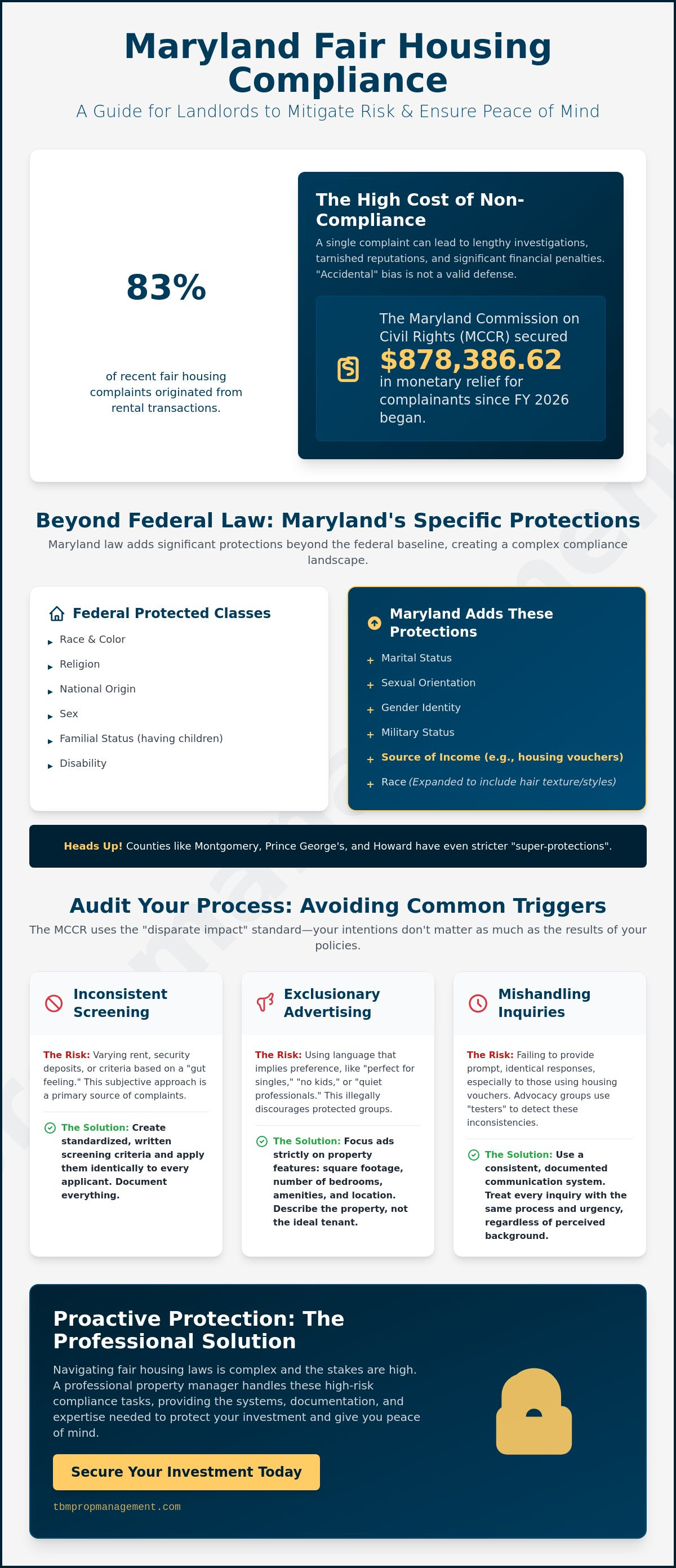
Have you ever felt that sinking feeling in your stomach when a formal legal notice arrives in the mail? For many self-managed landlords, a letter from the Maryland Commission on Civil Rights (MCCR) represents their greatest professional fear. The MCCR isn't just a bureaucratic office; it's a robust enforcement body dedicated to upholding the Federal Fair Housing Act and Maryland’s own even stricter statutes. Since the start of fiscal year 2026, the MCCR has already secured $878,386.62 in monetary relief for complainants. This isn't just a problem for large apartment complexes. Individual property owners in areas like Bethesda or Annapolis often find themselves in the crosshairs because they lack the rigorous systems required for avoiding fair housing complaints maryland.
Beyond the immediate financial penalties, a fair housing investigation can freeze your rental operations for months and drain your emotional energy. Your reputation in local communities can be tarnished overnight. It's vital to understand that "accidental" bias is no excuse in the eyes of the law. If your screening process unintentionally excludes a protected group, you're still legally liable. Furthermore, advocacy groups frequently use "tester" programs. These organizations send individuals to pose as prospective tenants to see if you provide consistent information. If a tester receives a different answer than a real applicant, you've provided the exact evidence needed for a costly lawsuit.
The Burden of Proof in Maryland
In 2026, the legal landscape shifted significantly toward tenant-friendly regulations. The MCCR now heavily utilizes the "disparate impact" standard. This means they examine the results of your policies rather than just your intentions. If a policy seems neutral but disproportionately affects a protected class, it may be deemed discriminatory. Detailed documentation is your only real defense. Without a clear, written record of why an applicant was denied based on objective criteria, you're left vulnerable to claims that are difficult to disprove after the fact.
Common Triggers for Fair Housing Investigations
Most investigations begin with a simple inconsistency. Are you providing the same set of facts to every caller who asks about your property in Columbia or Laurel? Common triggers include:
- Varying security deposit amounts based on a "gut feeling" about an applicant's stability.
- Using exclusionary language in rental advertisements that mentions "perfect for a single professional" or "no kids."
- Failing to provide prompt, identical responses to inquiries from individuals using housing vouchers.
Standardizing your communication isn't just a way to stay organized; it's the primary methodology for finding the security and relief you deserve as a property owner. By moving from a reactive "gut-check" approach to a proactive, documented system, you protect your investment from unnecessary risk.
Beyond Federal Law: Maryland's Specific Protected Classes in 2026
Are you aware that Maryland’s fair housing laws go significantly further than federal requirements? While the federal guidelines provide a baseline protecting race, color, religion, sex, national origin, familial status, and disability, our state has added several layers of protection that often catch self-managed landlords off guard. In 2026, Maryland law explicitly prohibits discrimination based on marital status, sexual orientation, gender identity, and military status. Even the definition of "race" has been expanded to include traits associated with race, such as protective hairstyles and hair texture. If you aren't accounting for these nuances in your daily operations, you aren't truly avoiding fair housing complaints maryland.
The complexity doesn't stop at the state level. Many landlords find themselves overwhelmed by "super-protections" found in specific jurisdictions like Montgomery, Prince George's, and Howard counties. These local rules can be even more restrictive than state law, creating a legal minefield for those who manage properties across different zip codes. Finding a sense of security in this environment requires a deep understanding of how these overlapping regulations impact your tenant selection process.
Navigating Source of Income Protections
The HOME Act remains one of the most critical pieces of legislation for Maryland property owners to master. Under 2026 guidelines, "Source of Income" includes any lawful form of assistance, such as Housing Choice Vouchers (Section 8). You cannot refuse to rent to someone simply because they use a voucher. A common mistake occurs during the income verification stage. You must calculate your income requirements based only on the "Tenant Portion" of the rent. If a voucher covers $1,500 of a $2,000 rent, your income-to-rent ratio should only be applied to the remaining $500. Rejecting an applicant because their total income doesn't triple the full rent amount is a fast track to an MCCR complaint.
Hyper-Local Protections in Central Maryland
Local jurisdictions often lead the way with even more specific requirements. For instance, Prince George's County includes "occupation" and "age" as protected classes, meaning you cannot favor a "young professional" over a retiree or a blue-collar worker. Montgomery County has long-standing "Ban the Box" laws that restrict when and how you can inquire about criminal history, a standard that has now influenced the statewide Maryland Fair Chance Housing Act effective October 1, 2026. Howard County also maintains unique standards for small-scale landlords that differ from larger complexes. If these regional variations feel like too much to track alone, partnering with a local expert can provide the professional oversight needed to keep your investment safe and compliant.
Auditing Your Process: Avoiding Discrimination in Advertising and Screening
Are you confident that your rental listing doesn't accidentally invite a lawsuit? For many property owners in Silver Spring or Rockville, the simple act of marketing a vacancy feels like walking through a minefield. The key to avoiding fair housing complaints maryland lies in shifting your focus from the "ideal tenant" to the "ideal property." By standardizing your approach before the first inquiry arrives, you create a stabilizing barrier between your investment and potential legal claims.
Before you ever hit "post" on a listing, you must establish your Minimum Qualification Criteria. This written document should outline your requirements for credit scores, income-to-rent ratios, and rental history. When you have these standards ready, you can provide them to every single applicant without variation. This eliminates the "gut feeling" decisions that often lead to disparate impact claims. If you find the process of vetting applicants too stressful, utilizing professional tenant placement services can provide a pre-vetted, objective system that removes the emotional burden from your shoulders.
Maryland also follows a strict "First-Qualified, First-Served" rule. This means you should process applications in the exact order they are received. If the first applicant meets all your written criteria, you should offer them the lease. Skipping over a qualified applicant to wait for a "better" one is a common trigger for an investigation. This proactive, chronological approach ensures fairness and provides a clear, defensible path if your decisions are ever questioned.
Red-Flag Words in Maryland Rental Ads
Your advertisement should describe the bricks, mortar, and amenities, not the person you hope will live there. Avoid phrases like "perfect for a single professional" or "great for a quiet couple," as these can be interpreted as excluding families or individuals based on marital status. Similarly, mentioning "walking distance to a specific church" can be seen as religious preference. Instead, focus on the property’s features. If the home has wide doorways or a ramp, describe them as "accessibility features" rather than making assumptions about who might need them. This keeps your marketing inclusive and legally sound.
Standardized Screening Workflows
Consistency is your greatest ally in property oversight. Keep a dated, written log of every inquiry, showing that you provided the same information and criteria to everyone. When you run credit and background checks, you must apply the same thresholds to every applicant. If you must deny an application based on a credit report, Maryland law requires you to issue a formal Adverse Action notice. This document explains the reason for the denial and provides the tenant with the contact information of the reporting agency. This level of detail provides the professional-grade results and security you need to manage your assets with confidence.
Navigating Reasonable Accommodations and Modifications
Do you find yourself hesitating when a tenant asks to install a grab bar in the shower or requests to keep a support animal in a unit with a "no-pets" policy? These moments are often the most stressful for Maryland landlords because the line between a helpful gesture and a legal requirement feels blurry. In the context of avoiding fair housing complaints maryland, you must distinguish between a reasonable accommodation and a reasonable modification. An accommodation is a change in your rules or policies. A modification is a physical change to the property. Understanding this distinction is a stabilizing force for your business, ensuring you respond with confidence rather than anxiety.
When a request arrives, Maryland law expects you to engage in an "interactive process." This isn't a one-way street; it's a collaborative dialogue to find a solution that meets the tenant’s disability-related needs without causing you an undue burden. You don't have to say "yes" instantly, but you cannot say "no" without a thorough, documented evaluation. This level of detail-oriented oversight is what separates seasoned experts from those who find themselves facing an MCCR investigation. For many owners in Baltimore or Towson, the easiest path to compliance is delegating these sensitive conversations to a full-service property management firm that understands the legal nuances of 2026 regulations.
Handling Service and Support Animal Requests
In 2024, discrimination based on disability accounted for 54.59% of all fair housing complaints nationwide. A huge portion of these stems from assistance animals. You must remember that service animals and Emotional Support Animals (ESAs) are not pets; they are tools for living. Consequently, "No Pets" policies and pet deposits do not apply. In Maryland, you can only request documentation if the disability or the need for the animal isn't readily apparent. Charging "pet rent" for an assistance animal is a direct violation that often leads to immediate legal action. Your documentation should remain professional, private, and focused strictly on the nexus between the disability and the animal.
When a Request Becomes "Unreasonable"
While the law is supportive of tenants, it doesn't require you to compromise the fundamental nature of your property or face bankruptcy. A request is considered unreasonable if it imposes an "undue financial and administrative burden" or if it fundamentally alters your operations. For example, if a tenant in a small Annapolis walk-up requests an elevator, the cost would likely be an undue burden. However, you must still allow the tenant to make physical modifications at their own expense in private housing, provided they agree to restore the interior to its original condition upon move-out. Always seek professional guidance before denying a request to ensure your reasoning stands up to the high standards of the MCCR.
Proactive Protection: How Professional Property Management Mitigates Risk
Why do so many DIY landlords find themselves at the center of MCCR inquiries? It isn't because they're intentionally discriminatory. It's usually because they lack the rigid, automated systems that eliminate human error. When you manage a property yourself, your personal interactions with tenants are unscripted and often emotional. Without a professional property management firm's pre-vetted systems, a casual comment during a showing or a slight delay in a response can be misinterpreted as bias. Shifting the legal liability of screening to a licensed expert provides an immediate sense of relief. You no longer have to worry if a "gut feeling" about a tenant will lead to a costly legal battle.
Staying current on Maryland’s evolving landlord tenant rights is a full-time job. With the Fair Chance Housing Act taking effect in late 2026, the margin for error has completely disappeared. TBM Property Management acts as a calming, stabilizing force for your investment by ensuring every process is compliant before a property is even listed. We've spent over 12 years refining our methodologies to protect owners from the high cost of non-compliance. Our expertise in avoiding fair housing complaints maryland is built on a foundation of mastery and dedication to local standards.
Standardization as a Shield
We utilize automated, bias-free screening software that applies your criteria consistently across every applicant. This removes subjective decision-making from the equation. Whether your rental is in Laurel or elsewhere in PG County, we ensure every compliance mark is met. Every tenant interaction is backed by third-party documentation. If an inquiry ever arises, we have a comprehensive, dated log ready to prove that your property was managed fairly and legally. This level of detail-oriented oversight is your best defense against the unexpected.
Partnering with Local Experts
Navigating county-specific fair housing updates in Anne Arundel and Montgomery counties requires a hyper-local presence. We aren't a distant service provider; we're your dedicated partner on the ground. Our team understands how Howard County's regulations differ from state law, and we adjust our strategies accordingly. This specialized, high-touch approach delivers professional-grade results without the typical stress of self-management. If you're ready to trade anxiety for security, protect your investment-contact TBM for a compliant management plan.
Securing Your Investment with Professional Compliance
The rental market in Maryland is shifting quickly. With the 2026 legislative updates now in effect, the margin for error has disappeared. You've seen how easy it is for a simple screening mistake or an incorrectly worded advertisement to spiral into a formal investigation. By standardizing your criteria and respecting the specific protections found in counties like Prince George's and Montgomery, you build a protective barrier around your assets. Finding a sense of security in this complex environment is possible when you move from reactive management to a proactive, documented system.
Mastering these rules doesn't have to be a source of constant stress. We've spent over 12 years perfecting our approach to avoiding fair housing complaints maryland by using proactive compliance auditing for every single lease. Our specialized knowledge of Howard, PG, and Montgomery County laws ensures you stay protected while we handle the heavy lifting of tenant screening and property oversight. We act as your dedicated partner, providing the professional-grade results you need to thrive.
Ready to trade your anxiety for lasting relief? Get a stress-free, compliant management plan for your Maryland rental today. You've worked hard to build your portfolio; let us provide the security and peace of mind you deserve to see it grow with confidence.
Frequently Asked Questions
Can I refuse to rent to someone with a Section 8 voucher in Maryland?
No, you cannot reject an applicant simply because they use a Housing Choice Voucher or any other form of rental assistance. Maryland law considers "Source of Income" a protected class statewide. You must evaluate these applicants using the same objective standards as any other tenant, making sure to calculate income requirements based only on the tenant’s portion of the rent.
What is the difference between a service animal and an emotional support animal in 2026?
Service animals are dogs trained to perform specific tasks for individuals with disabilities, while emotional support animals (ESAs) provide therapeutic benefit through companionship. Under 2026 Maryland standards, both are classified as assistance animals rather than pets. You must treat requests for both as reasonable accommodations, regardless of your property’s pet policy or any "no-pet" rules you've established.
Do I have to pay for a ramp if a tenant with a disability requests one?
Generally, the tenant is responsible for the cost of physical modifications like ramps in private residential housing. While you must allow the modification to be made, you can require the tenant to pay for the installation. You may also require them to set aside funds to restore the property’s interior to its original condition when they eventually move out.
How much can a fair housing fine cost a landlord in Maryland?
Financial penalties can be devastating to your investment and your reputation. Since July 1, 2025, the Maryland Commission on Civil Rights has already secured $878,386.62 in monetary relief for complainants. Beyond these direct payments, you'll likely face significant legal fees and administrative costs during the investigation process, which can drain your resources and your time.
Can I ask a prospective tenant about their criminal history in Montgomery County?
No, you cannot inquire about criminal history until after you've made a conditional offer of a lease. This "Ban the Box" approach is reinforced by the Maryland Fair Chance Housing Act, which becomes effective on October 1, 2026. This law aims to remove barriers for individuals by delaying background checks until the final stages of the rental application process.
What should I do if the MCCR contacts me about a fair housing complaint?
Respond immediately and provide the detailed, standardized documentation you’ve kept for your rental processes. The best way to find relief in this situation is to prove that you applied your written criteria consistently to all applicants. If you don't have a clear paper trail, this is the time to consult with a professional who understands the specific legal requirements in your jurisdiction.
Is "Source of Income" a protected class in all Maryland counties?
Yes, Source of Income protection is a statewide mandate that applies across all Maryland counties. Whether your property is in Anne Arundel, Prince George's, or Howard County, you must accept all lawful forms of income. This includes social security, alimony, and government housing vouchers. Understanding this is a vital part of avoiding fair housing complaints maryland.
How can I legally screen tenants without being accused of bias?
The most effective strategy for avoiding fair housing complaints maryland is to use a "First-Qualified, First-Served" processing system. Establish your written criteria for credit scores, income, and rental history before you ever list the property. By applying these objective standards to every applicant in the order they apply, you remove the subjective "gut feelings" that often trigger discrimination claims.