Common Rental Property Code Violations Maryland Tenants Face
Serious rental defects in Maryland, such as a lack of heat, electricity, or water, may qualify for rent escrow if they threaten a tenant’s life, health, or safety. Common rental property code violations in Maryland can also include sewage problems, rodent infestations, lead hazards, and unsafe structural conditions. After receiving notice, a landlord must address a habitability problem within a reasonable period, even if the tenant is behind on rent.
It’s frustrating when a hazardous condition goes unrepaired, but not every maintenance issue qualifies for rent escrow, and landlords may have defenses if a tenant caused the damage or denied access for repairs. This article explains which conditions may support rent escrow, what Maryland landlords are responsible for, and how lead-paint requirements apply to rentals built before 1978. You’ll also learn how habitability standards work and what steps tenants can take when a serious problem remains unresolved.
Key Takeaways
- Learn how the severity of a housing problem and the steps taken after notice can affect a rent escrow claim.
- See how state and local housing rules shape a landlord’s responsibilities, including registration and safety requirements.
- Understand why older rentals have additional lead-safety obligations and what follows when a hazard is identified.
- Find out how professional property management can help owners coordinate maintenance, inspections, and leasing responsibilities.
Conditions that may qualify for rent escrow
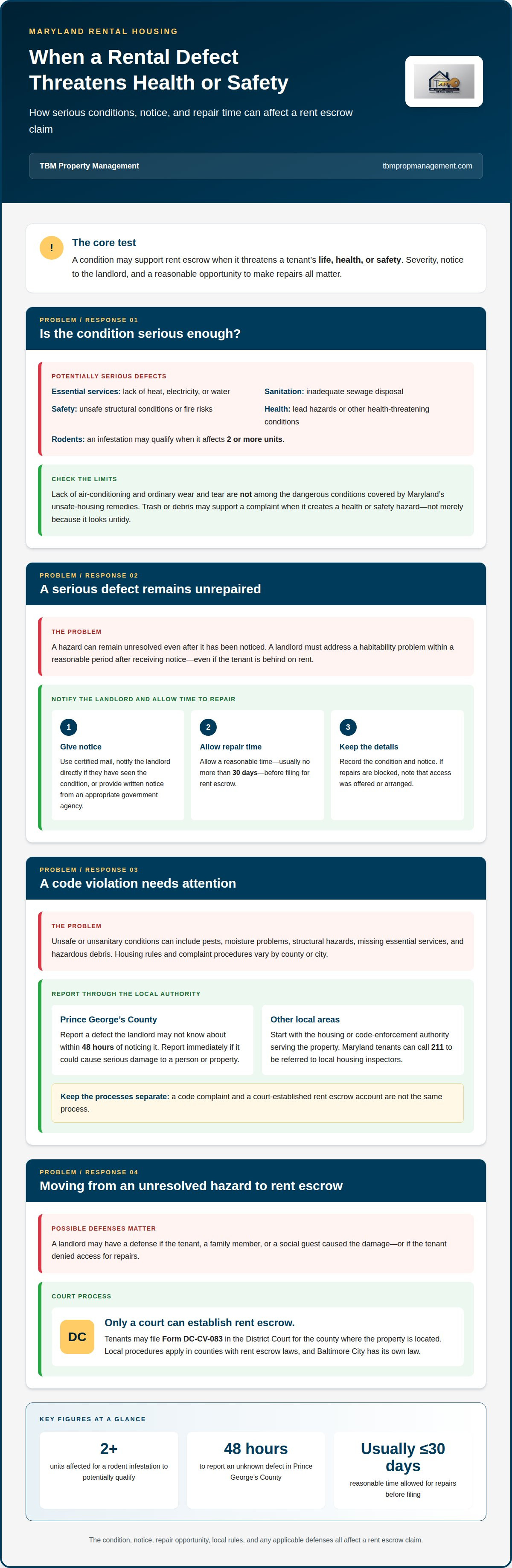
Maryland tenants may seek rent escrow for serious defects that threaten life, health, or safety. The condition’s severity, notice to the landlord, and the landlord’s opportunity to make repairs all matter.
Serious Defects and Safety Hazards
Serious defects include inadequate sewage disposal, lack of heat, electricity, or water, and unsafe structural conditions. Lead hazards, fire risks, and other conditions that threaten residents’ health may also qualify. These problems can make a home unsafe to live in. Lack of air-conditioning and ordinary wear and tear are not among the dangerous conditions covered by Maryland’s unsafe-housing remedies.
Rodent infestation may qualify as a serious housing problem when it affects 2 or more units. A landlord may have a defense if a tenant, family member, or social guest caused the damage, or if the tenant denied access for repairs.
Unsanitary Conditions and Debris
Unsanitary conditions such as rodent infestations and inadequate sewage disposal can threaten residents’ health. Maryland’s Minimum Livability Code requires landlords to keep each dwelling free from dangerous or unsanitary conditions and defects. Trash or debris may support a complaint if it creates a health or safety hazard, rather than merely looking untidy.
Tenants can report rental housing code violations to local authorities. In Prince George’s County, tenants must report a defect the landlord may not know about within 48 hours of noticing it. They must report immediately if it could cause serious damage to a person or property.
Reporting Defective Conditions
Tenants should notify the landlord of a serious defect and allow reasonable time for repairs before filing for rent escrow in District Court. Notice may be sent by certified mail, given directly when the landlord has seen the condition, or provided through written notice from an appropriate government agency. A tenant requesting repairs should allow a reasonable time, usually no more than 30 days.
Only a court can establish rent escrow. Tenants may file Form DC-CV-083 in the District Court for the county where the property sits. Local procedures apply in counties with rent escrow laws, and Baltimore City has its own law. According to Maryland Department of the Environment, the administrative penalty imposed shall be up to $20 per day, calculated from the date compliance is required, for each affected property which is not registered or for which registration is not renewed or updated.
Landlord responsibility to comply with housing laws
Maryland landlords must follow applicable federal, state, county, and municipal housing rules. Local ordinances may offer additional protections, so the responsible agency and complaint process depend on the property’s location.
Tall Grass, Trash, and Debris Complaints
Exterior complaints can involve overgrown grass, trash, debris, open storage, or dismantled vehicles. In Prince George’s County, grass at least 12 inches high can be reported alongside these conditions. An exterior complaint may concern property maintenance rather than a defect inside a tenant’s unit, so describe the location and condition clearly when reporting it.
Tenants can report housing code violations to local authorities. In Prince George’s County, an unlicensed rental property can be reported to PGC311 through a service request under “Private Property Concerns.”
Filing and Tracking Code Complaints
Start with the local housing or code-enforcement authority serving the property’s county or city. Montgomery County Housing Code Enforcement handles complaints about conditions in single-family and multifamily rental properties. Examples include unsafe conditions, structural hazards, pest infestations, moisture problems, missing essential services, and overcrowding.
Give the authority the property location and a clear account of the condition. Maryland tenants can call 211 to be referred to local housing inspectors. In Baltimore County, people who mail or fax a complaint are asked to allow five business days before checking its status. Keep the complaint details available when following up. A code complaint and a court-established rent escrow account are separate processes.
Building and Safety Complaints
Building and safety complaints concern hazards such as structural problems or missing essential services. Maryland’s Tenant Safety Act requires landlords to provide and maintain smoke detectors and carbon monoxide detectors in rental properties. In Prince George’s County, landlords operating three or more rental units must provide tenants with a 24-hour emergency telephone number or answering service for emergencies affecting health, safety, or welfare.
Prince George’s County requires licenses for single-family rental facilities and multifamily facilities with 3 or more rental dwelling units. Under §13-153, landlords must warrant that rental units and premises comply with applicable federal, state, county, and municipal laws and regulations. A local complaint can bring attention to an unresolved safety issue.
Lead-based paint requirements for older properties
Maryland’s lead-paint requirements focus on rental properties built before 1978. Landlords must register these properties with the Maryland Department of the Environment, provide lead-hazard information, and meet risk-reduction standards. Federal lead-based paint disclosure requirements also apply to rentals built before 1978. These requirements make a property’s age a key compliance detail for each rental unit.
After receiving notice of lead hazards, a landlord must perform lead risk reduction within 30 days, according to the Maryland Department of the Environment. If treatment lasts more than 24 hours, landlords must pay reasonable relocation expenses. These steps address the hazard while reducing disruption for tenants. Keep lead-related notices and repair records with the property’s compliance documents.
Lead concerns can become part of a broader housing dispute. Maryland tenants may pursue remedies for serious dangerous conditions, and a court may award actual damages, reduce rent, or terminate a lease. If a lease is terminated, relief may include unused security deposit funds and relocation expenses. A court hearing is required before rent escrow is established. This is separate from the lead-registration process.
Local requirements matter too. Prince George’s County requires licenses for single-family rental facilities and multifamily rental facilities with 3 or more rental dwelling units. The county issues a license when the property meets its Housing Code requirements; otherwise, the applicant receives a written statement identifying defects. This licensing process gives owners a specific list of issues to address before approval.
Property features can trigger separate rules. In Prince George’s County, sheds exceeding 150 square feet require a permit and may not be used as dwellings. A shed cannot serve as a substitute rental unit under that rule. Treat lead compliance, rental licensing, and shed permits as distinct state law and local obligations, then address each requirement that applies to the property.
Maryland rental-property habitability standards
Maryland rental units must remain fit for human habitation throughout the lease. The standard focuses on serious conditions that could threaten residents’ health, safety, or lives if not promptly addressed. It helps distinguish urgent hazards from ordinary maintenance concerns.
What are Maryland’s requirements for rental property smoke and carbon monoxide alarms? The Tenant Safety Act requires landlords to provide and maintain smoke detectors and carbon monoxide detectors in rental properties. Missing or unmaintained alarms can raise a housing compliance concern, along with other safety hazards.
Maryland’s Tenant Safety Act of 2024 deems every rental property offered for lease fit for human habitation. The warranty of habitability appears in Md. Code, Real Property § 8-212. Maryland’s Minimum Livability Code also requires each dwelling unit to be free from dangerous and unsanitary conditions or defects. That code does not apply to tenants in farm residences.
After receiving notice of a habitability problem, landlords must address it within a reasonable period, even if the tenant is behind on rent. A landlord may have a defense if the tenant, a family member, or a social guest caused the damage, or if access for repairs was denied. These details can matter in an enforcement dispute, but they do not remove the basic duty to address dangerous conditions.
Tenants may use warranty-of-habitability protections and rent escrow law at the same time. A court can award actual damages, reduce rent, or terminate a lease; possible relief may include unused security deposit funds and relocation expenses. Rent escrow places repairs under court oversight while the tenant remains in the home. Withholding rent without court-established escrow can prompt a landlord to pursue eviction, even if the tenant gave notice. It is important to distinguish a complaint from a remedy ordered by the court.
For owners managing repair obligations across a rental property, coordinate property maintenance to keep habitability concerns from becoming overlooked compliance issues.
TBM Property Management: Full-Service Property Management
TBM Property Management helps Maryland rental owners manage the ongoing responsibilities of maintaining and overseeing a property. If coordinating inspections, maintenance, tenants, and leasing has become difficult to manage alone, Full-Service Property Management brings these tasks together in one service.
Property inspections and maintenance coordination help owners monitor a property’s condition and repair needs. Tenant Placement, tenant screening, and Leasing Services support preparing a rental for occupancy, while Rent Collection helps manage rent administration. These services support day-to-day oversight, while legal disputes and court remedies remain separate matters.
If you’re ready for support managing your Maryland rental property, contact TBM Property Management.
Build a steadier approach to rental oversight
Understanding how common rental property code violations in Maryland arise can help owners build compliance into regular property oversight instead of waiting for a complaint. Keep clear records, address maintenance issues promptly, and communicate consistently to better manage your responsibilities and protect your rental property.
Managing every detail yourself can feel like a lot to carry. TBM Property Management offers Full-Service Property Management, Tenant Placement, and Leasing Services to support owners with rental oversight and leasing. Choose the level of support that fits your property and the work you want to handle directly.
Ready to discuss support for your rental property? Contact TBM Property Management to take the next step with a local management partner.
Frequently Asked Questions
Does a landlord have any defenses or reasons why they refuse to fix the problem?
A landlord may have a defense if a tenant, family member, or social guest caused the damage, or if the landlord or agent was denied access to make repairs. For example, a repair visit that could not proceed because access was refused may be relevant in a later dispute. The condition, its cause, and the history of access can all matter when a court considers the claim.
How Soon Will the County Act?
Response timing depends on the jurisdiction and the complaint. In Montgomery County, housing-code inspections usually take place within 5 business days, although timing can vary. DHCA doesn’t handle code-enforcement complaints inside Rockville or Gaithersburg, so the city’s jurisdiction matters. Include the property location and specific issue in a complaint so it can be directed to the appropriate local enforcement office.
What about problems that affect an entire building of rental housing?
Maryland law allows multiple tenants to join one lawsuit over problems affecting an entire rental building. This may be useful when residents face the same building-wide issue, such as a shared safety hazard or interruption to an essential service. A court may order repairs or allocate escrowed funds toward them. Each tenant’s circumstances and the evidence of the shared condition remain relevant to the case.
What are the most common rental property code violations in Maryland?
Common rental property code violations in Maryland include unsafe structural conditions, sewage problems, rodent infestations, lead hazards, and fire or health risks. Complaints may also involve missing essential services, moisture or mold, overcrowding, and repairs that have not been addressed. Whether an issue is a code violation or grounds for a tenant remedy depends on its effects, applicable local rules, and the facts reported to housing enforcement.
What Maryland housing codes apply to rental properties?
Maryland rental housing is subject to the Minimum Livability Code, the warranty of habitability in Md. Code, Real Property § 8-212, and the Tenant Safety Act. Local ordinances may add protections. Montgomery County’s housing and building maintenance standards are addressed in Chapter 26. Older rentals also fall under state lead-risk requirements, so the property’s location, condition, and construction date help identify relevant rules.
What are Maryland's minimum heating, plumbing, electrical, and ventilation requirements for rentals?
Maryland requires rental units to remain fit for human habitation and free from dangerous or unsanitary defects. Serious problems involving heat, water, or electricity may threaten habitability and warrant attention. Local housing standards also apply, and details can depend on the property’s jurisdiction. For example, Montgomery County addresses housing and building maintenance standards in Chapter 26; the statewide habitability standard remains the central baseline.