
Dealing With Noise Complaints From Tenants: A Maryland Landlord’s Guide
A noise complaint deserves neither an automatic warning nor a quick dismissal. When a tenant reports disruptive sounds, how can you tell whether the issue is occasional, recurring, or serious enough to act on? Dealing with noise complaints from tenants calls for a fair, consistent process that takes the reporting resident seriously while respecting the other tenant’s rights.
It’s understandable to feel caught in the middle, especially when accounts differ or the disturbance is difficult to verify. A measured response can help keep a one-time annoyance from becoming a lasting dispute. Clear records also make your decisions easier to explain and apply consistently.
This guide explains how to assess the type, timing, and frequency of reported noise; document conversations and incidents; and choose proportionate next steps based on the lease and applicable local rules. You’ll also learn when a noise concern may point to a property issue that calls for inspection or maintenance coordination. A reliable process for listening, following up, and keeping records can help you address legitimate concerns without turning every report into a conflict.
Key Takeaways
- Use a calm, repeatable process to hear the concern, protect residents, and avoid jumping to conclusions.
- Separate firsthand observations from estimates and secondhand reports when you investigate a noise complaint.
- Choose a proportionate response based on documented patterns, severity, lease terms, and applicable local rules.
- Keep communications with each resident respectful, record decisions, and set a clear follow-up point.
- Dealing with noise complaints from tenants is easier when tenant communication, property inspections, and maintenance follow-up are organized consistently.
Dealing With Noise Complaints From Tenants Starts With a Calm, Neutral Response
A noise complaint can put a landlord in a difficult position: one resident wants relief, while another may not know a concern has been raised. A fair, repeatable process helps you respond without taking sides. Start by understanding what happened, checking whether anyone needs immediate protection, and gathering facts before deciding what to do.
Don’t assume that a single report proves a lease violation. A short, isolated disturbance may call for a different response than frequent, disruptive noise described in several dated reports. Lease language, the property type, and current local rules may also affect the appropriate next steps. A fair first response acknowledges the report, records specific details, checks for immediate safety concerns, and avoids assigning blame before reviewing the facts.
What should a landlord do first when a tenant reports noise?
Acknowledge the report promptly and ask practical questions: When did the noise occur? Where did the tenant hear it? How long did it last, and how often has it happened? Ask what the resident directly heard or observed rather than relying on guesses about the source. Record the description neutrally, such as “loud music reported from the adjoining unit at approximately 11 p.m.,” not “the neighbor broke the rules.”
Ask whether there’s an immediate safety concern. If the report suggests a separate urgent risk, address that concern through the appropriate process rather than treating it as an ordinary noise issue. Otherwise, explain that you’ll review the details and follow up. Don’t promise a warning or other outcome before assessing the situation.
Why a neutral response matters in Maryland rentals
Apply the same intake and review steps to similar complaints, regardless of which residents are involved. Consistency helps reduce the risk that a tenant feels ignored or unfairly targeted, and gives you a clearer record if reports recur. Avoid deciding what happened based on a resident’s reputation, assumptions about household routines, or a secondhand account alone.
Noise concerns can also raise questions about a tenant’s ability to use their home peacefully. The general concept of the covenant of quiet enjoyment provides useful background, but it doesn’t determine the outcome of every complaint. Review the lease and the rules that apply to the property before taking formal action. For broader Maryland context, see this Maryland landlord-tenant rights guide.
With a calm first response, dealing with noise complaints from tenants becomes a fact-finding process rather than a reflexive enforcement decision. Once you’ve captured the report and checked for immediate concerns, assess the evidence and choose a proportionate next step.
How to Investigate Tenant Noise Complaints Without Taking Sides
After acknowledging a report, gather enough detail to distinguish a one-time disturbance from a recurring pattern or a concern that needs a separate, urgent response. A consistent investigation helps you compare accounts fairly, identify possible property issues, and decide on follow-up without treating an allegation as a proven violation.
What information belongs in a noise complaint log?
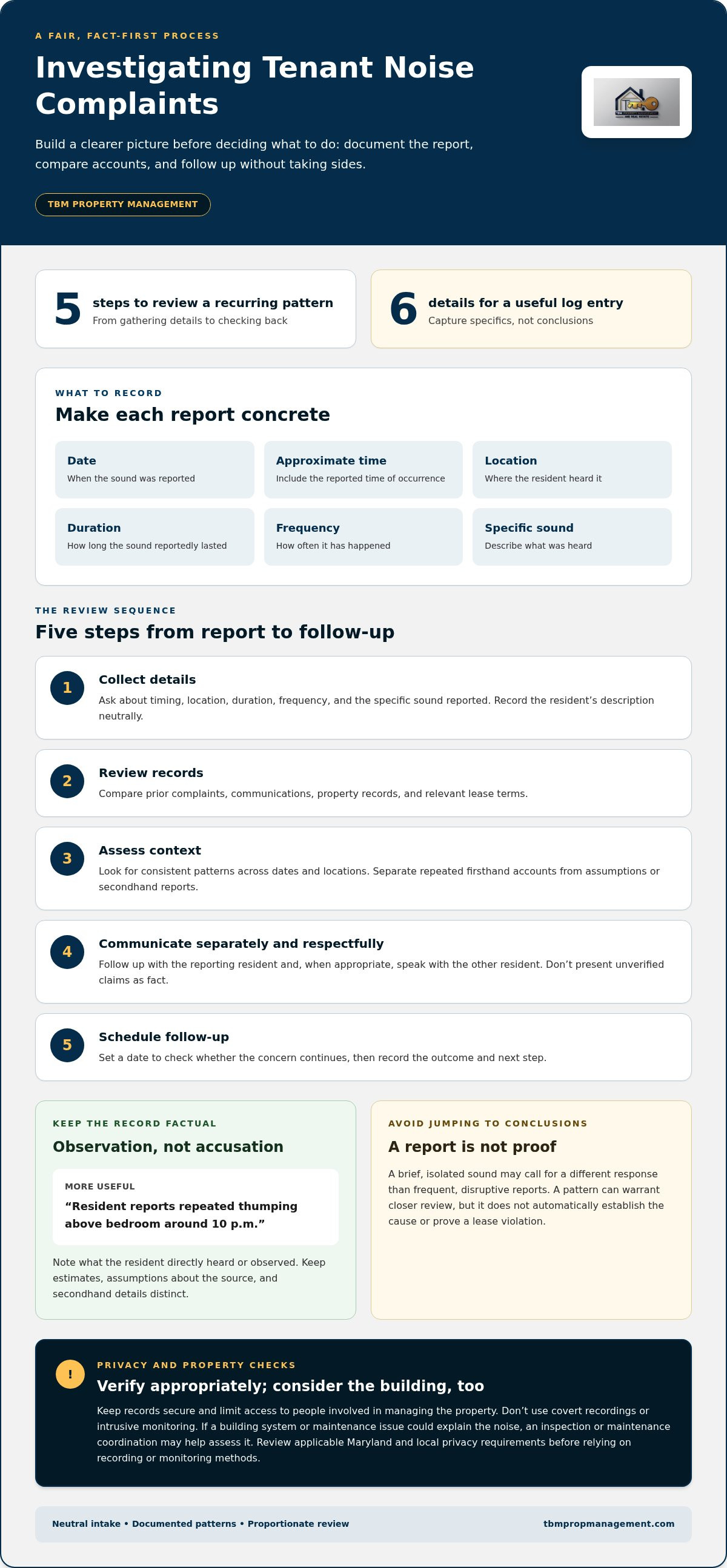
Record the reporting resident’s description, including the date, approximate time, location, reported duration, and how often the sound has occurred. Separate what the person directly heard from estimates, assumptions about the source, or details repeated by someone else. Note each contact, your response, any relevant observation, and the next step you agreed to take.
Keep entries factual and professional. “Resident reports repeated thumping above bedroom around 10 p.m.” is more useful than a conclusion about who caused it or why. Store records securely and limit access to people involved in managing the property. Don’t make covert recordings or use intrusive monitoring to verify a report. Before relying on recording or monitoring methods, have applicable Maryland and local privacy requirements reviewed.
How can a landlord verify a recurring noise pattern?
Use this five-step process to build a clearer picture:
- Collect details. Ask about timing, location, duration, frequency, and the specific sound reported.
- Review records. Compare prior complaints, communications, property records, and relevant lease terms.
- Assess context. Look for consistent patterns across dates and locations. Distinguish repeated firsthand accounts from assumptions or secondhand reports.
- Communicate. Follow up respectfully with the reporting resident and, when appropriate, speak separately with the other resident. Don’t present unverified claims as fact.
- Schedule follow-up. Set a date to check whether the concern continues and record the outcome.
For example, several reports describing similar sounds from the same area at roughly the same time may warrant a closer review than one report of a brief thud. A pattern doesn’t automatically establish its cause. Consider whether a building system or maintenance issue could explain the noise. An inspection or maintenance coordination may help assess that possibility.
Noise rules can vary by location, so don’t assume one standard applies throughout Maryland. Review current rules that govern the property and consult the Maryland rental housing laws resource for broader landlord-tenant context. Keep the investigation focused on documented facts, and avoid conclusions until you’ve reviewed the applicable rules and lease.
A well-organized record makes dealing with noise complaints from tenants more consistent and easier to follow through on. If coordinating resident communications, inspections, and maintenance is becoming difficult to manage, full-service property management can help keep those responsibilities organized.
Choose a Proportionate Response: Noise Conversation, Lease Reminder, or Further Review
A complaint is a reason to investigate, not proof that a tenant violated the lease. Choose the next step based on what you can document: the reported frequency and severity, the actual lease terms, and the rules that apply to the property. A brief, isolated disturbance may call for a different response than repeated, disruptive noise supported by several reports.
Use this framework to match your response to the facts. It’s a decision-making guide, not a substitute for reviewing the lease and current requirements.
| Response | Consider it when | Practical next step |
|---|---|---|
| Informal conversation | The report describes an isolated or lower-level concern, and the facts are still developing. | Speak respectfully, clarify expectations, and set a follow-up point. |
| Written reminder | A concern appears to recur, but a clear, factual reminder may address it. | Describe the reported conduct and relevant lease language without presenting unverified claims as established facts. |
| Maintenance review | The sound could be related to a building system, fixture, or other property condition. | Arrange an appropriate inspection or maintenance coordination and record what is checked and found. |
| Formal lease-related action | Documented facts suggest an ongoing issue that may conflict with the lease. | Review the lease, evidence, and applicable notice and enforcement requirements before proceeding. |
When is a direct conversation or written reminder appropriate?
An early, respectful conversation can clarify expectations without turning an uncertain report into a confrontation. If you send a written reminder, keep it specific: identify the reported dates or pattern, refer to the relevant lease provision, and state what conduct needs attention. Avoid accusations, threats, or promises about consequences. Apply the same standards to comparable situations, regardless of which residents are involved, and record the response and agreed follow-up.
When should a landlord review lease terms or seek legal guidance?
Before calling conduct a lease violation, read the actual lease and compare its language with the documented facts. Reports that persist, conflict, or raise questions about accommodations deserve careful review. Maryland’s discussion of quiet enjoyment recognizes that a disruption may be attributable to the landlord in some circumstances, so don’t dismiss a continuing concern simply because another tenant may be the source. The details matter.
Before issuing a formal notice or taking enforcement action, verify current Maryland and applicable county or municipal requirements. Notice procedures can depend on the situation. Seek Maryland legal guidance for complex disputes, accommodation-related questions, conflicting evidence, or uncertainty about the correct process. Careful review helps keep dealing with noise complaints from tenants fair, consistent, and grounded in the lease and verified rules.
A Landlord’s Step-by-Step Follow-Up Plan for Recurring Noise Complaints
Recurring reports need more than a one-time reply. A clear follow-up plan helps you keep both residents informed, check whether your response is working, and distinguish a documented pattern from an unresolved allegation. Use the same steps each time, then adjust based on what you learn.
- Open a record. Log the report, relevant dates and times, affected area, and what the resident directly observed. Keep reported details separate from assumptions.
- Acknowledge the concern. Let the reporting resident know you’ve received the report and will review it. Don’t promise a specific outcome before assessing the facts.
- Speak separately with each resident. Give the other resident a clear, neutral opportunity to understand the concern and respond. Share only information needed to address the reported issue, not private details about the other resident.
- Check for a property cause. If the sound could come from a building system or maintenance issue, arrange an appropriate review and document what was inspected and found. The Maryland rental maintenance guide offers more context on organizing maintenance follow-through.
- Explain the next step in writing. Summarize what you reviewed, any action taken, and what will happen next. Keep the language factual and avoid presenting unverified claims as established facts.
- Set a check-in date. Ask the reporting resident whether the noise has changed, record the response, and note any remaining concerns or agreed next steps.
How should landlords communicate with both tenants?
Keep each conversation respectful and focused on the reported conduct. You might tell the reporting resident, “I’ve recorded your concern and will follow up after reviewing the details.” To the other resident, describe the concern in neutral terms and invite their account without assuming responsibility. Avoid sharing unnecessary personal information or details that could inflame the disagreement.
How can landlords close the loop after taking action?
Choose a specific date for follow-up rather than leaving the matter open-ended. Record whether the reported disturbance continued, eased, or changed in timing or location. If it persists, compare the new information with prior entries and reassess your response. Repeating the same reminder without checking its effect may not resolve the issue.
Consistent records help reveal patterns, but a collection of reports is not, by itself, proof that a lease was violated. Keep observations, resident accounts, maintenance findings, and actions distinct in the file. This structured approach to dealing with noise complaints from tenants makes decisions easier to explain and follow through on. For help coordinating tenant communication, inspections, and maintenance, explore full-service property management.
When Property Management Can Make Tenant Noise Complaints Easier to Handle
Recurring noise concerns can create a steady stream of messages, disputed accounts, and follow-up tasks. A property manager can bring structure to that work with a consistent process for tenant communication, complaint records, inspections, and maintenance coordination. That organization won’t make every disagreement disappear, but it can help owners respond clearly and keep track of what has already been discussed or reviewed.
What can a property manager coordinate during a noise dispute?
A manager can document reports and responses, communicate with residents separately, and track agreed next steps. If the sound may relate to a building condition, a property inspection or maintenance review can help identify what needs attention. Recording the findings alongside the complaint keeps the investigation grounded in what was reported and observed, rather than treating an allegation as proof.
This coordinated approach is especially useful when reports continue over time. A clear record can help identify whether concerns involve similar times or locations, whether previous communication changed anything, and whether maintenance follow-up is still outstanding. Owners can also explore the full-service property management guide for a broader look at ongoing rental oversight.
How can Maryland rental owners move forward with less stress?
Local context matters, and rules shouldn’t be treated as interchangeable across jurisdictions. TBM Property Management is based in Laurel and serves rental-property owners across Anne Arundel, Prince George’s, Montgomery, and Howard counties. Consider the rules that apply to each property while following a consistent approach to listening, documenting, and following up.
If you’re dealing with noise complaints from tenants alongside other day-to-day management responsibilities, organized support can make the process more manageable. Full-service property management connects tenant relations with property inspections and maintenance coordination, helping keep follow-through in one place without promising a particular dispute outcome. Review TBM Property Management’s services to explore support for your rental property.
Build a Fair, Consistent Process for Your Rental
Dealing with noise complaints from tenants is easier when you respond calmly, document what you learn, and match each next step to the facts, lease terms, and applicable local rules. Keep communication respectful and consistent, and follow up to see whether the concern has changed. If the sound may stem from a property condition, inspections and maintenance coordination can help you investigate that possibility.
Managing resident concerns alongside the rest of your rental responsibilities can feel like a lot to carry. TBM Property Management supports owners with tenant relations, property inspections, and maintenance coordination from Laurel across Anne Arundel, Prince George’s, Montgomery, and Howard counties.
Ready to make day-to-day property oversight more organized? Explore full-service property management with TBM and take a confident next step toward a more consistent approach to your rental.
Frequently Asked Questions
What should a landlord do when a tenant complains about noisy neighbors?
Acknowledge the report, ask for specific details, and record the tenant’s account neutrally. Clarify when and where the noise occurred, how long it lasted, how often it happens, and whether there’s an immediate safety concern. Review the lease and any relevant prior reports before deciding how to respond. Follow up with each resident respectfully, and don’t promise a particular outcome before you’ve assessed the information.
Can a landlord evict a tenant for noise complaints in Maryland?
Noise complaints alone don’t automatically justify eviction in Maryland. A landlord should review the lease, document relevant incidents, and determine whether the evidence supports a violation before considering formal action. Eviction involves legal procedures, and notice requirements can depend on the circumstances and applicable rules. Because mistakes can escalate a dispute, seek Maryland legal guidance before pursuing eviction or issuing a formal notice based on noise.
How do you prove a tenant is making excessive noise?
Build a clear record rather than relying on a single allegation. Document dates, approximate times, locations, reported duration, and what each person directly observed. Compare separate reports for consistent patterns, review relevant lease terms, and note any property inspection or maintenance findings that could explain the sound. Distinguish firsthand accounts from estimates or secondhand claims. Don’t use covert recording or intrusive monitoring; review privacy requirements before using monitoring methods.
What counts as a reasonable noise complaint in a rental property?
A reasonable complaint describes noise that is recurring or disruptive enough to warrant review, with useful details about its timing, location, duration, or impact. Ordinary household sounds don’t necessarily indicate a lease violation. Consider the specific lease language, circumstances, and current noise rules for the property’s jurisdiction. Since local requirements can differ, avoid treating one quiet-hours schedule or noise standard as applicable throughout Maryland.
Can a landlord enter a rental unit to investigate a noise complaint?
A landlord should follow Maryland’s current entry requirements and the lease before entering. For non-emergency entry, Maryland law generally requires at least 24 hours’ written notice, including the date, approximate time, and purpose; entry is generally limited to 7 a.m. to 7 p.m., Monday through Saturday, unless the tenant agrees in writing to another time or a shorter notice period. Verify applicable rules and handle emergencies separately.
What should a landlord do if noise complaints keep happening?
Continue documenting each report and response, then compare the new details with earlier incidents. Check whether the timing, location, and reported sound suggest a recurring pattern or a possible maintenance issue. Follow up with the residents separately, set a clear check-in, and reassess if the concern continues instead of repeating an ineffective message. Dealing with noise complaints from tenants works best when each step is consistent, fact-based, and recorded.
Can a property manager handle noise complaints between tenants?
Yes. A property manager can coordinate resident communication, keep reports and responses organized, and track follow-up. If a building condition may contribute to the sound, property inspections and maintenance coordination can help investigate that possibility. TBM Property Management provides full-service rental management from Laurel across Anne Arundel, Prince George’s, Montgomery, and Howard counties. A manager can bring structure to the process, though no process can guarantee every resident dispute will disappear.