
Evicting a Tenant Without a Lease in Maryland: Complete 2026 Guide
Believing that an occupant without a written contract has zero legal rights is one of the most expensive assumptions a rental owner can make. If you are currently facing the challenge of evicting a tenant without a lease in Maryland, you already know the sinking feeling of watching rental income vanish while someone stays in your property for free. It is entirely reasonable to feel overwhelmed by the legal hurdles and worried that an honest procedural mistake could spark a costly wrongful eviction lawsuit.
You don't have to carry that burden alone or guess which complex state statutes protect your asset. In this guide, you'll discover the exact legal steps, statutory notice windows, and district court procedures required to lawfully regain possession of your property without incurring legal liability. We'll walk you through the vital differences between holdover tenancies and wrongful detainer actions across local jurisdictions like Montgomery, Prince George's, and Howard counties, giving you a definitive path forward to protect your investment.
Key Takeaways
- Understand the critical legal differences under Maryland law between an unleased month-to-month tenant at will and an unlawful occupant facing a wrongful detainer action.
- Follow the precise statutory steps and notice requirements essential for lawfully evicting a tenant without a lease in Maryland to avoid costly procedural delays.
- Protect yourself from severe civil liabilities, statutory damages, and court penalties caused by taking unlawful self-help measures like lock changes or utility shutoffs.
- Navigate local central Maryland compliance standards, including mandatory county licensing preconditions in jurisdictions like Montgomery and Prince George's counties before filing in court.
- Discover how comprehensive tenant screening and structured leasing services eliminate occupancy vulnerabilities and safeguard your rental revenue over the long term.
Understanding Tenancy Without a Lease Under Maryland Law
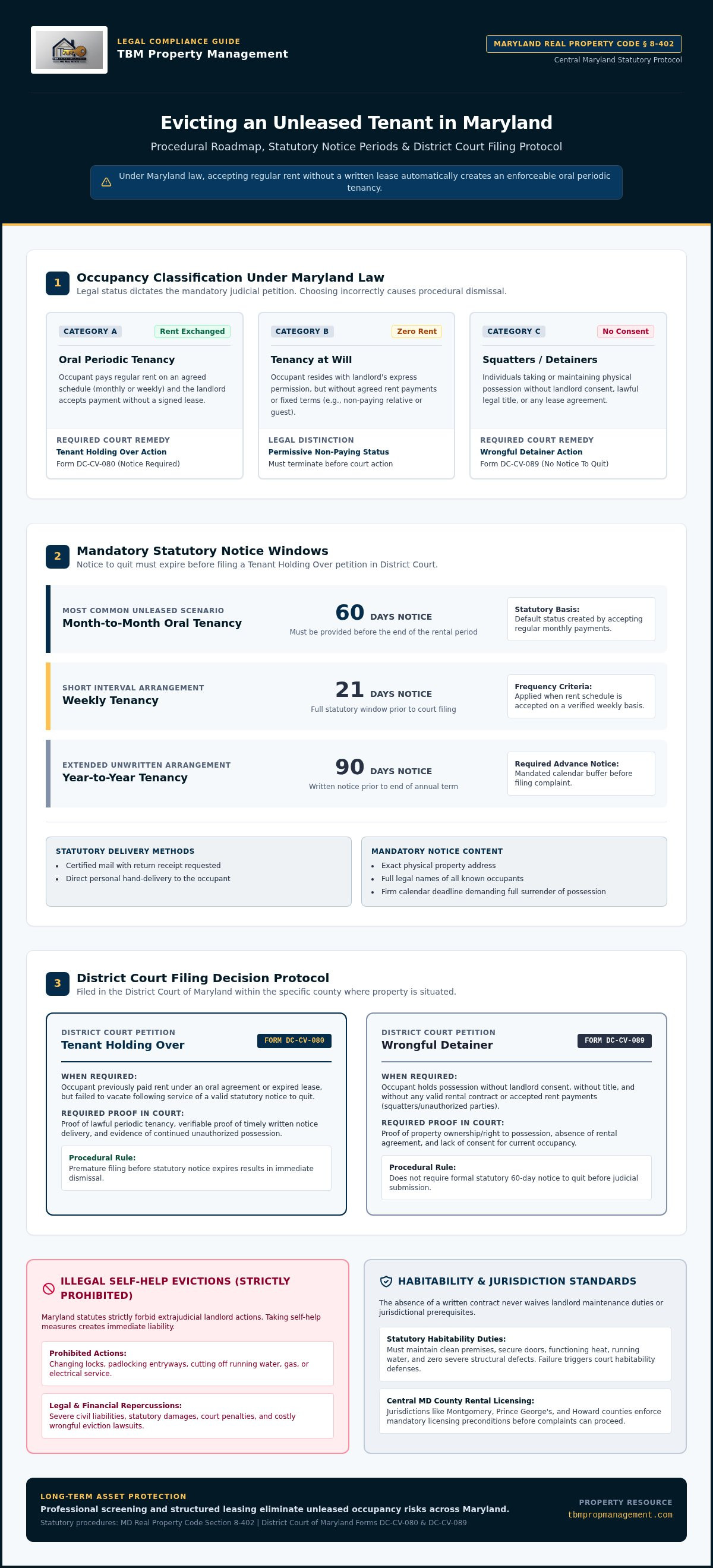
Many property owners assume that without a signed contract, an occupant holds zero legal claim to a property. Under Maryland Real Property Code Section 8-402, that assumption can lead to severe legal missteps. When you accept rent from someone without a written agreement, Maryland law recognizes an oral periodic lease. By default, regular monthly payments create a month-to-month tenancy, granting the occupant full statutory protections under state law. Successfully evicting a tenant without a lease in Maryland requires navigating these implied contracts properly to avoid immediate procedural dismissal in court.
Verbal Leases vs. Tenancies at Will vs. Squatters
Disentangling legal status is your critical first step. Each classification demands a distinct legal remedy:
- Oral Periodic Tenancies: Occur when an occupant pays rent on a set schedule (such as monthly or weekly) and you accept it. This arrangement mirrors a standard lease under state law, requiring formal statutory termination notices before filing a Tenant Holding Over action.
- Tenancies at Will: Exist when someone occupies the property with your express permission, but without agreed-upon rent payments or fixed duration terms. A non-paying adult child or a friend staying indefinitely falls into this category.
- Squatters and Unlawful Detainers: Involve individuals who take or retain physical possession without your consent, legal title, or any rental agreement. You remove these parties through a Wrongful Detainer action, not standard landlord-tenant holdover proceedings.
Why Maryland Law Protects Occupants Without Written Leases
Maryland statutory law prioritizes stable housing and prevents arbitrary displacement. What starts as a casual arrangement, such as letting a relative pay a portion of utility bills or rent while staying in your basement, immediately establishes an enforceable tenancy in the eyes of local district courts. Once established, you must follow the formal judicial eviction process to regain lawful possession.
Critically, the absence of written paperwork does not exempt you from strict maintenance requirements. Landlords maintain statutory obligations to provide clean, secure, and habitable premises, including functioning heat, running water, and freedom from severe structural defects. For a comprehensive breakdown of statewide landlord responsibilities, review our guide to Maryland Landlord Tenant Rights: The Definitive 2026 Landlord Guide. Overlooking these fundamental rights while evicting a tenant without a lease in Maryland can expose you to retaliatory eviction claims or costly habitability defenses that halt court proceedings in their tracks.
Step-by-Step Legal Process for Evicting an Unleased Tenant
Regaining control of your property requires steady, methodical execution. Because state law strictly prohibits self-help evictions, property owners must navigate the judicial pipeline from formal notice to physical lockout. Missing a single statutory requirement can force you to restart the calendar entirely, costing you months of unpaid occupancy. When evicting a tenant without a lease in Maryland, following this sequential roadmap protects your investment and ensures a defensible case before a district court judge.
Serving the Proper Written Notice to Vacate
For an oral month-to-month arrangement, state statute requires you to provide a written 60-day notice to quit before the end of the rental period. Weekly tenancies require 21 days, while year-to-year tenancies demand 90 days. Deliver this notice using verifiable methods: send it via certified mail with a return receipt requested or hand-deliver it directly to the occupant. Your notice must explicitly state the exact property address, the names of all known occupants, and a firm deadline demanding full surrender of possession.
Filing in the District Court of Maryland
If the occupant remains past your deadline, file a formal complaint in the District Court of Maryland located in the county where the property sits. Choose the correct petition:
- Tenant Holding Over (Form DC-CV-080): Use this when the individual previously paid rent under an oral or expired agreement and failed to vacate after receiving a valid notice to quit.
- Wrongful Detainer (Form DC-CV-089): Use this when the occupant took or maintained possession without any legal right, title, or lease agreement.
After filing, the court issues a summons. A county sheriff or constable delivers this document directly to the occupant or posts it prominently on the property. Bring your property deed, proof of rental licensing where mandated, and signed postal receipts proving timely notice delivery to the hearing.
Securing Judgment and the Warrant of Restitution
Once the judge enters a judgment for possession, statutory appeal windows apply. For holdover judgments, the occupant has 10 days to appeal; wrongful detainer cases provide 14 days. If the occupant does not appeal or vacate, file a Petition for Warrant of Restitution. After the court grants the warrant, you must deliver a written notice of pending eviction to the occupant at least 6 days before the scheduled date (or 14 days in Howard County). Finally, coordinate with the county sheriff to execute the physical lockout. If managing court filings, statutory deadlines, and local court appearances feels overwhelming, partnering with a reliable local team providing full-service property management can restore peace of mind and protect your rental income.
Self-Help Evictions: Illegal Traps Maryland Landlords Must Avoid
Watching non-paying occupants live comfortably in your home while rental income slips away tests anyone's patience. In moments of extreme stress, taking matters into your own hands feels tempting. You might consider changing the deadbolts, shutting off the breaker panel, or hauling furniture out to the curb. Yielding to that urge creates catastrophic legal exposure under Maryland rental housing laws. The state strictly outlaws self-help evictions. Even when evicting a tenant without a lease in Maryland, taking extralegal action instantly flips the script, transforming a delinquent occupant into an aggrieved plaintiff.
Common Self-Help Mistakes Frustrated Landlords Make
Courts recognize several landlord behaviors as constructive illegal evictions:
- Cutting off essential utilities: Shutting down electricity, natural gas, or running water violates fundamental statutory habitability mandates.
- Altering locking mechanisms: Swapping deadbolts, installing padlock hasps, or barring entryways without a signed court order constitutes an unlawful lockout.
- Premature personal property removal: Dragging an occupant's personal effects out to the yard or curb exposes you to liability for private property damage, civil theft, or conversion.
- Entering without lawful authority: Law enforcement officers cannot remove occupants during private disagreements. Unless county deputies execute an active Warrant of Restitution signed by a judge, police will deem the matter a civil dispute and advise you to leave the occupant alone.
The True Financial Cost of Botched DIY Evictions
Taking illegal shortcuts can destroy your rental balance sheet. If an unleased occupant files an emergency petition for unlawful detainer or injunctive relief, judges move aggressively. Courts regularly order landlords to immediately restore possession, grant temporary housing stipends, and cover the occupant's legal fees. Maryland statutory protections enable occupants to pursue actual financial damages alongside severe punitive penalties.
Worse yet, a flawed self-help maneuver ruins your legitimate legal action. If a judge discovers you shut off the heat or padlocked the back door, they will dismiss your Tenant Holding Over complaint on the spot. That dismissal forces you to restart your statutory notice calendars back at day one. Successfully evicting a tenant without a lease in Maryland requires following rigid court processes. Partnering with seasoned professionals to handle rent collection, oversight, and dispute management eliminates the emotional toll of self-management while shielding your equity from devastating civil judgments.
Navigating County-Specific Rental Rules Across Central Maryland
State statutes lay the legal baseline, but local county codes dictate whether your case actually survives in the courtroom. Throughout central Maryland, individual jurisdictions impose strict administrative barriers that trip up well-meaning property owners. If you attempt evicting a tenant without a lease in Maryland without satisfying local licensing and registration hurdles first, District Court judges will immediately dismiss your petition. Knowing your specific county's playbook is essential before scheduling a single court date.
Prince George's County and Anne Arundel Nuances
Prince George's County enforces rigorous landlord compliance standards. You must possess an active, valid Prince George's County rental housing license and provide proof of lead paint compliance for properties constructed before 1978. Without valid license documentation presented to the judge, the court will refuse to award a judgment for possession. In neighboring Anne Arundel County, scheduling physical evictions requires navigating specific sheriff department guidelines, where severe winter weather warnings or precipitation cancel scheduled lockouts automatically. For properties located in Laurel, where boundaries cut across county lines, confirming your parcel's exact municipality and county governance prevents filing your initial paperwork in the wrong courthouse entirely.
Montgomery County and Howard County Requirements
Operating in Montgomery and Howard counties brings extensive administrative oversight directly into the eviction process:
- Montgomery County: The Department of Housing and Community Affairs (DHCA) and the Office of Landlord-Tenant Affairs monitor rental relationships closely. Tenants can lodge complaints that trigger county administrative reviews, potentially stalling holdover filings.
- Howard County: Howard County rental housing regulations demand flawless habitability documentation and licensing. The county extended its pre-eviction notice period to 14 days, effective March 10, 2026, forcing property owners to provide two full weeks of warning before any physical sheriff execution.
Navigating this patchwork of local rules requires deep regional familiarity. Reviewing our resource on Choosing Professional Property Management in Maryland: The 2026 Landlord’s Guide can help you evaluate management standards across jurisdictions. If you are struggling with local compliance or evicting a tenant without a lease in Maryland, let our experienced team help you regain control. Explore our local full-service property management solutions to ensure full regulatory compliance across Prince George's, Montgomery, Howard, and Anne Arundel counties.
Protecting Your Rental Investment: Professional Leasing Solutions
Ending a messy occupancy through court action solves an immediate crisis, but preventing it from happening again protects your long-term wealth. Most unleased occupancy disputes stem from informal arrangements made with good intentions. You might welcome an acquaintance during a tough transition or allow a friend to move in without initial paperwork. Unfortunately, evicting a tenant without a lease in Maryland is an emotionally exhausting, time-consuming ordeal. Establishing a proactive, legally sound operational system is the most dependable safeguard against future possession disputes.
Preventative Screening and Bulletproof Lease Agreements
Diligent placement stops unauthorized occupancy before it ever takes root. Comprehensive tenant screening examines identity verification, credit reliability, income stability, nationwide eviction records, and criminal backgrounds. Layering this rigorous vetting process with an airtight residential agreement ensures your interests remain thoroughly protected from day one.
Every legally defensible agreement should include clear, enforceable stipulations:
- Strict unauthorized guest limitations: Explicit rules establishing the maximum number of consecutive days a visitor may stay before they must apply as a legal leaseholder or vacate.
- Defined renewal and non-renewal windows: Clear written notice timelines that govern periodic transitions and eliminate ambiguous verbal month-to-month rollovers.
- Clear default conditions: Detailed contractual language specifying what constitutes an actionable breach, enabling decisive enforcement.
To learn how structured placement safeguards your asset, explore our complete resource on Tenant Placement Services: The 2026 Landlord’s Guide to Stress-Free Leasing.
How Full-Service Management Eliminates Landlord Eviction Stress
Asset oversight does not have to feel like a constant legal tightrope walk. Partnering with a dedicated regional management firm lifts the emotional burden of self-management off your shoulders. From systematic rent collection and documented property inspections to proactive maintenance coordination, professional oversight transforms uncertain ownership into predictable cash flow.
Headquartered centrally in Laurel, MD, TBM Property Management brings over 12 years of specialized regional property management experience to real estate owners across Prince George's, Montgomery, Howard, and Anne Arundel counties. We implement airtight leasing services, compliant operational frameworks, and thorough tenant screening designed to protect property equity. If you are exhausted by occupant conflicts or concerned about evicting a tenant without a lease in Maryland, let our seasoned team handle the pressure. Protect your rental with TBM Property Management today and secure total peace of mind for your property portfolio.
Regain Control and Safeguard Your Rental Property Today
Dealing with an uncooperative occupant is stressful, but you don't have to face the court system alone. While evicting a tenant without a lease in Maryland requires strict adherence to statutory notice periods, valid court filings, and county-level licensing rules, following the proper legal roadmap shields you from costly civil liability. Bypassing illegal self-help shortcuts and securing the appropriate judicial judgment ensures you regain lawful possession with confidence.
The most dependable way to eliminate future possession disputes is by building a resilient management foundation. With over 12 years of specialized regional property management experience, TBM Property Management provides the compliant leasing frameworks, comprehensive tenant vetting, and proactive oversight you need. Headquartered centrally in Laurel, we proudly serve rental owners throughout Prince George's, Montgomery, Howard, and Anne Arundel counties. You can protect your investment equity and enjoy true peace of mind. Partner with TBM Property Management for Stress-Free Rental Oversight and take the first step toward effortless rental ownership today.
Frequently Asked Questions
Can you evict a tenant without a lease in Maryland?
Yes, you can legally remove an unleased occupant, but you must follow Maryland's judicial eviction process. Even without a written document, accepting rent creates an enforceable periodic verbal tenancy. You cannot force them out informally. You must serve a formal written notice to vacate, file the appropriate complaint in District Court, and secure a physical eviction order enforced solely by the county sheriff.
How much notice must a landlord give an unleased tenant to vacate in Maryland?
For an unleased month-to-month tenancy, Maryland statute requires landlords to provide at least 60 days of written notice before terminating the agreement. If the verbal arrangement involves weekly rent payments, you must provide 21 days of written notice. Year-to-year verbal tenancies require a full 90-day notice. You must deliver these notices via certified mail or personal physical delivery before filing any action in court.
What is the difference between a Tenant Holding Over and a Wrongful Detainer action in Maryland?
A Tenant Holding Over action applies when a legitimate tenancy existed, such as an expired lease or an oral periodic agreement where you accepted rent, but the occupant refused to leave after notice expired. A Wrongful Detainer action applies when someone occupies the property without any legal title, right, or landlord-tenant relationship, such as an uninvited squatter or a houseguest who refuses to surrender possession.
Can a Maryland landlord change locks if someone has no written lease?
No, Maryland strictly prohibits self-help evictions regardless of whether a written lease exists. Changing locks, removing exterior doors, or cutting off basic utility services is illegal constructive eviction. If you shut an unleased occupant out without a signed court order, judges can award them possession, attorney fees, and substantial financial damages while dismissing your legitimate complaint.
What happens if an unleased tenant refuses to leave after the 60-day notice expires?
If an unleased occupant remains past the 60-day termination deadline, you must file a formal Tenant Holding Over complaint in the District Court of Maryland. Do not attempt to remove their personal belongings or force them out yourself. The court will schedule a hearing, evaluate proof of notice delivery, and issue a judgment for possession before granting a Warrant of Restitution for physical removal.
Does a Maryland landlord need a rental license to evict an unleased occupant?
In jurisdictions like Prince George's County and Montgomery County, maintaining an active rental housing license is a mandatory precondition for using the court system. District Court judges in these regions routinely dismiss possession actions if property owners fail to present valid rental licenses and lead inspection certificates for older properties. Ensuring full licensing compliance before filing protects your case from immediate dismissal.
How long does the formal court eviction process typically take in Maryland?
The judicial eviction timeline in Maryland typically ranges from 3 to 8 weeks from initial court filing to physical sheriff execution. Complex contested cases, local court backlogs, mandatory appeal periods, or severe weather cancellations through county sheriff offices can extend this timeframe. Successfully evicting a tenant without a lease in Maryland requires patience and precise legal adherence to prevent resetting statutory timelines.