
Financing an Investment Property in Maryland: A Practical 2026 Guide
What if the loan that gets you into a Maryland rental isn’t the one that makes the property financially workable? Managing an investment property in maryland starts with looking beyond the mortgage payment. Rent also needs to account for operating expenses, vacancy, maintenance, and the cash you’ll need at closing and after purchase.
It’s understandable to wonder how an investment-property loan differs from a home mortgage, how much cash to set aside, and whether expected rent can cover the costs. This guide compares common financing routes and their tradeoffs, explains how to build a property-level cash-flow estimate, and outlines Maryland and local details to research before committing.
Financing decisions depend on realistic operating assumptions, not just loan terms. Leasing, tenant screening, rent collection, inspections, and maintenance coordination all shape the day-to-day costs and responsibilities of a rental. Considering financing alongside those operational needs gives you a clearer picture of a potential purchase.
Key Takeaways
- Compare conventional investment-property mortgages, portfolio loans, cash-out refinancing, and DSCR loans by how each lender evaluates the borrower and property.
- Estimate the full cash needed for acquisition, closing, initial repairs, and operating reserves, not just the down payment.
- Test whether projected rent can support debt service and operating costs by accounting for vacancy, turnover, repairs, insurance, taxes, and management.
- Before committing to a property, research licensing, inspection, and tax requirements for its specific Maryland county or municipality.
- When managing an investment property in maryland, plan for leasing, tenant screening, rent collection, inspections, and maintenance coordination as part of ongoing operations.
Financing an Investment Property in Maryland: Start With the Full Deal
A rental can look affordable based on its mortgage payment alone and still strain your budget once repairs, vacancy, and other costs enter the picture. Evaluate the financing alongside the cash required to buy and operate the property.
An investment-property loan is financing for a property intended to generate rental income rather than serve as the borrower’s primary residence. Its terms and underwriting may differ from a primary-residence mortgage, and requirements vary by lender and loan program. A long-term rental is generally analyzed differently from a home you plan to occupy. Before applying, explain your intended use to the lender and review the loan’s occupancy terms. Don’t assume that managing a property yourself makes it eligible for primary-residence financing.
What makes a property an investment rather than a primary residence?
The lender’s occupancy definitions can affect eligibility, documentation, and underwriting. Be specific about how you plan to use the home, including whether you intend to rent it long term or live in it. If your plans change, review the loan terms with the lender rather than assuming the original classification still applies.
Which costs belong in a Maryland rental-property plan?
Separate the money needed to close from the costs of keeping the property operating. This helps you assess whether you can fund the purchase and handle unexpected expenses without assuming rent will arrive on schedule every month.
- Acquisition funds: Money needed to complete the purchase, including the down payment and closing expenses.
- Initial costs: Immediate repairs or updates identified before or soon after taking ownership. Keep these separate from recurring maintenance.
- Recurring operating costs: Debt payments, property taxes, insurance, utilities, maintenance, vacancy, and property management. Estimate each based on the property and your operating plan.
- Operating reserves: Cash set aside for periods without rent and unplanned expenses. Reserves provide a buffer, rather than assuming costs will occur on a predictable schedule.
For a simple starting estimate, subtract financing payments and operating expenses from expected rental income, then account for reserve contributions. This helps test whether projected rent can support the property, but it cannot predict future cash flow. When managing an investment property in maryland, leasing, rent collection, inspections, and maintenance coordination are important operating considerations, but they do not eliminate vacancy or repair costs.
Check county and municipal requirements for the specific address, including applicable taxes, fees, inspections, or rental rules. Also investigate whether ground rent applies, since its terms can affect ownership costs and lender review. The overview of Ground Rent in Maryland provides background on this arrangement. Confirm the property’s specific details during due diligence.
Compare Common Financing Options for a Maryland Rental Property
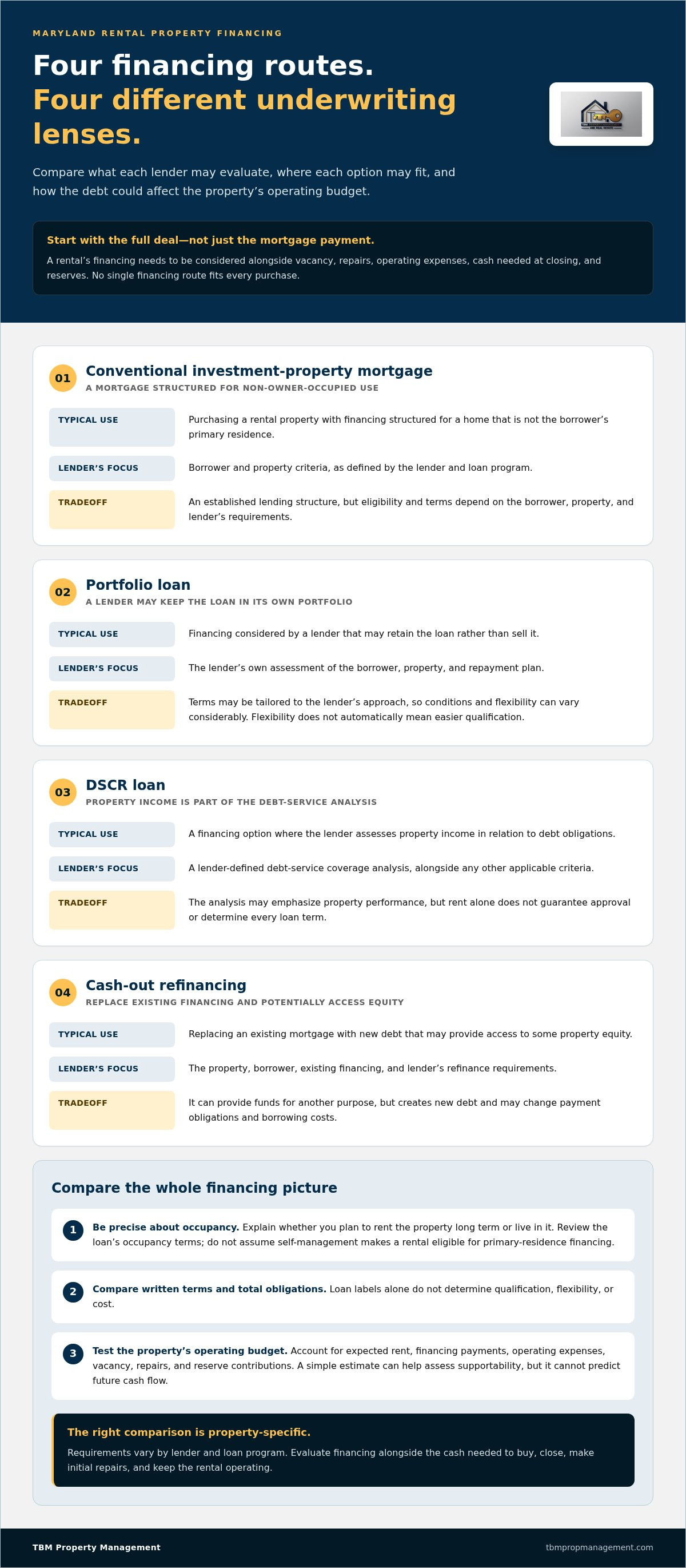
No single financing route fits every rental purchase. Compare what the lender evaluates, how much flexibility the structure offers, and how the debt could affect the property’s operating budget. The options below are a starting point for comparison, not a promise of eligibility or approval.
| Financing option | Typical use case | Underwriting focus | Flexibility and tradeoffs |
|---|---|---|---|
| Conventional investment-property mortgage | Purchasing a rental property with a mortgage structured for non-owner-occupied use. | Borrower and property criteria, as defined by the lender and loan program. | Established lending structure, but eligibility and terms depend on the borrower, property, and lender’s requirements. |
| Portfolio loan | Financing considered by a lender that may keep the loan in its own portfolio. | The lender’s own assessment of the borrower, property, and repayment plan. | Terms may be tailored to the lender’s approach, so conditions and flexibility can vary considerably. |
| DSCR loan | A financing option where the lender assesses property income in relation to debt obligations. | A lender-defined debt-service coverage analysis, alongside any other applicable criteria. | May place emphasis on property performance, but rent alone doesn’t guarantee approval or determine every loan term. |
| Cash-out refinancing | Replacing an existing mortgage with new debt that may provide access to some property equity. | The property, borrower, existing financing, and lender’s refinance requirements. | Can provide funds for another purpose, but creates new debt and may change payment obligations and borrowing costs. |
How do conventional and portfolio loans differ?
Conventional underwriting considers both borrower and property qualifications, with specific criteria set by the loan program and lender. A portfolio lender may retain a loan rather than sell it, and can set its own terms. That flexibility doesn’t automatically mean easier qualification; the lender’s policies still determine the requirements. Compare written terms and total obligations rather than relying on the loan label.
When might DSCR financing or refinancing enter the discussion?
DSCR analysis relates property income to debt service, but lenders define which income and expenses count and may consider other factors. Cash-out refinancing also merits careful review: accessing equity creates new debt, and the revised payments need to fit the property’s operating assumptions. These are general financing concepts, not individualized financial advice.
Rates, down payments, reserves, fees, and eligibility vary by lender and borrower. For Maryland-specific housing resources, review information from the Maryland Department of Housing and Community Development. Financing is only one part of owning a rental. TBM Property Management provides residential property management support for leasing, rent collection, inspections, and maintenance coordination as you plan for managing an investment property in maryland.
Will the Rental Income Support the Financing? Underwrite the Property
A rent estimate is only a starting point. To judge whether a Maryland rental can carry its financing, compare expected income with debt service, operating costs, and cash reserves. Gross rent is money collected before expenses; net cash flow is what remains after financing payments and property costs are accounted for.
Build a simple worksheet for a typical month, then review the annual picture for irregular expenses:
- Expected rent collected: Start with a realistic rent estimate, then allow for vacancy, leasing gaps, and delayed or missed payments.
- Debt service: Enter the projected principal and interest payment, plus any other required loan payments.
- Recurring operating costs: Include property taxes, insurance, utilities paid by the owner, routine maintenance, and management.
- Irregular costs and reserves: Budget for turnover, repairs, and larger capital work. Set aside reserves rather than assuming every month will run smoothly.
Use property-specific figures wherever possible. Check the tax bill and applicable local charges for the address, and obtain insurance estimates based on the actual property. If a property manager will handle leasing, rent collection, inspections, or maintenance coordination, include the related management expense in your model. Management helps organize operations, but it does not remove vacancy or repair risk.
Which expenses can change the property’s cash-flow picture?
Separate predictable bills, such as recurring debt payments and insurance, from variable maintenance and less frequent capital work. Turnover can mean both a gap in rent and costs to prepare the unit for a new tenant. Don’t count every scheduled rent payment as collected income. For information about Maryland real estate practices, consult the Maryland Real Estate Commission.
How can investors stress-test rent and debt assumptions?
Compare a base case with a more conservative scenario. Change one assumption at a time, then see how the remaining cash flow responds:
- Lower-rent scenario: Test whether the numbers still work if achievable rent is below your initial estimate.
- Vacancy scenario: Model a period without rental income, including a possible leasing gap between tenants.
- Repair scenario: Add an unexpected repair and assess whether available reserves can absorb it without disrupting debt payments.
Compare income with debt service and all operating obligations, not just the mortgage. Projected appreciation or gross rent alone doesn’t establish that a property is profitable. For anyone managing an investment property in maryland, realistic estimates for leasing, rent collection, and maintenance make the operating side of the calculation more useful, though actual results still depend on the property and its costs.
Maryland Due Diligence Before You Finance a Rental Property
A financing plan is only as reliable as the property details behind it. Before committing, confirm how the address can be used, understand its condition and local requirements, organize lender materials, and update your cash-flow estimate with what you learn. Maryland rules and local processes can vary, so verify current requirements for the specific property rather than relying on a general checklist alone.
What should you verify about the property and jurisdiction?
Start with the address and intended rental use. Check the relevant county and municipal sources for zoning, rental registration or licensing, inspection, and tax requirements that apply. Then assess the property’s physical condition, likely repairs, insurance availability, and ongoing maintenance needs. These findings can change both the cash you need before closing and the reserves that make sense afterward.
- Confirm local requirements: Identify which county and municipality have jurisdiction, then check their current rental-property rules and processes.
- Review condition and repairs: Document known issues and expected work, distinguishing immediate repairs from future maintenance.
- Recheck property costs: Verify applicable property taxes and local charges, and obtain insurance information for the specific address.
- Revisit the numbers: Update your rent, expense, and reserve estimates if inspections or local research reveal new costs or constraints.
For a separate overview of landlord-tenant topics, read this Maryland landlord-tenant rights guide. Use it as a starting point for research, and verify current requirements through relevant state, county, and municipal sources before acting.
What information may lenders request?
Prepare to discuss your finances and the property, but remember that lenders don’t all use the same checklist. Depending on the loan and lender, requested materials may include borrower financial information, property details, existing or proposed leases, and records supporting income estimates. Lenders may also set their own documentation and reserve requirements.
- Borrower information: Financial records or other documents requested to assess the application.
- Property information: Purchase details, condition information, and materials relevant to the lender’s property review.
- Rental information: Leases, if available, and income records or estimates requested for the loan assessment.
Keep documents organized, but remember that preparation doesn’t guarantee approval. Before finalizing financing decisions, compare the lender’s actual requirements with updated property costs and your revised cash-flow estimate. A sound purchase plan for managing an investment property in maryland should also account for leasing, tenant placement, rent collection, inspections, and maintenance coordination. Explore residential rental property management as you plan for those responsibilities.
Plan for Ownership After Closing: Financing Meets Property Management
Closing completes the purchase, not the work of owning a rental. Your operating plan should identify who will handle tenant placement, leasing, screening, rent collection, inspections, and maintenance coordination. These tasks affect how consistently the property is overseen and what responsibilities remain with you. Management does not guarantee occupancy, investment returns, or loan approval.
Which operating tasks should your plan account for?
Map the recurring work before deciding how you’ll handle it. Leasing and tenant screening shape the process of placing renters. Rent collection and recordkeeping help you track payments and follow up on account questions. Inspections and maintenance coordination help you monitor property condition and organize repairs. Tenant communication and clear records also take time, so include them in your ownership workload rather than treating them as incidental tasks.
For a closer look at how these responsibilities fit together, read the full-service property management guide. Use the task list to clarify which responsibilities you’ll manage yourself and which you’d prefer to have coordinated.
How can management support a Maryland rental investment?
Coordinated leasing and rent collection help organize important parts of ongoing rental operations. Tenant placement, inspections, and maintenance coordination support day-to-day oversight. These services provide operational support, not a substitute for realistic financial planning: rent can be interrupted, repairs can arise, and investment performance can vary.
Local context matters, too. TBM Property Management serves residential rental owners in Laurel and Anne Arundel, Prince George’s, Montgomery, and Howard Counties. Familiarity with these communities informs the practical work of leasing and property oversight. Address-specific requirements and property costs still belong in your due diligence.
As you plan for managing an investment property in maryland, consider how much time you can devote to these responsibilities and what support would make ownership more manageable. Read about professional property management in Maryland, or explore residential property management services to plan the next steps for your rental.
Move Forward With a Clear Rental Ownership Plan
A sound financing decision looks beyond the loan. Compare options based on lender-specific terms, estimate the full costs of ownership, and test whether projected rent can support debt payments and operating expenses under less favorable conditions. Before committing, verify requirements for the property’s Maryland county or municipality and update your cash-flow assumptions with what you learn.
Planning for the work after closing matters, too. Leasing, tenant screening, rent collection, inspections, and maintenance coordination shape the day-to-day demands of managing an investment property in maryland. Local support can help organize those operations, but it can’t guarantee occupancy, returns, or financing approval.
TBM Property Management brings more than 12 years of local real estate experience, serving Anne Arundel, Prince George’s, Montgomery, and Howard Counties. If you’re ready to plan for the operational side of rental ownership, explore full-service property management for Maryland rentals. Pair careful due diligence with a practical ownership plan to move toward your investment decision with greater clarity.
Frequently Asked Questions
How do you finance an investment property in Maryland?
Compare lender options, then review the borrower and property requirements for each loan type. Build a property-specific estimate that includes the down payment, closing expenses, immediate repairs, recurring costs, and reserves, rather than focusing on the mortgage payment alone. Loan terms and eligibility vary, so verify current rates, conditions, and documentation requirements directly with a lender. This article provides general education, not individualized financial advice or a guarantee of approval.
Can you use a conventional mortgage to buy a Maryland rental property?
Some conventional mortgage products may finance an investment property, but details depend on the lender and product. Eligibility, pricing, down payment, reserve requirements, and occupancy rules can differ. Describe the property’s intended use accurately and verify the requirements for the specific property and loan before making plans. Don’t assume that a conventional mortgage option is available or approved based only on expected rent.
How much money do you need upfront for an investment property?
The amount depends on the lender’s terms, closing expenses, immediate repairs, the property’s condition, and the reserves you plan to keep. Separate purchase funds and closing costs from initial work and cash for ongoing operations. Then estimate recurring debt payments, taxes, insurance, utilities, vacancy, maintenance, and management. Build the estimate around the specific property and financing offer, since no single dollar amount or percentage applies to every investment purchase.
Can projected rental income help you qualify for an investment-property loan?
Some lenders consider rental income, using their own documentation and calculation rules. They may review existing leases, income records, or property details, but projected rent isn’t guaranteed income and doesn’t ensure loan approval on its own. A lender may also assess borrower finances and other factors as part of underwriting. Ask how rental income is evaluated for the specific loan, and keep your own cash-flow estimate grounded in realistic rent and expenses.
Are investment-property loans different from primary-residence mortgages?
Yes, intended occupancy can affect which loan products are available and how an application is underwritten. A property intended as a long-term rental may be evaluated differently from a home the borrower plans to occupy. Terms and requirements vary by lender and product, so describe your intended use accurately and review the specific occupancy definitions before applying. Don’t assume that managing the home yourself makes it eligible for primary-residence financing.
What Maryland requirements should you check before renting out an investment property?
Check whether licensing, registration, inspection, tax, and landlord-tenant requirements apply to the specific property. Details can vary by jurisdiction and property, so verify current information with relevant Maryland state, county, and municipal sources before committing or renting. Confirm which local authorities have jurisdiction over the address, and include applicable requirements or charges in your operating plan. This makes managing an investment property in maryland more informed, without relying on broad assumptions.
Is a rental property a good investment if the rent covers the mortgage?
Mortgage coverage alone doesn’t establish that a rental is profitable. Compare expected rent with debt payments and the full range of ownership costs, including vacancy, turnover, maintenance, insurance, property taxes, management, and reserves. Also test what happens if rent is lower than expected or a repair arises. Assess the property using realistic, property-specific assumptions, not gross rent alone. No cash-flow estimate can guarantee future returns or occupancy.