
Handling Late Rent Payments in Maryland: A Landlord’s 2026 Guide to Legal Compliance and Cash Flow
Did you know that a single administrative error in your notice of intent can completely reset your legal timeline and keep your rental income in limbo for weeks? Managing property in Maryland has become increasingly complex since the Renters' Rights and Stabilization Act took effect, and it's natural to feel overwhelmed by the strict compliance standards. We understand the frustration of watching your cash flow stall while you worry about accidentally violating local laws in jurisdictions like Montgomery or Prince George’s County. If you're currently handling late rent payments maryland, you aren't alone in your search for a more stable, professional way to manage these difficult tenant interactions.
You deserve a clear, stress-free roadmap that protects both your investment and your peace of mind. In this 2026 guide, you'll learn the exact legal steps required to resolve late rent issues while staying fully compliant with the latest state mandates. We'll explore the mandatory 10-day notice requirement, the specific limits on late fees, and professional strategies to restore your monthly income. By the end of this article, you'll have the tools to move from a state of confrontation to a state of ease. Our goal is to provide the expert clarity you need to stabilize your portfolio and protect your long-term interests.
Key Takeaways
- Master the mandatory 10-day notice of intent to file a complaint to ensure your legal timeline remains on track and compliant with Maryland state law.
- Discover how to balance professionalism with firmness when handling late rent payments maryland, including the use of effective communication scripts during grace periods.
- Navigate the complexities of the Summary Ejectment process and the local District Court system with a clear, step-by-step roadmap for filing failure-to-pay-rent complaints.
- Implement high-standard preventative measures like rigorous tenant screening and online payment portals to minimize the risk of future income disruptions.
- Learn how a dedicated property management partner provides professional relief by acting as an authoritative buffer and managing the entire collection process for you.
Understanding the Maryland 10-Day Notice & Legal Timeline
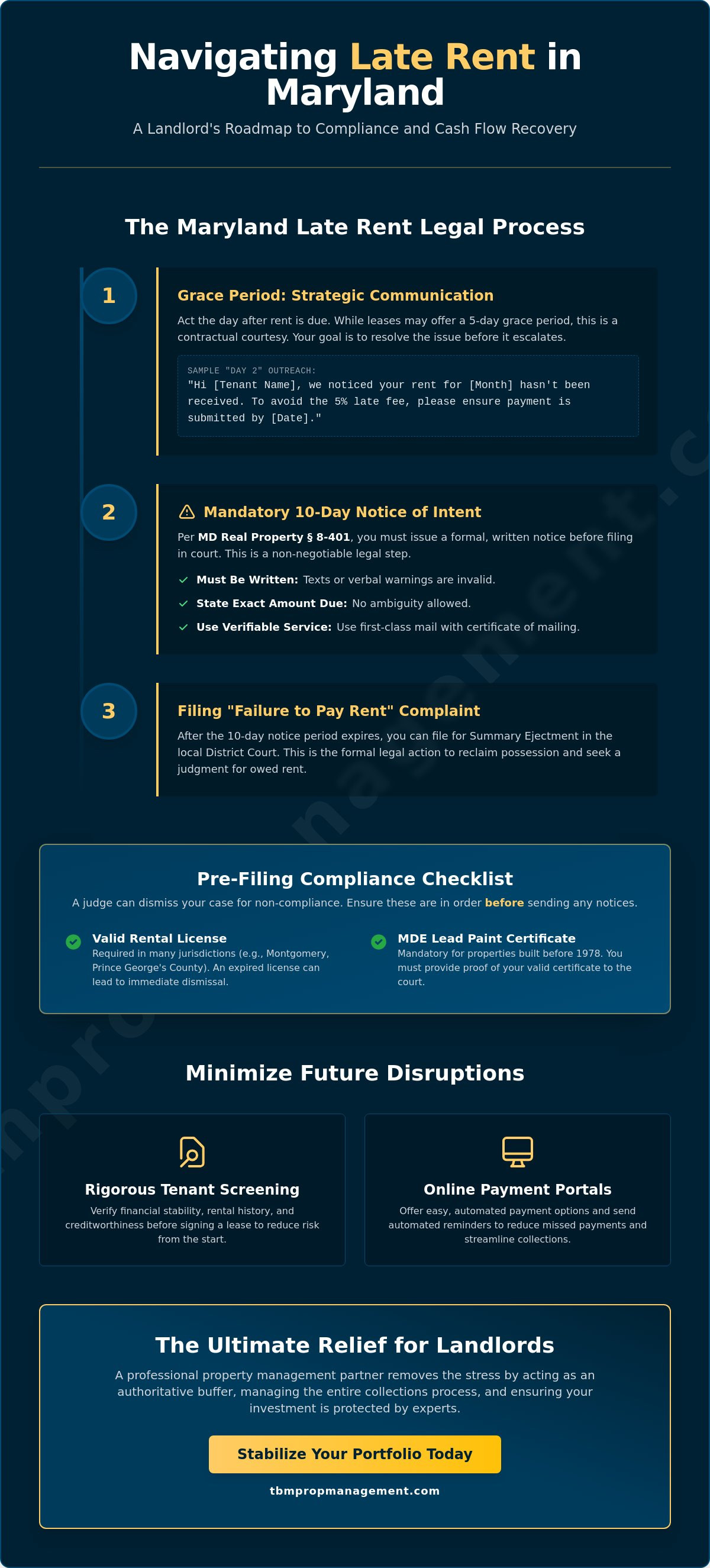
Is your investment income currently stuck in a cycle of excuses? When you're handling late rent payments maryland, the state's legal framework requires a very specific sequence of events before you can seek relief in court. Under Maryland Real Property § 8-401, you can't simply file for eviction the moment a payment is missed. Instead, you must provide a formal written notice of your intent to file a summary ejectment complaint. This notice acts as a bridge between the legal framework of a lease and the judicial process, giving your tenant exactly 10 days to cure the balance before you take further action.
The clock doesn't start the moment you write the letter; it begins the day after the notice is delivered or posted. If you mail the notice, Maryland law typically presumes three days for delivery. Calculating this incorrectly is one of the most common mistakes we see, and it often leads to judges dismissing cases during the hearing. You should always document your service methods meticulously, whether through a certificate of mailing or a dated photograph of the notice posted on the property door. This level of detail provides the professional relief you need when standing before a judge.
The 10-Day Notice Requirements
Your notice must clearly state the total amount of rent due and your intent to file for summary ejectment if the balance isn't paid within ten days. Don't rely on verbal warnings or casual text messages; these hold zero weight in a Maryland District Court. To ensure your documentation is airtight, we recommend using first-class mail with a certificate of mailing. This provides the court with verifiable proof that you followed the statutory requirements for handling late rent payments maryland, preventing unnecessary delays in your case.
Licensing: The Hidden Prerequisite
Before you even issue a notice, have you verified your local compliance? In jurisdictions like Prince George’s County or Montgomery County, your right to use the court system is often tied directly to your rental license status. If your license is expired or missing, a judge may dismiss your case immediately, regardless of how much rent is owed. Additionally, if your property was built before 1978, you must provide proof of your Maryland Department of the Environment (MDE) lead paint inspection certificate. Without these credentials, your legal path to restoring cash flow remains blocked.
Strategic Communication: Handling the Grace Period Professionally
How do you handle that uncomfortable moment when the first of the month passes and the rent check hasn't arrived? It's a high-stress situation that requires a delicate balance of empathy and professional firmness. While your lease might offer a five-day grace period, it's vital to remember that this is a contractual courtesy, not a legal requirement under state law unless specified by local jurisdictions. Understanding this distinction is the first step in effectively handling late rent payments maryland without damaging the landlord-tenant relationship or your own cash flow.
If a tenant misses the deadline, your goal is to resolve the issue before it escalates into the formal Maryland's summary ejectment process. You can offer a compassionate ear for a genuine one-time hardship, such as a sudden medical expense or a temporary payroll glitch. However, you must maintain clear business boundaries to prevent "serial lateness" from becoming the new norm. If you find yourself constantly chasing payments or listening to the same excuses every month, it might be time to transition to a more structured approach. Many landlords find that utilizing professional rent collection helps remove the emotional friction from these interactions, positioning a third party as the stabilizing force.
The "Day After" Outreach
Success often lies in the speed of your response. We recommend using automated email or text reminders the day after rent is due to take the emotion out of the transaction. A professional "Day 2" script might look like this: "Hi [Tenant Name], we noticed your rent payment for [Month] hasn't been received yet. To avoid the 5% late fee, please ensure your payment is submitted through the portal by [Date]." This keeps the conversation focused on the lease terms rather than personal feelings. Always document these exchanges; they serve as valuable evidence if you eventually need to demonstrate a pattern of non-payment in court.
Standardizing Your Late Fee Policy
Maryland law is very specific about financial penalties: you cannot charge a late fee that exceeds 5% of the monthly rent. Whether your property is in Baltimore, Annapolis, or a smaller local community, you must apply these fees consistently across all your units. Playing favorites or waiving fees for some tenants but not others can leave you vulnerable to Fair Housing or discrimination claims. When you explain the "why" behind the fee, frame it as a standard business practice required for high-quality property oversight. This transparency helps maintain a professional rapport while reinforcing that rent is a non-negotiable priority.
Navigating the Maryland Summary Ejectment Process
When the 10-day notice period expires and your tenant still hasn't settled their balance, the next step in handling late rent payments maryland is filing a Failure to Pay Rent complaint. This legal action, known as summary ejectment, is designed to be faster than standard civil litigation, but it requires absolute precision in your documentation. You aren't just asking for money; you're asking the District Court for a judgment of possession. This judgment grants you the legal right to reclaim your property if the tenant doesn't pay what they owe.
One of the most complex aspects of Maryland Code § 8–401 is the tenant's "Right to Redeem," often called the pay-and-stay rule. In Maryland, a tenant can stop an eviction at almost any time, even on the day the sheriff arrives, by paying all past-due rent, late fees, and court costs. However, there is a limit to this protection. If you've obtained three or more judgments for possession against the same tenant within the previous 12 months, you can ask the judge to "foreclose" the right to redeem, which means the tenant can no longer stay just by paying the balance.
You also need to decide whether you're seeking a money judgment or just possession. While a judgment for possession allows you to evict, a money judgment allows you to pursue the tenant's assets or garnish wages later. To get a money judgment, the tenant must be served personally by the sheriff or a private process server, or they must show up to the hearing and defend the case. If the summons is simply posted on the door, the court can usually only grant you possession of the property.
Step-by-Step Court Filing
To begin, you'll need to complete form DC-CV-082 accurately. Any discrepancy between the amount listed on your 10-day notice and the court filing can lead to an immediate dismissal. Filing fees and sheriff service costs vary by jurisdiction, so check the specific rates for Prince George’s or Montgomery County before you submit your paperwork. Once filed, a trial date is typically set within five to fifteen days, though local court backlogs may extend this timeline.
The Trial and Judgment
On your trial date, your rent ledger is your most important piece of evidence. It should clearly show every charge and payment date to counter any tenant claims of "lost checks." Tenants may attempt to raise a "Rent Escrow" defense, claiming they withheld rent due to property defects. However, under Maryland law, they must have provided you with written notice of the issues and a reasonable time to fix them before they can legally stop paying. If you win, the tenant has a four-day window to appeal the judgment before you can move forward with a warrant of restitution.
Preventative Measures: Avoiding Late Payments Before They Happen
Wouldn't it be easier if you never had to step foot in a courtroom or draft a 10-day notice? While the legal process provides a necessary safety net, the most successful property owners in Prince George’s and Montgomery County focus on prevention. Effectively handling late rent payments maryland begins long before the first of the month. It starts with a proactive management style that eliminates the common friction points leading to missed deadlines. By setting clear expectations and providing modern tools, you can transform your rental from a source of stress into a stabilized, high-performing asset.
The first line of defense is always a rigorous tenant screening process. We've found that verifying at least three times the monthly rent in income and checking for a history of stable housing are the best predictors of future payment behavior. Once you've selected a reliable tenant, use the move-in orientation to walk through the lease's late rent clauses. Explicitly explain when rent is due, how late fees are calculated, and the exact date the legal notice process begins. This transparency establishes a professional boundary from day one, ensuring the tenant understands that rent is a non-negotiable priority.
Engagement doesn't stop at move-in. Conducting regular property inspections serves a dual purpose. It allows you to catch maintenance issues early and reminds the tenant that you're an active, diligent partner in their housing experience. When a landlord is responsive and the property is well-maintained, tenants are statistically more likely to prioritize their rent payments out of mutual respect. If you're tired of chasing checks and want a more proactive approach, our full-service property management can handle these preventative systems for you.
Incentivizing On-Time Payments
Positive reinforcement can be just as effective as late fee penalties. Many modern landlords now offer positive credit reporting as a tenant benefit, where on-time payments help build the tenant’s credit score. This creates a tangible "win" for the renter. While some consider "early bird" discounts, we generally find that consistent maintenance responsiveness and a culture of respect are more reliable drivers of on-time behavior. When tenants feel valued, they're less likely to let their payment slip to the bottom of their monthly budget.
Leveraging Technology for Rent Collection
Paper checks are the enemy of consistent cash flow. To eliminate the "check is in the mail" excuse, you should implement an online payment portal that supports ACH and credit card options. Technology allows you to set up automated late fee triggers that apply the 5% Maryland cap exactly when the grace period ends. This takes the personal confrontation out of the equation. Providing multiple frictionless ways to pay ensures that even a busy tenant can settle their balance in seconds from their smartphone, keeping your revenue steady and predictable.
Why Professional Management Is the Ultimate Relief for MD Landlords
Why carry the heavy emotional burden of asset oversight alone? Managing a rental property shouldn't feel like a second full-time job that keeps you up at night. When you're handling late rent payments maryland, the pressure to remain compliant while protecting your cash flow can be exhausting. This is where a dedicated partner makes all the difference. By positioning ourselves as a professional buffer, we remove you from the friction of tenant confrontations and the stress of legal deadlines. Our goal is to transform your rental from a source of constant anxiety into the passive, high-performing investment you originally intended it to be.
With over 12 years of experience navigating the complexities of Maryland landlord-tenant rights, we've developed airtight systems that prioritize your security. We understand the nuances of the 2026 legal landscape, from the strict 5% late fee caps to the precise wording required in a 10-day notice. Mistakes in these areas don't just cause delays; they can lead to costly Fair Housing violations or dismissed court cases. By leaning on our seasoned expertise, you ensure that every action taken is legally sound, protecting both your reputation and your financial interests.
The TBM Advantage in Rent Collection
Our approach to rent collection is built on a foundation of proactive communication and early intervention. We don't wait for a payment to be weeks late before taking action. Instead, our team uses a structured methodology that identifies potential issues during the grace period, often resolving them through professional dialogue before they require a court filing. If a situation does escalate, we handle the entire legal process from the initial notice of intent to the final warrant of restitution. You'll receive consistent, transparent financial reporting through our secure portal, so you always know exactly where your money is without having to ask.
Ready for a Stress-Free Rental Experience?
Investors in Laurel and throughout Prince George’s County trust us with their high-value assets because we treat every property with the same diligence we'd use for our own. The true ROI of professional management isn't just found in faster collections or fewer vacancies; it's found in the restoration of your peace of mind. We take the "work" out of being a landlord so you can focus on what matters most to you. Are you ready to see how a stabilized management plan can protect your investment? Get your complimentary rental analysis from TBM today!
Restore Your Cash Flow and Peace of Mind
Managing a rental property in Maryland shouldn't be a source of constant anxiety. By mastering the mandatory 10-day notice requirement and implementing rigorous preventative measures like modern payment portals, you've already taken the first steps toward a more stable portfolio. You now have a clear, professional roadmap for handling late rent payments maryland, from initial outreach to navigating the summary ejectment process in the local District Court. These strategies are essential for protecting your investment and ensuring your legal compliance remains airtight.
However, you don't have to manage these complexities alone. With over 12 years of local real estate expertise in Anne Arundel, PG, Montgomery, and Howard Counties, TBM Property Management is here to act as your dedicated partner. We offer full-service management, including professional tenant screening and precise legal filing, to ensure your cash flow remains consistent. It's time to step away from the frustration of self-management and enjoy the relief of professional-grade results.
Let TBM Property Management Handle the Stress of Rent Collection—Contact Us Today!
We're ready to help you stabilize your rental income and restore the security you deserve. Your investment is a valuable asset, and with the right professional support, it can finally become the passive income stream you've always wanted.
Frequently Asked Questions
How long does the eviction process take in Maryland for non-payment of rent?
The summary ejectment process generally takes between 3 and 8 weeks from the initial notice to the final lockout. This timeline includes the mandatory 10-day notice period, the time to secure a court date, and the subsequent 4-day appeal window following a judgment. Local court backlogs in jurisdictions like Prince George’s County can sometimes extend this period beyond the standard timeframe.
Can I change the locks if my tenant in Maryland hasn’t paid rent?
No, you cannot use "self-help" measures like changing locks or turning off utilities to remove a tenant. Maryland law requires a court-supervised process and a specific court order known as a Warrant of Restitution to legally reclaim your property. Attempting an illegal eviction can lead to significant legal penalties and damages awarded to the tenant, which often far exceed the unpaid rent.
What is the maximum late fee I can charge in Maryland in 2026?
The maximum late fee you can legally charge is 5% of the monthly rent amount. For weekly rentals, the limit is $3 per week up to a monthly maximum of $12. You must have this fee clearly specified in your written lease agreement to enforce it when handling late rent payments maryland. Charging more than the statutory limit can result in your entire court case being dismissed.
Do I need a lawyer for a Failure to Pay Rent case in Maryland District Court?
While individual landlords can represent themselves, corporations are generally required to have legal representation in Maryland courts. Many owners choose to work with a professional property management firm to handle these filings on their behalf. This ensures all documentation is accurate and compliant with the latest state mandates without the stress of personal court appearances or administrative errors.
What is the "Right to Redeem" and how many times can a tenant use it?
The "Right to Redeem" allows a tenant to stop an eviction by paying all past-due rent and court costs at any time before the sheriff completes the lockout. A tenant can typically use this right an unlimited number of times. However, if you've obtained three or more judgments for possession within a 12-month period, you can ask the court to foreclose this right and proceed with the eviction regardless of payment.
Can I refuse a partial rent payment in Maryland?
Yes, you have the right to refuse a partial payment if you intend to move forward with the summary ejectment process. Accepting even a small portion of the rent can sometimes waive your current legal action or require you to refile with a new 10-day notice. It's usually best to demand the full balance to maintain your legal standing and avoid confusing the court ledger during your hearing.
How much does it cost to file a Failure to Pay Rent complaint in MD?
Filing fees vary by county but typically include a base court fee plus a sheriff service fee for each tenant listed on the lease. These costs are relatively low compared to other civil lawsuits but must be paid upfront at the time of filing. It's best to check the current fee schedule for your specific Maryland District Court location to ensure you provide the correct payment with your DC-CV-082 form.
What should I bring to my rent court hearing in Maryland?
You should bring your original signed lease, a detailed rent ledger showing all charges and payments, and proof that you delivered the 10-day notice. Additionally, you'll need your current rental license and a lead paint certificate if the property was built before 1978. Having these documents organized provides the professional clarity needed to win your case and demonstrates your commitment to legal compliance.