
Handling Late Rent Payments Legally in Maryland: A Landlord’s 2026 Guide
What if a single clerical error on a notice form could cost you months of rental income and leave you vulnerable to legal penalties? It's a question that keeps many local property owners awake at night. Since the Renters’ Rights and Stabilization Act took effect in late 2024, handling late rent payments legally in maryland requires absolute precision and a deep understanding of the current statutes. You've invested significant time and capital into your properties, yet the increasing complexity of tenant protections can make even a simple collection feel like a legal minefield.
We recognize the emotional burden of managing these assets while trying to maintain professional boundaries with your tenants. You shouldn't have to choose between protecting your investment and staying on the right side of the law. This guide offers a clear roadmap to navigate the 2026 regulatory environment with confidence. We'll outline the mandatory 10-day notice requirements, the strict 5% late fee limits, and the essential documentation you need to ensure your rent collection process remains compliant and effective.
Key Takeaways
- Learn why the 10-day Notice of Intent is your most critical document for maintaining a compliant and successful collection timeline.
- Understand the 2026 late fee caps to ensure you're only charging what's legally permissible on overdue rent portions.
- Gain a clear roadmap for handling late rent payments legally in maryland through the formal summary ejectment process in local District Courts.
- Avoid the devastating financial consequences of "self-help" evictions by sticking to court-approved methods of possession recovery.
- Discover how professional rent collection and property management can alleviate the emotional burden of tenant confrontations.
Understanding the Maryland 10-Day Notice of Intent
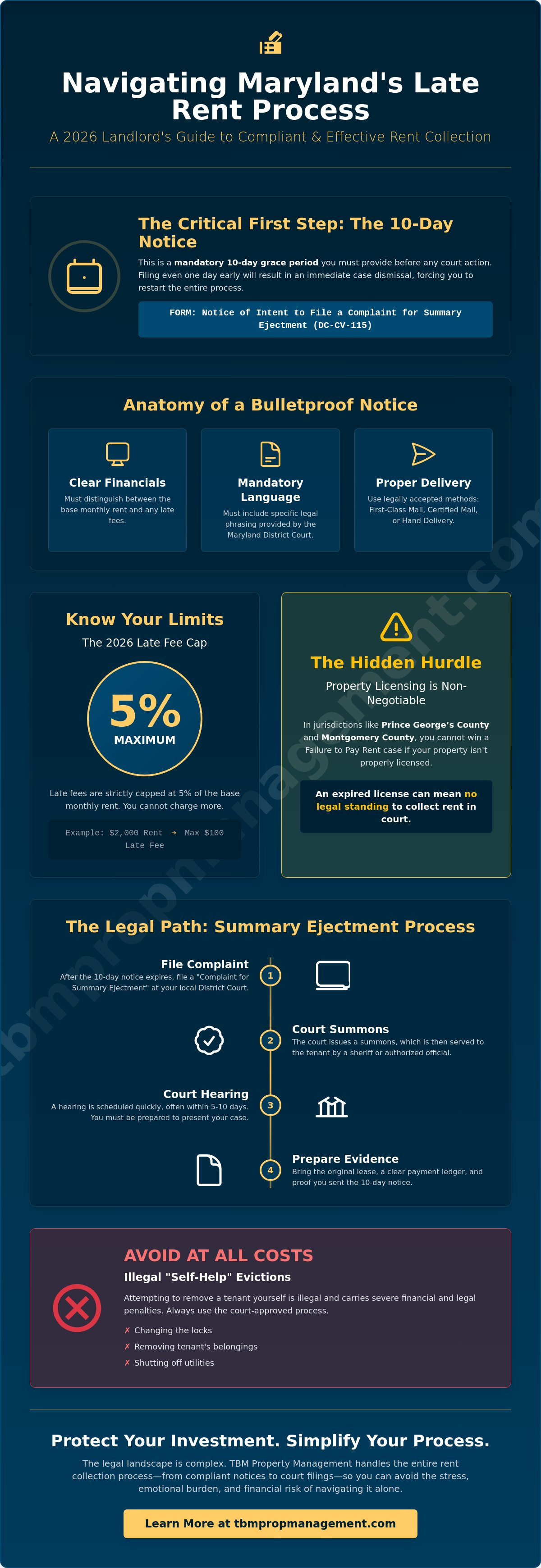
Handling late rent payments legally in maryland is no longer a matter of simply sending a polite reminder or making a phone call. As of 2026, the law requires a formal, document-driven approach that starts with the "Notice of Intent to File a Complaint for Summary Ejectment" (Form DC-CV-115). This isn't just a suggestion; it's a mandatory 10-day grace period that you must provide before you can even step foot in a courtroom. If you file your case on day nine, the District Court will likely dismiss your complaint immediately. This mistake forces you to start the entire process over from scratch while your financial loss continues to grow.
The 10-day window gives your tenant a final opportunity to cure the balance before legal fees and court costs enter the picture. While it might feel frustrating to wait when the mortgage is due, this period acts as a vital legal safeguard for you. It demonstrates to the court that you've acted in good faith and followed the prescribed The Eviction Process. Consistency here is your best defense against claims of harassment or improper procedure. We find that many tenants prioritize payment once they receive this formal notice, often resolving the issue without further legal intervention.
What Must Be Included in the Notice?
To ensure your notice carries legal weight, it must be precise. You cannot simply state a lump sum. The document needs to clearly distinguish between the base monthly rent and any late fees, which are strictly capped at 5% of the monthly rent. Including mandatory language provided by the Maryland District Court is non-negotiable. For delivery, you have three reliable options:
- First-Class Mail: This is the standard legal requirement for providing notice.
- Certified Mail: This provides a paper trail of receipt, which is excellent evidence if the case goes to trial.
- Hand Delivery: This is direct and immediate, though it can be the most stressful for self-managing landlords.
The Importance of Licensing Before Filing
Many landlords overlook a critical regional requirement that can stop a legal collection effort in its tracks: property licensing. In jurisdictions like Prince George’s County and Montgomery County, you cannot legally win a Failure to Pay Rent case if your property isn't properly licensed. Before you send that 10-day notice, verify that your Laurel, MD rental license is current and active. If your license has expired, the court may rule that you have no legal standing to collect rent through the summary ejectment process. Taking a moment to confirm your compliance now saves you from a costly and embarrassing defeat in the courtroom later. Professional property management ensures these details are handled long before a payment is missed.
The Summary Ejectment Process: From Filing to Court
Once the 10-day notice period expires without payment, your next move is filing a "Complaint for Summary Ejectment" at your local District Court. In our region, this often means visiting the court in Laurel or Upper Marlboro. This formal step officially begins the summary ejectment process. When you file, you'll need to pay a filing fee. It's important to remember that under the 2024 Renters’ Rights and Stabilization Act, these fees cannot be passed on to your tenant unless you win the case and the judge specifically awards them as a deduction from the security deposit later.
After filing, the court issues a summons. A sheriff or authorized official will then serve this summons to the tenant, typically by posting it on the property and mailing a copy. A hearing is usually scheduled within 5 to 10 days. This quick turnaround is designed to provide relief, but it also means you must be ready to present your case on short notice. If the prospect of standing before a judge feels overwhelming, partnering with a firm that specializes in professional rent collection can provide the peace of mind you need.
Preparing Your Evidence for the Hearing
Victory in court depends on your documentation. You must bring the original lease agreement and a clear, chronological ledger showing every payment and missed balance. Judges in Maryland have little patience for messy records. You also need to prove you sent the mandatory 10-day notice, so keep your certificates of mailing or signed delivery receipts handy. Be prepared for common tenant defenses, such as "Rent Escrow" or "Habitability" claims. If a tenant argues that the property is unsafe, they may ask the court to hold their rent in an escrow account until repairs are made. Having recent property inspection reports can help you counter these claims effectively.
Judgment and the Right of Redemption
If the judge rules in your favor, they will grant a "Judgment for Possession." This gives you the legal right to the property. However, it's distinct from a "Money Judgment," which is a separate ruling for the actual cash owed. Most importantly, Maryland law provides tenants with a "Right of Redemption." This means they can stop the eviction at any time before the sheriff arrives by paying all past-due rent and court-awarded costs. There's a limit to this leniency, though. If you have successfully won three judgments against the same tenant within the last 12 months, you can ask the court to "foreclose" the right of redemption on the fourth filing. This "three-strike" rule is a powerful tool for handling late rent payments legally in maryland when dealing with chronic late payers.
Calculating Late Fees Legally Under 2026 Maryland Law
How do you calculate a late fee when a tenant only pays half the rent? It's a common point of confusion that can lead to significant legal trouble if handled incorrectly. Under current 2026 Maryland law, the rules for financial penalties are rigid and leave no room for error. The 5% cap is the maximum allowable penalty for late rent. However, you can only charge this 5% against the overdue portion of the rent, not the total monthly amount. If your tenant pays $1,500 toward a $2,000 balance, your late fee must be calculated based only on the remaining $500. Charging a fee based on the full $2,000 is now considered an illegal penalty and can lead to your case being thrown out during the Maryland Courts eviction process.
For landlords managing weekly rentals, the restrictions are even tighter. Fees are capped at $3 per week, with a absolute maximum of $12 per month. These limits are non-negotiable. Even if your tenant signs a lease agreeing to a higher amount, Maryland law overrides that contract. Including unenforceable clauses doesn't just look unprofessional; it puts your entire investment at risk by signaling to the court that you aren't following state regulations. When handling late rent payments legally in maryland, accuracy in your ledger is your strongest asset.
Handling Partial Payments Correctly
Accepting partial payments after you've already filed for summary ejectment is a delicate situation. While receiving some cash flow is helpful, it can complicate your legal standing if you don't document it perfectly. You must ensure your ledger reflects exactly when the payment was received and how it was applied to the balance. If you don't clearly state that the partial payment does not waive your right to continue the eviction for the remaining balance, a tenant might argue you've reached a new agreement. This level of meticulous detail ensures you don't accidentally lose your standing in court while trying to be flexible with a tenant.
Lease Compliance and Enforcement
Is your lease actually protecting you, or is it a liability? Many self-managing landlords use outdated templates that haven't been updated for the 2024 or 2025 legislative shifts. Understanding landlord tenant rights maryland is the only way to ensure your lease remains a shield rather than a target. We often see leases with "daily" late fees or flat rates that exceed the 5% cap. These are red flags for judges. Professional lease drafting and rent collection services remove this guesswork, ensuring every dollar you charge is fully defensible. When your documentation is beyond reproach, you can manage your properties with a sense of security and professional pride.
Avoiding "Self-Help" and Legal Pitfalls
When the rent is weeks overdue and communication has stopped, it's natural to feel a sense of urgency. However, taking matters into your own hands through "self-help" evictions is a catastrophic legal mistake that can lead to massive tenant lawsuits. In Maryland, self-help includes changing the locks, removing a tenant's belongings, or shutting off essential utilities like water or electricity. These actions are strictly prohibited. If you bypass the court system, you aren't just risking your current case; you're inviting the court to award damages to the tenant. Maintaining high real estate management maryland standards means following the law even when the process feels slow.
Consistency is your strongest shield against liability. You must treat every late payment with the same procedural rigor. If you make "casual exceptions" for one late payer but strictly enforce the rules for another, you could face claims of discriminatory treatment or housing bias. Handling late rent payments legally in maryland requires a uniform approach that prioritizes documentation over personal relationships. By sticking to a predefined collection timeline, you protect your professional reputation and your financial interests simultaneously.
The Legal Cost of Emotional Reactions
Have you ever felt the weight of a tenant dispute follow you home at the end of the day? Landlord burnout is a common reality for those who manage their own assets. When stress peaks, it's easy to send an impulsive text or leave a heated voicemail. Unfortunately, these emotional reactions are often presented as evidence in court to paint a picture of harassment or intimidation. This is why a third-party buffer is so valuable. By allowing a professional to manage the interaction, you maintain a necessary distance. This professional boundary ensures that rent collection remains a business process rather than a personal conflict, providing you with much-needed relief.
Documentation: Your Best Legal Defense
In a courtroom, your memory isn't a legal document. To protect your investment, you must keep a meticulous "Communication Log" for every tenant interaction. Note the date, time, and specific details of every call, email, or letter sent. Alongside these logs, regular inspections serve as vital evidence of the property's condition. If a tenant claims they withheld rent because of a maintenance issue, your documented inspection reports can help prove the property was well-maintained. This prevents "retaliatory" claims from gaining traction during the summary ejectment process. If you're tired of the paperwork and the pressure of compliance, our team offers full-service property management to handle every legal detail for you.
The TBM Approach: Stress-Free Rent Collection
Do you ever feel like you've taken on a second full-time job just to track down rent payments? It's a common frustration for many property owners, but it doesn't have to be your reality. At TBM Property Management, we've spent over 12 years perfecting a system that removes the emotional friction from the collection process. By automating our rent collection, we ensure that every payment is tracked with digital precision. When a payment is missed, our "Zero-Tolerance" policy kicks in immediately. This isn't about being harsh; it's about maintaining a professional standard that protects your cash flow while staying strictly within the bounds of 2026 regulations.
We take the lead on handling late rent payments legally in maryland so you can return to your life. From generating the mandatory 10-day notice to attending hearings in the District Court, our team manages the entire administrative burden. You no longer need to worry about missing a filing deadline or using the wrong court form. This transition allows you to move from being a stressed property manager to a truly passive investor. We believe that professional management should act as a stabilizing force, giving you back the time and peace of mind you deserve.
Why Local Expertise Matters in Laurel and PG County
Our deep roots in the community give us a unique advantage when problems arise. We understand the specific nuances of the District Courts in Laurel, Upper Marlboro, and Annapolis. This hyper-local focus across Prince George’s, Anne Arundel, and Howard Counties ensures your property is managed by experts who know local ordinances by heart. One of the best ways we protect your investment is through our proactive tenant placement services. By screening for high-quality residents from the start, we significantly reduce the likelihood of late payments ever occurring. We don't just react to problems; we build systems to prevent them.
Your Next Steps Toward Relief
Are you ready to experience the stability of professional oversight? The path to a more secure investment starts with a simple conversation. We offer a complimentary rental analysis to help you understand your property's potential and identify any existing compliance gaps. Switching from the headaches of self-management to our dedicated care is a seamless process. We handle the paperwork, the tenant communication, and the legal hurdles. Let TBM handle the stress of late rent for you. We're here to provide the mastery and dedication your assets deserve, ensuring your portfolio remains a source of growth rather than a source of anxiety.
Securing Your Rental Income for the Future
You've seen how the landscape of rental law has shifted, moving toward a more rigid, document-driven system. Success now depends on your ability to remain patient during mandatory notice periods and precise when calculating fee caps. Handling late rent payments legally in maryland doesn't have to be a source of constant anxiety. By following the roadmap we've discussed, you can protect your assets from the risks of "self-help" mistakes and costly courtroom dismissals. Precision in your documentation is ultimately your best defense against liability.
Why manage the heavy burden of compliance alone when you can have a dedicated partner? With over 12 years of local Maryland expertise, TBM Property Management offers a stabilizing force for your portfolio. We provide comprehensive tenant screening and placement to minimize risks from the start, alongside full-service rent collection and legal compliance to handle any challenges that arise. Protect your investment and your peace of mind—Contact TBM Property Management today. You deserve a management experience that prioritizes your relief and long-term success.
Frequently Asked Questions
Can I charge a late fee on the first day rent is late in Maryland?
You can only charge a late fee if your lease agreement specifically allows for it. While Maryland law doesn't mandate a specific grace period, any fee you charge is strictly capped at 5% of the monthly rent amount. It's essential to ensure your lease language is clear and compliant with the 2026 standards to avoid having the fee invalidated by a District Court judge during a hearing.
What happens if a tenant pays the rent during the 10-day notice period?
If your tenant pays the full balance owed within the 10-day window, you cannot proceed with filing a Failure to Pay Rent complaint. This mandatory period is designed to give tenants a final chance to cure the delinquency before legal action begins. Accepting the full payment effectively resolves the current dispute and prevents you from moving forward with the summary ejectment process for that specific month.
Is a 10-day notice required for every month the rent is late?
Yes, you must issue a new 10-day Notice of Intent to File a Complaint for Summary Ejectment for every separate filing. You can't use a notice from a previous month to justify a new court case for a different rental period. Handling late rent payments legally in maryland requires this repetitive, document-heavy approach to ensure the tenant's rights are protected and your legal standing remains secure.
Can I evict a tenant in Maryland without a written lease?
You can still pursue an eviction if you have a verbal agreement, as Maryland recognizes "at-will" tenancies. However, proving the specific terms of your agreement, such as the rent amount and due date, is much harder without a written contract. Additionally, you cannot charge late fees without a written lease, as state law requires those penalties to be agreed upon in writing by both parties.
How much does it cost to file a Failure to Pay Rent case in Maryland?
Filing fees for summary ejectment cases are set by the District Court and were recently adjusted by the Renters’ Rights and Stabilization Act of 2024. These costs must be paid by the landlord at the time of filing and cannot be charged directly to the tenant as an immediate penalty. You may only seek to recover these fees by requesting a judgment that allows for a deduction from the security deposit after the case is won.
What is the "Right of Redemption" in Maryland eviction cases?
The "Right of Redemption" is a tenant's legal right to stop an eviction by paying all past-due rent and court-awarded costs at any time before the actual eviction occurs. This remains one of the most significant tenant protections in the state. However, if you've already won three rent-related judgments against the same tenant within a 12-month period, you can ask the court to deny this right on the fourth filing.
Can I refuse a partial rent payment from my tenant?
You have the legal authority to refuse a partial payment if you intend to proceed with an eviction for the full balance. Accepting partial rent can sometimes complicate your legal case or be interpreted as a new agreement, which might reset your timeline. If you're handling late rent payments legally in maryland, it's often cleaner to insist on the full amount or have a written agreement stating that the partial payment doesn't waive your right to evict.
Do I need a lawyer for a Failure to Pay Rent hearing in Maryland?
You aren't required to hire an attorney for these hearings, but the procedural requirements are very strict. Many self-managing landlords find the court environment intimidating and the paperwork confusing. Partnering with a professional property management firm provides a similar level of protection and expertise, ensuring your filings are correct and your interests are represented without the stress of navigating the courthouse alone.