
How Long Does an Eviction Take in Maryland? 2026 Timeline
What if the court rules in your favor, but the eviction still isn’t over? In Maryland, a judgment doesn’t mean a tenant is removed that day. If you’re searching “how long does an eviction take in maryland,” the answer depends on each stage. Uncontested cases often take 45 to 75 days, while disputes, appeals, or court and sheriff scheduling delays can stretch the process to 90 to 150 days or longer.
It’s understandable to want a clear date when rent arrears or a tenancy dispute is already creating uncertainty. But one estimate can be misleading. Notice, filing, a court judgment, a warrant of restitution, and the sheriff’s physical eviction are separate stages, each with its own requirements and timing.
This guide explains how the Maryland eviction timeline typically unfolds, what can speed it up or cause delays, and how organized records and procedural accuracy can help you avoid preventable setbacks. You’ll also learn why a court order is required before a sheriff can carry out an eviction and what landlords should understand about notice before the scheduled eviction date.
Key Takeaways
- Learn why how long does an eviction take in maryland depends on the case and its procedural stages, not one dependable estimate.
- Understand how nonpayment, lease violations, and holdover situations can involve different notice and court procedures.
- Spot common sources of delay, including disputes, service problems, court scheduling, and missed procedural steps.
- Use a practical preparation checklist to organize records, notices, communications, and court documents, and avoid unlawful self-help actions.
- See how TBM’s Full Management (Premium Service) coordinates eviction-related processes, with the 1st Month FREE promotion.
How long does an eviction take in Maryland? Start with the stages, not a fixed number
There’s no single reliable duration for every Maryland eviction. The total time depends on the reason for the case, whether notices and court papers are handled correctly, what happens at the hearing, and how post-judgment steps proceed. An eviction’s duration varies because each stage has its own requirements, and disputes or scheduling can affect when the next stage happens.
That distinction matters when you’re asking how long an eviction takes in Maryland. The date a landlord starts proceedings and the date possession is restored are different milestones. Starting proceedings may involve delivering a required notice. Possession is restored only after the case advances through court and any required enforcement steps.
What does an eviction timeline include?
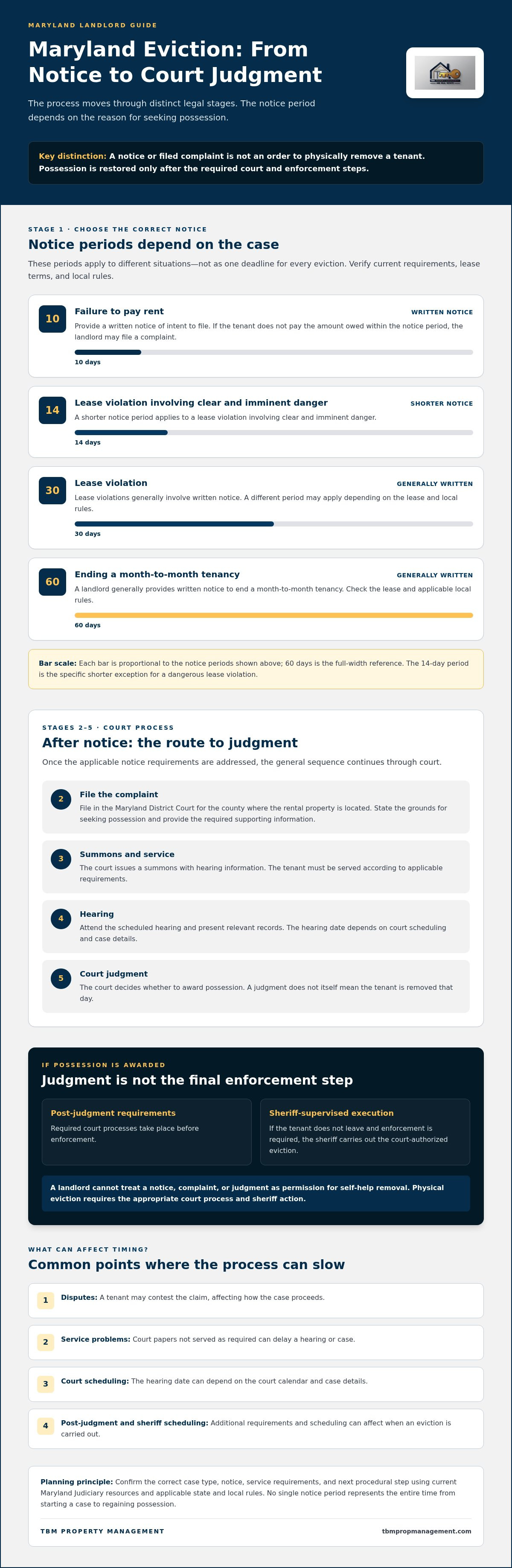
For residential landlord-tenant cases in Maryland, think of the timeline as a sequence: the applicable notice, filing a court case, service of court papers, a hearing and judgment, post-judgment requirements, and, if ordered, sheriff-supervised execution. The details depend on the grounds for seeking possession. Notice and process for unpaid rent may differ from those for a lease breach or holdover case.
A notice or demand is not a court order to physically remove a tenant. Filing a complaint doesn’t mean the landlord has regained possession, either. The court must address the case and issue a judgment. If possession is awarded and the tenant doesn’t leave, additional court and sheriff steps may be required before the landlord can take back the property.
Why a single Maryland eviction estimate can mislead
Two cases that begin on the same day can move at different speeds. A tenant may contest the claim, court papers may not be served as required, or the court calendar may affect the hearing date. After judgment, additional requirements and sheriff scheduling can also influence when an eviction is carried out. As a result, a case can take longer than an initial estimate even when the landlord is actively moving it forward.
Use the stages below to understand what the clock measures, rather than treating any estimate as a promised move-out date:
- Notice: The landlord provides the notice required for the specific legal ground.
- Court case: The landlord files a complaint, and the tenant receives notice of the proceedings.
- Hearing and judgment: The court considers the case and decides whether to award possession.
- Post-judgment steps: Required court processes take place before enforcement.
- Sheriff execution: If necessary, the sheriff carries out the court-authorized eviction.
Don’t assume a standard number of days from notice to move-out. Before acting, confirm current requirements and deadlines through official Maryland Judiciary resources and applicable state and local rules. Identifying the right case type, notice, service requirements, and next procedural step can help you plan and reduce the risk of preventable delay.
Maryland eviction timeline: what happens from notice to court judgment?
The steps before a court judgment depend on why the landlord is seeking possession. A nonpayment case doesn’t use the same notice rules as a lease violation or a holdover. Applying one deadline to every situation can create avoidable problems. First identify the legal ground, then confirm the current notice and filing requirements that apply.
In Maryland, the general sequence is to provide the notice required for the applicable ground, file a complaint in the District Court where the property is located, ensure the tenant is served with court papers, attend the scheduled hearing, and obtain the court’s judgment. Check Maryland Judiciary guidance and current state and local rules for the requirements that apply to a particular case.
How the process begins in different cases
For failure to pay rent, the landlord must provide a written 10-day notice of intent to file. If the tenant doesn’t pay the amount owed within that period, the landlord may file a complaint. This notice period applies to nonpayment and shouldn’t be treated as the rule for every eviction ground.
Lease violations generally involve a 30-day written notice, with a shorter 14-day period for a violation involving clear and imminent danger. To end a month-to-month tenancy, a landlord generally provides 60 days’ written notice. Other periods may apply depending on the lease and local rules, so verify the correct notice before serving it.
What happens after the complaint is filed?
After the landlord files, the court issues a summons with the hearing information, and the tenant must be served. Service matters. If it isn’t completed according to current requirements, the hearing or case may be delayed. The hearing date also depends on court scheduling and the case details. A hearing may be scheduled soon after filing, but don’t assume a particular date.
- Prepare the complaint: State the grounds for seeking possession and provide the required supporting information.
- File in the correct court: Submit the complaint to the Maryland District Court for the county where the rental property is located.
- Complete service: Follow the applicable rules so the tenant receives the summons and case information.
- Attend the hearing: Present relevant records and respond to the tenant’s position. The tenant may dispute the claim or raise defenses.
- Receive the judgment: The judge may rule for the landlord, rule for the tenant, or take another procedural step. The outcome depends on the evidence and applicable law.
For broader context on landlord and tenant responsibilities, review this Maryland landlord-tenant rights guide. If you manage rentals in Anne Arundel, Prince George’s, Montgomery, or Howard County, TBM Property Management’s Full Management (Premium Service) includes eviction coordination and handling, not legal representation. The service currently includes a 1st Month FREE promotion. Organized records and communications can help keep the process on track.
What can make a Maryland eviction take longer after the court case begins?
A court case can take longer when the tenant disputes the landlord’s claims, raises a defense, or challenges whether required steps were completed correctly. Service problems may require additional court action, while motions or other procedural issues can affect what the court needs to address before the case moves forward. These factors can add steps, but none guarantees a specific amount of delay.
Court calendars and sheriff scheduling also vary by jurisdiction and case circumstances. A hearing date or enforcement date in one county isn’t a reliable prediction for another case. To understand how long does an eviction take in maryland, track the case’s actual milestones rather than adding together assumed waiting periods.
How tenant responses and court scheduling affect timing
If the tenant disputes the facts, the judge may need to consider evidence and arguments before deciding whether to award possession. A service issue can affect whether the hearing proceeds as scheduled. Even when both parties are prepared, available hearing dates and local scheduling practices influence when the court can take the next step. There’s no dependable countywide average to apply to every landlord-tenant case.
An appeal may affect enforcement, but the right to appeal, applicable deadline, and effect on the case depend on current law and the circumstances. Don’t assume an appeal automatically creates the same delay in every case. Check current Maryland Judiciary procedures and applicable rules for the specific type of judgment.
What happens after judgment, including redemption and execution?
A judgment for possession doesn’t mean the landlord can immediately remove the tenant or belongings. In a failure-to-pay-rent case, current Maryland procedures require a landlord to wait seven days after judgment before filing a Petition for Warrant of Restitution. The warrant authorizes the sheriff to carry out the eviction. The sheriff’s schedule affects when execution can occur, and current rules require separate written notice of the scheduled eviction date at least six days in advance. Montgomery County and the City of Rockville require 14 days.
In a nonpayment case, a tenant generally may redeem the tenancy by paying the full amount due, including court costs, before the physical eviction. State law limits that right when a tenant has had three prior judgments in the preceding 12 months; Baltimore City has a stricter local rule. Eligibility and procedure depend on the case, so confirm current requirements before relying on a general description.
Typical sequence, not a fixed-duration estimate: Judgment → post-judgment requirements → warrant petition and court action → notice of scheduled eviction → sheriff execution
For failure-to-pay-rent cases, the landlord must file the warrant petition within 60 days of judgment, and the sheriff must execute a signed warrant within 60 days or it expires. These are deadlines, not promises about how quickly the court or sheriff will act. Only the sheriff may carry out a court-authorized eviction. Never change locks, shut off utilities, or remove a tenant yourself.
How Maryland landlords can prepare without creating avoidable eviction delays
Good preparation can’t control a court calendar or guarantee a faster result, but it can prevent avoidable confusion. Start by identifying the reason for seeking possession and organizing the records that support it. Then confirm current Maryland court instructions and applicable notice requirements before filing. For a case-specific legal question, seek advice from a qualified attorney rather than relying on a general timeline.
Documents and records to organize before filing
Keep a clear, dated file so you can quickly find relevant information. Separate original documents from working notes, and preserve communications in their original form. Accurate records help clarify what happened and when, but they don’t guarantee a particular court outcome or timeline.
- Lease and related documents: Keep the signed lease, amendments, and relevant written agreements together.
- Payment records: Maintain a rent ledger showing charges, payments, and the dates they were received or recorded.
- Notices and delivery records: Save copies of notices and records showing how and when they were delivered.
- Relevant communications: Keep dated messages about rent, lease concerns, repair issues, or efforts to resolve the dispute.
- Court documents: Organize the complaint, summons, filings, and court orders as the case progresses.
Update records consistently. If you discover an error, preserve the original and make a transparent, dated correction rather than changing or backdating an entry. A complete file makes it easier to explain the facts, respond to questions, and track what has already been submitted.
Actions landlords should avoid while a case is pending
Don’t try to speed up the process by bypassing the court. In Maryland, a landlord must not change the locks, shut off utilities, or remove a tenant’s belongings to force a move-out. A lawful eviction requires the court process and sheriff execution. Self-help actions can create serious legal problems and further complicate a dispute.
Before taking the next step, review current instructions from the Maryland Judiciary and the court handling the case. Procedures can depend on the claim and circumstances. For questions about notice, deadlines, defenses, or enforcement, consult an attorney who can consider the specific facts.
Preparation is one part of steady rental oversight. A broader look at choosing professional property management in Maryland can help landlords understand how ongoing records, rent collection, and tenant communication fit into managing a property. TBM Property Management’s Full Management (Premium Service) includes eviction coordination and handling, not legal representation, and currently includes a 1st Month FREE promotion. Explore property management support for residential rentals in Anne Arundel, Prince George’s, Montgomery, and Howard counties.
How property management can coordinate a Maryland eviction process
An eviction can add paperwork, difficult conversations, and follow-up to an already demanding rental workload. Property management can help organize administrative tasks, including rent collection records, tenant communications, and case-related documents. That support can make responsibilities easier to track, but it doesn’t determine the court’s schedule or replace the legal process.
What eviction coordination can and cannot do
TBM Property Management’s Full Management (Premium Service) includes eviction coordination and handling. This service can help landlords keep relevant records and communications organized as the case proceeds. A property manager doesn’t control hearing dates, decide the outcome, issue a warrant, or schedule a sheriff’s execution. Those steps belong to the court and sheriff under the applicable process.
Coordination isn’t legal representation. Questions about a landlord’s rights, the correct legal grounds, a tenant’s defenses, or how a specific rule applies should go to a qualified legal professional. Keeping those roles clear helps landlords get administrative support without mistaking it for legal advice or a guarantee of possession by a particular date.
If you’re asking how long an eviction takes in Maryland, management support can help keep paperwork and communications in order, but it can’t promise a shorter timeline. Court proceedings and enforcement still depend on the case and the required legal steps.
When local property-management support may help
Ongoing oversight can be especially useful when a landlord is balancing several responsibilities. Rent collection records help organize payment information, tenant relations provide a consistent channel for routine communication, and orderly documentation makes it easier to locate relevant information if a dispute arises. These practices support day-to-day management, not a guaranteed court result.
TBM Property Management serves residential landlords and investors in Anne Arundel, Prince George’s, Montgomery, and Howard counties. Owner/operator Tanika Belfield-Martin brings over 13 years of licensed real-estate experience. For landlords who want support beyond a single tenancy issue, the company’s property management service currently includes a 1st Month FREE promotion.
Local coordination can reduce the administrative details a landlord must manage alone while keeping court authority where it belongs. Explore TBM Property Management to learn about support for residential rentals in its Maryland service area.
Take the next step toward steadier rental oversight
If you’re still wondering how long an eviction takes in Maryland, focus on what you can influence: clear records, consistent communication, and careful attention to each required step. You can’t control every court or case development, but you can build a more organized process for managing your rental and responding to challenges.
For landlords who want help carrying the administrative load, TBM Property Management’s Full Management (Premium Service) includes eviction coordination and handling, not legal representation. The service currently includes a 1st Month FREE promotion. A conversation about your rental goals can help you decide what support makes sense for your property.
Explore TBM’s full-service property management and request a free rent analysis. With the right preparation and support, you can move forward with greater clarity and confidence.
Frequently Asked Questions
How long does an eviction take in Maryland for nonpayment of rent?
There’s no dependable end-to-end duration because each case moves through notice, court, and enforcement steps at its own pace. Maryland’s People’s Law Library describes a 10-day notice period before a landlord files a nonpayment complaint. That period is only the starting point, not a move-out estimate. Service, the hearing, judgment, and any warrant and sheriff scheduling affect the total time. Check current requirements before acting.
Can a Maryland landlord evict a tenant without going to court?
No. A landlord can’t lawfully force a tenant out by changing the locks, shutting off utilities, or taking belongings. Possession must be recovered through the required court process, with a sheriff carrying out a court-authorized eviction. For example, even if a tenant appears to have moved out, don’t assume you can dispose of property or change access without checking the applicable rules. Use official Maryland court guidance or legal advice for case-specific questions.
Does a tenant’s court hearing make an eviction take longer in Maryland?
It can, but a hearing doesn’t automatically create a fixed delay. If the tenant disputes the rent balance, challenges a notice, or raises another defense, the judge may need to consider evidence and arguments before deciding the case. Service problems or additional proceedings can also affect scheduling. Keep an accurate ledger and copies of relevant communications so you can address questions clearly, and don’t treat the filing date as a guaranteed decision date.
Can paying the rent stop an eviction in Maryland?
In some failure-to-pay-rent cases, a tenant may stop the eviction by paying the full amount due, including court costs, before the physical eviction, subject to legal exceptions. Statewide, the right of redemption is limited if the tenant has had three prior judgments in the past 12 months; Baltimore City has a stricter local rule. Because eligibility can depend on case details, confirm the current balance and applicable rules before assuming payment will end the case.
How long after an eviction judgment can a Maryland sheriff remove a tenant?
There isn’t one fixed number of days that applies to every case. A landlord must complete the required post-judgment process, including obtaining a warrant of restitution, before the sheriff can carry out the eviction. The sheriff’s schedule and any applicable protections affect the date. Follow court notices and sheriff communications closely, and never treat a judgment alone as permission to remove a tenant or belongings.
Are eviction timelines different across Maryland counties?
Yes. Practical timing can differ because court calendars, case details, and sheriff scheduling aren’t identical across jurisdictions. Local requirements may also affect particular steps. For instance, the required notice before a scheduled eviction is longer in Montgomery County and the City of Rockville than the statewide minimum. Check District Court and sheriff resources for the county where the property is located instead of relying on another county’s timeline.