
How to Avoid Bad Tenants in Maryland: A Proactive Landlord’s Guide for 2026
Did you know that a single eviction in Maryland can cost you up to $10,000 in lost rent and turnover expenses? In a state where legal protections for renters are stronger than ever, one wrong placement can quickly turn your investment into a financial burden. You likely feel the weight of keeping up with the Renters’ Rights and Stabilization Act or the upcoming Fair Chance Housing Act of 2026. It's stressful to balance local compliance with the need to protect your property from professional tenants who know how to work the system. We understand that managing rentals in Baltimore City or Montgomery County requires a rigorous, data-driven strategy. This guide provides a battle-tested framework on how to avoid bad tenants in maryland while staying 100% compliant with the law.
We believe your peace of mind is just as important as your monthly cash flow. By following this proactive approach, you'll gain a repeatable screening checklist and learn how to spot hidden red flags before a lease is signed. We want to help you move from a state of anxiety to a state of total confidence in your property oversight. This article previews the essential screening steps you need to take to ensure your asset remains protected for the long term.
Key Takeaways
- Quantify the "eviction gap" to understand why Maryland’s legal timeline makes rigorous upfront screening a financial necessity for your investment.
- Implement a repeatable 5-step framework on how to avoid bad tenants in maryland while staying compliant with the latest $25 application fee limits.
- Protect your asset by learning to spot legitimate red flags without violating evolving laws regarding protected classes and source of income.
- Move beyond basic credit reports with advanced verification techniques and specific landlord interview questions that reveal a prospect's true rental habits.
- Discover how a "zero-tolerance" vetting process can replace the stress of self-management with the security of high-quality, long-term placements.
The High Cost of a Bad Tenant in Maryland
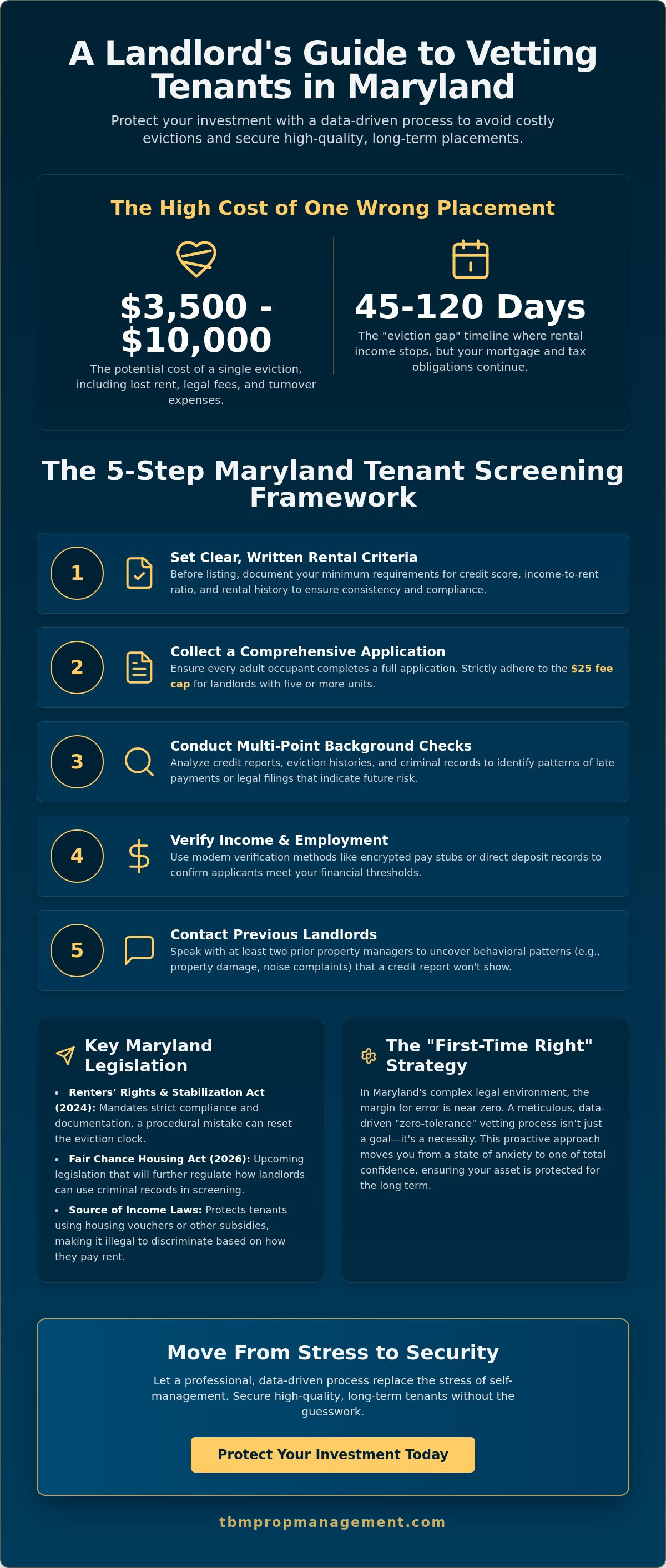
Owning a rental property should feel like a secure investment, not a source of constant stress. We've seen many self-managing landlords discover too late that the eviction gap in Maryland can be financially devastating. This gap represents the time between a tenant's first missed payment and the day a sheriff finally returns possession of the property to you. In a contested case, this window can stretch between 45 to 120 days. During this period, your mortgage and tax obligations don't stop, even if your rental income does. Knowing how to avoid bad tenants in maryland is the only way to prevent this scenario from draining your reserves.
Professional tenants often understand the nuances of local court systems better than the landlords themselves. In jurisdictions like Prince George’s County and Montgomery County, court dockets are frequently crowded, and local ordinances provide additional layers of protection that can extend a tenant's stay. These individuals look for "gut feeling" landlords who skip a rigorous tenant screening process, allowing them to exploit the system for months of free housing. The emotional toll of this experience is often just as heavy as the financial burden, leaving many owners feeling helpless and burnt out.
The Financial Reality of Eviction
When you calculate the true cost of a bad placement, the numbers are sobering. Industry data suggests that a single eviction in Maryland can cost between $3,500 and $10,000 when you factor in lost rent, legal fees, and turnover expenses. Beyond the missing checks, bad tenants often neglect basic property care. This leads to deferred maintenance that can significantly tank your property value or require expensive, emergency repairs after they vacate. A long-term vacancy is often cheaper than a bad tenant who causes thousands of dollars in physical damage while blocking your ability to re-lease the unit. Mastering how to avoid bad tenants in maryland requires moving past intuition and toward a data-driven vetting system.
Why Maryland Laws Demand Perfection
The legal environment in our state has become increasingly complex. With the implementation of the Renters’ Rights and Stabilization Act of 2024, the margin for error is nearly zero. You must understand the specific landlord tenant rights Maryland requires to stay compliant. One small procedural mistake, such as failing to provide the mandatory Tenants’ Bill of Rights or incorrectly calculating a late fee, can cause a judge to dismiss your case. This resets your eviction clock to zero, forcing you to start the multi-month process all over again. We believe a "first-time right" placement strategy isn't just a goal; it's a necessity for protecting your equity in 2026.
A 5-Step Maryland Tenant Screening Framework
The best way to protect your investment is to stop a bad situation before it begins. We believe that a structured, repeatable process is the only way to ensure consistency and legal safety. When you treat tenant placement as a data-driven business decision, you remove the emotional bias that professional tenants often exploit. Mastering how to avoid bad tenants in maryland requires a commitment to these five essential steps.
- Step 1: Set clear, written rental criteria. Document your requirements for credit, income, and rental history before you ever list the property.
- Step 2: Collect a comprehensive application. Ensure every adult occupant completes a full application while strictly adhering to the $25 fee cap for landlords with five or more units.
- Step 3: Conduct multi-point background and credit checks. Look for patterns of late payments or legal filings that indicate future risk.
- Step 4: Verify income and employment. Use 2026-standard documentation, such as encrypted pay stubs or direct deposit records, to confirm the applicant meets your financial thresholds.
- Step 5: Contact previous landlords. Speak with at least two prior property managers to identify behavioral patterns that a credit report might miss.
If the prospect of vetting every applicant feels overwhelming, our specialized tenant placement services can handle the heavy lifting for you, ensuring only the most qualified candidates move forward.
Setting Your Minimum Standards
We recommend establishing an income-to-rent ratio of at least 3x the monthly rent. This provides a necessary buffer for the tenant's other living expenses and reduces the risk of default. While credit scores are important, they don't tell the whole story. Look for a history of utility payments and a lack of recent collections. To maintain a fair and non-discriminatory process, apply your policies regarding pets and smoking uniformly to every single applicant without exception. This level of dedication protects you from both bad tenants and potential legal disputes.
Navigating Maryland Application Laws
Staying updated on Maryland landlord-tenant laws is essential for every property owner. Under the Renters’ Rights and Stabilization Act of 2024, you must be precise with your fees. For landlords owning five or more units, you cannot charge more than $25 for an application fee. You must also provide a written receipt for any fees or deposits collected. If you take a holding deposit to take the unit off the market, ensure your written agreement clearly states when that deposit becomes non-refundable or how it applies to the first month's rent. This transparency builds trust and keeps you on the right side of the law.
Red Flags vs. Protected Classes: Staying Compliant
Distinguishing between a high-risk applicant and a protected class is one of the most complex challenges you'll face as a property owner. Many landlords feel a sense of anxiety when rejecting an application, fearing they might inadvertently trigger a discrimination claim. However, understanding the boundary between legitimate business concerns and legal protections is key to learning how to avoid bad tenants in maryland without putting your asset at risk. Professional tenants often rely on this confusion; they present a polished image while hiding a history of legal disputes or property damage behind a veneer of cooperation.
A thorough review of a tenant screening report provides the objective data you need to make an informed choice. Legitimate red flags include a history of frequent moves without explanation or an inability to provide verifiable employment records. These are not protected traits; they are indicators of financial instability. By focusing on these concrete data points, you protect yourself from those who know how to exploit the system in Annapolis or Baltimore County.
Legitimate Reasons for Rejection
Rejection is legal when it's based on objective, non-discriminatory criteria. If an applicant has insufficient income or you simply cannot verify their employment after multiple attempts, you have a valid reason to deny the application. Negative references from previous Maryland landlords are also powerful tools. If a prior manager reports consistent late payments or significant property damage, that behavior is a predictive red flag. Under the Maryland Fair Chance Housing Act, you must also be careful about how you handle criminal history, focusing only on records that pose a direct threat to the safety of others or the property itself.
Avoiding Fair Housing Traps
Maryland law provides robust protections that every landlord must respect. You cannot flatly refuse an applicant because they use a Housing Choice Voucher (Section 8), as "Source of Income" is a protected class across the state. Similarly, protections for gender identity and sexual orientation are non-negotiable. To stay safe, treat every applicant exactly the same from the first inquiry to the final decision. We strongly recommend keeping a detailed "rejection log" that notes the specific, non-discriminatory reason each applicant was denied. This documentation is your best defense during a fair housing audit, proving that your goal was simply how to avoid bad tenants in maryland through objective vetting and professional standards.
Advanced Verification: Beyond the Credit Report
While a credit score provides a baseline, it rarely tells the full story of a tenant's reliability in a post-2024 economy. High-risk applicants often maintain decent scores by prioritizing credit card payments while letting their rent obligations slip. If you want to master how to avoid bad tenants in maryland, you must look deeper into their financial and behavioral history. This proactive approach ensures you aren't just filling a vacancy, but securing a partner who will respect your property in Bowie or Silver Spring.
Professional vetting requires a mix of technology and old-fashioned detective work. Many landlords find this part of the process the most time-consuming and anxiety-inducing. If you're feeling the pressure of verifying complex applications, utilizing professional tenant placement services can provide the specialized oversight needed to filter out high-risk individuals before they ever receive a key. We believe that taking these extra steps today is the only way to ensure long-term stability for your rental portfolio.
Interviewing Previous Landlords
The landlord reference call is your most powerful tool, provided you ask the right questions. Don't settle for a simple confirmation of residency. Ask directly: "Would you rent to them again?" This single question often reveals more than an entire credit report. You should also watch for "fake" references where friends or family members pose as previous managers. We recommend cross-referencing the property owner's name with public tax records to ensure you're speaking with the actual decision-maker. Confirm that the tenant gave proper notice and received their full security deposit back, which indicates they left the property in good condition.
Modern Income Verification
In 2026, many reliable applicants work in the gig economy or are self-employed. Relying solely on pay stubs is no longer sufficient, especially since fraudulent or "photoshopped" financial documents have become increasingly common. We suggest requesting three months of consecutive bank statements to see the actual cash flow into their accounts. This provides an unvarnished look at their ability to meet the 3x rent-to-income ratio. Remember that under current Maryland law, you are capped at charging one month's rent for a security deposit. This limit makes your upfront verification even more critical, as you have a smaller financial cushion if things go wrong.
Ready to secure a high-quality tenant without the headache? Let us handle your professional tenant screening today.
The TBM Approach: Stress-Free Tenant Placement
Managing a rental property shouldn't feel like a second full-time job that keeps you up at night. We've spoken with countless property owners who found that DIY screening was the primary cause of their burnout, especially in competitive markets like Laurel. The pressure to stay compliant with 2026 regulations while trying to identify hidden red flags is an immense emotional burden. When you're handling everything yourself, a single mistake in the vetting process can lead to the costly evictions and court delays we discussed earlier. Our goal is to provide the stabilizing force you need to protect your asset without the personal exhaustion.
We've developed a "Zero-Tolerance" vetting process designed specifically for the complex Maryland market. This isn't just about running a basic background check; it's a comprehensive methodology that helps us identify the top 1% of applicants. By applying these high standards consistently, we provide the definitive answer on how to avoid bad tenants in maryland. We take the guesswork out of the equation, replacing "gut feelings" with data-driven results. This proactive approach ensures that your property is occupied by individuals who value your investment as much as you do.
Why Local Expertise Matters
Our deep roots in Prince George’s and Anne Arundel Counties allow us to navigate local court systems and neighborhood dynamics with ease. We leverage over 12 years of local Maryland real estate expertise to ensure your property remains a high-value asset. Many owners find that professional property management actually pays for itself by significantly reducing vacancy rates and preventing the "professional tenant" scenarios that often plague DIY landlords. We treat your investment like our own, providing a level of dedication and mastery that only a seasoned local partner can offer.
Next Steps for Your Investment
Are you ready to transition from being a stressed, hands-on landlord to a truly passive investor? The relief of knowing your property is in professional hands is life-changing. From our rigorous how to avoid bad tenants in maryland screening protocols to handling a 2:00 AM maintenance emergency, we manage every detail with precision. You can get started today by claiming your complimentary rental analysis to see exactly what your property is worth in the current market. This report provides the clarity you need to make informed decisions about your financial future.
If you're looking for a comprehensive solution, our full-service property management plan offers end-to-end oversight that simplifies your life and secures your equity. Don't let the complexities of self-management drain your energy or your bank account. Schedule your free consultation with TBM Property Management today.
Take Control of Your Rental Future
Your property is a vital asset, and protecting it requires more than just luck. We've explored how a rigorous screening framework and a deep understanding of 2026 compliance can shield you from the devastating costs of a bad placement. Mastering how to avoid bad tenants in maryland means moving beyond basic credit scores and embracing a data-driven verification process. By setting clear standards and verifying every detail, you ensure your investment remains a source of steady income rather than a cause of constant stress.
We've spent over 12 years perfecting our approach in Laurel, PG, Montgomery, and Howard Counties. Our comprehensive 10-point tenant screening process is designed to find the top-tier renters your property deserves. You don't have to carry the emotional burden of asset oversight alone. Let TBM Handle the Vetting; Schedule Your Free Rental Analysis today to gain the clarity and relief you've been looking for. We're here to help you build a more secure and profitable portfolio with total confidence.
Frequently Asked Questions
How much can I legally charge for a rental application fee in Maryland?
If you own five or more residential rental units, the application fee is strictly capped at $25. This limit ensures that the cost remains accessible for applicants while covering the basic administrative expense of the vetting process. You are also required by law to provide a written receipt for any application fee or deposit you collect from a prospective tenant.
Can I reject a tenant for having a low credit score in Maryland?
Yes, you can reject an applicant based on a low credit score, provided you apply this standard uniformly to every applicant. Credit history is considered a legitimate business metric for assessing financial risk. If you deny an application based on a credit report, you must provide the applicant with an adverse action notice that explains their rights under the Fair Credit Reporting Act.
What is the maximum security deposit I can collect in Maryland in 2026?
The maximum security deposit you can collect is now limited to one month’s rent. This change became effective on October 1, 2024, through the Renters’ Rights and Stabilization Act, which reduced the previous two-month limit. Collecting any amount exceeding one month’s rent is a violation of state law and could result in you being liable for up to three times the extra amount charged.
Is it illegal to refuse Section 8 or housing vouchers in Maryland?
Yes, it is illegal to refuse an applicant simply because they use a Housing Choice Voucher or other government assistance. Maryland law recognizes "Source of Income" as a protected class. You must evaluate voucher holders using the same non-discriminatory criteria you use for all other prospects, such as rental history and personal references, rather than their method of payment.
How do I verify if a tenant is telling the truth about their previous landlord?
We recommend cross-referencing the landlord's name and contact information with public tax records to confirm they actually own the property. During the call, ask for specific details like the exact dates of the lease and the amount of the security deposit returned. Professional tenant screening involves looking for inconsistencies that might suggest the "landlord" is actually a friend or family member posing as a reference.
What should I do if a tenant stops paying rent shortly after moving in?
You should file a "Failure to Pay Rent" complaint in the District Court as soon as the legal grace period expires. Because Maryland has a "Right of Redemption," tenants can stop the eviction by paying the full amount owed at any point before the sheriff arrives. Taking swift legal action is the most effective way how to avoid bad tenants in maryland from occupying your property for free for an extended period.
Can I ask a prospective tenant about their criminal record in Maryland?
Under the Maryland Fair Chance Housing Act, which takes effect on October 1, 2026, there are new limits on when you can inquire about criminal history. Generally, you cannot ask about an applicant's criminal record until after you have made a conditional offer of housing. Even then, you must focus only on specific offenses that pose a direct threat to the safety of other residents or the property itself.
How long does the eviction process typically take in Maryland?
An uncontested eviction usually takes between 30 and 60 days from the initial filing to the physical removal of the tenant. However, if the tenant decides to contest the case in court or file an appeal, the timeline can easily stretch to 120 days or more. These delays are particularly common in busy jurisdictions like Baltimore City and Prince George's County, where court dockets are often crowded.