How to Make Your Rental Property More Profitable with ROI
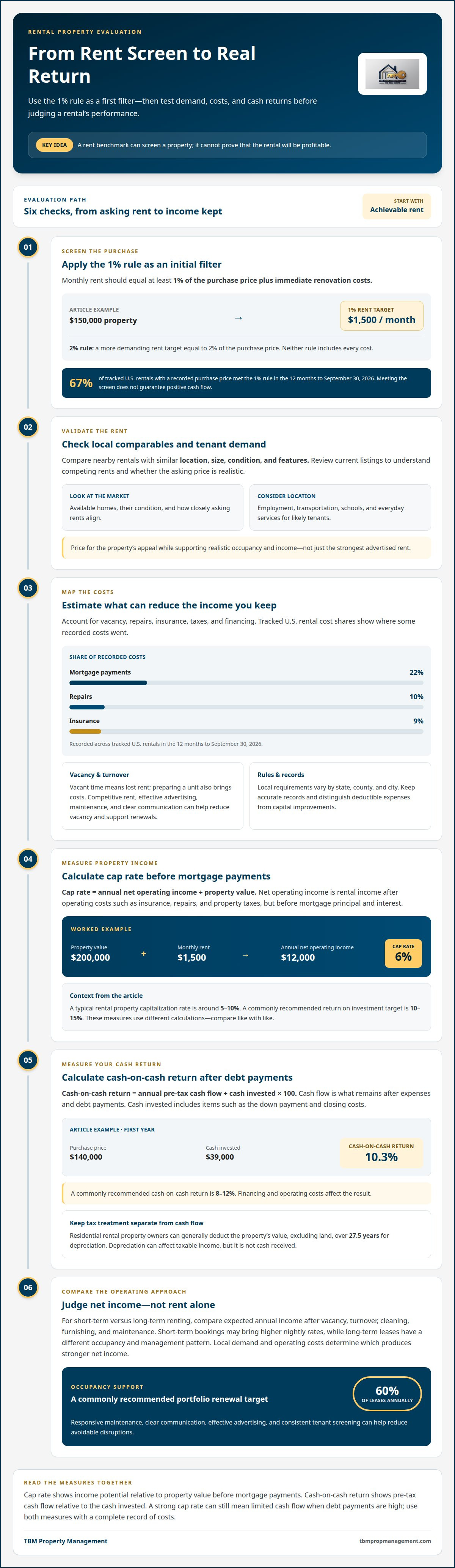
The 1% rule is a useful screening test, not proof that a rental will be profitable. It suggests monthly rent should equal at least 1% of the purchase price plus immediate renovation costs. To learn how to make your rental property more profitable, use that benchmark alongside operating expenses, mortgage payments, and return measures such as cap rate and cash-on-cash return.
It’s easy to focus on rent and overlook the costs that determine what you actually keep. The 1% rule can help compare potential properties, but it doesn’t account for every expense or replace a fuller financial assessment.
This article explains how the 1% rule compares with profit measures, which costs can weigh on returns, and how to assess a rental property’s performance. You’ll get a clearer way to evaluate the numbers and spot practical opportunities to improve them.
Key Takeaways
- Use the 1% rule to screen rental opportunities, then assess whether the property’s income can cover its full operating costs and financing.
- Compare cap rate and cash-on-cash return to understand both the property’s income potential and the return on the cash you invest.
- Rental demand, vacancy, repairs, insurance, and turnover all affect what you keep, so evaluate costs alongside achievable rent.
- Use multiple profit benchmarks to judge performance in context, rather than relying on one rule of thumb to make your decision.
Cap rate and cash-on-cash return
Cap rate and cash-on-cash return measure different aspects of rental income. Cap rate compares a property’s annual net operating income with its value, before mortgage payments. Cash-on-cash return compares annual pre-tax cash flow with the cash invested, including the down payment and closing costs. Together, they help show whether the income supports the property’s value and your financing.
For example, a rental valued at $200,000 with $1,500 monthly rent has a 6% cap rate when annual net operating income is $12,000. Net operating income is rental income after operating costs, such as insurance, repairs, and property taxes, but before mortgage principal and interest. A typical rental property capitalization rate is around 5-10%, while a commonly recommended return on investment target is 10-15%. These measures use different calculations, so compare like with like.
How should landlords set rent using comparable local listings and market data? Compare nearby rentals with similar locations, size, condition, and features, then review current listings to gauge competing rents. Price the property to reflect its appeal while supporting realistic occupancy and income.
Cash flow is what remains after expenses and debt payments. To calculate cash-on-cash return, divide annual pre-tax cash flow by the cash invested, then multiply by 100. A worked example of a $140,000 purchase with $39,000 invested in cash produced a 10.3% cash-on-cash return in the first year. A commonly recommended cash-on-cash return is 8-12%, but financing and operating costs affect the result.
Depreciation can also affect a rental property’s taxable income, though it is not cash received. According to the Internal Revenue Service, residential rental property owners can generally deduct the value of a property, excluding land, over 27.5 years for depreciation. Keep this tax treatment separate from cash-flow calculations.
Use both return measures alongside a complete record of costs. A strong cap rate can still mean limited cash flow when debt payments are high. A favorable cash-on-cash return may reflect financing choices as well as the property’s performance. Comparing the figures helps owners and investors see what is driving returns.
How Much Profit Should You Make on A Rental Property?
There is no single profit target that fits every rental. Test the purchase price against achievable rent, then account for vacancy, repairs, insurance, taxes, and financing. Strong advertised rents can still produce weak returns if local demand is inconsistent or operating costs are high.
The 1% rule offers a quick screening measure: monthly rent should equal at least 1% of the purchase price plus immediate renovation costs. A $150,000 property would need $1,500 in monthly rent to meet that target. The 2% rule sets a more demanding rent target, equal to 2% of the purchase price. Neither rule accounts for every cost, so treat them as initial filters.
Location affects whether projected rent is achievable. Compare similar local listings and look for signs of demand, such as the range of available homes, their condition, and how closely asking rents align. Then consider whether employment, transportation, schools, and everyday services suit likely tenants. These checks help landlords assess durable demand instead of relying on one appealing listing.
Compare that rental income with similar properties, then estimate vacancy, maintenance, insurance, and financing before judging profit. In the 12 months to September 30, 2026, 67% of tracked US rentals with a recorded purchase price met the 1% rule. That makes the rule a useful filter, not a guarantee of positive cash flow.
Is long-term or short-term renting more profitable in your area? Compare expected annual income after accounting for vacancy, turnover, cleaning, furnishing, and maintenance. Short-term bookings may bring higher nightly rates, while long-term leases have a different occupancy and management pattern. Local demand and operating costs determine which approach produces stronger net income.
Small equipment choices can also affect upkeep. A refrigerator without an ice maker avoids a component that can fail and leak, potentially damaging floors, walls, or cabinetry. For investing decisions, consider purchase price, tenant demand, property condition, and ongoing management needs together. Rental property management can support consistent leasing and oversight.
Expense categories and cost reduction
Track recurring expenses separately from one-time capital improvements to see what reduces positive cash flow. Across tracked US rentals, mortgage payments accounted for 22% of recorded costs, repairs 10%, and insurance 9% during the 12 months to September 30, 2026.
Turnover and Vacancy Periods
Turnover combines rental income lost during vacancy with the expense of preparing a unit for new tenants. Competitive rent, effective advertising, and a well-maintained property help reduce vacancy periods. Responsive maintenance and clear communication also support lease renewals. A commonly recommended portfolio target is renewing at least 60% of leases annually. Consistent tenant screening helps landlords assess applicants before placement and reduce avoidable disruptions.
Local Rules, Taxes, and Deductions
Local rules cover matters such as rent practices and rental licensing, and vary by state, county, and city. Identify the requirements for the property’s jurisdiction before setting rent or operating the rental. For US tax reporting, deductible rental expenses may include legal and professional services, insurance, repairs, depreciation, and interest. Depreciation is also a tax benefit, as outlined earlier. Keep accurate records to distinguish deductible expenses from capital improvements.
Insurance, Maintenance, and Liability Risks
Insurance premiums, uncovered damage, delayed repairs, and liability claims all reduce the income a property retains. Review coverage in light of the property’s condition and risks, and keep records of inspections, repairs, and claims. Address maintenance issues early, before a small leak damages floors, walls, or cabinetry. Regular inspections and coordinated maintenance can help identify problems and document follow-up, protecting the building and supporting cash flow.
For late payments or property damage, use consistent screening criteria and document each decision. Clear lease terms, reliable rent collection, and prompt maintenance follow-up help landlords manage payment issues and protect the property. Keep expense records current to spot rising costs and adjust operating plans.
Rental property profit benchmarks
Rental property benchmarks help compare real estate opportunities, but no single figure captures every market. Consider each measure alongside financing, vacancy, repairs, and expected annual income. A market with higher rents may also have higher expenses, so compare properties using consistent assumptions. To understand how to make your rental property more profitable, use benchmarks to identify which operating factors need attention.
Across 1,323 tracked single-unit US rentals, median cash remaining after recorded costs, including mortgage payments, was $631 monthly during the 12 months to September 30, 2026. The middle half had $221 to $1,138 monthly remaining, and 84% had positive cash flow. Median annual rent collected was $19,985 over that same period. These figures describe varied properties, not a guaranteed target for an individual investment.
A common rule of thumb is to seek at least $100+ in positive cash flow per rental unit per month. Calculate that amount after operating expenses and mortgage payments, then compare it with reserves needed for repairs and periods without rent. Track actual results against projections, since a repair or vacancy can change the year’s outcome.
Debt service coverage ratio, or DSCR, compares net operating income with required debt payments. Lenders generally look for a rental property DSCR of 1.20x to 1.25x or higher. That range means net income exceeds debt service by 20% to 25%. Gross rent multiplier offers another screening lens: divide property price by annual gross rent. A multiplier between about 4 and 7 is described as a good deal in many places, but local rents and expenses still shape returns.
Use benchmarks to identify questions, not to rank properties blindly. Compare actual collected rent, operating costs, debt payments, and repair records over the same period. Then investigate whether weak performance comes from pricing, vacancy, or expenses. For a clearer view of how to make your rental property more profitable, consider whether consistent reporting and oversight would help you act on those patterns. Explore full-service property management to support clearer tracking of rental operations.
TBM Property Management: Full-Service Property Management
TBM Property Management can help when leasing, rent collection, and ongoing oversight take time away from managing your investment. Its Full-Service Property Management brings key rental operations together, while Tenant Placement and Leasing Services support the transition from vacancy to a new tenancy.
Consistent rent collection keeps income records organized, while tenant screening supports informed placement decisions. Property maintenance coordination and inspections help owners monitor the property’s condition and manage upkeep. These services can help when vacancies, tenant communication, or maintenance demands make it harder to track costs and rental performance.
Contact TBM Property Management to discuss support for managing your rental property.
Turn your rental analysis into a clear next step
Profitability depends on decisions you can sustain, not a spreadsheet you review once and forget. Set regular times to review income, expenses, occupancy, and maintenance patterns. When costs rise or a lease ends, use that information to decide what needs attention before it affects the property’s performance.
If you’re deciding how to make your rental property more profitable, consider which ownership tasks require the most time and follow-through. A dependable management approach can keep day-to-day responsibilities organized while you focus on your investment goals. Talk with TBM Property Management about how its services can support your rental property.
Contact TBM Property Management to start a conversation about your property. With a clearer operating plan and the right support, you can move forward with greater confidence in your next rental decision.
Frequently Asked Questions
Does the 1% rule still work?
Yes, the 1% rule remains a quick screening tool, not a measure of guaranteed profit. It compares monthly rent with the purchase price plus immediate renovation costs. For example, a property costing $270,000 under this rule would need $2,700 monthly rent. Check whether comparable local rentals support that figure, then assess expenses, financing, and vacancy before deciding.
What rental property expenses can landlords reduce without hurting tenant satisfaction?
Look for savings that improve efficiency without delaying necessary service. LED lighting and proper insulation can reduce energy use, while durable flooring may reduce replacement needs between tenancies. Review recurring bills and maintenance records to find avoidable waste. Cutting essential repairs or basic upkeep can harm the tenant experience and lead to more costly problems later.
Which renovations and upgrades produce the best rental property ROI?
The most useful upgrades improve durability, ease of upkeep, and tenant appeal, rather than adding features renters may not value locally. Consider durable flooring, reliable appliances, quality paint, and low-maintenance landscaping. Energy-efficiency improvements, such as LED lighting, insulation, and double-glazed windows, may also support appeal. Compare each project’s cost with the rent and property condition it can realistically support before investing.
How can landlords reduce vacancy and tenant turnover costs?
Price the rental competitively, advertise it effectively, and maintain the home to appeal to prospective tenants. Respond promptly to maintenance requests and communicate clearly during the tenancy to encourage renewals. Before a lease ends, plan needed repairs and prepare listing materials. Coordinating these tasks can shorten the vacancy between tenants and reduce lost rental income.
What are typical property management fees, and is self-management more profitable?
Property management fees vary according to the property, rental income, and included responsibilities, so there is no single figure for every landlord. Self-management avoids a management fee but takes time for leasing, tenant communication, rent collection, and maintenance coordination. Compare management costs with the time and expenses you would take on yourself, including vacancy and turnover tasks.
How can landlords calculate rental cash flow, cap rate, and return on investment?
Calculate cash flow by subtracting operating expenses and mortgage payments from rental income for the same period. For cap rate, divide annual net operating income by the property’s value, then multiply by 100. To calculate cash-on-cash return, divide annual pre-tax cash flow by the cash invested and multiply by 100. Keep the periods and expense categories consistent across comparisons.