
How to Write a Legally Binding Lease Agreement in Maryland (2026)
What makes a Maryland lease legally binding: the signatures, or the details behind them? A signature matters, but writing a legally binding lease agreement in maryland also means setting out clear terms, including required disclosures, and documenting how the agreement was completed. An outdated template can leave important points unclear, especially when state and local requirements change.
If you’re unsure what to include, you’re not alone. A residential lease should make the arrangement easy for both landlord and tenant to understand while meeting the rules that apply to the property. This guide walks you through a Maryland-focused process for drafting, checking, and signing a lease in 2026. You’ll learn what information and terms to organize, which disclosures to review, how to check for local requirements, and what to keep on record before the tenant moves in.
Key Takeaways
- A signed lease still needs review for completeness and compliance with rules that apply to the property.
- Use a Maryland-focused checklist to organize property details, utility and repair responsibilities, notices, and security-deposit documentation.
- When writing a legally binding lease agreement in maryland, compare each template clause with the actual terms and disclosures your rental requires.
- Before signing, check names, premises, dates, payment terms, attachments, and blank fields.
- Owners in Anne Arundel, Prince George’s, Montgomery, and Howard counties can use local leasing support to coordinate lease preparation and signing.
What Makes a Maryland Residential Lease Legally Binding?
A residential lease records the rental relationship, the terms both sides agreed to, and each party’s obligations. A clear agreement identifies the people and property involved, explains how the tenancy works, and puts the parties’ promises in writing. The broad principles of landlord-tenant law provide useful context, but Maryland statutes and any applicable local rules govern a Maryland rental.
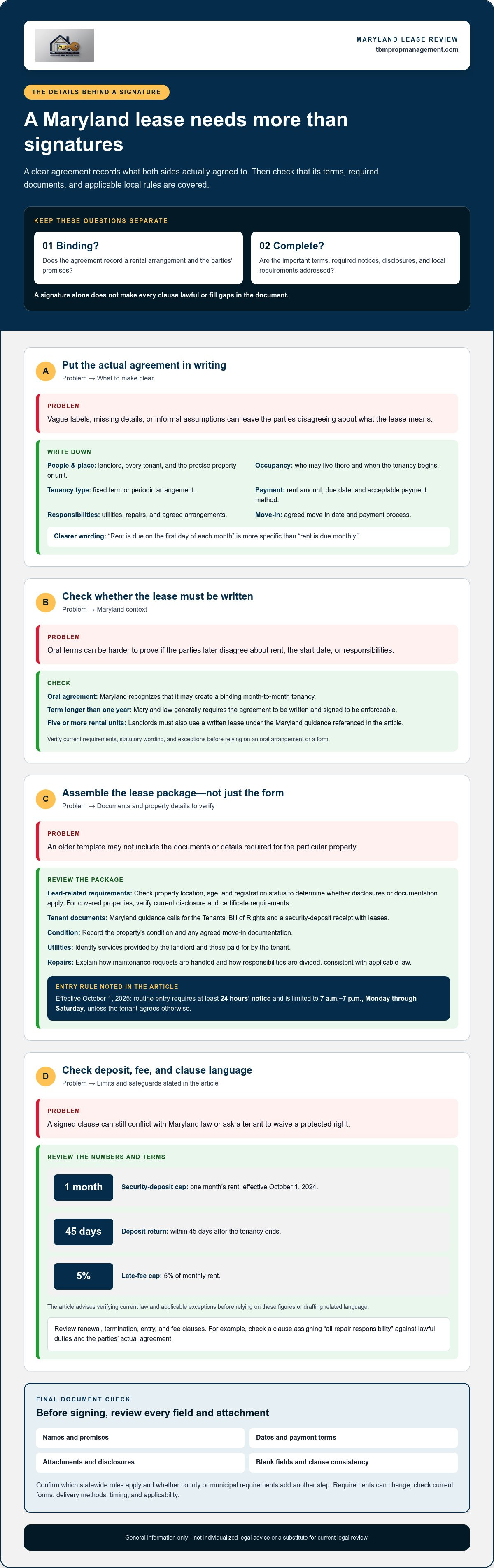
Keep two questions separate: is the agreement binding, and is it complete and compliant? An agreement may show that the parties formed a rental arrangement yet omit important terms or a required notice or disclosure. A signature alone doesn’t make every clause lawful or fill gaps in the document. When writing a legally binding lease agreement in maryland, start with the parties’ actual understanding, then check the legal requirements that apply before signing.
What terms create a clear landlord-tenant agreement?
Identify the landlord and every tenant by name, and describe the rental property precisely, including the unit in a multi-unit building. State who may occupy the home, when the tenancy starts, and whether it has a fixed term or continues on a periodic basis. Don’t rely on informal labels or an address that doesn’t distinguish the rented unit.
Set out the rent amount, due date, acceptable payment method, and lease duration in plain language. For example, “rent is due on the first day of each month” is clearer than “rent is due monthly.” Spell out responsibilities and agreed arrangements instead of assuming both parties understand them the same way. If the landlord and tenant agreed on a move-in date or payment process, include it in the written terms. A document that says one thing while the parties expect another can create confusion later.
When does Maryland require a written lease?
Maryland law recognizes that a rental agreement may be oral or written, and an oral agreement can create a binding month-to-month tenancy. But oral arrangements are harder to prove: the parties may later disagree about rent, the start date, or their responsibilities. Maryland Real Property law generally requires an agreement for a lease term longer than one year to be in writing and signed to be enforceable. Landlords with five or more rental units must also use a written lease under the Maryland guidance referenced here. Because statutory wording and exceptions matter, verify current requirements before relying on an oral arrangement or a form.
A written lease is often clearer even when the law doesn’t require one. It gives both sides a shared record of the agreed terms and makes it easier to review what was promised. Still, putting terms in writing doesn’t guarantee compliance: required disclosures, property-specific details, and local rules may also apply. This section offers general information, not individualized legal advice or a substitute for current legal review. Check current Maryland requirements and seek qualified legal guidance for questions about a specific tenancy.
Which Maryland Lease Requirements and Disclosures Should You Check?
A useful lease review goes beyond checking that the rent and dates are filled in. Gather the agreement and its attachments, then verify which statewide rules apply and whether county or municipal requirements add another step. Maryland requirements can change, so confirm current statutory wording and applicability before using a form. For broader state-law context, review this Maryland landlord-tenant rights guide.
Which disclosures and statements may belong in the lease package?
Check the property’s location, age, and registration status to determine whether lead-related disclosures or documentation apply. For properties covered by Maryland’s lead-risk rules, verify the current disclosure and certificate requirements, and include required documents with the lease. Maryland guidance also calls for the Tenants’ Bill of Rights and a security-deposit receipt with leases. Confirm the current form, delivery method, and timing rather than relying on an older template.
Use the lease or an attached statement to make practical arrangements clear:
- Condition: Record the property’s condition and any agreed move-in documentation.
- Utilities: Identify which services the landlord provides and which the tenant pays for.
- Repairs: Explain how maintenance requests are handled and how responsibilities are divided, consistent with applicable law.
- Entry: Check current notice and access rules. Maryland’s routine-entry rule effective October 1, 2025, requires at least 24 hours’ notice and limits entry to 7 a.m. to 7 p.m., Monday through Saturday, unless the tenant agrees otherwise.
How should a landlord handle deposits, fees, and prohibited terms?
State the agreed deposit amount and payment details in the lease, but treat those terms separately from the landlord’s legal duties for receipt, handling, and return. Maryland’s security-deposit cap is one month’s rent, effective October 1, 2024. The deposit must be returned within 45 days after the tenancy ends. Late fees are capped at 5% of monthly rent. Verify current law and any applicable exceptions before relying on these figures or drafting related language.
Review renewal, termination, entry, and fee clauses against current requirements. Don’t include a term that asks a tenant to waive a protected right or conflicts with Maryland law. A clause doesn’t become valid simply because both parties signed it. If a template says “tenant accepts all repair responsibility,” check that the language reflects lawful duties and the parties’ actual agreement.
How do statewide and local rules fit together?
State law provides a baseline, but local ordinances may add requirements. Check the county and municipality where the rental is located, including rules that affect notices, disclosures, or lease administration. Don’t assume a form suitable for one Maryland jurisdiction automatically fits another. A location-specific review can reveal requirements a statewide template doesn’t address.
For owners in Anne Arundel, Prince George’s, Montgomery, or Howard County, Maryland leasing support can help coordinate lease preparation and signing.
How Can You Compare a Lease Template With Maryland Requirements?
A template is a starting point, not proof that a lease is current or complete. A polished layout or “Maryland” label doesn’t establish that the form reflects current state law, local rules, or your property’s details. Compare each section against the facts and requirements that apply to your rental, then mark anything missing, unclear, or inconsistent before using the form.
Use a simple review grid. In the middle column, summarize what the form actually says. In the final column, note what needs verification or revision.
Lease topic | What the form says | What the landlord should verify
Property and occupancy | Address and unit description, named tenants, permitted occupants | Does the description identify the correct unit and reflect the agreed occupancy?
Payment terms | Rent, due date, payment instructions, fees | Are amounts and deadlines specific, consistent, and aligned with current Maryland requirements?
Disclosures and addenda | Required statements or attached documents | Are applicable Maryland disclosures included in current form, and are all referenced attachments present?
Utilities and repairs | Responsibility clauses | Do the clauses describe the actual arrangement without shifting duties in a way that conflicts with law?
Entry, renewal, and termination | Notice periods and procedures | Are the deadlines clear and consistent with current state and local requirements?
Deposits | Deposit amount and related terms | Do the lease terms align with current limits and separate receipt, handling, and return obligations?
For example, if the lease names an addendum that’s missing from the packet, the paperwork is incomplete. If one clause says rent is due on the first while another gives a different deadline, resolve the conflict rather than leaving the tenant to guess. A side-by-side review makes writing a legally binding lease agreement in maryland more deliberate and easier to verify.
What should you review before reusing an older lease form?
Look for the revision date, statutory citations, linked addenda, and phrases that refer to old rules or procedures. Check every disclosure and required statement against current Maryland law, including whether the referenced version is still appropriate. A form that worked for a prior tenancy, or is widely shared online, may no longer match current requirements or this property’s circumstances.
How can you make lease language easier to understand?
Replace vague promises with precise responsibilities, dates, and steps. Use the same defined terms throughout, and remove duplicate clauses that say different things. If the lease says “promptly,” clarify the intended procedure where the agreement and law allow. A plain-language summary can help tenants follow the document, but it should point to the operative terms, not replace them.
A careful comparison can surface problems before signing. Landlords who want help coordinating lease preparation and signing can use Maryland leasing support.
How to Draft, Review, and Sign a Maryland Lease Step by Step
A consistent workflow helps turn a blank form into an agreement that reflects the actual rental arrangement. When writing a legally binding lease agreement in maryland, handle information gathering, form selection, disclosures, review, and signing in order. Don’t circulate a draft with unresolved terms or missing attachments. Those gaps can create confusion when both parties need clarity.
What information should you gather before drafting?
Before opening the form, collect the landlord’s and tenants’ full names, the rental property’s complete address and unit, intended occupants, lease dates, rent, due date, and payment instructions. Write down who handles utilities, maintenance requests, repairs, and property-condition documentation. Identify disclosures and addenda that may apply so you can review them with the lease rather than add them as an afterthought.
- Gather and organize the facts. Confirm names, contact details, premises, occupancy, term, payment arrangements, and each party’s agreed responsibilities. Keep supporting property information and proposed attachments together.
- Select a current form. Use a lease form appropriate for the property and review its revision date, cited rules, and attached documents. A familiar form still needs a current check against Maryland and local requirements.
- Complete the agreement carefully. Fill in every relevant field with specific terms. State dates, amounts, deadlines, and procedures clearly. Mark sections that don’t apply as appropriate for the form rather than leaving unexplained blanks.
- Check disclosures and addenda. Compare the completed packet with your list of applicable notices and documents. Confirm that each item named in the lease is attached and that tenant information is current.
- Review the full packet together. Read the lease and attachments from beginning to end. Look for conflicting clauses, inconsistent terms, unclear deadlines, misspelled names, incorrect premises, and blank fields that should be completed.
- Arrange signatures on the final version. Give each party time to review the completed documents before signing. Make sure all parties sign and date the same final version, including any addenda that require signatures.
What should happen before and after everyone signs?
Do one last read-through for names, property description, dates, payment terms, attachments, and completed fields. If a change is needed, update the document and make sure everyone reviews and signs the same revised version. After signing, provide each party with a complete copy of the lease and attachments. Retain the executed agreement, related disclosures, and a record of when and how copies were delivered in a secure, organized place.
Owners who want help coordinating lease preparation and signing can use tenant placement and leasing services. For support with Maryland leasing, connect with a local leasing professional serving Anne Arundel, Prince George’s, Montgomery, and Howard counties.
When Can Maryland Leasing Support Make the Process Easier?
Preparing a lease is one part of renting a home. Owners may also be coordinating marketing, showings, applicant screening, document preparation, and the move-in process. If those tasks compete with other responsibilities, leasing support can help bring them into a manageable sequence. It can also help keep the lease process organized, though no management service can guarantee a legal outcome. Landlords remain responsible for checking that their agreement and disclosures meet current requirements.
What leasing tasks can a property manager coordinate?
TBM Property Management supports residential leasing in Anne Arundel, Prince George’s, Montgomery, and Howard counties. Leasing tasks include digital marketing, in-person showings, and tenant screening with credit, background, and employment checks. Support also includes lease preparation and signing coordination, helping keep paperwork connected to the leasing process without replacing a landlord’s responsibility to review applicable legal requirements.
Owners who want help with the full rental cycle can consider how leasing connects to ongoing management. Full Service includes tenant placement functions, rent collection, monthly owner statements, semi-annual inspections, and maintenance coordination. It costs 7%-9% of monthly rent, with a minimum of $99 per month. Full Management, the premium service, includes everything in Full Service plus eviction coordination and handling. It costs 9%-11% of monthly rent, with a minimum of $150 per month. For Property Management Service, TBM currently promotes “1st Month FREE.”
How can a landlord take the next step with TBM?
Start by deciding which part of the process needs support. Tenant Placement & Leasing Only may fit an owner who mainly needs help marketing a vacancy, showing the property, screening applicants, and arranging the lease. The fee is 1st Month’s Rent. Full Service may suit owners looking for ongoing rental oversight, while Full Management adds eviction coordination and handling. TBM serves owners in Anne Arundel, Prince George’s, Montgomery, and Howard counties. Tanika Belfield-Martin, owner/operator and a licensed associate broker, has over 13 years of real-estate experience.
If you’re still planning a rental, a free rent-analysis report can offer a practical starting point for considering the property and its leasing plans. For Property Management Service, TBM currently promotes “1st Month FREE.” The promotion is a service offer, not a promise of legal compliance or a particular leasing result.
Whether you’re preparing one rental or looking for ongoing support, TBM’s tenant placement and leasing services bring marketing, screening, and lease coordination together. To discuss support for your county and rental needs, explore TBM’s Maryland property management services.
Set Your Next Lease Up With Confidence
A lease can shape the working relationship long after move-in day. Make room to check current requirements, confirm that the agreement reflects what both sides intend, and organize the final documents before signing. If a legal question turns on your specific property or circumstances, get individualized legal guidance rather than relying on a general checklist. Careful preparation can make the next steps clearer for everyone.
If you’d like support coordinating the leasing process, explore TBM Property Management’s Maryland property management services. Choose the level of assistance that fits your rental, from tenant placement and leasing to ongoing management. For help getting started, call 240-547-9945 or email [email protected]. With a clear plan for writing a legally binding lease agreement in maryland, you can move forward with greater confidence and a more organized start to the tenancy.
Frequently Asked Questions
Is a written lease required to rent a home in Maryland?
Not in every situation, but the duration and circumstances matter. Maryland guidance generally says an agreement for a term of one year or less may be oral, while a lease longer than one year must be written and signed to be enforceable. Landlords with five or more rental units are also generally required to use a written lease. Verify the current Maryland statute and any exceptions before relying on an oral agreement.
What makes a residential lease legally binding in Maryland?
A lease needs to reflect an agreement between the parties, identify the rental arrangement, and satisfy the rules that apply to its term and circumstances. A signature doesn’t automatically make an unlawful clause enforceable or fix missing information. Before signing, check that the final document includes applicable disclosures and required statements, and that all parties sign the same version. For a specific dispute or unusual term, seek legal advice tailored to the situation.
What disclosures must a Maryland landlord provide with a lease?
Required documents can depend on the property and tenancy. Maryland lease guidance addresses property condition, utilities, repairs, and security-deposit documentation; lead-related information may also apply to certain properties. Before sending the lease, identify which disclosures fit the rental and confirm their current wording and delivery requirements. Keep a copy of each document and a record showing when it was provided, so the lease file is complete and consistent.
Can a landlord use a generic lease template in Maryland?
Yes, a generic template can provide a starting structure, but it needs a Maryland-specific review before use. Check its revision date and legal references, then compare its disclosure and addendum list with current requirements. For example, a form may describe a deposit but omit a related receipt or leave a utility responsibility undefined. Complete relevant fields, remove contradictions, and verify the final packet before requesting signatures.
Does a Maryland lease need to state who pays utilities and handles repairs?
Clear written responsibilities help prevent disputes over routine costs and maintenance. Specify which utilities each party pays, how the tenant reports a repair, and how the landlord will handle requests, while ensuring the wording fits current law. For example, don’t rely on “tenant handles utilities” if the parties have agreed that the landlord pays for a particular service. Clear terms make the agreed process easier to follow.
Can a Maryland landlord change a lease after the tenant signs it?
A landlord shouldn’t assume they can change a signed lease unilaterally. First review the agreement for any relevant change process, then determine what Maryland law and applicable local rules require for the proposed change. A change to a payment arrangement, for instance, may raise different issues from a correction to a clerical mistake. Document any agreed amendment in writing, and make sure all affected parties receive the final record.
Should a Maryland landlord have a property manager prepare the lease?
A property manager can coordinate lease preparation and signing as part of leasing support, which may be useful if organizing documents and rental tasks is taking time away from other responsibilities. That assistance doesn’t guarantee legal compliance or replace a landlord’s review of current requirements. TBM Property Management provides residential leasing support, including tenant screening and lease preparation and signing, so owners can decide how much coordination to delegate.