
Howard County Landlord Laws: The Complete 2026 Compliance Guide
Did you know that in Howard County, you can't legally collect a single dollar of rent if your property license isn't perfectly up to date? It's a sobering reality for many local property owners who find themselves caught between Maryland state statutes and the much stricter requirements of Howard County Title 17. Managing a rental in Columbia or Ellicott City often feels like walking a tightrope. It's completely natural to feel anxious about the "LIVE" initiative or the fear that one small oversight could lead to a costly tenant lawsuit.
We understand the weight of protecting your assets while trying to maintain a stress-free business. This guide simplifies the complexities of howard county landlord laws to ensure your investment remains both compliant and profitable. You'll gain total clarity on the specific steps needed to navigate the 2026 regulatory landscape without the legal headaches or the risk of unlicensed status.
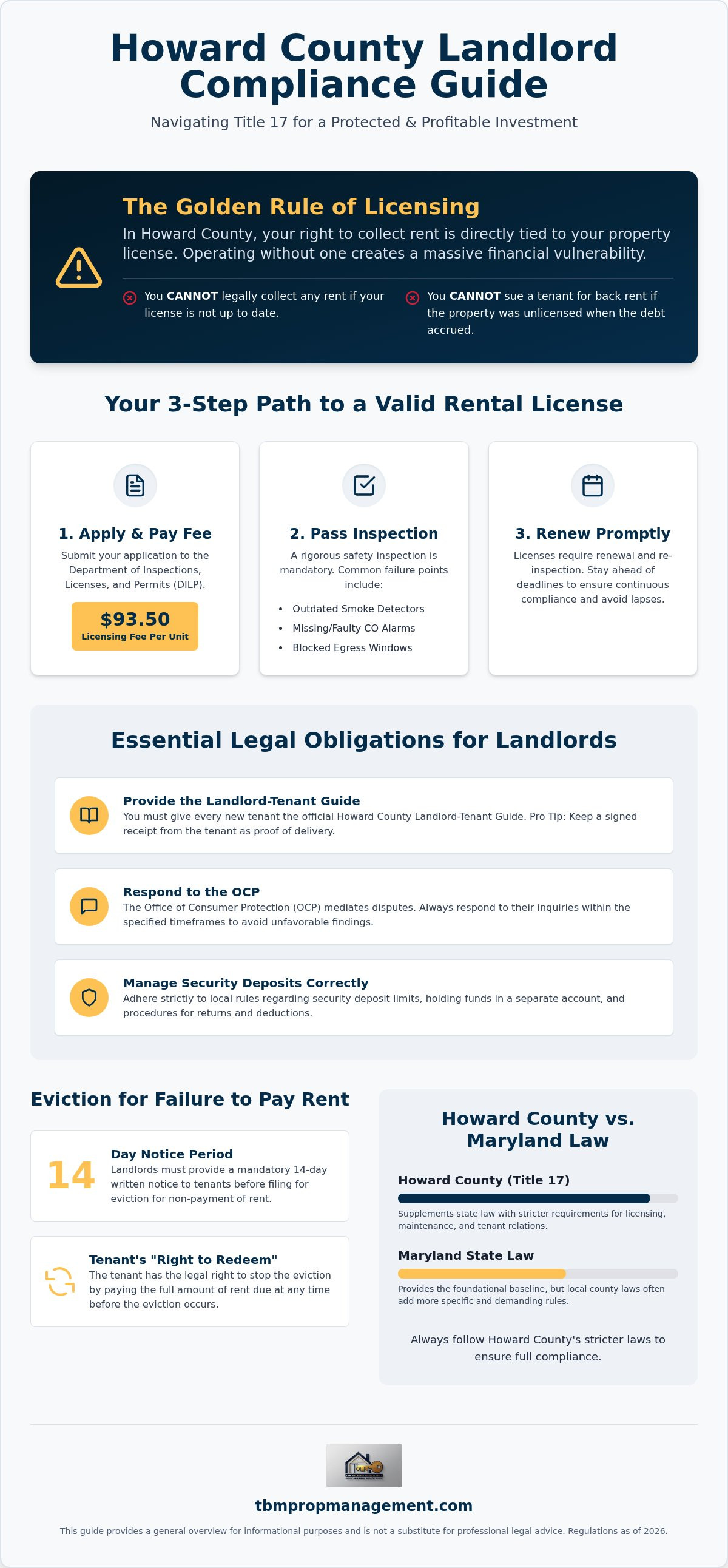
We'll walk you through the mandatory $93.50 licensing fees, the updated 14-day eviction notice delivery rules, and the essential strategies for maintaining your status as a licensed, protected landlord in today's market. By the end of this guide, you'll have a clear roadmap to handle everything from security deposits to the Department of Inspections, Licenses, and Permits (DILP) with total confidence.
Key Takeaways
- Understand how Title 17 of the Howard County Code creates local requirements that go beyond Maryland state law to keep your business fully compliant.
- Learn why maintaining a current rental license is a legal prerequisite for collecting rent or pursuing back payments under howard county landlord laws.
- Identify the mandatory lease provisions and security deposit limits required to protect your investment from costly legal pitfalls and tenant disputes.
- Navigate the specific steps of the 2026 eviction process, including the mandatory notice periods and the tenant’s "Right to Redeem."
- Discover how professional property management can alleviate the burden of licensing and inspections, ensuring your rental remains a stress-free asset.
Understanding the Howard County Landlord-Tenant Relations Act (Title 17)
If you find yourself confused by the overlap of state and local regulations, you're not alone. While Maryland's Real Property Article provides a baseline, Title 17, Subtitle 10 of the Howard County Code is the definitive authority for local rentals. These howard county landlord laws don't replace state rules; they supplement them, adding extra protections for both parties. One of your first duties as a compliant landlord is providing every new tenant with the official Howard County Landlord-Tenant Guide. Failing to do this isn't just a minor oversight. It's a breach of mandatory disclosure requirements that can complicate future legal actions. It's best to keep a signed receipt of this guide to prove you've met your obligations from day one.
The Role of the Office of Consumer Protection (OCP)
The Office of Consumer Protection (OCP) serves as the primary regulatory body overseeing rental relationships in the county. They don't just wait for a court date. Instead, they actively mediate disputes to resolve issues before they escalate to the District Court level. If a tenant files a complaint regarding maintenance or lease terms, you'll receive an inquiry from the OCP. You must respond within the specific timeframes they dictate, as ignoring these requests often leads to unfavorable findings. These findings are significant because they're frequently introduced as evidence if the case eventually moves to a judge. Having the OCP on your side through clear communication can save you thousands in legal fees and unnecessary stress.
Why Local Howard County Laws Supersede Maryland State Defaults
Why does the county need its own set of rules? Simply put, Howard County often demands higher standards for habitability and maintenance than the state baseline. This local focus ensures that communities like Columbia and Ellicott City maintain their reputation for quality living. Staying updated on the 2026 legislative changes, such as those introduced under the "LIVE" initiative, is critical for your protection. Understanding the broader context through resources like the Howard County Housing and Community Development framework helps landlords see how these rules fit into the county's long-term vision. Title 17's purpose is to maintain a delicate balance of fair housing and equitable relations between property owners and residents. By following these stricter howard county landlord laws, you protect your investment from the risk of being labeled an unlicensed landlord, which can strip away your right to collect rent entirely.
The Licensing Mandate: Why Unlicensed Landlords Cannot Collect Rent
In Howard County, your right to collect rent is tied directly to a piece of paper: your rental housing license. Under howard county landlord laws, operating without this license isn't just a regulatory oversight; it's a total legal barrier. If you don't have a valid license issued by the Department of Inspections, Licenses, and Permits (DILP), you legally cannot collect rent for that period. Even worse, local legal precedents establish that you cannot sue a tenant for back rent if the property was unlicensed when the debt accrued. This creates a massive financial vulnerability that can turn a profitable investment into a liability overnight.
Obtaining and Renewing Your Howard County Rental License
The application process is managed through DILP and requires a proactive approach to safety. For 2026, the licensing fee for a single unit is $93.50. Before a license is issued or renewed, the property must pass a rigorous inspection. We often see landlords fail these for simple, avoidable issues. Common culprits include outdated smoke detectors, blocked egress windows, or the lack of properly functioning carbon monoxide alarms. Since these inspections are mandatory for renewal, many owners find relief by utilizing property maintenance coordination to ensure every safety standard is met before the inspector arrives. The Howard County Landlord-Tenant Relations Act mandates these checks to ensure housing quality remains high across the region.
The Financial Consequences of Non-Compliance
If your property is unlicensed, your tenant may have the legal right to withhold rent until the issue is rectified. If you attempt to collect rent during an unlicensed period, you could be found in violation of the Maryland Consumer Debt Collection Act. This carries the risk of county-imposed fines and potential lawsuits that far outweigh the cost of compliance. When you consider the thousands of dollars in lost revenue at stake, keeping your paperwork current is the most important part of your business strategy. To see how these local mandates fit into the broader state landscape, you can review our guide on Maryland Landlord Tenant Rights. Staying compliant doesn't have to be a source of anxiety. With the right oversight, you can focus on your life while we handle the complex licensing paperwork for you.
Lease Requirements and Security Deposit Nuances in Howard County
Once your license is secured, the next layer of protection for your investment lies within the lease agreement itself. Howard County Title 17 mandates specific provisions that go beyond a standard Maryland template. If your lease isn't specifically tailored to howard county landlord laws, you risk having key clauses struck down in court just when you need them most. A common mistake is failing to include mandatory lead paint and utility disclosures or forgetting to provide the required "Receipt for Security Deposit" at the exact moment the payment is made. These small procedural errors can lead to significant legal friction during a dispute.
Essential Clauses for Your Howard County Lease
Your lease must be a shield, not just a formality. One of the most critical local restrictions involves late fees. Howard County caps these at exactly 5% of the monthly rent due. Any amount higher than this 5% threshold is illegal and could jeopardize your standing in a Failure to Pay Rent case. You also need to ensure your lease doesn't contain "prohibited clauses," such as those requiring the tenant to pay for ordinary wear and tear or waiving their right to a jury trial. These clauses are legally unenforceable in our local courts and often lead to immediate investigations by the Office of Consumer Protection if a tenant flags them.
Managing Security Deposits Without Legal Friction
Handling a tenant's money requires absolute precision and a clear understanding of Maryland's 2026 standards. You can't charge more than two months' rent as a security deposit. Once received, this money must be placed in a dedicated Maryland escrow account within 30 days. Failing to manage this timeline correctly can lead to severe penalties. We've seen many landlords struggle with the "45-day rule," which requires you to return the deposit with statutory interest and a detailed, itemized list of any damages within 45 days of the tenancy ending.
- Receipt Requirements: You must provide a written receipt that explicitly states the tenant's right to be present for the final move-out inspection.
- Inspection Rights: Tenants have the right to request a joint move-in inspection to document existing damage, which creates a vital baseline for both parties.
- Treble Damages Risk: If you fail to return the deposit or provide the itemized list within the 45-day window, a judge can award the tenant up to three times the withheld amount.
This "treble damages" risk is why high-resolution photo documentation during every transition is non-negotiable. It transforms a subjective argument into an objective, evidence-based decision. Managing these financial nuances is often the most stressful part of property oversight, which is why many owners rely on professional rent collection and accounting services to ensure every penny is handled with surgical precision. By keeping your documents and escrow practices compliant with howard county landlord laws, you maintain the professional standards your investment deserves.
Navigating Evictions: Failure to Pay Rent and Breach of Lease
Facing a non-paying tenant is often the most stressful scenario for any property owner. Under howard county landlord laws, you must follow a strict procedural path to regain possession of your home. Before you can even file a Failure to Pay Rent complaint in the District Court, you're required to provide a written 10-day notice to the tenant. This gives them a window to settle the debt before legal action begins. If the case proceeds to court, you'll also need to understand the "Right to Redeem." This allows a tenant to stop the eviction at any point before the Sheriff arrives by paying all past-due rent and court costs. However, if you've won three previous cases against the same tenant within the last 12 months, you can ask the judge to foreclose that right.
It's vital to distinguish between a "holding over" action and a "breach of lease" filing. A holding over case applies when a tenant remains after the lease term has expired and they've been given proper notice to vacate. A breach of lease, conversely, is used when a tenant violates specific terms like unauthorized pets or excessive noise. Each requires different evidence and notice periods, making it essential to categorize the violation correctly from the start.
The Legal Timeline for Repossession
The path from a late payment to a physical eviction is governed by specific county timelines and costs. After the initial 10-day notice and subsequent court hearing, you may apply for a Warrant of Restitution. In 2026, Howard County Bill No. 12-2026 increased the required notice period for the actual eviction from 6 days to 14 days after the warrant is issued. You'll encounter modest filing fees starting around $5, while the Sheriff's fee for executing the eviction typically starts at $40. It's a hard rule that only a Sheriff, not a landlord, can physically remove a tenant or their belongings from the property.
Avoiding Wrongful Eviction Claims
The temptation to take matters into your own hands is high when rent goes unpaid, but "self-help" evictions are a fast track to a costly lawsuit. Changing locks, removing doors, or cutting off utilities will result in heavy fines and potential damages awarded to the tenant. You must also be prepared for a "retaliation" defense. If a tenant has recently filed a complaint with the Office of Consumer Protection, the court may view your eviction attempt as a punitive move. Documenting every lease violation with dates and photos is your best defense in a Breach of Lease case. If this process feels overwhelming, our expert tenant placement and management services can help you avoid these pitfalls from the start.
Eliminating Legal Stress with Professional Property Management
Managing a rental alone often feels like a second full-time job, especially when you're trying to keep up with the shifting landscape of howard county landlord laws. The constant risk of an unlicensed status or a botched eviction notice is a heavy burden for any property owner to carry. At TBM Property Management, we act as your dedicated local partner to alleviate that pressure. We ensure every property under our care is 100% licensed and compliant with Title 17, handling the complex paperwork and county inspections so you don't have to. Our goal is to transform your property from a source of anxiety into a stabilizing financial force.
Our approach starts with comprehensive tenant screening to ensure legal compliance from day one. By placing high-quality residents through a rigorous vetting process, we significantly reduce the risk of non-payment and the need for the complex eviction proceedings we discussed earlier. To keep your property in peak condition and maintain habitability standards, we utilize Property Meld for maintenance coordination. This streamlined system ensures every repair request is documented and addressed swiftly, protecting your asset's value while keeping your tenants satisfied and your business compliant.
TBM’s Comprehensive Compliance Audit
We begin our partnership with a deep dive into your current operations. Our team reviews your existing leases for prohibited clauses and checks your licensing status for any gaps that might prevent you from legally collecting rent. This audit provides immediate relief by identifying and fixing vulnerabilities before they become legal liabilities. Beyond compliance, you'll benefit from professional rent collection and transparent financial reporting that turns a chaotic side-hustle into a structured, profitable business. If you have assets in neighboring areas, our Full-Service Property Management in Laurel, MD offers the same high standards and regional authority.
Partnering for Long-Term Investment Success
Transitioning from a stressed DIY landlord to a passive investor is the ultimate goal for most property owners. With over 12 years of local Maryland real estate expertise, we've navigated every nuance of the howard county landlord laws and the "LIVE" initiative. We don't just fix problems after they occur; we prevent them through diligent oversight and a mastery of local codes. This specialized, high-touch approach allows you to focus on your family or career while your investment grows securely under the watch of seasoned experts. It's time to trade your management headaches for professional-grade results. Request your complimentary rental analysis from TBM today!
Securing Your Rental Future in Howard County
Protecting your investment requires more than just finding a tenant; it demands a deep commitment to the specific nuances of howard county landlord laws. As we've explored, one missing license or an incorrectly formatted lease can strip away your legal right to collect rent or pursue an eviction. The 2026 regulatory landscape, especially with the new 14-day notice requirements and Title 17 mandates, leaves very little room for error. It's clear that staying compliant is a full-time job in itself.
You don't have to manage these high-stakes requirements alone. With over 12 years of Maryland real estate expertise and specialized Howard County Title 17 knowledge, TBM Property Management provides the full-service licensing and inspection support you need. We handle the technicalities so you can enjoy the rewards of your investment without the constant fear of a legal pitfall. It's time to trade self-management stress for professional-grade results. Let TBM Property Management handle your Howard County compliance and reclaim your peace of mind today. Your hard-earned assets are in safe, local hands.
Frequently Asked Questions
Do I need a rental license to rent out my house in Howard County?
Yes, you must obtain a rental housing license for any residential property you rent out in Howard County. This requirement is mandatory under Title 17 of the county code and applies to single-family homes, condos, and apartments alike. For a single unit in 2026, the licensing fee is $93.50. Operating without a valid license puts your investment at risk because you cannot legally collect rent or pursue legal action against a tenant for unpaid balances.
Can I collect rent if my Howard County rental license is expired?
You cannot legally collect rent if your license has expired. Howard County law is very strict on this point. If a tenant stops paying while your property is unlicensed, a judge will likely dismiss any Failure to Pay Rent case you file. It's a significant financial vulnerability that can turn your profitable asset into a liability. We recommend setting reminders for renewals at least 60 days in advance to ensure your property remains compliant and your income stays protected.
What is the maximum security deposit allowed in Howard County in 2026?
The maximum security deposit you can charge is two months' rent. This limit is set by Maryland state law and applies to all residential leases in Howard County. If you accidentally charge more than this amount, you may be liable for up to three times the extra amount plus attorney fees. Always ensure your ledger clearly separates the security deposit from the first month's rent to avoid any legal confusion during the move-out process.
How much notice must I give a tenant before an inspection in Howard County?
You should typically provide at least 24 hours of notice before entering a rental property for a non-emergency inspection. While the lease agreement often dictates the specific terms, Howard County standards prioritize the tenant's right to quiet enjoyment. For routine maintenance or safety checks, it's best to coordinate via text or email to document the communication. This proactive approach helps maintain a positive relationship with your residents while protecting your asset and ensuring legal compliance.
What happens if a tenant doesn't pay rent in Howard County?
If a tenant fails to pay, you must first provide a written 10-day notice of your intent to file a Failure to Pay Rent complaint. This is a mandatory step under 2026 howard county landlord laws. If they don't settle the debt within that window, you can proceed to the District Court. Remember that tenants have a "Right to Redeem" the property by paying all owed amounts before the Sheriff executes the final eviction.
Is the Howard County Landlord-Tenant Guide mandatory for all leases?
Yes, providing the Howard County Landlord-Tenant Guide to all new tenants is a mandatory requirement. You must deliver this guide at the start of the tenancy to comply with Title 17 disclosure rules. Many landlords include a signed acknowledgment form in their lease package to prove delivery. Failing to provide this guide can be used as a defense by tenants during disputes, potentially complicating your ability to enforce lease terms or proceed with certain legal actions.
Can I charge a late fee for rent in Howard County?
You can charge a late fee, but it is strictly capped at 5% of the total monthly rent due. For example, if the rent is $2,000, the maximum late fee allowed is $100. Charging anything above this 5% threshold is illegal under howard county landlord laws and could render that portion of your lease unenforceable in court. It's essential to ensure your lease agreement explicitly states when rent is considered late to avoid unnecessary disputes.
Who handles landlord-tenant disputes in Howard County?
Landlord-tenant disputes are primarily handled by the Howard County Office of Consumer Protection (OCP) and the District Court. The OCP often acts as a mediator to resolve issues regarding security deposits or maintenance before they reach a judge. If mediation fails, the case moves to the District Court for a final ruling. Having professional property management can help you navigate these bodies effectively and often prevents disputes from escalating to a courtroom through proactive compliance.