
Key Management 101: A Landlord’s Guide to Rental Security and Access
Imagine the sinking feeling of realizing a former tenant might still have a working copy of your front door key, or worse, that a master key has gone missing during a busy turnover. For many landlords in Anne Arundel or Prince George’s County, the simple act of handing over a set of keys feels like a gamble with their property’s security. You likely already know that managing physical access is one of the most stressful parts of property oversight. It's a constant cycle of re-keying locks, tracking duplications, and worrying about who has entry to your investment when you're not looking.
We understand that your goal is to maintain a professional, secure environment without the constant anxiety of a security breach. This guide will help you master the logistics of rental property key management to protect your Maryland rental property from liability and modern security risks. We'll walk through building a documented system for tenant turnover, staying compliant with the latest Maryland security regulations, and choosing the right tools to ensure your property remains secure 24/7. By the end, you'll have a clear roadmap to transition from the frustration of lost keys to the relief of a controlled, professional access system.
Key Takeaways
- Learn how to mitigate legal and insurance risks by implementing a strict re-keying protocol after every Maryland tenant turnover.
- Discover how professional rental property key management reduces the stress of unauthorized access while protecting your asset's value.
- Compare the long-term savings of smart lock technology against traditional deadbolts to find the most secure fit for your budget.
- Establish a foolproof checkout procedure for vendors and tenants so you're never left wondering who has a copy of your keys.
- See how local experts in Howard and Prince George's counties can eliminate the burden of midnight lockouts and emergency maintenance calls.
Understanding Key Management in Residential Property Oversight
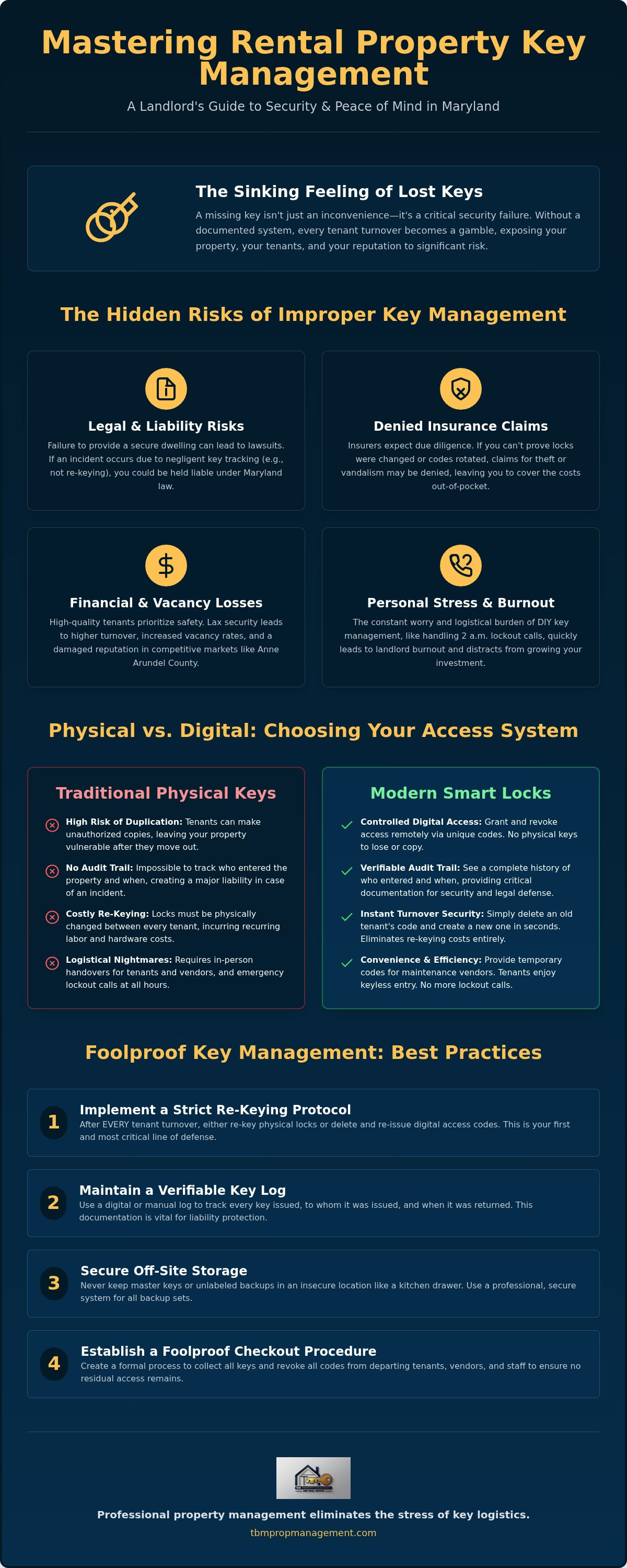
Effective property oversight starts with a clear understanding of who can enter your building at any given moment. At its core, key management is the systematic control of property access and security. It's the invisible foundation that ensures your investment remains protected. While many see it as a simple administrative task, professional rental property key management is actually a sophisticated strategy designed to minimize liability and maximize tenant safety.
A robust system serves as a critical component of professional property management because it creates a verifiable audit trail. If a security incident occurs, having a documented history of key issuance and return is vital for insurance claims and legal defense. This layer of Physical security protects your physical asset while simultaneously respecting the tenant’s right to privacy. When you control the keys, you control the risk.
The Basics of Rental Property Access
A professional system differentiates between several types of access. Master keys offer total entry for emergencies, while tenant keys are strictly for the resident's use. Maintenance copies are often temporary sets handed to vendors for specific repairs. To stay secure, you must maintain a reliable, off-site storage system for backup sets. This ensures that a single lost keyring doesn't compromise the safety of the entire property. True management involves more than just a physical keyring; it requires a digital or manual log that tracks every hand-off in real time. Without this documentation, you have no way to prove who was in the unit if a dispute arises.
Why Landlords Struggle with Key Logistics
Managing access becomes exponentially more difficult as you scale your portfolio across Maryland. If you own properties in both Anne Arundel and Prince George’s counties, the travel time alone makes manual key hand-overs a logistical nightmare. Landlords who attempt DIY tracking often fall into common traps like keeping unlabeled keys in a kitchen drawer or losing track of how many copies a tenant actually made. If you can't account for every copy of a key, the security of your property is effectively zero.
Beyond the physical mess, there's a significant emotional burden. Are you prepared to handle a 2 a.m. lockout call in the middle of a winter storm? The stress of being "on call" for access emergencies can quickly lead to burnout. These logistical hurdles are why many local owners seek a dedicated partner to handle the high-stress details of rental property key management and maintenance coordination.
The Hidden Risks of Improper Key Management for Maryland Landlords
Handing over keys is a gesture of trust, but failing to manage those keys properly creates a massive vulnerability for your business. If a previous tenant enters the property because you didn't change the locks, the legal fallout can be devastating. Beyond the immediate safety concerns, improper rental property key management can lead to insurance claims being denied. Most carriers expect landlords to exercise due diligence. If you can't prove the locks were changed or codes were rotated, you might find yourself footing the bill for theft or vandalism out of pocket.
Security issues also directly impact your bottom line through tenant turnover. High-quality renters prioritize safety. If they notice signs of lax security, such as loose locks or a lack of key control, they're less likely to renew their lease. This leads to higher vacancy rates and the recurring stress of finding new occupants. Effective access control isn't just about locks; it's about protecting your reputation as a reliable housing provider in competitive Maryland markets like Laurel and Columbia.
Liability and Maryland Tenant Rights
Maryland law requires landlords to provide a dwelling that is fit for habitation and secure. While the state doesn't mandate a specific brand of lock, the expectation of safety is non-negotiable. If a security breach occurs due to negligence in your key tracking, you could face significant lawsuits. It's essential to stay updated on the latest Maryland Landlord Tenant Rights to ensure you're meeting these obligations. Professional oversight helps mitigate these risks by providing the documentation needed to prove you've taken every reasonable precaution for your residents.
Security Breaches and Asset Protection
A compromised master key is a financial nightmare. If one key that opens every door in a multi-unit building goes missing, you're looking at the cost of re-keying the entire facility. This can easily run into thousands of dollars in labor and hardware. Additionally, unauthorized key duplication remains a major red flag. When tenants make copies for friends or family without your knowledge, you lose control over who has access to your asset. This lack of control makes your property a target for squatters, who often look for homes with weak access points. Utilizing a full-service property management partner ensures that inspections and key audits happen regularly, keeping your asset locked down and your mind at ease.
Physical vs. Digital Key Management: Which is Right for Your Rental?
Deciding between a heavy keyring and a smartphone app is one of the most significant choices you'll make for your property. While traditional locks offer a sense of familiarity, the evolution of rental property key management has introduced digital tools that can save hours of administrative work. In high-demand areas like Laurel, Maryland, the choice often comes down to balancing upfront investment against long-term operational ease. Are you looking for the simplicity of a metal key, or the flexibility of a remote code?
The Pros and Cons of Traditional Master Key Systems
Traditional master key systems remain popular because they are famously reliable. You don't have to worry about a Wi-Fi outage or a dead battery locking out a tenant in the middle of a rainy Maryland night. However, the logistics of physical handovers are a persistent headache. Every time a tenant moves out, you face the chore of coordinating with a locksmith. Research shows the cost of rekeying a traditional lock typically ranges from $75 to $150 for each turnover. Over several years, those individual service calls add up to a significant expense that eats into your rental income. If you own multiple units, the physical management of hundreds of keys can quickly become a full-time job.
Smart Locks and Digital Access in 2026
By 2026, smart locks have become the standard for landlords looking to scale their portfolios without increasing their stress levels. Systems like the Schlage Encode or Yale Assure Lock 2, which range from $200 to $280, allow you to change access codes instantly from your smartphone. This eliminates the need for physical keys entirely. If a maintenance contractor needs entry for a quick repair, you can issue a temporary code that expires after a set time. This level of control provides an invaluable audit log, giving you documented proof of when property inspections occurred. While some owners fear technology failures, most modern units include physical key overrides or external battery jump-start points to ensure access is never truly lost.
Modern tenants in Anne Arundel and Howard counties increasingly view digital access as a premium feature. Offering keyless entry can boost your property's appeal and even justify a slight increase in rent. While cloud-based access control might cost $5 to $10 per door monthly, the relief of never driving across town for a midnight lockout is priceless. Whether you choose physical or digital, the goal is a secure, documented system that keeps your asset protected and your schedule clear.
Best Practices for Key Handover and Security Compliance
Mastering the logistics of turnover is where many DIY landlords feel the most pressure. To maintain a secure environment, you must follow the "Golden Rule" of property oversight: never allow a new tenant to move in with a key used by the previous occupant. Whether you use physical deadbolts or digital codes, rotating access is the only way to guarantee security. Implementing a professional rental property key management system ensures that every handover is documented and every copy is accounted for, protecting you from liability and your tenants from intrusion.
It's a simple rule. If you don't track the keys, you don't control the property. By 2026, Maryland regulations require landlords to provide an eight-page "Tenants' Bill of Rights" with every lease, which includes clear expectations for property access and privacy. Establishing a foolproof procedure now saves you from legal headaches later. We've found that the most successful owners in Anne Arundel and Prince George’s counties treat key security as a non-negotiable part of their operational excellence.
The Tenant Move-In/Move-Out Checklist
Your documentation should begin the moment a lease is signed. Use a formal key release form that specifies the exact number of keys issued, including mailboxes and common areas. During the move-out phase, verify that every single copy is returned. This prevents unauthorized duplicates from circulating in the community. We recommend integrating these checks into your regular property inspections to confirm that locks haven't been tampered with or replaced without your permission. If a tenant has changed the locks themselves, it’s a major red flag that requires immediate attention to restore your legal access.
Managing Maintenance and Emergency Access
Coordination is key when repairs are needed. Using tools like Property Meld allows you to streamline how vendors gain entry without compromising security. For physical keys, avoid the "key under the mat" approach. Instead, use secure, code-protected lockboxes or a centralized office storage system. Remember that as of October 2025, Maryland law requires you to provide at least 24 hours' advance notice before entering a unit, except in true emergencies. Proper management ensures you stay compliant with these notice periods while still getting the job done. If managing these logistics feels like a second full-time job, our Full-Service Property Management team can take the weight off your shoulders and handle the 24/7 coordination for you.
Stress-Free Key Management: How TBM Protects Your Assets
TBM Property Management takes the high-stress logistics of rental property key management and transforms them into a streamlined, professional system. We recognize that for many landlords, the burden of asset oversight feels like a constant weight. By acting as your dedicated partner, we provide a stabilizing force that protects your property around the clock. You no longer have to worry about the midnight "I lost my key" phone calls or the anxiety of a tenant turnover. We handle the lockouts, the re-keying, and the vendor coordination so you can focus on the growth of your investment.
Our approach is built on comprehensive documentation and proactive oversight. We maintain a rigorous audit trail for every property under our care, ensuring that every hand-off is logged and every access point is secure. This level of diligence doesn't just offer peace of mind; it provides the professional-grade results needed to satisfy insurance requirements and maintain strict Maryland security compliance. When you work with us, you're not just hiring a service provider. You're gaining a protective ally who treats your asset with the same high standards and dedication you do.
Local Expertise in Laurel and Surrounding Areas
With over 12 years of local Maryland experience, we understand the specific challenges of managing rentals in Laurel, Prince George’s, and Montgomery counties. We have spent over a decade building a network of trusted local locksmiths and security vendors who respond quickly to our needs. This regional authority allows us to tailor access solutions to the unique requirements of each local jurisdiction. Whether you need a high-security master key system for a multi-unit building in Anne Arundel or smart lock integration for a single-family home in Howard County, we have the mastery to execute it flawlessly. Our deep roots in these communities ensure your property is well-protected by someone who knows the neighborhood.
Get Your Complimentary Rental Analysis
The transition from a state of frustration to a state of ease begins with a clear understanding of your current security posture. We offer a complimentary analytical report to identify potential gaps in your existing rental property key management strategy. During this initial property review, we look for red flags that could lead to liability, such as unrecorded duplicates or outdated hardware. This proactive step is the first move toward professional ease and long-term security. Stop letting key logistics drain your time and energy. Let TBM handle the keys and the stress-Contact us today!
Securing Your Investment and Your Peace of Mind
Effective rental property key management is the invisible shield protecting your Maryland investment. By prioritizing strict turnover protocols and choosing a system that fits your lifestyle, you eliminate the risks of unauthorized access and legal liability. Whether you stick with high-reliability physical keys or embrace the remote flexibility of smart locks, having a documented audit trail is your best defense against the unexpected. You don't have to carry the burden of 24/7 lockout calls or turnover logistics alone.
With over 12 years of real estate expertise in Laurel, PG County, and Montgomery County, TBM Property Management provides the relief you've been looking for. We pair comprehensive tenant screening with diligent property inspections to ensure your asset stays protected from every angle. It's time to transition from the stress of self-management to the ease of professional oversight.
Experience Stress-Free Management. Get Your Free Rental Analysis from TBM
Your property deserves professional-grade security, and you deserve a schedule free from access emergencies. Let's build a more secure future for your rental business together.
Frequently Asked Questions
Is it legal to not change the locks between tenants in Maryland?
While Maryland state law doesn't explicitly mandate re-keying in every jurisdiction, it falls under your duty to provide a secure dwelling. Failing to rotate access creates massive liability if a previous tenant enters the property. Most professional rental property key management standards require a lock change to ensure the new resident's safety. It's the only way to prove you've met your safety obligations if a dispute arises.
How much does it typically cost to re-key a rental property?
The cost of re-keying a traditional lock typically ranges from $75 to $150 per turnover. This price usually includes the locksmith's service call and the labor for adjusting the internal pins of the existing hardware. If you choose to replace the entire lockset, costs will increase based on the hardware quality. For landlords with multiple units, these recurring expenses highlight the long-term value of investing in smart systems.
Can I charge a tenant for a lost key or a lockout service?
Yes, you can generally charge tenants for the actual cost of replacing lost keys or providing lockout services, provided this is outlined in your lease. These fees should be reasonable and reflect your actual expenses. Many Maryland landlords include a specific lockout fee to cover the time and travel involved in granting access. Clear lease language helps prevent disputes while encouraging tenants to be more careful with their access.
What is a master key system and is it safe for my rental?
A master key system allows one master key to open multiple units while individual tenant keys only open specific doors. While highly convenient for maintenance coordination, these systems carry significant risks. If the master key is lost or stolen, every lock in the building must be replaced immediately. This can lead to thousands of dollars in emergency hardware and labor costs. For many owners, the risk often outweighs the convenience.
Are smart locks worth the investment for a single-family rental?
Smart locks are often worth the investment because they eliminate recurring locksmith fees and simplify turnover logistics. With a typical smart lock costing between $200 and $280, the hardware often pays for itself after just two tenancies. They also offer a premium experience that attracts high-quality renters. The ability to rotate digital codes remotely provides a level of control that traditional rental property key management simply cannot match.
What should I do if a tenant changes the locks without my permission?
You should immediately notify the tenant that they're in violation of the lease and request a copy of the new key. Most Maryland residential leases prohibit unauthorized alterations to the property, including lock changes. As the landlord, you must have access for emergency repairs and required property inspections. If the tenant refuses to provide a key, it may be grounds for a formal lease violation notice or further legal action.
How many sets of keys should I provide to a new tenant?
You should typically provide one full set of keys for every adult occupant listed on the lease agreement. Providing extra sets can lead to unauthorized copies being made and distributed, which compromises the security of your asset. It's best practice to document the exact number of keys issued on a signed key release form. This ensures you have a clear record when it's time for the tenant to return them at move-out.
Does professional property management include key handling?
Yes, full-service property management includes the comprehensive handling of all key logistics and access control. This covers everything from coordinating locksmiths during turnovers to managing vendor access for maintenance repairs. At TBM Property Management, we take the stress out of the process by maintaining secure audit trails and providing 24/7 support for lockout emergencies. This allows you to step back from the daily hassles of physical property oversight.