Landlord Responsibilities for Repairs in Maryland: The 2026 Legal Guide
What if a simple maintenance delay could legally allow your tenant to stop paying you rent directly? In the current legal climate, understanding landlord responsibilities for repairs maryland is no longer just about being a good property owner; it's about safeguarding your financial future. You likely feel the weight of managing 24/7 maintenance requests while trying to distinguish between a minor cosmetic fix and a mandatory habitability issue. It's natural to feel concerned about potential lawsuits or the complexities of the District Court's rent escrow process when you're simply trying to protect your hard-earned investment.
We understand that you want to be a diligent partner to your tenants without being overwhelmed by shifting regulations like the 2025 Consumer Protection for Renters Act. This guide provides the professional clarity you need to master Maryland's repair laws, reduce your liability, and ensure total compliance with both state and local ordinances. We'll explore the specific timeframes for hazardous repairs, the nuances of Prince George's County emergency requirements, and how a proactive maintenance strategy leads to higher lease renewal rates and a more stable, stress-free portfolio.
Key Takeaways
- Understand why the implied Warranty of Habitability is a non-negotiable legal duty that you cannot waive in any Maryland lease agreement.
- Master the specific timelines for landlord responsibilities for repairs maryland, distinguishing between the 30-day "reasonable" standard and immediate 24-hour emergency triggers.
- Learn the exact conditions tenants must meet to initiate rent escrow, allowing you to proactively resolve issues before payments are diverted to the court.
- Identify the critical differences between state-level requirements and stricter local codes in jurisdictions like Montgomery and Prince George's Counties.
- Discover how professional maintenance coordination reduces your personal liability while ensuring 24/7 coverage for your most valuable assets.
The Warranty of Habitability: Your Primary Legal Duty in Maryland
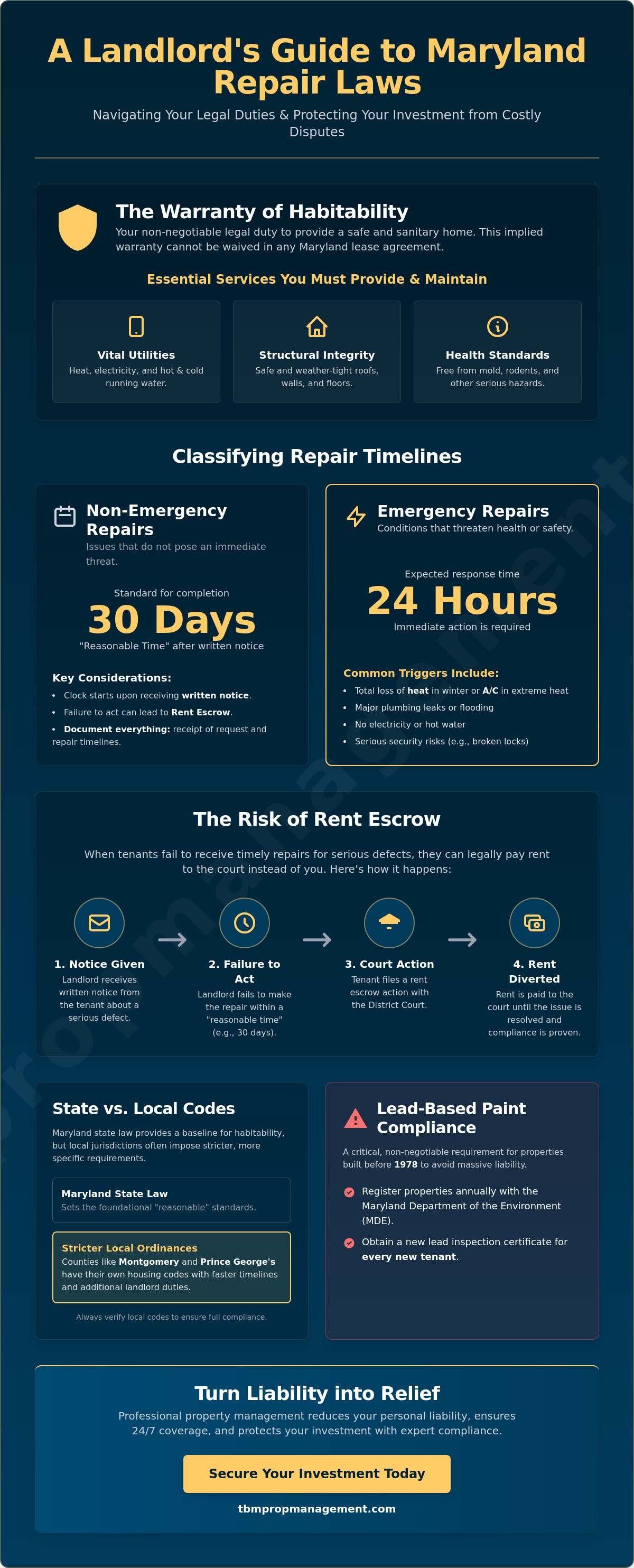
Do you know the exact point where a minor maintenance request becomes a legal liability? In Maryland, every residential lease includes an unspoken promise known as The Warranty of Habitability. This isn't just a suggestion; it's a foundational legal requirement that ensures every tenant has a safe, sanitary, and functional place to live. Even if you include a clause in your lease stating the tenant accepts the property 'as-is' regarding essential systems, Maryland courts will likely find that provision unenforceable. You can't contract your way out of basic safety.
Understanding landlord responsibilities for repairs maryland requires a clear grasp of how state law interacts with local housing codes. While state statutes provide a baseline, jurisdictions like Montgomery County and Prince George's County often impose even stricter standards. Failing to meet these habitability benchmarks doesn't just lead to unhappy tenants; it exposes you to rent escrow actions, administrative fines, and potential lawsuits. When you prioritize these duties, you aren't just following the law; you're protecting the long-term value of your investment and building a reputation as a reliable local expert.
Essential Services You Must Provide
What does 'habitable' actually look like in practice? It means your property must meet specific standards for health and safety at all times. If a furnace fails in January or a pipe bursts in July, your legal obligations shift from routine maintenance to urgent priorities. You're required to provide and maintain:
- Vital Utilities: Consistent access to heat, light, electricity, and both hot and cold running water.
- Structural Integrity: Safe and weather-tight roofs, walls, and flooring that can withstand the elements.
- Health Standards: A living environment free from serious health hazards, including mold infestations and pest problems like rodents or bedbugs.
Lead-Based Paint Compliance (Maryland MDE)
For owners of older Maryland properties, compliance involves more than just fixing leaks. If your rental was built before 1978, the Maryland Department of the Environment (MDE) requires strict adherence to lead-paint regulations. You must register these properties annually and obtain a new lead inspection certificate every time a new tenant moves in. Ignoring these steps creates massive liability risks. In the event of a lead-related dispute, having documented, professional compliance is your strongest defense against devastating financial penalties. Keeping your MDE registration current is a simple way to gain peace of mind and protect your professional standing.
Classifying Repairs: Emergency vs. Non-Emergency Timelines
How quickly do you really need to fix a leaking faucet or a flickering light? In Maryland, the legal standard for most repairs is a "reasonable time" after receiving written notice. While courts generally view 30 days as a standard window for non-essential fixes, the clock starts ticking the moment you're notified. If you fail to act within this period, you risk the tenant initiating the rent escrow process in Maryland, where their monthly payments are held by the court instead of being sent to you. Understanding landlord responsibilities for repairs maryland means knowing that "reasonable" is often defined by the severity of the problem and the time of year.
Documentation is your best defense. Always acknowledge receipt of maintenance requests in writing and provide a projected timeline for completion. This paper trail demonstrates your diligence and protects you if a dispute arises. Seasonal changes significantly impact your response speed; a broken air conditioner in October might wait, but a failed furnace in January requires immediate intervention. If you find the constant stream of requests stressful, partnering with a professional property management team can provide the buffer you need to maintain compliance without the 24/7 headache.
What Constitutes a Maintenance Emergency?
An emergency is any condition that threatens the health or safety of the occupants or the structural integrity of the property. In these cases, Maryland landlords are expected to respond within 24 hours. Common triggers include:
- Total Loss of Heat: During winter months, failing to maintain a minimum temperature (often 65 to 68 degrees depending on your specific county) is a major violation.
- Plumbing Disasters: This includes a total lack of running water, major active leaks that could cause structural damage, or a complete sewage backup.
- Electrical Hazards: Sparking outlets, exposed wiring, or a total power loss not caused by the utility company fall into the emergency category.
Handling Cosmetic and Non-Essential Requests
Not every request requires a late-night technician. You'll often face "cosmetic" requests, like outdated cabinet hardware or minor carpet stains. It's vital to distinguish between normal wear and tear, which is your responsibility, and tenant-caused damage, which they should pay for. Managing tenant expectations early in the lease can prevent frustration later. One of the most effective ways to stay ahead of these issues is by utilizing a preventative maintenance checklist. This proactive approach catches small leaks before they become midnight emergencies, keeping your costs low and your tenants satisfied.
The Risk of Rent Escrow: When Maryland Tenants Legally Withhold Rent
Does a tenant's threat to withhold rent keep you up at night? While tenants generally must pay rent regardless of maintenance issues, the Rent Escrow Law creates a specific legal pathway for them to divert funds if serious defects go unaddressed. This mechanism allows a tenant to pay their monthly rent into a court-administered account instead of sending it directly to you. It's a high-stakes situation that can lead to frozen cash flow and mounting legal fees. Mastering your landlord responsibilities for repairs maryland is the most effective way to ensure you never find yourself defending your management practices in a District Court hearing.
The process usually starts with a "Notice of Defect." This is a formal written communication, often sent via certified mail, that puts you on legal notice. Your response to this first letter is the most important step in the entire dispute. If you ignore the request or fail to provide a concrete repair plan, you're giving the tenant the evidence they need to file an escrow action. If the case reaches a judge, the outcomes can be severe. The court may grant a rent abatement, which permanently reduces the amount of rent you're entitled to collect for the period the defect existed. In extreme scenarios, the court can even terminate the lease entirely or order you to pay for the tenant's temporary relocation.
The Tenant's Burden of Proof
To successfully open an escrow account, the tenant must meet strict legal requirements. They have to prove that they provided you with written notice and that you failed to act within a "reasonable" window, which typically aligns with the 30-day standard for non-emergencies. Crucially, the tenant must remain current on their payments. They aren't legally allowed to just keep the money in their own bank account; they must deposit the full rent amount with the court. If a tenant stops paying you but fails to file for escrow correctly, they may still be subject to a standard failure to pay rent action.
Defending Against Frivolous Escrow Claims
How do you protect your professional reputation from a tenant using minor cosmetic issues to avoid payment? Detailed documentation is your best defense. Keep a comprehensive log of every repair attempt, including photos of the completed work and receipts from licensed contractors. If a tenant refuses to grant access for a repair, document that refusal immediately with a follow-up email or letter. Having a firm grasp of Maryland landlord tenant rights helps you distinguish between legitimate habitability claims and simple lease frustrations. By maintaining a transparent paper trail and acting as a diligent partner, you can often resolve these disputes before they ever reach a courtroom.
Local Jurisdictions: PG County vs. Montgomery County Codes
Did you know that meeting state requirements is often only half the battle? While the Maryland state code provides a solid foundation, local jurisdictions frequently layer on additional, more stringent regulations. If you own property in Prince George's or Montgomery County, you're subject to specific standards that can lead to heavy fines if overlooked. Understanding landlord responsibilities for repairs maryland requires a hyper-local approach because what passes as compliant in one town might trigger a violation notice just across the county line. Staying on top of these shifting rules is essential for protecting your rental license and avoiding administrative headaches.
Your rental license is often directly tied to your repair compliance. In many Maryland jurisdictions, local inspectors won't renew your license if there are outstanding maintenance citations or if the property fails a basic safety check. This creates a high-stakes environment where a simple missed repair can effectively shut down your ability to collect rent legally. If you're feeling overwhelmed by the different layers of bureaucracy, our full-service property management team can step in to handle the inspections and coordination for you, ensuring your assets remain fully licensed and protected.
Prince George's County Specifics
In Prince George's County, the Department of Permitting, Inspections, and Enforcement (DPIE) maintains a watchful eye on habitability. If you operate three or more rental units here, you're legally required to provide a 24-hour telephone number or answering service for emergencies. Beyond basic utilities, the county is particularly strict about fire safety, requiring specific types of smoke detectors and carbon monoxide alarms. You also need to keep an eye on "curb appeal" issues; exterior maintenance failures, such as peeling paint or overgrown landscaping, can lead to citations just as quickly as an interior leak.
Montgomery County and Howard County Nuances
Montgomery County is widely considered to have some of the strictest habitability standards in the state, overseen by the Department of Housing and Community Affairs (DHCA). Under the Consumer Protection for Renters Act passed in April 2025, enforcement of these standards has become even more aggressive. You're now required to meet specific weatherization and insulation benchmarks to ensure energy efficiency and tenant comfort. Meanwhile, in Howard County, you'll find unique requirements for the condition of window screens and the specific types of locks allowed on entry doors. Staying compliant with rental management in Prince George's County and surrounding regions means recognizing these subtle but legally significant differences.
Professional Maintenance: Turning Liability Into Relief
Have you ever felt the sinking feeling of a phone ringing at 3:00 AM while you're trying to rest? The emotional toll of self-management often outweighs the perceived savings of DIY maintenance. When you handle everything yourself, you aren't just a landlord; you're a plumber, an electrician, and a legal compliance officer. In a state with strict habitability standards, the hidden costs of burnout and potential liability can be devastating. Managing landlord responsibilities for repairs maryland requires more than just a toolbox; it demands a systematic, professional approach that protects your time and your assets.
Professional maintenance coordination provides a stabilizing force between you and the complexities of the law. By utilizing technology to document every request, response time, and completed work order, you create an ironclad defense against future rent escrow claims. We ensure that every vendor entering your property is fully licensed and insured, which is a non-negotiable requirement in Maryland's litigious environment. This level of oversight transforms your property from a source of stress into a high-performing investment, allowing you to focus on your long-term financial goals instead of daily firefighting.
The TBM Property Management Approach
We believe that your peace of mind is just as important as your property's structural integrity. Our team leverages professional property management systems to handle those middle-of-the-night emergencies so you don't have to. You gain immediate access to our vetted network of trusted, local Maryland contractors who understand the specific codes of Prince George's and Montgomery Counties. Through our transparent reporting portal, you can see your repair history and invoices in real-time, giving you total visibility without the need for constant phone calls.
Protecting Your ROI Through Preventative Care
The most successful landlords move from reactive 'firefighting' to proactive asset protection. Regular property inspections are the key to catching a small drip under a sink before it evolves into a mold issue or a costly court case. By identifying these minor concerns early, you maintain the Warranty of Habitability and keep your tenants happy and renewing their leases. If you're ready to trade maintenance stress for professional results, get a free rental analysis and maintenance review from TBM today. Let us act as your dedicated partner in navigating the complexities of Maryland rental ownership.
Secure Your Maryland Investment Through Proactive Compliance
Do you feel prepared for the next unexpected maintenance request? Mastering landlord responsibilities for repairs maryland is about more than avoiding a courtroom; it's about building a sustainable, profitable investment. By prioritizing the Warranty of Habitability and staying ahead of local code changes in Montgomery and Prince George's Counties, you protect your cash flow and your reputation. You've learned that proactive care is the only way to prevent the stress of rent escrow filings and administrative citations.
You don't have to manage these complexities in isolation. With over 12 years of local Maryland expertise, TBM Property Management acts as your dedicated partner in asset protection. We provide 24/7 emergency maintenance coordination and professional oversight across Prince George's, Montgomery, Howard, and Anne Arundel Counties. Let TBM handle your Maryland rental repairs; Get your free management quote today!
Reclaiming your time and peace of mind is possible when you have the right systems in place. We look forward to helping you simplify your management journey and secure your financial future. Your success as a property owner starts with the right support.
Frequently Asked Questions
How long does a landlord have to make repairs in Maryland?
Maryland law requires you to make repairs within a "reasonable time," which is generally considered 30 days for non-emergencies after receiving written notice. However, for severe defects that threaten safety, you're expected to act much faster. We know that balancing these timelines while managing multiple properties is stressful. Having a professional coordination system in place ensures you meet these legal windows every time, providing relief for both you and your tenants.
Can a Maryland tenant withhold rent if repairs aren't made?
No, Maryland tenants are not legally allowed to simply withhold rent payments if repairs are delayed. Instead, they must use the formal rent escrow process, which requires them to pay their rent into a court-administered account. This protects the tenant's rights while ensuring the funds are available once the repairs are completed. It's always better to address maintenance issues early to avoid the complexity of court-mandated escrow.
What are 'emergency repairs' according to Maryland law?
Emergency repairs involve any condition that poses an immediate threat to the tenant's life, health, or safety. Examples include a total lack of heat during the winter, no running water, major sewage backups, or electrical issues that could start a fire. In these high-pressure situations, Maryland landlords are generally expected to respond within 24 hours. Professional 24/7 coordination can handle these late-night crises so you don't have to.
Is a landlord responsible for mold in Maryland?
Yes, you are responsible for mold remediation if the growth is caused by structural defects or a failure to maintain the property in a weather-tight condition. Mold is often viewed as a serious habitability issue because it can lead to respiratory problems for your tenants. By conducting regular property inspections, you can catch the moisture issues that lead to mold before they become expensive liabilities or legal disputes.
Does a landlord have to provide air conditioning in Maryland?
Maryland state law does not strictly require landlords to provide air conditioning in every rental unit. However, if you provide an AC unit as part of the lease agreement, you are legally obligated to keep it in good working order. Some local jurisdictions may have specific rules regarding cooling during extreme heat waves, so it's vital to check your specific county's housing code to ensure you're fully compliant.
What happens if a landlord ignores a repair request in PG County?
If you ignore a repair request in Prince George's County, you may face enforcement actions from the Department of Permitting, Inspections, and Enforcement (DPIE). This can include administrative fines or the suspension of your rental license. Tenants also have the option to seek mediation through the county's landlord-tenant commission. Staying proactive with your maintenance coordination is the most effective way to avoid these local regulatory headaches.
Can I evict a tenant if they file for rent escrow?
No, you cannot evict a tenant as a direct response to them filing for rent escrow. Maryland law specifically prohibits retaliatory evictions, which occur when a landlord tries to remove a tenant for exercising their legal rights. If you attempt to evict a tenant within six months of an escrow filing, the court may presume the action is retaliatory. It's much safer to resolve the repair issue professionally.
Who is responsible for pest control in a Maryland rental?
Landlords are typically responsible for pest control in multi-unit properties or when infestations like rodents or bedbugs compromise the property's habitability. If the tenant's actions caused the problem, the responsibility might shift, but you must first ensure the living environment is safe. Mastering landlord responsibilities for repairs maryland allows you to resolve these health hazards quickly, protecting both your tenant's well-being and your asset's long-term value.