
Landlord Responsibilities in Prince George's County: A 2026 Compliance Guide
Did you know that charging just one dollar over the 2026 rent stabilization cap could potentially expose you to a legal dispute that costs thousands? It's exhausting to keep track of where Maryland state law ends and Prince George’s County Subtitle 13 begins, especially when the rules seem to shift every July. You want to provide a great home for your tenants, but the constant anxiety over mandatory DPIE licenses and strict maintenance timelines can make property ownership feel like a burden instead of an investment. Understanding your landlord responsibilities in Prince George's County shouldn't feel like a full-time job.
We're here to turn that stress into a streamlined strategy. This definitive guide will help you master the complex local rental laws so you can protect your assets and maintain full legal compliance without the guesswork. We'll break down the latest 2026 rent increase limits, security deposit escrow requirements, and the specific licensing steps you need to take right now to reduce your liability and finally find some relief.
Key Takeaways
- Discover how Subtitle 13 establishes specific landlord responsibilities in Prince George's County that go beyond standard Maryland state regulations.
- Learn the essential maintenance standards required to meet the "express warranty" of habitability and avoid costly code violations.
- Master the strict timelines for security deposit escrowing and the mandatory 45-day window for returning funds to tenants.
- Understand why a valid DPIE rental license is the only way to legally collect rent or pursue an eviction in the county.
- See how professional local oversight can simplify your compliance journey and protect your long-term investment from regulatory risks.
Understanding the Prince George’s County Landlord-Tenant Code (Subtitle 13)
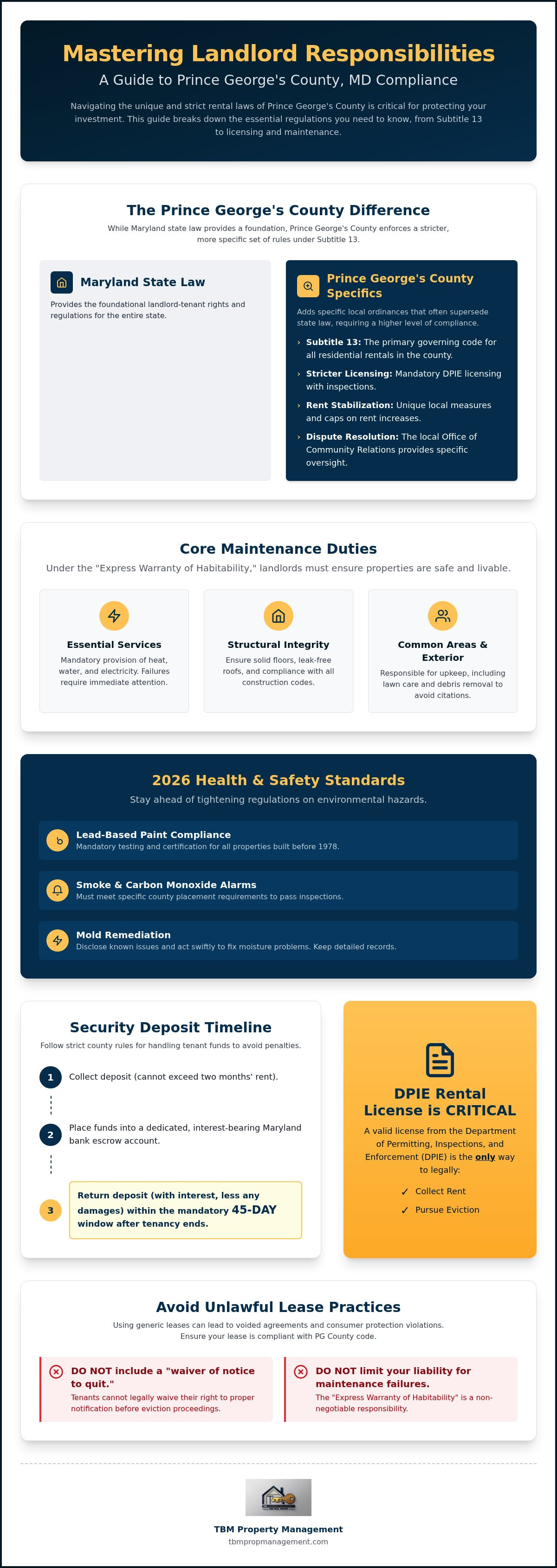
Owning rental property in Maryland is one thing, but operating within the borders of Prince George’s County adds a layer of complexity that can feel overwhelming. Subtitle 13 is the specific section of the County Code that serves as the primary governing framework for all residential rentals here. Whether you own a single-family home in Laurel, a high-rise apartment in Hyattsville, or a suburban condominium, these local regulations dictate how you interact with your tenants and manage your assets. While the foundation of these rules rests upon broader U.S. Property Law, the county has established its own set of high standards to protect both parties. Central to this is the "express warranty of habitability." This is a non-negotiable legal requirement where you promise, by the very act of leasing, that the property is safe and fit for human residence. If you fail to meet these standards, you aren't just facing a maintenance issue; you're in breach of a legal contract.
Why PG County Laws Differ from Maryland State Law
Why does Prince George’s County feel so much more restrictive than its neighbors? It's because the county has enacted specific local ordinances that often supersede general state requirements. For instance, the local Office of Community Relations plays a specialized role in dispute resolution, offering a layer of oversight you won't find in other jurisdictions. While understanding general Maryland landlord tenant rights is a great first step, it's merely the starting point for local owners. Your landlord responsibilities prince george's county include stricter licensing procedures and unique rent stabilization measures that require a granular level of mastery. Ignoring these local nuances can lead to administrative fines that quickly erode your rental income.
Unlawful Practices and Consumer Protection
A common mistake many self-managed owners make is using a "one-size-fits-all" lease agreement found online. In Prince George’s County, certain lease provisions are strictly prohibited. If your lease includes a waiver of notice to quit or attempts to limit your liability for failing to maintain the property, the entire agreement could be rendered void in court. Landlords face heavy liability for consumer protection violations if they use deceptive or unfair practices. This is why using a county-compliant lease is the only way to ensure your landlord responsibilities prince george's county are fully met. Protecting your investment requires more than just a signature; it requires a document that stands up to the scrutiny of the Department of Permitting, Inspections, and Enforcement (DPIE).
Core Maintenance Duties: Ensuring Habitability and Safety
Maintaining a rental property involves more than just a fresh coat of paint between tenants. In this jurisdiction, your landlord responsibilities prince george's county are anchored by a legal promise known as the "express warranty." This means you must comply with all federal, state, and local construction codes to ensure the home is safe. Essential services like heat, water, and electricity aren't just perks; they are mandatory. If a furnace fails in January, you don't have weeks to fix it. You have hours. Structural integrity, including solid floors and leak-free roofs, falls squarely on your shoulders. You are also responsible for the upkeep of common areas and the general exterior appearance of the property. Failing to mow the lawn or clear debris can result in county citations that complicate your licensing status.
Health and Safety Standards in 2026
Regulatory requirements have tightened as we head into 2026. For properties built before 1978, lead-based paint compliance remains a top priority, requiring mandatory testing and certification. Smoke detectors and carbon monoxide alarms must meet specific county placements to pass inspections. Additionally, mold remediation has become a critical focus for the Department of Permitting, Inspections, and Enforcement. You must disclose any known mold issues and act swiftly to remediate moisture problems. Detailed records of these actions are your best defense against future disputes. The Prince George’s County Landlord-Tenant Code provides the specific legal thresholds for these environmental hazards, and staying ahead of these standards is the only way to protect your investment.
Managing Repairs Without the Stress
The greatest risk of deferred maintenance is "rent escrow." This is a legal process where a tenant pays rent to the court instead of you because repairs aren't being made. To avoid this financial nightmare, you need a proactive system. Investing in professional property maintenance ensures that minor leaks don't turn into major structural failures. A 24/7 emergency repair protocol is essential for handling midnight pipe bursts or electrical failures. If managing these logistics feels like an emotional burden, partnering with a local expert for full-service property management can provide the stabilizing force your investment needs. By automating your maintenance response, you ensure that every repair is handled according to county-mandated timelines, significantly reducing your legal liability.
Financial Responsibilities: Security Deposits and Late Fees
Handling the financial side of your rental shouldn't feel like a high-stakes gamble. Yet, for many owners, managing security deposits and rent collection is the most anxiety-inducing part of their landlord responsibilities prince george's county. The legal requirements are precise, and the penalties for even small administrative errors can be severe. Maryland law limits security deposits to two months' rent, but the real challenge lies in the aftermath of the lease. You have exactly 45 days from the end of the tenancy to return the deposit with interest. If you intend to withhold any portion for damages, you must provide a detailed, itemized list of costs. Missing this deadline doesn't just result in a late payment; it can strip you of your right to withhold any funds at all.
Security Deposit Escrow and Interest
Where you keep your tenant's money matters just as much as how much you collect. You must place these funds in an interest-bearing escrow account within 30 days of receipt. Calculating the exact interest owed upon lease termination is a common stumbling block. If a court finds you've willfully failed to follow these escrow rules, you could be liable for up to three times the security deposit amount plus attorney fees. This is a heavy burden for a self-managed owner to carry alone. Reviewing the Prince George's County Tenant Resources can help you understand the perspective of the court and the tenant during these disputes.
Rent Collection and Late Payment Protocols
Consistency is the key to a stable investment. In Prince George's County, you can charge a late fee starting on the 6th day rent is overdue. However, this fee is strictly capped at 1% of the monthly rent per day, with a total monthly maximum of 5%. If you're managing a weekly rental, the limit is $3 per week. Beyond late fees, you must also navigate the Permanent Rent Stabilization and Protection Act of 2024. This law limits annual rent increases to the lesser of the CPI-U plus 3%, or a flat 6%. Properly notifying tenants of these changes requires a 60-day or 90-day notice depending on the lease type. Utilizing professional rent collection services can remove the friction from this process, ensuring your cash flow remains steady while you stay within the strict lines of the law. Keeping meticulous records for at least three years is not just a suggestion; it's a requirement that protects you if a dispute ever reaches the Human Rights Commission.
Rental Licensing and Mandatory Inspections in PG County
In Prince George’s County, a rental license isn't a suggestion; it's your legal permission to operate. The Department of Permitting, Inspections, and Enforcement (DPIE) oversees this rigorous process to ensure every tenant resides in a safe environment. One of the most critical aspects of landlord responsibilities prince george's county is understanding that without a valid license, you lose your most vital legal protections. You cannot legally collect rent, and more importantly, you cannot file for an eviction in the county court system. This administrative hurdle can quickly turn into a financial catastrophe if a tenant stops paying and you lack the proper credentials to take action. Whether you're managing a single-family home or a multi-family complex, the licensing requirements vary, but the consequences of non-compliance remain equally severe.
Step-by-Step: Getting Your PG County Rental License
Securing your license starts with a comprehensive application through the DPIE portal. You'll need to provide proof of ownership and pay the required fees, which are updated for the 2026 cycle. Once your paperwork is processed, you must schedule an initial safety inspection. This isn't a mere formality; it's a detailed walkthrough where an official verifies that your property meets every local housing code. After the initial approval, you're responsible for tracking renewal timelines. Licenses don't last forever, and letting one lapse can trigger fines or the immediate suspension of your right to lease the property. If you change ownership or move to a different management structure, you must update your records with the county immediately to avoid a break in compliance.
Preparing for the County Inspector
Passing a county inspection on the first try requires a proactive approach. Inspectors typically focus on life-safety issues that could endanger a tenant. Common "fail" items include missing or loose handrails, windows that don't stay open on their own, and inadequate egress in basement bedrooms. You should also ensure every smoke detector and carbon monoxide alarm is functional and properly placed. Before a new tenant moves in, completing a "Report of Condition" is a mandatory step that documents the property's state, protecting you from future damage claims. Integrating regular property inspections into your management routine ensures that these small issues are caught long before the county official arrives at your door. If the licensing process feels like an administrative maze, let our team handle the heavy lifting by choosing full-service property management to secure and maintain your DPIE compliance.
How TBM Property Management Simplifies Your Landlord Obligations
The weight of Subtitle 13 and the constant pressure of DPIE deadlines can turn a promising investment into a source of chronic anxiety. Why should you shoulder the emotional burden of these complex regulations alone? At TBM Property Management, we've spent over 12 years mastering the specific landlord responsibilities prince george's county demands, acting as the stabilizing force our clients need to thrive. We don't just list the rules; we execute the solutions. From navigating the initial licensing application to representing your interests during mandatory county inspections, our team ensures your property remains a high-performing asset without the administrative headaches. We bridge the gap between regulatory confusion and operational ease.
The TBM Difference: From Stress to Security
Professional oversight is about more than just fixing leaky faucets. It's about protecting your financial future through meticulous lease management and strict legal adherence. By implementing our rigorous tenant screening process, we identify high-quality residents who value your property, which significantly reduces the risk of disputes or late payments. Our automated rent collection and transparent financial reporting provide the clarity you've been searching for. Choosing professional property management isn't an expense; it's a strategic investment in your peace of mind that pays dividends in reduced liability and long-term tenant retention. We handle the 24/7 maintenance coordination so you can focus on growing your portfolio instead of answering midnight repair calls.
Local Expertise in Laurel and Prince George's County
Our deep roots in the Laurel community and surrounding jurisdictions give us a unique advantage in understanding local market trends and regulatory shifts. We don't operate from a distant corporate office; we're your neighbors and dedicated partners in asset oversight. Whether you're dealing with the specific ordinances of an incorporated town or the broader county housing code, our regional mastery ensures you're always one step ahead. We exceed standard expectations by providing a high-touch, detail-oriented service that treats your portfolio with the dedication it deserves. Are you ready to trade the stress of self-management for professional-grade results? Get your complimentary property analysis from TBM today! and see how we can streamline your landlord responsibilities prince george's county while maximizing your investment's potential.
Securing Your Future as a Prince George’s County Landlord
Managing a rental property shouldn't feel like a constant legal battle. By mastering the specifics of Subtitle 13 and staying ahead of DPIE licensing requirements, you transform your property from a source of stress into a stable financial asset. Remember that maintaining the express warranty of habitability and adhering to strict security deposit timelines are the pillars of a successful tenancy. You don't have to navigate these complex landlord responsibilities in Prince George's County alone. It's possible to achieve full compliance while actually enjoying the benefits of your investment.
Our dedicated team in Laurel, MD, brings over 12 years of local real estate mastery to your portfolio. We provide full-service management that covers everything from mandatory inspections to 24/7 maintenance coordination. If you're ready to find relief from the regulatory burden and protect your long-term interests, we're here to act as your stabilizing partner. Let TBM Property Management handle your PG County compliance; contact us for a free consultation! You've worked hard to build your investment, and we're committed to helping you keep it secure and profitable for years to come.
Frequently Asked Questions
Do I need a rental license for a single-family home in Prince George's County?
Yes, you absolutely need a rental license for a single-family home in Prince George's County. The Department of Permitting, Inspections, and Enforcement (DPIE) requires all residential rental properties to be licensed before any tenant moves in. Operating without this credential is a major risk to your investment. It prevents you from using the court system for evictions and can lead to significant county fines that disrupt your cash flow and peace of mind.
What is the maximum late fee I can charge a tenant in PG County?
The maximum late fee you can charge in Prince George's County is 5% of the total monthly rent. You can only begin charging this fee on the 6th day after the rent was due. For daily calculations, the fee cannot exceed 1% of the monthly rent per day. Staying within these strict financial boundaries is a key part of your landlord responsibilities in Prince George's County to avoid legal disputes.
How much notice must I give a tenant before entering the property?
You should provide at least 24 hours of notice before entering a tenant's property for non-emergency reasons. While Maryland law doesn't strictly define a "reasonable" time in every scenario, Prince George's County standards and most professional lease agreements favor the 24-hour rule. This practice maintains a positive relationship with your tenants while ensuring you meet your maintenance obligations. Emergencies involving immediate safety or property damage are the only exceptions.
Can a landlord in Prince George's County refuse to accept Section 8 vouchers?
No, you cannot refuse to accept Section 8 vouchers or any other lawful source of income in Prince George's County. Local and state fair housing laws prohibit discrimination based on how a tenant pays their rent. You must treat voucher holders with the same screening standards as any other applicant. Failing to comply with these anti-discrimination rules can lead to costly investigations and penalties from the Human Rights Commission.
What happens if I don't have a rental license and my tenant stops paying rent?
If you don't have a valid rental license, you cannot legally file for an "unlawful detainer" or "failure to pay rent" eviction in court. This is one of the most dangerous positions for an owner because the court will likely dismiss your case until the license is secured. You are essentially stuck with a non-paying resident while still being responsible for the property's mortgage, taxes, and mandatory maintenance duties.
How many days do I have to return a security deposit in Maryland?
In Maryland, you have exactly 45 days after the lease ends to return a tenant's security deposit. This return must include any interest earned in the mandatory interest-bearing escrow account. If you're withholding funds for damages beyond normal wear and tear, you must provide an itemized list of costs within that same 45-day window. Missing this deadline could result in a court awarding the tenant up to three times the original deposit amount.
Are landlords responsible for pest control in Prince George's County?
Landlords are generally responsible for pest control in Prince George's County as part of the "express warranty of habitability." Subtitle 13 requires you to provide a home free from infestations like rodents or bedbugs. While a tenant might be held liable if their specific actions caused the problem, the initial burden of remediation falls on the owner. Keeping your property pest-free is essential for passing your mandatory DPIE safety inspections and protecting your reputation.
What are the requirements for smoke detectors in PG County rentals for 2026?
For 2026, all rentals must have smoke detectors that are either hardwired with a battery backup or equipped with 10-year sealed lithium-ion batteries. You must place these devices on every level of the home and inside each sleeping area to meet current safety codes. Ensuring these alarms are functional is a critical part of your landlord responsibilities in Prince George's County. Regular testing helps you avoid liability and protects your tenants' safety.