
Maryland Eviction Process: 2026 Comprehensive Guide
Your rental property represents years of hard work, but one "professional tenant" who knows how to exploit the legal system can quickly turn your investment into a source of constant anxiety. It's an exhausting reality for many property owners in Prince George's and Montgomery County who watch their rental income vanish while waiting for a court date. You likely feel the weight of every passing day, worrying that a minor paperwork error might reset the entire maryland eviction process for landlords. We understand that the pressure of managing these defaults alone is overwhelming, but you don't have to carry that burden without a seasoned partner by your side.
This guide provides a clear, step-by-step roadmap to the 2026 legal landscape, designed to protect your assets and restore your peace of mind. We'll walk you through the Summary Ejectment process and explain the latest 10-day notice requirements so you can recover possession of your property legally. You will learn how to handle court filings with precision and implement better management practices to minimize your future risks. By following this professional framework, you can move from a state of frustration to a state of total ease.
Key Takeaways
- Master the mandatory 10-day notice period and filing requirements to ensure your case stays on track within the Maryland District Court system.
- Understand the "Summary Ejectment" process and why avoiding illegal "self-help" evictions is critical to protecting your long-term investment.
- Navigate the complexities of the maryland eviction process for landlords with a roadmap designed to handle "Right to Redemption" and rent escrow delays.
- Prepare for your day in Rent Court with a professional checklist of essential evidence, from payment ledgers to proof of notice.
- Discover how rigorous tenant screening and proactive management can act as a buffer, preventing the emotional drain of legal defaults entirely.
Disclaimer: The following information is for educational purposes only and does not constitute legal advice. Please consult with a qualified attorney or professional property manager before initiating any legal proceedings.
Understanding the Maryland Eviction Process: A Landlord's Overview
Facing a tenant who refuses to pay rent feels like a personal betrayal of your hard work. In Maryland, the legal term for this specific court action is "Summary Ejectment." While the broader U.S. Eviction Process varies significantly by state, Maryland's system is uniquely rigid and procedural. You might feel tempted to change the locks or cut off utilities when a tenant stops paying, but these "self-help" actions are strictly illegal. Doing so can lead to heavy court-ordered penalties and lawsuits that dwarf the original unpaid rent. Your written lease is your strongest shield in these moments, serving as the definitive foundation for your legal standing in the District Court.
Have you considered the pre-eviction phase? Many landlords in Prince George's or Montgomery County rush to file paperwork without realizing that early, professional intervention can often resolve the issue without a judge. At TBM Property Management, we believe that rigorous tenant screening acts as a vital buffer. It protects your peace of mind by preventing high-risk situations before they start. When a conflict does arise, having a seasoned partner ensures you don't have to handle the emotional burden of asset oversight alone.
The Three Legal Pillars of Maryland Eviction
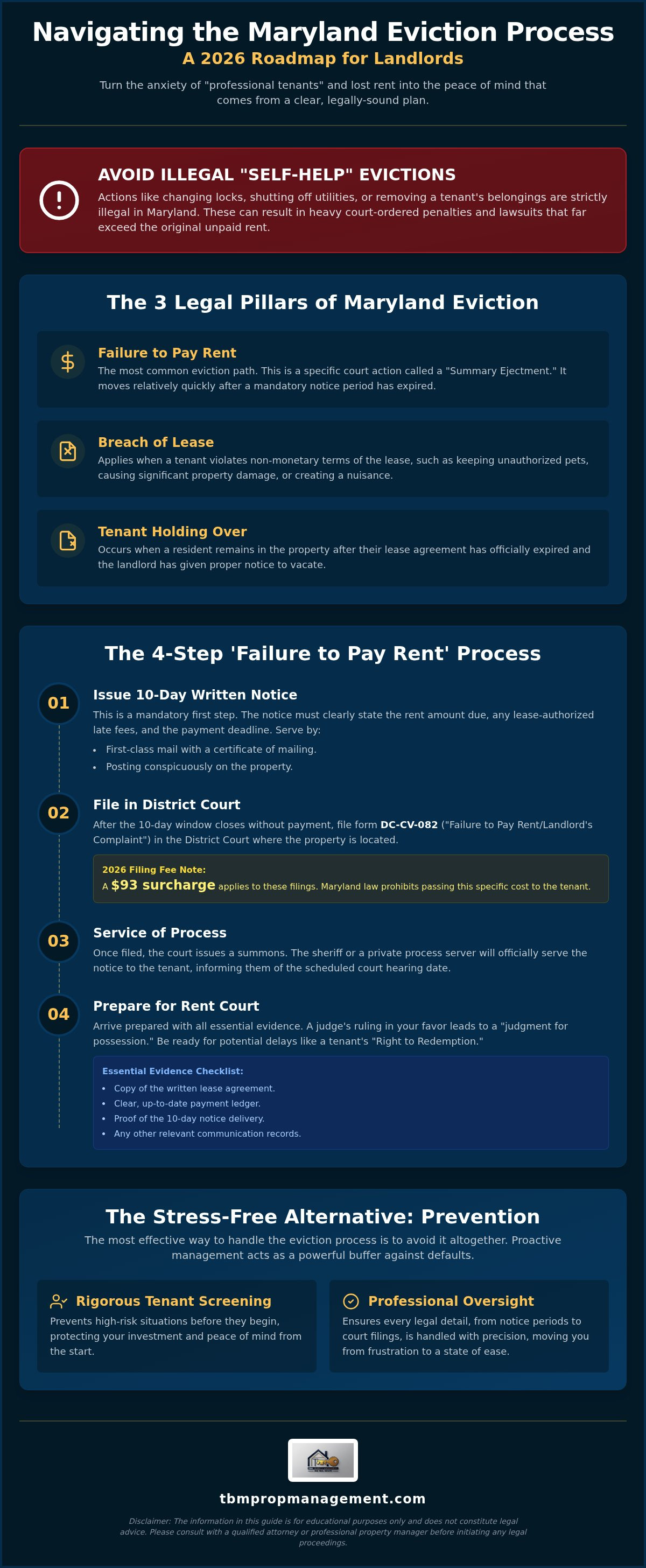
Maryland law categorizes evictions into three primary pillars. Failure to Pay Rent is the most common path, moving relatively quickly through the courts once the mandatory 10-day notice period expires. Breach of Lease applies when a tenant violates non-monetary terms, such as keeping unauthorized pets or causing significant property damage. Finally, Tenant Holding Over occurs when a resident remains in the property after their lease term has officially ended. Each pillar requires specific documentation and a unique strategy to recover your property legally.
Why Precision Matters in 2026
Why is accuracy so vital this year? The maryland eviction process for landlords has become increasingly complex due to evolving tenant protections and strict filing requirements. A single typo on an official form like DC-CV-082 can result in an immediate case dismissal. The District Court of Maryland demands total compliance with local notice periods. If you miss a deadline in Howard or Anne Arundel County, you don't just lose time; you lose months of potential rental income. Professional oversight ensures every detail is handled correctly, moving you from a state of frustration to a state of ease.
Step-by-Step Guide to Filing a 'Failure to Pay Rent' Action
Dealing with unpaid rent is more than just a financial loss; it is an emotional drain that can keep you up at night. To regain control of your property, you must follow the maryland eviction process for landlords with surgical precision. Every county has its own rhythm, but the legal requirements remain the strict baseline for every case.
Step 1: The 10-Day Written Notice Requirement
A 10-day written notice is a mandatory precursor to filing any Failure to Pay Rent action in Maryland. You must serve this notice by first-class mail with a certificate of mailing or by posting it conspicuously on the property. This document must clearly state the specific amount of rent due, any late fees authorized by your lease, and the exact date the tenant must pay by to avoid further court action.
Once that window closes without payment, you can file form DC-CV-082 in the District Court where the property sits. For 2026, keep in mind that a $93 surcharge now applies to these filings. Maryland law prohibits you from passing this specific cost on to the tenant, so it must be factored into your legal budget. After filing, the sheriff or a private process server will handle the Service of Process to notify the tenant of the hearing date. You can find more details via Maryland Courts Housing Information regarding the specific forms and procedural requirements.
At the trial, presenting a clear payment ledger and a copy of the original lease is the most effective way to navigate the maryland eviction process for landlords successfully. If the judge rules in your favor, you receive a judgment for possession. However, the tenant isn't removed immediately. You must then file a Warrant of Restitution, which costs $40 statewide, to authorize the sheriff to schedule the actual eviction date.
Filing in Specific Maryland Counties
Local nuances can make or break your case. In Prince George's County, court dockets move quickly, requiring you to have your ledgers perfectly organized before you step into the room. Montgomery County often has additional local tenant protections that require careful navigation to avoid delays. In Howard and Anne Arundel counties, "Rent Court" days are specific, and as of July 1, 2026, Anne Arundel landlords must provide a written notice to the tenant at least 14 days before a scheduled eviction. Don't forget to include your Lead Paint Certificate number on your complaint if your property was built before 1978, as omitting this will lead to an immediate dismissal.
If this level of detail feels overwhelming, partnering with a team for full-service property management can remove the burden of legal compliance from your shoulders and restore your peace of mind.
Common Maryland Eviction Pitfalls: Avoiding Costly Legal Delays
Even when you follow the maryland eviction process for landlords to the letter, "professional tenants" often have a few legal maneuvers left to stall your progress. It is incredibly draining to spend weeks on paperwork only to see your case reset because of a technical oversight. You deserve a management strategy that anticipates these hurdles before they cost you another month of rental income. Understanding these common pitfalls is the first step toward reclaiming your property and your peace of mind.
Navigating the 'Pay and Stay' Rule
In Maryland, the "Right to Redeem" allows a tenant to stop an eviction by paying all past-due rent and court costs at any time before the sheriff completes the lockout. This is often called the "pay and stay" rule. However, this right isn't an infinite loop. If you have won three Failure to Pay Rent judgments against the same tenant within the previous 12 months, you can ask the judge to "foreclose the right to redeem" on the fourth filing. This means the tenant loses their ability to stop the eviction through payment. Handling last-minute cash offers at the courthouse steps is stressful, so it's vital to stay firm on the full legal amount to avoid accidentally resetting your timeline.
Defeating the Rent Escrow Defense
Tenants frequently stall evictions by claiming the property has dangerous defects that justify withholding rent. This "Rent Escrow" defense can stop your case in its tracks if you aren't prepared with documentation. To defeat this tactic, you need proof of regular property inspections that verify the home's condition. If a tenant claims a leak exists, your maintenance logs and timestamped photos are your best weapons in court. Show the judge that you've attempted repairs or that the tenant denied access to your maintenance team. A clear paper trail transforms a stressful dispute into a factual victory.
Two other traps can ruin your legal standing. First, never accept partial payments after you've filed your case. Taking even a small amount can be interpreted as a waiver of the current eviction action, which might force you to start the maryland eviction process for landlords all over again. Second, avoid illegal lockouts at all costs. Changing locks or cutting off utilities without a sheriff present carries massive financial penalties that far outweigh any unpaid rent. It is much safer to let a dedicated partner handle the heavy lifting of legal compliance while you focus on your next investment.
What to Expect in Maryland Rent Court: Preparation and Evidence
Stepping into a crowded Maryland District Court can feel like entering a storm without an umbrella. The atmosphere is often tense, but your preparation is the stabilizing force that ensures a favorable outcome. When you understand the maryland eviction process for landlords, you realize that winning isn't about arguing; it's about presenting undeniable facts. How do you ensure the judge sees your side clearly? Conduct yourself with professional composure, speak clearly when addressed, and let your documentation do the heavy lifting.
The Landlord's Evidence Checklist
A clean, chronological payment ledger is the most vital piece of evidence you can present to the court. This document must detail every rent payment received, every late fee applied, and the current outstanding balance. If the tenant raises a rent escrow defense, your timestamped photos and detailed maintenance logs become your primary defense to prove the property's condition. These records demonstrate that you've fulfilled your obligations as a property owner. We also recommend keeping a copy of our Maryland Landlord Tenant Rights guide handy to reference specific statutes if a legal question arises during the hearing.
What happens if your tenant doesn't show up? If the tenant was properly served and fails to appear, the judge will typically grant a default judgment in your favor for possession of the property. This is a common outcome in the maryland eviction process for landlords, but it still requires you to have your paperwork in perfect order. Even in an uncontested case, a judge will review your ledger and notice of intent to ensure every legal requirement was met before signing the order.
The Warrant of Restitution and the Sheriff
Winning the judgment is a massive relief, but it doesn't mean you can reclaim the home that same afternoon. You must file for a Warrant of Restitution, which incurs a $40 statewide fee. In Laurel and surrounding Prince George's County, you'll then work with the local Sheriff's office to schedule the actual lockout. You shouldn't forget that you are responsible for providing the moving crew and a locksmith to change the locks during the eviction. The Sheriff is there to keep the peace and oversee the legal removal, while you handle the logistics of securing the unit.
If the logistics of Rent Court feel like too much to handle, our team offers full-service property management to manage the entire legal process on your behalf and restore your peace of mind.
The Stress-Free Alternative: How TBM Property Management Prevents Evictions
Why spend your weekends worrying about Rent Court when you could be enjoying the fruits of your investment? Most property owners only focus on the maryland eviction process for landlords when a crisis hits. However, the most effective way to protect your assets is to ensure a default never happens in the first place. By shifting from a reactive mindset to a proactive strategy, you can eliminate the emotional burden of asset oversight and secure a steady stream of rental income. We position ourselves as your calming, stabilizing force, handling the complexities of management so you can reclaim your peace of mind.
The foundation of a successful rental starts long before a lease is signed. Our thorough tenant screening acts as a rigorous filter, stopping high-risk tenants before they ever set foot in your property. We look beyond basic credit scores to analyze rental history and employment stability with professional precision. With 12+ years of local Maryland real estate expertise, we have developed a seasoned intuition for finding residents who respect your property and pay on time. This diligent approach significantly reduces the likelihood that you will ever need to step into a courtroom.
Proactive Management vs. Reactive Eviction
Are you tired of chasing late payments every month? If you choose to work with a professional property manager in Laurel, MD, you gain a dedicated partner who handles the "heavy lifting" of rent collection and tenant relations. We maintain a firm yet empathetic line with residents, resolving minor issues before they escalate into legal battles. If a default does occur, we manage the entire maryland eviction process for landlords on your behalf. From filing the initial 10-day notice to attending court hearings in Prince George’s or Montgomery County, we ensure every detail is handled with mastery. Best of all, professional management fees are typically tax-deductible, making this a high-value investment in your own freedom.
Get Your Property Back on Track
When an eviction is unavoidable, the speed of your recovery determines your annual ROI. We specialize in rapid property turnovers, coordinating maintenance and inspections the moment a unit becomes vacant. Our team aggressively markets your rental to high-quality tenants across Anne Arundel, Prince George's, and Howard counties to minimize costly vacancy periods. We don't just find a new tenant; we find the right tenant. If you are ready to transition from a state of frustration to a state of total ease, contact TBM Property Management today for a specialized, high-touch management experience that protects your investment and your future.
Securing Your Investment and Your Peace of Mind
Successfully navigating the maryland eviction process for landlords requires a strategic blend of legal precision and proactive management. You've learned that every detail matters, from the mandatory 10-day notice to the specific filing surcharges that apply in 2026. While the court system provides a path to recover your property, the real victory lies in preventing these defaults before they start. By prioritizing a specialized tenant screening process and maintaining meticulous records, you can transform your rental business from a source of anxiety into a stable, high-performing asset.
Are you ready to hand over the "heavy lifting" to a dedicated partner who understands the local nuances of Laurel, Howard, and Montgomery counties? With 12+ years of local Maryland real estate expertise, TBM Property Management acts as your stabilizing force in Prince George's and beyond. We handle the complexities of Rent Court and tenant defaults so you can focus on what truly matters. Stop the Stress: Let TBM Handle Your Maryland Property Management Today. You deserve the security of professional-grade results and the relief of knowing your investment is in expert hands.
Disclaimer: The information provided in this FAQ section is for educational purposes only and does not constitute legal advice. Landlord-tenant laws are subject to change, and you should consult with a qualified attorney or professional property manager regarding your specific situation.
Frequently Asked Questions
How long does the eviction process take in Maryland?
The maryland eviction process for landlords typically takes between 3 to 8 weeks from the initial notice to the final sheriff lockout. This timeline depends heavily on the court's current docket and how quickly the sheriff can schedule the eviction. Any errors in your filing or notice periods can significantly extend this duration. Partnering with a professional management team can help you navigate these timelines with greater efficiency and fewer delays.
Can I evict a tenant in Maryland without a written lease?
Yes, you can evict a tenant without a written lease because Maryland recognizes oral agreements as month-to-month tenancies. However, proving the specific terms of your agreement in court is much more difficult without documentation. You'll still need to follow the standard notice requirements and filing procedures. We always recommend having a written lease to provide the strongest legal foundation for your investment and your peace of mind.
What is a 'Failure to Pay Rent' action in Maryland?
A "Failure to Pay Rent" action, also known as Summary Ejectment, is a specific legal proceeding used when a tenant fails to pay rent on time. It is the most common type of eviction case in Maryland District Courts. This process allows you to seek a judgment for possession of the property and the unpaid rent amount. It requires a mandatory 10-day written notice before you can officially file your complaint.
How much notice must a landlord give a tenant to move out in Maryland?
The notice period depends on the reason for the request. For non-payment of rent, you must provide a 10-day written notice of intent to file for eviction. If you are terminating a month-to-month lease without a specific cause, you generally must provide 60 days of notice. For a lease violation, a 30-day notice is required. Always verify your specific lease terms to ensure you are in full compliance with local laws.
Can a tenant stop an eviction by paying the rent owed?
Yes, most tenants have a "Right to Redemption" that allows them to stop an eviction by paying all past-due rent and court costs before the lockout occurs. This is commonly known as the "pay and stay" rule. However, if you have won three prior rent judgments against the same tenant within a 12-month period, you can ask the judge to foreclose this right on the fourth filing to ensure the eviction proceeds.
What should I do if a tenant breaches the lease but still pays rent?
If a tenant violates lease terms like unauthorized pets or property damage but continues to pay rent, you should file a "Breach of Lease" action. This requires providing a 30-day written notice before filing your complaint in the District Court. You must prove that the breach is substantial and warrants an eviction. Documenting these violations through property inspections and photos is essential to building a successful case in court.
Do I need a lawyer for a Maryland Rent Court case?
While you aren't legally required to hire a lawyer for Rent Court as an individual landlord, the maryland eviction process for landlords is highly procedural and technical. Corporations and limited liability companies are generally required to be represented by an attorney in Maryland courts. Many owners find that hiring a professional property management firm provides the necessary expertise to handle these filings correctly without the high cost of a dedicated legal team.
What are the rules for evicting a tenant in Prince George's County?
Evictions in Prince George's County follow Maryland state law but require navigating one of the busiest court dockets in the region. You must file your complaint in the District Court located in Hyattsville or Upper Marlboro. Local judges expect perfect documentation, including your lead paint certificate and current rental license. Ensuring your paperwork is flawless is the only way to avoid repeated delays in this specific jurisdiction.