
Maryland Eviction Process for Non-Payment of Rent: The 2026 Landlord’s Guide
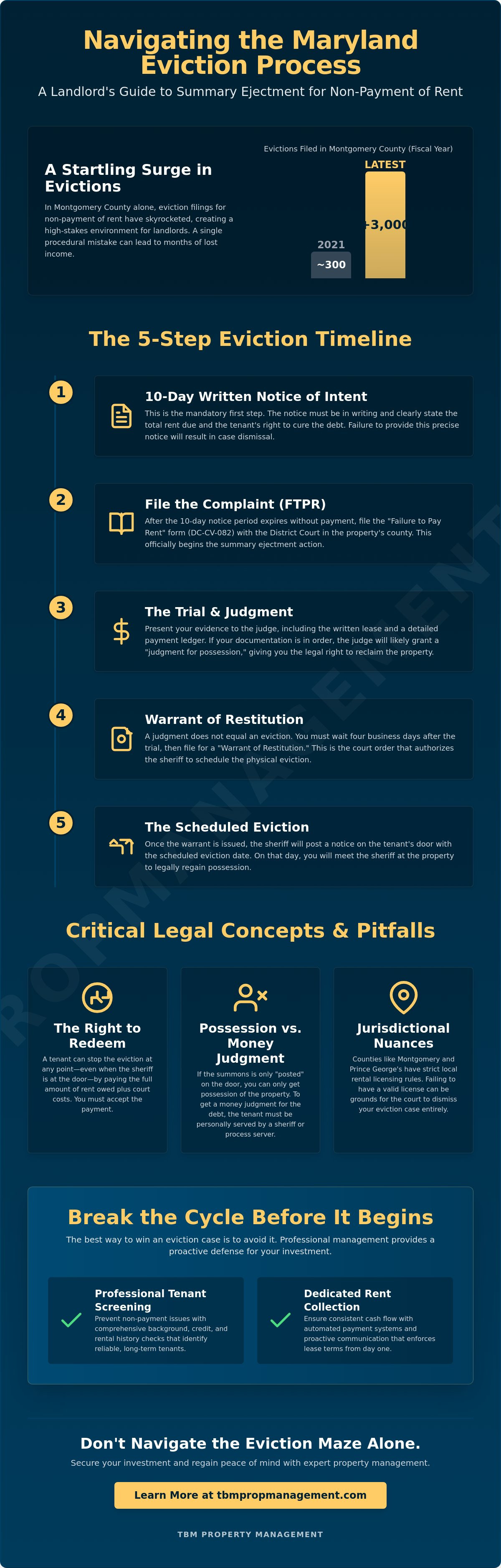
In Montgomery County alone, evictions surged from just a few hundred in 2021 to more than 3,000 in the last fiscal year. This dramatic increase highlights a stressful reality for local landlords: the maryland eviction process for non-payment of rent has become a rigid legal ritual where even a minor procedural error can cost you months of income. It's exhausting to deal with the fear of professional tenants who understand the court timelines better than you do, but you don't have to face this burden alone.
We understand the pressure you're under when a tenant stops paying. You deserve to feel secure in your investment rather than overwhelmed by the intricacies of the Renters' Rights and Stabilization Act of 2024. This guide provides the clarity you need to navigate the summary ejectment process with confidence and regain possession of your property quickly. We'll walk you through the essential 10-day notice requirements, local filing fee nuances in jurisdictions like Baltimore City, and how professional rent collection and tenant screening can stop the cycle of non-payment before it starts.
Key Takeaways
- Discover why "Summary Ejectment" is the specialized legal tool you need to bypass lengthy court delays and regain possession of your rental property.
- Navigate the mandatory 10-day notice requirements and the strict filing timelines within the maryland eviction process for non-payment of rent.
- Learn to manage the "Right to Redeem" rule so you aren't caught off guard by last-minute tenant payments at the doorstep of an eviction.
- Uncover the vital jurisdictional nuances in Montgomery and Prince George’s Counties that can make or break your case based on local licensing rules.
- See how professional tenant screening and dedicated rent collection services provide a long-term solution to prevent the cycle of non-payment from starting.
Understanding Summary Ejectment in Maryland
When a tenant stops paying rent, the emotional and financial toll can feel overwhelming. You've worked hard to maintain your property and provide a home, so it's only natural to feel frustrated when that commitment isn't reciprocated. In Maryland, the legal mechanism designed to address this specific challenge is called "Summary Ejectment." While the name sounds technical, it's actually a streamlined path created to help you reclaim your property without the years of litigation often found in other civil matters.
The maryland eviction process for non-payment of rent is unique because it is "summary" in nature. In a typical lawsuit, parties spend months or even years in a "discovery" phase, exchanging documents and taking depositions. Summary ejectment skips these hurdles. It's a fast-track system meant to resolve the simple question of whether rent was paid. Because the eviction process is accelerated, the court expects you to have your documentation in perfect order. Any procedural slip can reset the clock, adding weeks of lost income to your balance sheet.
It is vital to understand that a Summary Ejectment action is strictly limited to rent and possession. You cannot use this specific court filing to address other lease violations, such as unauthorized pets or property damage. If your goal is to remove a tenant for non-payment, this is your most efficient tool. Having a clear, written lease is the foundation of this efficiency. While the law recognizes oral agreements, they often lead to "he-said, she-said" disputes that can stall your case. A written lease acts as your shield, providing the court with undeniable proof of the agreed-upon terms.
The Legal Basis for Failure to Pay Rent (FTPR)
The entire maryland eviction process for non-payment of rent is governed by the Maryland Code, Real Property Section 8-401. Under this statute, the burden of proof rests entirely on you as the landlord. You must demonstrate to the judge that the rent is truly due and remains unpaid. This is where professional ledger tracking becomes your greatest asset. While oral leases are technically recognized in Maryland, they're significantly harder to enforce in a summary action because they lack a physical paper trail. If you don't have a written contract, the court may require additional testimony, which can complicate an otherwise straightforward hearing.
Possession vs. Money Judgment
One of the most common points of confusion for self-managed landlords is the difference between regaining your property and getting paid. If the sheriff "posts" the summons on the tenant's door because they couldn't be found in person, the court can only grant you possession of the property. To get a money judgment for the unpaid rent, you must ensure the tenant is personally served by a process server or sheriff. "In Maryland, a judgment for possession allows you to reclaim your asset, while a money judgment is the first step toward debt recovery." Understanding this distinction helps you set realistic expectations for your court date.
The 5-Step Maryland Eviction Timeline for 2026
Time is your most valuable asset when rent goes unpaid. Understanding the specific rhythm of the maryland eviction process for non-payment of rent helps you move from a state of frustration to a state of control. While the law provides a clear path, it requires absolute precision at every turn. Missing a single deadline can force you to start the entire sequence over, leading to more lost income and unnecessary stress.
Step 1: The Written Notice of Intent
Maryland law requires you to provide a formal 10-day written notice before you can file a Failure to Pay Rent (FTPR) action in court. This document, known as the "Notice of Intent to File," must clearly state the total amount due, the specific dates for which rent is owed, and a statement informing the tenant of their right to cure the debt. If you fail to provide this notice or if it lacks these specific details, the judge will dismiss your case immediately at the hearing. It is your first and most critical hurdle in the summary ejectment process.
Once those ten days pass without payment, you move to Step 2: Filing the Complaint. You'll submit the Failure to Pay Rent form (DC-CV-082) at the District Court in the county where your property is located. After filing, you proceed to Step 3: The Trial. Here, you must present your evidence, including the lease and a clear payment ledger. If the judge rules in your favor, they will grant a judgment for possession.
Step 4: The Warrant of Restitution
Winning your court case doesn't mean you can reclaim the property that same afternoon. You must wait exactly four business days to allow the tenant their legal right to file an appeal. Once that window closes, you can file a Warrant of Restitution. This is the official court order that authorizes the Sheriff or Constable to remove the tenant. It is important to act quickly because these warrants are not indefinite; in most Maryland jurisdictions, they expire if not executed within 60 days of being issued.
The final phase is Step 5: The Scheduled Eviction. After the warrant is issued, you must provide the tenant with at least six additional days of written notice before the actual eviction date. On the day of the eviction, the Sheriff or Constable will arrive to oversee the transition of possession. If managing these rigid deadlines feels overwhelming, our dedicated property management services can streamline the entire process, ensuring every notice is served with professional accuracy.
The 'Right to Redeem' and Common Legal Pitfalls
Does it feel like you are stuck in a revolving door of non-payment? One of the most frustrating aspects of the maryland eviction process for non-payment of rent is the "Right to Redeem," often called the "Pay to Stay" rule. Under Maryland law, a tenant has the right to stop an eviction at almost any time by paying all past-due rent, late fees, and court costs. This right remains valid until the moment the Sheriff actually arrives to execute the warrant. For many landlords, this creates a cycle of uncertainty where they spend time and money on legal filings, only for the tenant to produce a payment at the eleventh hour.
While this rule provides a safety net for tenants facing temporary hardships, it can place a heavy emotional and financial burden on you as a property owner. If you have ever felt like a "professional tenant" is gaming the system, you aren't alone. However, the law does offer a specific mechanism to break this cycle for chronically delinquent residents. By understanding the Maryland eviction timeline and its exceptions, you can protect your investment from being held hostage by repeated late payments.
The 3-Judgments Rule (Foreclosing the Right to Redeem)
If you are dealing with a tenant who consistently fails to pay until a court order is issued, you may be able to block their ability to "Pay to Stay." In Maryland, if a tenant has had three or more judgments of restitution entered against them in the 12 months prior to the current eviction action, you can ask the court to "Foreclose the Right to Redeem." You must specifically request this during your trial and provide the case numbers for those previous judgments as proof. "Foreclosing the right to redeem is a powerful tool for landlords dealing with chronically delinquent tenants in Maryland." When the court grants this request, the tenant can no longer stop the eviction simply by paying the balance due.
Avoiding Illegal Eviction Claims
When the frustration of non-payment peaks, it might be tempting to take matters into your own hands. However, "self-help" evictions are strictly illegal and can lead to massive lawsuits that far outweigh the cost of lost rent. Self-help includes actions such as changing the locks, removing the tenant's belongings, or shutting off essential utilities like water or electricity. In Maryland, only a Sheriff or Constable has the legal authority to physically remove a tenant from a property. To ensure you stay compliant with all state regulations, we recommend reviewing our guide on Maryland Landlord Tenant Rights. Staying within the legal boundaries of the maryland eviction process for non-payment of rent is the only way to protect yourself from liability while reclaiming your asset.
Local Jurisdictional Nuances: PG County vs. Montgomery County
While the statutes governing the maryland eviction process for non-payment of rent are technically statewide, the actual experience of a landlord varies significantly from one county to the next. Local administrative rules and court backlogs often dictate the speed of your case more than the state law itself. If you own property in Laurel, you might find yourself navigating a complex overlap of City of Laurel ordinances and Prince George's County court procedures. Understanding these hyper-local differences is the only way to ensure your investment remains protected and your timeline stays on track.
In Montgomery County, the hurdles are particularly high. As of December 15, 2025, local regulations require landlords to provide tenants with a 14-day written notice before a scheduled eviction can take place. This is significantly longer than the 6-day state minimum we discussed in the timeline section. Additionally, the Office of Landlord-Tenant Affairs (OLTA) plays a proactive role in mediating disputes. If your paperwork isn't flawless, or if you haven't accounted for the $305 filing fee unique to this jurisdiction, you may find your case stalled before it even reaches a judge.
Rental Licensing as a Prerequisite
In both Prince George's and Montgomery counties, your ability to even file a Failure to Pay Rent (FTPR) complaint hinges on one document: your rental license. We've seen many self-managed landlords lose their cases because they didn't realize their license had expired. Tenants in these regions are often well-informed and will use the lack of a valid license as a complete defense in Rent Court. If you cannot prove the property is properly registered, the judge will likely dismiss your case entirely, forcing you to start the maryland eviction process for non-payment of rent from scratch after resolving the licensing issue. Always verify your registration status before you sign a complaint form.
Sheriff Scheduling and Weather Delays
The final step of reclaiming your property depends heavily on the local Sheriff's office. In Anne Arundel County, scheduling may move at a different rhythm than in Howard County, where the volume of cases can lead to longer wait times for a physical eviction date. You should also be aware of the "Winter Eviction" reality. While there is no law that stops evictions during the winter months, extreme weather conditions like heavy snow or temperatures falling below a certain threshold can trigger automatic 24-hour postponements. When the day finally arrives, you'll need to be prepared with a crew. Many local jurisdictions require the landlord to provide enough labor to move the tenant's belongings to the curb within a limited timeframe.
Staying compliant with these shifting local rules shouldn't be a source of constant anxiety. Our full-service property management team stays on top of every jurisdictional change, from licensing renewals to sheriff coordination, so you don't have to. We act as your local expert, ensuring that your property management strategy is as precise as the law requires.
How Professional Management Prevents the Eviction Cycle
Why endure the stress of a courtroom if you can avoid the conflict entirely? While understanding the maryland eviction process for non-payment of rent is essential for every property owner, the goal should always be prevention. The financial and emotional exhaustion of chasing rent can drain the joy out of owning investment property. By shifting from a reactive stance to a proactive management strategy, you can protect your cash flow and your peace of mind simultaneously. Professional management isn't just about reacting to problems; it's about building a system where those problems rarely take root.
One of the most effective ways to reduce delinquency is through consistent, professional rent collection. We use automated systems that provide tenants with gentle reminders before a payment is even late. This removes the "forgetfulness" factor and establishes a clear expectation of punctuality. When a tenant knows that their payment is being tracked by a dedicated firm rather than an individual, they're statistically more likely to prioritize that obligation. This systematic approach often stops the maryland eviction process for non-payment of rent before the first legal notice is ever drafted.
The Power of Professional Tenant Screening
The best way to win an eviction case is to never have to file one. Our rigorous tenant placement services act as your first line of defense. We don't just look at a credit score; we perform deep dives into criminal backgrounds and specific Maryland eviction histories. DIY landlords often miss subtle "red flags," such as a history of multiple "Right to Redeem" filings that don't show up as final evictions. We identify these patterns of chronic delinquency early, ensuring that only the most reliable residents move into your property.
TBM Property Management: Your Shield in Laurel
With over 12 years of local expertise, we understand that your property is more than just a building; it's a vital part of your financial future. Our full-service property management in Laurel, MD, provides a protective barrier between you and the complexities of the legal system. We handle the heavy lifting, including:
- Drafting and serving the mandatory 10-day Notice of Intent.
- Managing all District Court filings and appearances.
- Coordinating directly with the Sheriff or Constable for physical evictions.
- Performing regular property inspections to ensure your asset is maintained.
You shouldn't have to spend your weekends worrying about court dates or professional tenants. Let us carry the emotional burden of asset oversight while you enjoy the rewards of your investment. Contact TBM Property Management today for a stress-free rental experience and the professional-grade results you deserve.
Secure Your Property's Future with Professional Oversight
Successfully navigating the maryland eviction process for non-payment of rent requires more than just legal knowledge; it requires a proactive partner who understands the hyper-local rules of Montgomery and Prince George's Counties. By mastering the mandatory 10-day notice period and avoiding the common pitfalls of the "Right to Redeem," you've already taken the first step toward reclaiming control. However, the most effective way to protect your asset is to prevent delinquency before it begins through rigorous screening and systematic collection.
With over 12 years of specialized Maryland real estate expertise, we provide the stabilizing force you need to thrive. Our dedicated management for Laurel and surrounding jurisdictions includes comprehensive tenant screening to minimize your risks and ensure your investment remains profitable. Protect your investment and end the stress of non-payment, see how TBM handles the hard work for you. You have worked hard to build your portfolio, and you deserve to enjoy the rewards without the emotional burden of self-management. We are here to ensure your property remains a source of security and growth for years to come.
Frequently Asked Questions
How long does the eviction process take in Maryland for non-payment?
The timeframe for the maryland eviction process for non-payment of rent typically ranges from six to twelve weeks. This timeline includes the mandatory 10-day notice period, the wait for a court date, and the subsequent 4-day appeal window. Local backlogs in high-volume jurisdictions like Montgomery County or Baltimore City can extend this window, so acting immediately when rent is missed is essential to minimize your financial loss.
Can a tenant stop an eviction by paying the rent at the last minute?
Yes, a tenant can generally stop an eviction by paying all past-due rent, late fees, and court costs at any time before the Sheriff executes the warrant. This legal right is known as the "Right to Redeem." However, if you have already obtained three judgments of restitution against that specific tenant in the previous 12 months, you can request that the court "foreclose" or deny this right to stay.
What is a 10-day notice of intent to file a complaint for summary ejectment?
A 10-day notice is a mandatory written document you must provide to the tenant before you are legally allowed to file a Failure to Pay Rent complaint. This notice must clearly state the total amount of rent due and the specific dates it covers. If this notice is missing or contains incorrect information, the District Court will likely dismiss your case, which forces you to restart the entire legal sequence.
Do I need a lawyer for a Failure to Pay Rent hearing in Maryland?
You aren't legally required to hire a lawyer if you own the rental property as an individual. However, if your property is held within an LLC or a corporation, Maryland law typically requires that a licensed attorney represent the entity in District Court. Many landlords find that hiring a professional property manager provides a similar level of relief by ensuring all paperwork and procedural steps are handled correctly.
What happens if a tenant leaves their belongings behind after an eviction?
In most Maryland jurisdictions, any belongings left inside the property are moved to the nearest public curb under the supervision of the Sheriff or Constable. Once these items are placed on the curb, they are considered abandoned, and the landlord no longer has a legal responsibility to store or protect them. You should always verify local trash removal ordinances, as some cities have specific rules about how long items can remain outside.
Can I evict a tenant in Maryland if I don't have a written lease?
You can evict a tenant without a written lease, but it makes the maryland eviction process for non-payment of rent much more difficult to prove in court. While Maryland recognizes oral leases, you must provide enough evidence to convince a judge of the agreed-upon rent amount and the specific due dates. A written lease acts as your primary shield, providing the court with undeniable proof of the tenant's financial obligations.
What is the 'Right to Redeem' in a Maryland eviction case?
The 'Right to Redeem' is a tenant's legal authority to cancel an eviction by paying the full balance of rent and court costs before the physical removal occurs. This "pay to stay" provision is a standard part of Maryland's summary ejectment law. It provides tenants with a final chance to keep their housing, though landlords can ask to have this right removed for tenants who are repeatedly delinquent.
Can I evict a tenant during the winter in Maryland?
Yes, you can evict a tenant during the winter because Maryland does not have a statewide law prohibiting cold-weather evictions. However, local Sheriffs will often postpone an eviction if there is active snow, ice, or if the temperature falls below a specific dangerous level. These delays are typically short-term, and the Sheriff's office will usually reschedule the eviction for the next available day with safe weather conditions.