Maryland Landlord Maintenance Responsibilities: The 2026 Essential Guide
Here's a truth most Maryland landlords learn the hard way: a single ignored repair request can land you in rent escrow court faster than you can find a plumber. Understanding your Maryland landlord maintenance responsibilities isn't just about keeping tenants happy; it's about protecting your investment from a legal system that is deliberately designed to favor renters.
You already know that owning rental property in Laurel, Prince George's County, or anywhere across the Maryland corridor is not for the faint of heart. Between tracking down reliable contractors, fielding late-night calls, and trying to grow your portfolio, maintenance compliance can feel like a full-time job layered on top of an already demanding one. That frustration is real, and it's shared by nearly every self-managing landlord in the region.
This guide gives you a clear, practical breakdown of exactly what repairs Maryland law requires you to make, how quickly you must act, and what happens when deadlines slip. By the end, you'll have the knowledge to stay legally compliant, reduce costly tenant turnover, and manage your property with genuine confidence rather than constant anxiety.
Key Takeaways
- Maryland landlord maintenance responsibilities are legally non-negotiable — the Implied Warranty of Habitability cannot be waived by any lease clause, no matter how it is worded.
- Failing to act on a serious repair request within Maryland's required timeframe can trigger rent escrow proceedings, putting your rental income at direct legal risk.
- Lead-based paint compliance requires active registration and certification through the Maryland Department of the Environment — a step many landlords in older housing stock dangerously overlook.
- Maintenance rules vary significantly by jurisdiction, and counties like Montgomery have enacted their own requirements — such as mandatory air conditioning standards — that go beyond state law.
- Professional maintenance coordination can eliminate the hidden costs of self-management, from contractor liability to compliance gaps across Anne Arundel, Prince George's, Montgomery, and Howard Counties.
The Warranty of Habitability: Your Primary Duty as a Maryland Landlord
Maryland law doesn't give you a choice on this one. Under the Implied Warranty of Habitability, every residential lease in the state carries an automatic legal promise that the property is fit for human habitation, regardless of what any lease clause says. You can write "tenant accepts property as-is" in bold letters across every page of your lease. It won't hold up in court. Maryland courts have consistently ruled that this warranty is non-waivable, meaning no contractual language can strip a tenant of their right to a livable home.
What triggers legal liability? Maryland courts look for "serious and substantial" defects — conditions that genuinely threaten a tenant's health, safety, or ability to use the property as a residence. This isn't about a squeaky floorboard or a slow-draining sink. The threshold matters because it determines when a tenant can legally withhold rent or pursue rent escrow proceedings against you.
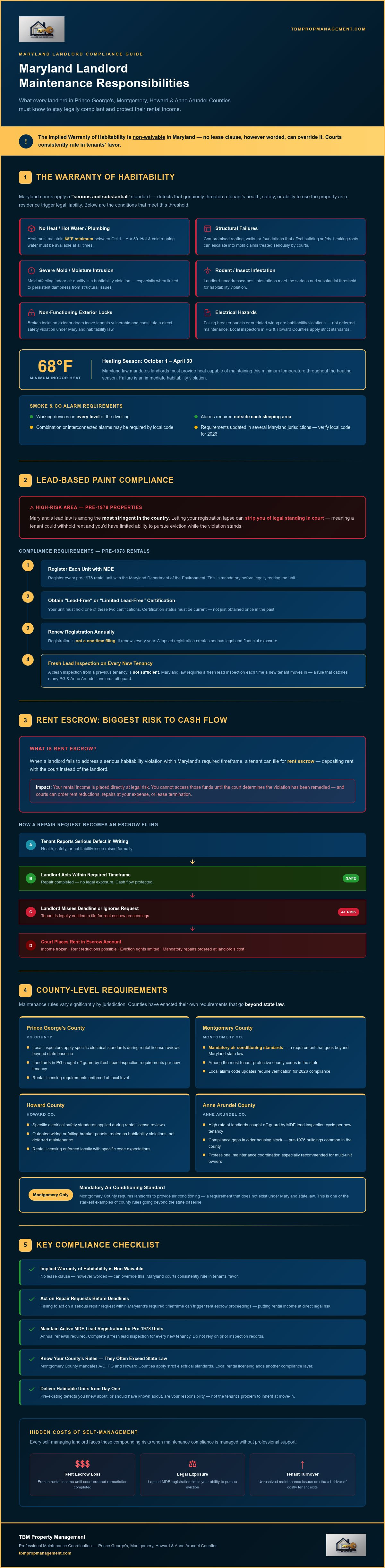
Conditions that typically meet the "serious and substantial" standard include:
- Absence of heat, hot water, or functional plumbing during occupancy
- Structural failures that compromise the safety of the building
- Severe mold or moisture intrusion affecting indoor air quality
- Infestation of rodents or insects that the landlord has failed to address
- Non-functioning locks on exterior doors that leave tenants vulnerable
- Electrical hazards that present a fire or shock risk
At move-in, your duty is clear: deliver a unit that meets habitability standards from day one. Pre-existing defects you knew about, or should have known about, are your responsibility — not the tenant's problem to inherit.
Essential Services: Heat, Water, and Electricity
Maryland requires landlords to provide heat capable of maintaining a minimum indoor temperature of 68 degrees Fahrenheit between October 1 and April 30. Hot and cold running water must be available at all times. Electrical systems must meet applicable safety codes; in Prince George's and Howard Counties, local inspectors apply specific standards during rental license reviews that go beyond the state baseline. A failing breaker panel or outdated wiring isn't a deferred maintenance item — it's a habitability violation waiting to happen.
Structural Integrity and Safety Standards
Roofing, windows, and exterior door locks fall squarely within your maryland landlord maintenance responsibilities. A leaking roof that causes persistent dampness can escalate into a mold claim, which courts treat seriously. On smoke detectors and carbon monoxide alarms, Maryland law requires working devices on every level of the dwelling and outside each sleeping area. For 2026, confirm that your units have combination or interconnected alarms where required by local code, as requirements have been updated in several Maryland jurisdictions in recent years.
Lead-Based Paint and Environmental Compliance in Maryland
If your rental property was built before 1978, lead-based paint compliance isn't optional background knowledge. It's one of the most consequential areas of your maryland landlord maintenance responsibilities, and the consequences of getting it wrong extend far beyond a fine. Maryland's lead law is among the most stringent in the country, and it creates active, ongoing duties that follow you through every lease cycle.
Maryland's lead law requires landlords who own pre-1978 rental properties to register each unit with the Maryland Department of the Environment and maintain either a "Lead-Free" or "Limited Lead-Free" certification. Registration isn't a one-time filing. It renews annually, and your certification status must be current before you can legally rent the unit. Letting that registration lapse doesn't just expose you to MDE fines; it can strip you of legal standing in court, which means a tenant could withhold rent and you'd have limited ability to pursue eviction while the violation stands.
The MDE Registration and Inspection Cycle
Here's where many landlords in Prince George's and Anne Arundel Counties get caught off guard: Maryland law requires a fresh lead inspection every time a new tenant moves in. It's not enough to have a clean inspection on file from a previous tenancy. Each tenant turnover triggers a new compliance obligation. You'll need a certified inspector to conduct the inspection, document the results, and provide the tenant with the required disclosures before they take possession. Non-compliance here doesn't just mean fines from the MDE. It can render your lease unenforceable at the exact moment you need it most.
For 2026, lead dust testing standards during tenant turnover remain a critical checkpoint. Dust wipe sampling must meet the clearance standards set by the MDE, and results must be documented and retained. If testing reveals lead dust levels above the threshold, you're required to remediate before the unit can be re-occupied.
Safe Repair Practices for Older Homes
When a tenant reports peeling or chipping paint in a pre-1978 unit, your response window is short and your contractor options are legally constrained. Any repair work that disturbs painted surfaces must be performed by a contractor certified under the EPA's Renovation, Repair, and Painting (RRP) rule, which requires Lead-Safe Certified firms to follow specific containment, cleanup, and recordkeeping protocols on any project disturbing painted surfaces in pre-1978 housing. Before major renovation work begins, tenants must receive written notification and the EPA's "Renovate Right" pamphlet. Skipping that step, even unintentionally, creates liability that a well-documented paper trail could have prevented entirely.
Coordinating compliant contractors across multiple properties is where self-managing landlords often absorb the most hidden cost. Professional property maintenance coordination ensures that every vendor working on your older housing stock carries the right certifications before a single wall gets touched.
- Register annually with the MDE and confirm your certification status before each new tenancy begins
- Schedule a lead inspection at every tenant turnover, not just at initial purchase or renovation
- Respond immediately to tenant reports of peeling or chipping paint; delays in pre-1978 units carry disproportionate legal risk
- Use only RRP-certified contractors for any repair work disturbing painted surfaces
- Retain all inspection reports, clearance results, and tenant notification records for the duration of the tenancy and beyond
Navigating Rent Escrow: The Biggest Risk to Your Cash Flow
Rent escrow is where delayed repairs become a direct threat to your income. Under Maryland law, when a landlord fails to address a serious habitability defect after proper notice, a tenant can petition the District Court to pay rent into an escrow account rather than directly to you. That money sits frozen until a judge decides whether you've met your obligations. For landlords managing properties in Laurel, Prince George's County, or anywhere along the Maryland corridor, this isn't a theoretical risk. District Court dockets in PG County see rent escrow filings regularly, and judges there are well-practiced at evaluating landlord compliance.
The court process moves faster than most landlords expect. Once a tenant files, a hearing is typically scheduled within a matter of weeks. At that hearing, the judge will examine whether you received proper notice of the defect, whether the defect meets the "serious and substantial" threshold, and whether you took reasonable steps to remedy it within a reasonable timeframe. If the court rules against you, it can order repairs at your expense, reduce the rent owed, or release escrowed funds directly to the tenant to pay for remediation. Your rental income doesn't just get delayed. It can be permanently reduced.
The 'Notice and Opportunity' Rule
Maryland law doesn't allow tenants to file for escrow the moment something breaks. They must first give you written notice of the defect and a reasonable opportunity to repair it. What counts as "reasonable" depends on the severity of the issue. A complete heating failure in January demands an emergency response within days. A broken window latch in a ground-floor unit requires urgency, but a non-load-bearing fence repair carries a longer window. Courts assess reasonableness based on the nature of the defect, the season, and contractor availability in your area.
This is why certified mail is one of your most valuable tools as a landlord. When a tenant sends a written repair request and you respond in writing, documenting your acknowledgment, your scheduled repair date, and your contractor's confirmation, you create a timestamped record that tells a coherent story in court. Equally important: Maryland law requires tenants to provide reasonable access for repairs. If a tenant refuses entry after you've scheduled a contractor, document that refusal immediately in writing. It becomes part of your defense if the case escalates.
Strong maintenance records are the single most effective way to defeat a frivolous escrow claim. A judge reviewing a complete paper trail, including dated work orders, contractor invoices, and tenant communication logs, is far less likely to rule against you than one presented with nothing but your verbal account of events. This is a core reason why professional property maintenance coordination, like the systems used across TBM Property Management's portfolio in Anne Arundel, Montgomery, and Howard Counties, provides landlords with documentation infrastructure that self-management rarely replicates.
Avoiding Retaliatory Eviction Claims
Maryland's anti-retaliation statute creates a legal presumption that any eviction or rent increase occurring within a certain period after a tenant files a repair complaint is retaliatory. That presumption shifts the burden of proof onto you. If a tenant has recently submitted a maintenance request and you subsequently issue a notice to vacate for an unrelated lease violation, you need airtight documentation showing the two events are genuinely separate. Keep your lease violation records and your maintenance request logs in distinct, clearly dated files. Conflating them, even accidentally, hands a tenant's attorney exactly the narrative they need.
For a deeper understanding of how Maryland's tenant protection framework intersects with your day-to-day landlord responsibilities, the Maryland Landlord Tenant Rights: The Definitive 2026 Landlord Guide covers the full legal landscape in practical detail. Managing your maryland landlord maintenance responsibilities with consistent documentation isn't just good practice. It's the most reliable defense you have against claims that can freeze your cash flow and tie up your time in court.
Local Maintenance Nuances: PG, Montgomery, and Howard Counties
State law sets the floor. County ordinances often raise it considerably higher. If you're managing properties across the Maryland suburbs and applying a single compliance standard everywhere, you're almost certainly falling short somewhere, and the jurisdiction where you're short is the one most likely to generate a complaint, a failed inspection, or a rent escrow filing. Your maryland landlord maintenance responsibilities don't look the same in Rockville as they do in Bowie or Ellicott City, and treating them as identical is one of the more expensive assumptions a self-managing landlord can make.
Montgomery County: The AC and Window Guard Rules
Montgomery County enacted Bill 24-19, which established one of the most specific cooling requirements for residential rentals in the Maryland region. Under this legislation, landlords must provide functioning air conditioning capable of maintaining a reasonable indoor temperature during the cooling season, a standard that goes well beyond anything Maryland state law requires. The county's heat rule mirrors the state baseline: you must maintain a minimum of 68 degrees Fahrenheit indoors from October 1 through April 30. On the cooling side, confirm your HVAC systems are operational and serviced before summer tenancies begin, because a malfunctioning unit in July carries real legal exposure in Montgomery County that it simply wouldn't in many other jurisdictions.
Multi-family properties in Montgomery County where children under 11 reside also carry a mandatory window guard requirement. Landlords must install approved window guards on windows above the first floor upon a tenant's written request. Keep a log of those requests and your installation responses. Missing this one detail in a multi-unit building can turn a routine inspection into a compliance crisis.
Prince George's County: Licensing and Safety Inspections
In Prince George's County, your rental license and your maintenance compliance are directly linked. The county requires a rental license for residential properties, and that license is contingent on the unit passing a "Fit for Habitation" inspection before a new tenant takes occupancy. Local inspectors in Laurel and across PG County pay particular attention to older housing stock issues: deteriorating exterior paint, aging electrical panels, and evidence of moisture intrusion are common triggers for failed inspections. A failed inspection doesn't just delay your move-in date; it can void your ability to collect rent until the deficiencies are corrected and re-inspected.
Howard County operates its own Landlord-Tenant Commission, which provides a formal mediation process for repair disputes before they escalate to District Court. Landlords with documented maintenance records and clear communication logs consistently fare better in that process. The pattern holds across all three counties: documentation is your most reliable protection.
Staying current across three different county code frameworks while managing tenants and contractors is exactly where self-management starts to break down. Connect with TBM Property Management to work with a team that knows the specific inspectors, ordinances, and compliance timelines across Anne Arundel, Prince George's, Montgomery, and Howard Counties.
Relief for Landlords: Professional Maintenance Coordination
Self-managing landlords rarely account for the full cost of handling repairs on their own. The obvious expenses show up on invoices. The hidden ones show up in your calendar: hours spent sourcing contractors, chasing callbacks, coordinating tenant access, and trying to verify that the work actually met code. Add the liability exposure from an unvetted contractor who cuts corners on a pre-1978 unit, and the real cost of DIY maintenance coordination becomes considerably harder to justify. Your maryland landlord maintenance responsibilities don't shrink because you're managing them alone. They accumulate.
Professional maintenance coordination doesn't just save time. It closes the compliance gaps that self-management consistently leaves open, the kind that quietly build toward rent escrow filings, failed inspections, and tenant turnover you didn't see coming.
Streamlining Repairs with TBM's Local Network
TBM Property Management brings over 12 years of Maryland real estate experience to every maintenance request across Anne Arundel, Prince George's, Montgomery, and Howard Counties. That tenure means a vetted contractor network built on performance, not proximity. When an emergency repair comes in from a Laurel property, the response doesn't start with a Google search. It starts with a direct call to a contractor who already knows the county's inspection standards and has a track record of meeting them.
Coordination runs through Property Meld, a maintenance management platform that keeps landlords, tenants, and contractors connected in a single documented workflow. Every request, every response, and every completed work order is logged automatically. That paper trail isn't just convenient. It's the same documentation that protects you if a repair dispute ever reaches a District Court hearing in Prince George's County.
Proactive Inspections: The TBM Advantage
The most expensive repairs are the ones nobody caught early. A slow roof leak ignored through one winter becomes a mold remediation project by spring. TBM's move-in, move-out, and periodic inspections are designed to interrupt that pattern before it starts. Documented condition reports at every tenancy transition protect your security deposit claims and establish a clear baseline that holds up in court. Regular mid-tenancy checks catch minor issues while they're still minor.
In PG County, where rental licensing and habitability inspections are directly tied, proactive property care also reduces the risk of a failed re-inspection delaying your next tenant placement. Lower vacancy rates, stronger documentation, and fewer emergency calls aren't separate benefits. They're the same outcome, achieved through consistent, professional oversight of your maryland landlord maintenance responsibilities.
You've built an investment worth protecting. Experience stress-free management with TBM today and put a team behind your property that treats compliance as a system, not an afterthought.
Put Your Maryland Rental Property on Solid Legal Ground
Managing your maryland landlord maintenance responsibilities well comes down to three things: knowing exactly what the law requires, responding before small problems become legal ones, and keeping documentation that tells a clear story in court. From the Implied Warranty of Habitability to lead paint compliance and county-specific rules across PG, Montgomery, and Howard Counties, the margin for error is genuinely narrow.
You don't have to navigate it alone. TBM Property Management brings over 12 years of local Maryland real estate expertise and a dedicated maintenance coordination team that knows the inspectors, ordinances, and compliance timelines across all four major counties. That kind of on-the-ground knowledge isn't something you build overnight, and it's exactly what protects your income when things get complicated.
Your investment deserves more than reactive repairs and crossed fingers. Get your free Maryland rental maintenance analysis and find out where your properties stand before a tenant or inspector does it for you.
Frequently Asked Questions About Maryland Landlord Maintenance Responsibilities
How long does a landlord have to make repairs in Maryland?
Maryland law doesn't set a single fixed deadline for all repairs. The timeframe is determined by the severity of the defect. A heating failure in winter demands an emergency response within days, while less urgent issues allow more time. Courts evaluate whether your response was reasonable given the nature of the problem, the season, and contractor availability in your area. Document every step you take, because that timeline becomes your primary defense if a dispute reaches court.
Can a tenant withhold rent for repairs in Maryland?
Yes, but only through the formal rent escrow process, not by simply stopping payment. A tenant must first give you written notice of the defect and a reasonable opportunity to fix it. If you don't respond adequately, they can petition the District Court to pay rent into an escrow account held by the court. That money stays frozen until a judge rules on whether you've met your maryland landlord maintenance responsibilities. Tenants who withhold rent outside this legal process remain liable for the full amount owed.
What are the rules for air conditioning in Maryland rentals?
Maryland state law doesn't mandate air conditioning as a standard landlord obligation. Montgomery County is a notable exception: under local legislation, landlords there must provide functioning cooling capable of maintaining a reasonable indoor temperature during the summer months. If you own rentals in Rockville, Silver Spring, or elsewhere in Montgomery County, your HVAC systems need to be operational and serviced before the cooling season begins. Confirm current local requirements directly with the county, as standards can be updated.
Do Maryland landlords have to provide a stove and refrigerator?
Maryland state law doesn't explicitly require landlords to furnish appliances like stoves or refrigerators. However, if your lease promises these appliances or they were present when the tenant moved in, you're generally obligated to keep them in working order. A broken refrigerator in a unit where one was provided at move-in can become a habitability dispute if left unaddressed for an unreasonable period. Check your lease language carefully, because what you've promised in writing creates enforceable obligations.
Is a landlord responsible for pest control in Maryland?
Generally, yes. Infestations of rodents or insects that affect a tenant's ability to use the property fall under the Implied Warranty of Habitability. If a pest problem existed before the tenant moved in, or develops due to structural issues in the property, it's your responsibility to address. Tenants who create conditions that attract pests, through improper food storage or sanitation habits, may share some responsibility. Document the timeline of any infestation report carefully, as timing matters significantly in determining liability.
What happens if a landlord doesn't fix a mold problem in Maryland?
Ignoring a mold problem in a Maryland rental is one of the higher-risk decisions a landlord can make. Severe mold or moisture intrusion that affects indoor air quality meets the "serious and substantial" threshold for a habitability violation. A tenant can pursue rent escrow, and if the property is a pre-1978 unit, moisture damage that disturbs painted surfaces adds lead compliance complications on top of the mold issue. Courts treat mold claims seriously, and remediation costs grow substantially the longer a moisture source goes unaddressed.
Can I enter my rental property for repairs without the tenant's permission?
Maryland law requires landlords to provide reasonable advance notice before entering a rental unit for non-emergency repairs. What's considered reasonable is generally interpreted as at least 24 hours, though your lease may specify a different period. For genuine emergencies, such as a burst pipe or gas leak, you can enter without prior notice. If a tenant refuses access after you've properly scheduled a contractor, document that refusal in writing immediately. That record protects you if the tenant later files an escrow claim over the same unrepaired defect.
What is the Maryland rent escrow law?
Maryland's rent escrow law allows tenants to petition the District Court to deposit rent into a court-held account when a landlord fails to correct a serious habitability defect after receiving proper written notice. The law is codified under Maryland Code, Real Property Article, and it gives courts broad authority to order repairs, reduce rent owed, or release escrowed funds to the tenant for remediation costs. Hearings move quickly once a petition is filed, often within weeks. Strong documentation of your repair response is the most reliable protection against an adverse ruling.