
Maryland Landlord Security Deposit Law: The Complete 2026 Guide
What if a single oversight in your move out process could force you to pay a tenant three times their original security deposit? For property owners in Montgomery, Prince George's, and Anne Arundel Counties, the stakes for mishandling the maryland landlord security deposit law have never been higher. You likely feel the weight of these shifting regulations, especially with the 2024 legislative changes that slashed the maximum deposit you can legally collect. It’s exhausting to keep up with interest rate calculations and strict 45 day deadlines while trying to maintain a profitable rental.
We understand that you want to be a fair, professional landlord without leaving yourself vulnerable to costly lawsuits or "treble damage" penalties. This 2026 guide is designed to act as your compliance shield, providing the clarity you need to manage your escrow accounts and inspections perfectly every time. You’ll learn exactly how to navigate the one month rent cap, calculate mandated interest, and follow a foolproof move out checklist that protects your ROI and your peace of mind.
Key Takeaways
- Understand that Maryland classifies pet deposits and prepaid last month's rent under the same strict regulations as a standard security deposit.
- Stay compliant with the latest maryland landlord security deposit law by limiting your charges to one month's rent for all standard leases signed after October 1, 2024.
- Avoid legal penalties by maintaining deposits in a dedicated, Maryland-based interest-bearing account that remains separate from your personal business funds.
- Protect your investment from "treble damage" lawsuits by mastering the 45-day return window and the mandatory itemized deduction process.
- Discover how professional property management provides a legal buffer, handling mandatory inspections and escrow requirements to eliminate your compliance stress.
What is the Maryland Landlord Security Deposit Law?
The maryland landlord security deposit law serves as a critical framework designed to balance your need for financial protection with the rights of your tenants. In its simplest form, the state defines a security deposit as any payment of money given to a landlord in advance to protect against financial loss. If you've ever wondered, What is a Security Deposit?, it's essentially a financial guarantee that the tenant will fulfill their lease obligations and return the property in good condition. This law isn't just a suggestion; it's a strict set of rules that dictates how you collect, hold, and return those funds.
Many property owners mistakenly believe that pet deposits or "last month's rent" paid upfront fall into different categories. Under Maryland's regulations, these are all considered part of the security deposit. If the total of these advance payments exceeds the legal limit, you're already out of compliance before the tenant even moves in. According to Md. Code, Real Property 8-203, a security deposit is any payment of money, including the payment of the last month's rent in advance of the time it is due, given to a landlord by a tenant in order to protect the landlord against nonpayment of rent or damage to the leased premises.
Why Compliance Matters for Laurel Landlords
Ignoring the finer points of the law can lead to a financial nightmare. Maryland courts are famously protective of tenants when it comes to the 45-day return window. If you miss this deadline or fail to provide a proper itemized list of damages, you lose your right to withhold any portion of the money. Even worse, a judge can award the tenant "treble damages." This means you could be forced to pay three times the original deposit amount, plus the tenant's legal fees. In many cases, these court-ordered penalties far exceed the actual value of the deposit itself, turning a small dispute into a major loss for your rental investment.
Key Jurisdictions: From PG County to Montgomery
While the maryland landlord security deposit law provides a statewide baseline, local nuances often come into play. If your property is in Prince George's County or Montgomery County, you may face specific court interpretations or local ordinances that add layers of complexity to your management duties. Our team at TBM Property Management has spent over 12 years navigating these regional differences from our home base in Laurel. We act as your compliance shield, ensuring your lease agreements and banking practices align with both state and local expectations. To better understand how these rules fit into the broader legal landscape, you should also review our guide on Maryland Landlord Tenant Rights: The Definitive 2026 Landlord Guide.
Maximum Limits: How Much Can You Charge in 2026?
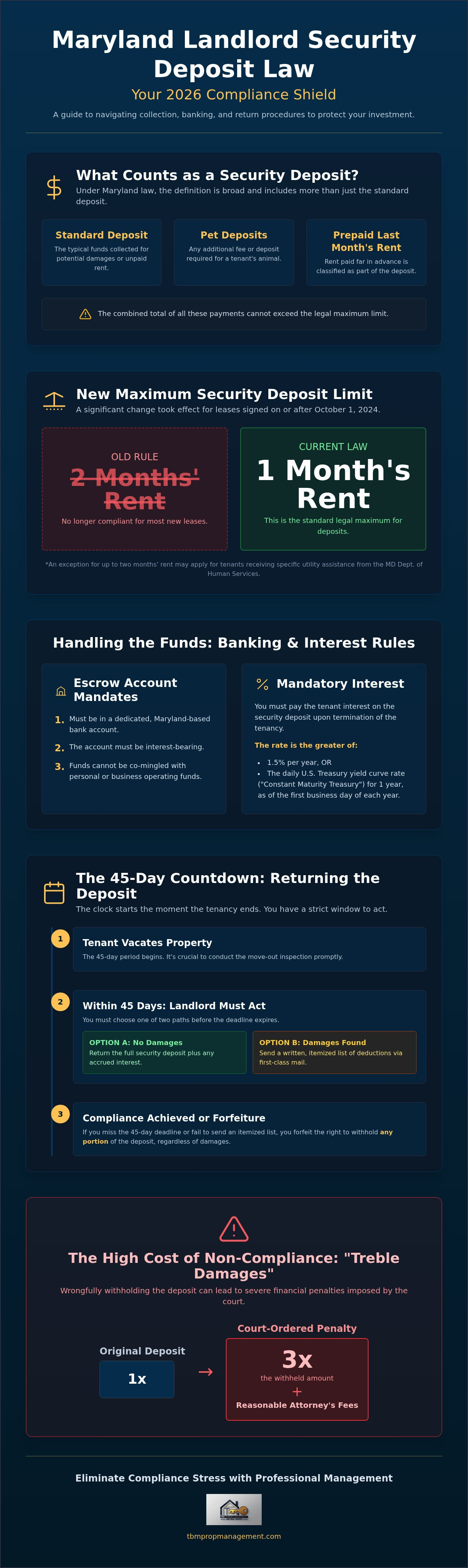
Maryland law is incredibly specific about how much a landlord can request from a tenant before the keys are handed over. For any lease signed on or after October 1, 2024, the standard maximum security deposit is capped at one month's rent. This was a significant shift from previous years when two months was the norm. If you're still using an old lease template that asks for a double deposit, you're inadvertently violating the maryland landlord security deposit law and exposing your investment to unnecessary risk.
There are very few exceptions to this rule. The primary one involves tenants receiving utility assistance through the Maryland Department of Human Services. In these specific cases, a landlord may be permitted to collect up to two months' rent, provided certain conditions are met. Outside of this narrow scenario, sticking to the one-month limit is your safest bet. If you accidentally overcharge a tenant, the legal consequences are severe. A judge can order you to pay the tenant up to three times the excess amount collected, along with their attorney fees. Starting your relationship with the correct financial calculation is the first step in choosing professional property management in Maryland: the 2026 landlord guide to ensure your assets remain protected.
The Receipt Requirement: What Must Be Included
You must provide a written receipt for the security deposit immediately upon payment. This isn't just a courtesy; it's a legal mandate. This receipt must do more than just acknowledge the dollar amount. It has to inform the tenant of their right to have the dwelling unit inspected by the landlord in their presence. According to the Maryland Attorney General's Office, the receipt must also clearly state the tenant's right to receive a written list of all existing damages if they request it within the first 15 days of occupancy. Partnering with a dedicated expert for tenant placement ensures these documentation requirements are met flawlessly every time.
Move-In Inspections and the 'List of Damages'
The first two weeks of a tenancy are a critical window for compliance. Tenants have exactly 15 days after moving in to request a written list of any damages that already exist in the unit. If they make this request, you're required to provide that list. We've found that a proactive, thorough move-in inspection is your best defense against future disputes. At TBM Property Management, we use detailed digital inspections for every Laurel property we manage. By documenting the exact condition of the home with high-resolution photos and notes before the tenant moves in, we eliminate the "he-said, she-said" arguments that often lead to expensive court dates during the move-out phase.
Handling the Money: Banking and Interest Rules
Collecting the initial check is only the beginning of your financial responsibilities. Under the maryland landlord security deposit law, you have exactly 30 days from the moment you receive the funds to place them into a dedicated escrow account. This account must be held in a Maryland based financial institution and must be federally insured. You can't simply drop the money into your personal savings or your business checking account; the law requires these funds to be kept entirely separate from your own money.
Maintaining a clean paper trail is your best defense against future claims of mismanagement. For a deeper dive into the specific legal statutes governing these accounts, the Maryland security deposit regulations provided by the People's Law Library offer an excellent breakdown of these banking mandates. Remember that this account must be devoted exclusively to security deposits. Mixing tenant funds with your personal capital, known as commingling, is a serious violation that can lead to significant legal penalties if a dispute ever reaches a courtroom.
Escrow Account Logistics
Commingling is one of the fastest ways to lose a court case. If you mix tenant funds with your operating budget, a judge may view it as a breach of fiduciary duty. If you decide to sell your rental property, the law requires you to transfer all security deposits and any accrued interest to the new owner. You must also notify your tenants in writing about the transfer within a specific timeframe. These transitions are often fraught with anxiety for self managed landlords. This is why full-service property management in Laurel is a vital asset. We automate these complex escrow logistics, ensuring your accounts remain compliant from move in to move out.
Calculating Interest Accrual
Maryland requires you to pay interest on any deposit of $50 or more that you've held for at least six months. As of 2026, the statutory rate is calculated as the greater of 1.5% per year or the daily U.S. Treasury yield curve rate for one year. You must credit or pay this interest to the tenant at least every six months. When the tenancy ends, you are responsible for providing the tenant with a final statement that clearly shows the interest earned over the life of the lease. There's one specific relief for owners: if a tenant is legally evicted or breaches the lease in a way that causes you financial loss, you may not be required to pay the accrued interest. However, you should never make this withholding without a clear, documented legal basis.
The 45-Day Countdown: Returning the Deposit
The 45 day deadline is the most critical hurdle in the maryland landlord security deposit law. Once the tenancy ends and the tenant vacates the property, the clock starts ticking immediately. You have exactly 45 days to return the deposit, including any accrued interest, to your former tenant. If you fail to meet this strict window, you don't just face a frustrated tenant; you legally forfeit your right to withhold any portion of the deposit for damages. Even if the property requires significant repairs, missing this deadline means you're obligated to return the full amount or risk a lawsuit for triple the original sum.
Managing this process requires precision and a calm, structured approach. You must calculate the interest earned over the life of the lease and subtract any legitimate, documented withholdings. This final settlement is often the most stressful part of property management for self managed owners in Prince George's and Montgomery Counties. Our team at TBM Property Management specializes in handling these high pressure transitions, ensuring every calculation and deadline is met with professional accuracy to protect your rental investment.
Damage vs. Ordinary Wear and Tear
Do you know where "normal" ends and "damage" begins? Ordinary wear and tear is the natural deterioration of the property resulting from normal, everyday use. This includes things like slightly faded paint, minor carpet wear in high traffic hallways, or small scuffs on baseboards. Conversely, deductible damage involves tangible destruction like large holes in drywall, broken appliances, excessive filth, or pet related stains. Correctly identifying these differences is vital for staying compliant with the maryland landlord security deposit law and avoiding disputes in small claims court.
The Itemized Statement: Avoiding Legal Disputes
If you decide to withhold any portion of the deposit, you must provide a detailed itemized statement. This document should list each specific repair and its actual cost, supported by copies of receipts or invoices. You are required to send this statement via first class mail to the tenant's last known address within that same 45 day window. Why leave your compliance to chance? Integrating regular property inspections into your workflow is the most effective way to substantiate these deductions. By having a clear record of the home's condition throughout the year, you can confidently justify any necessary repairs. If you're feeling overwhelmed by the logistics of move out inspections and legal notices, partner with TBM Property Management to handle the entire process for you.
Eliminating Compliance Stress with TBM Property Management
How much time do you spend worrying about the 45 day deadline or the latest interest rate calculations? The maryland landlord security deposit law is a heavy administrative burden that can quickly turn your investment into a source of constant anxiety. At TBM Property Management, we act as your dedicated legal buffer. We take the weight of compliance off your shoulders and place it onto our experienced team. With over 12 years of local Maryland real estate expertise, we understand the specific expectations of courts in Laurel and throughout Prince George's County. We handle the complex escrow accounts, the mandatory move in and move out inspections, and the precise itemized statements so you don't have to. Our goal is to transform your property from a legal liability into a truly passive income stream.
It's not just about following the rules; it's about the security that comes from knowing every detail is handled by a seasoned professional. When you manage a property yourself, a single mistake in a legal notice can cost you thousands in court. We eliminate that risk by staying ahead of every legislative shift. We've seen how the 2024 law changes affected local owners, and we've refined our processes to ensure our clients are always protected. This proactive stance is what makes us a stabilizing force for landlords who are tired of the self management grind. We provide the mastery and dedication your assets deserve, ensuring you feel both understood and well protected.
Our Comprehensive Compliance Process
We've developed a rigorous methodology designed to eliminate friction at every stage of the tenancy. It begins with our specialized tenant screening process. We find high quality renters who respect your property, which significantly reduces the likelihood of damage disputes. Once a lease is signed, our automated systems take over. We provide built in escrow tracking and rent collection, ensuring that interest is calculated correctly and funds are held according to state mandates. Our proactive maintenance coordination ensures that minor wear and tear doesn't escalate into major damage. This detail oriented approach protects your ROI and keeps you on the right side of the law without you ever having to lift a finger.
Get Your Stress-Free Rental Analysis
Are you confident that your current lease and banking practices are fully compliant with the 2026 regulations? Whether your property is in Howard, Montgomery, or Anne Arundel Counties, our hyper local expertise provides the stabilization you need. We invite you to contact us for a complimentary analytical report of your rental property. This report will help you identify potential compliance gaps and show you exactly how we can simplify your management process. Don't let the fear of treble damages or legal penalties keep you up at night. Protect your investment with TBM Property Management and experience the relief that comes with professional grade results.
Secure Your Rental Investment and Reclaim Your Peace of Mind
Staying compliant with the maryland landlord security deposit law shouldn't feel like a full time job that keeps you awake at night. By mastering the one month rent cap and the strict 45 day return deadline, you've already taken the first steps toward protecting your assets from "treble damage" lawsuits. Remember that proper escrow management and detailed digital inspections are your best defenses in a legal system that often favors tenants. You don't have to carry the emotional burden of asset oversight alone.
With over 12 years of local Maryland expertise, TBM Property Management is here to act as your stabilizing force. We provide full service compliance and maintenance coordination across Laurel, Prince George's, Montgomery, and Howard Counties. We're ready to turn your complex legal obligations into a streamlined, professional operation that respects your time and your bottom line. Are you ready to transition from a state of frustration to a state of ease? Get a Stress-Free Property Management Quote from TBM today. You've worked hard to build your rental portfolio; let us work hard to protect it.
Frequently Asked Questions
What is the maximum security deposit a landlord can charge in Maryland in 2026?
For standard residential leases signed after October 1, 2024, you can charge a maximum of one month's rent as a security deposit. There's a narrow exception for tenants receiving utility assistance through the Maryland Department of Human Services, where you may collect up to two months' rent. Charging more than these limits is a direct violation of the maryland landlord security deposit law and can result in you paying the tenant three times the excess amount collected.
How many days does a Maryland landlord have to return a security deposit?
You have exactly 45 days from the date the tenancy ends to return the security deposit plus any accrued interest. This is a firm deadline that doesn't offer any wiggle room for delays. If you don't meet this 45 day window, you legally forfeit your right to withhold any portion of the money for damages. Missing this date often leads to "treble damage" lawsuits where a judge can award the tenant three times the deposit amount.
Can a Maryland landlord charge a non-refundable pet deposit?
No, you can't charge a non-refundable deposit of any kind in Maryland. The state considers any money paid in advance to protect the landlord, including pet deposits and prepaid last month's rent, as part of the total security deposit. These funds must be kept in an interest bearing escrow account and are refundable to the tenant at the end of the lease, minus any legitimate deductions for damages or unpaid rent.
What happens if a landlord fails to provide a receipt for the security deposit?
If you fail to provide a written receipt immediately upon receiving the deposit, you are liable to the tenant for a $25 penalty. While that amount seems small, the larger risk involves the legal disclosures required on that receipt. The document must inform the tenant of their right to a move in inspection. If you skip this documentation, you may find it much harder to defend your deductions if a tenant takes you to court later.
Does a landlord have to pay interest on a security deposit in Maryland?
Yes, you must pay interest on any deposit of $50 or more that has been held for at least six months. The current rate is the greater of 1.5% simple interest per year or the daily U.S. Treasury yield curve rate. You are required to credit this interest to the tenant or pay it out at least every six months. Failing to calculate or pay this interest correctly is a common way for landlords to fall out of compliance.
What can a landlord deduct from a security deposit in Maryland?
You can deduct for unpaid rent, costs associated with a breach of lease, or physical damage to the unit that exceeds ordinary wear and tear. You must provide the tenant with an itemized statement of these costs, including actual receipts or invoices for repairs, within the 45 day return window. We always recommend performing detailed digital inspections at move in and move out to substantiate these deductions and avoid "he-said, she-said" disputes.
Can a tenant use their security deposit as the last month's rent?
A tenant cannot use the deposit as their final rent payment unless your lease agreement explicitly allows it, which is quite rare. The security deposit is intended to cover damages and defaults discovered after the tenant has moved out. If a tenant refuses to pay the last month's rent, you can eventually deduct it from the deposit, but it's better to maintain clear communication to ensure rent is paid on time through the end of the lease.
How does the 2024 law change affect leases signed before that date?
The 2024 update to the maryland landlord security deposit law primarily affects leases signed or renewed after October 1, 2024. If you have a tenant on a long term lease signed before that date, you can continue to hold a deposit of up to two months' rent. However, once that lease expires and a new agreement or renewal is signed, you must adjust the deposit to comply with the new one month cap to remain legal.