
Maryland Law on Entering a Tenant’s Property: 2026 Guide
Could a routine repair visit become a privacy problem if you get the timing or notice wrong? The maryland law on entering a tenant's property sets statewide expectations, but lawful entry still depends on the reason for the visit, the notice you provide, the lease, and any applicable local rules.
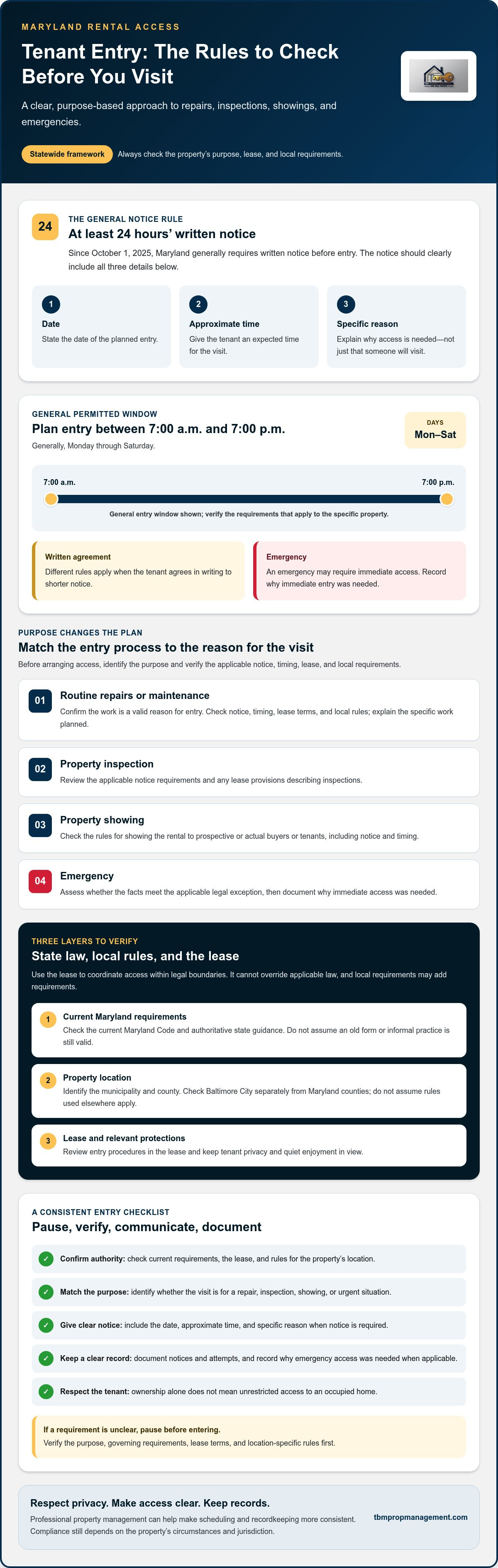
It’s understandable to want repairs handled promptly while respecting a tenant’s right to privacy and quiet enjoyment. Since October 1, 2025, Maryland generally requires at least 24 hours’ written notice before entry. The notice must state the date, approximate time, and specific reason, and entry is generally limited to 7:00 a.m. to 7:00 p.m., Monday through Saturday. Different rules apply when a tenant agrees in writing to shorter notice or an emergency requires immediate access.
This guide explains when entry may be allowed and how to give and document notice for repairs, inspections, showings, and emergencies. It also explains why checking the lease and local requirements matters, so you can plan access clearly and reduce avoidable conflict.
Key Takeaways
- The maryland law on entering a tenant's property works alongside lease terms and local rules, so check all three before arranging access.
- Match your entry plan to its purpose, whether it’s a repair, inspection, showing, or urgent situation, and verify the applicable requirements first.
- Respect a tenant’s privacy and quiet enjoyment. Ownership alone doesn’t mean unrestricted access to an occupied home.
- Use a consistent process to confirm authority, explain the reason for entry, and keep a clear record of notices and attempts.
- Professional property management can help make scheduling and recordkeeping more consistent. Legal compliance still depends on the property’s circumstances and jurisdiction.
Maryland Law on Entering a Tenant’s Property: The Basic Rules to Check
Owning a rental home doesn’t automatically mean you can enter whenever you choose. The maryland law on entering a tenant's property depends on more than ownership. The reason for entry, applicable notice requirements, the lease, court decisions, and rules for the property’s location may all affect what’s appropriate.
Lawful entry means access for a valid purpose, handled according to applicable notice and timing rules, while respecting the tenant’s privacy and right to quiet enjoyment. Use this as a practical starting point, not a substitute for checking the rules that apply to a particular rental.
What Maryland law says, and what still needs checking
Before scheduling access, review the current Maryland Code and authoritative state guidance. Confirm whether a statewide requirement applies to the type of entry, then check whether local rules add requirements. Don’t rely on an old lease form or an informal practice as proof that a notice period or procedure is still valid.
A lease can explain how a landlord and tenant will coordinate entry, but it can’t override applicable law. Court decisions may also inform how legal protections, including quiet enjoyment, apply. For general background on the relationship between landlord and tenant rights, see Landlord-tenant law. That overview doesn’t explain Maryland-specific entry requirements, so verify those separately.
Keep the categories distinct: state statutes establish statewide requirements, local rules may add requirements, and the lease may set procedures within those legal boundaries. If you can’t confirm a deadline or delivery method in an authoritative source, verify it before relying on it.
Why the rental’s county and city can matter
Start by identifying the property’s municipality and county. A mailing address may not make clear which local rules apply, and Baltimore City should be checked separately from Maryland counties. Verify the relevant local code or official guidance rather than assuming that a procedure used in one county applies elsewhere.
For broader context on landlord and tenant protections, review this Maryland landlord-tenant rights guide, then confirm the entry rules for the specific property. TBM Property Management serves rental owners in Anne Arundel, Prince George’s, Montgomery, and Howard counties. Regional experience can support consistent procedures, but it doesn’t replace checking current legal requirements for each jurisdiction.
If the rule is unclear, pause before entering. Confirm the purpose, governing requirements, lease terms, and location-specific rules first. This check can help prevent avoidable disputes and support respectful communication with the tenant.
How Entry Purpose Changes Notice: Repairs, Inspections, Showings, and Emergencies
The reason for a visit affects how a landlord should plan and explain it. Entry procedures should fit the purpose rather than treat every visit as interchangeable. Maryland’s statewide framework generally requires at least 24 hours’ written notice, with the date, approximate time, and specific reason for entry. Entry is generally limited to 7:00 a.m. to 7:00 p.m., Monday through Saturday. Check current law, local requirements, and the lease for the property before acting. The Maryland Right of Entry law resource summarizes allowed purposes and related protections.
| Purpose | What to check before arranging access |
|---|---|
| Routine repairs or maintenance | Confirm the work is a valid reason for entry, then check notice, timing, lease terms, and local rules. |
| Property inspection | Review applicable notice requirements and any lease provisions describing inspections. |
| Showing the rental | Check the rules for showing the property to prospective or actual buyers or tenants, and confirm notice and timing. |
| Emergency | Assess whether the facts meet the applicable legal exception, then record why immediate access was needed. |
Routine repairs, inspections, and property showings
Advance coordination gives tenants time to prepare and can reduce disruption. For a planned repair, inspection, or showing, identify the specific purpose and proposed time. Then verify the applicable notice deadline, delivery method, permitted hours, and lease provisions. Don’t assume a procedure for maintenance automatically covers a showing. A visit by a prospective renter or buyer has a different purpose from a repair or inspection, so check the rules that apply to that access. Make sure the written notice clearly describes the planned visit.
Emergency access and urgent damage prevention
An emergency exception isn’t a general shortcut around notice. It depends on the facts and applicable law, including whether an imminent threat calls for immediate entry. An active leak threatening damage is one possible example, not a complete legal definition. If immediate access is justified, document what happened, why entry was necessary, when it occurred, and what actions were taken. If the situation isn’t clearly an emergency, verify the requirements before entering.
These checks make the maryland law on entering a tenant's property easier to apply to real situations while keeping tenant privacy in view. Owners who want more consistent maintenance coordination and tenant communication can learn about TBM Property Management services.
Can a Maryland Landlord Enter Without Permission? Privacy, Notice, and Limits
Ownership doesn’t give a landlord unrestricted access to an occupied rental home. A tenant’s right to privacy and quiet enjoyment means they should be able to use their home without unreasonable interference. At the same time, a tenant’s lack of express permission for a particular visit doesn’t automatically settle whether entry is lawful. The maryland law on entering a tenant's property requires landlords to consider the purpose, applicable notice rules, the lease, and any emergency circumstances.
Keep these concepts separate. Consent is the tenant’s agreement to entry. Notice communicates a planned visit and doesn’t necessarily mean the tenant has expressly agreed. Lease terms may describe access procedures, but must be read alongside governing law and local rules. Emergency access depends on the facts and applicable legal exceptions, not simply a landlord’s preference to enter quickly.
Maryland’s statewide framework generally calls for at least 24 hours’ written notice, with the date, approximate time, and specific reason for entry. Entry is also generally limited to 7:00 a.m. through 7:00 p.m., Monday through Saturday, with exceptions such as written tenant agreement to shorter notice and qualifying emergencies. Check current requirements for the rental’s jurisdiction and circumstances before relying on an exception.
How the lease and reasonable access fit together
Review the lease’s entry clause for permitted purposes, notice procedures, approved contact methods, and scheduling language. A clause can help set expectations, but it can’t displace applicable law or local requirements. If the lease appears to conflict with a legal rule, don’t assume its wording controls. For broader context on Maryland landlord and tenant protections, see this Maryland landlord-tenant rights guide.
Quiet enjoyment doesn’t mean a landlord can never enter. It protects tenants against unreasonable interference with their use of the home. Repeated visits, unclear reasons, or disregard for notice procedures may create conflict and legal risk, even when a landlord has a legitimate property-related concern.
When entry disputes or refusals arise
If a tenant questions or declines a proposed visit, respond calmly in writing. State the purpose, proposed date and time, and relevant scheduling details. Ask what access limitation is causing concern and, where practical, work toward another suitable time. Don’t treat a refusal as automatic permission to enter, or assume it settles the issue either way.
Keep copies of notices and messages, along with notes about responses, proposed alternatives, and any access restrictions. If a disagreement continues, or you’re considering entering without the tenant’s agreement, seek Maryland legal counsel before escalating or attempting to force access.
A Maryland Landlord’s Checklist for Giving Notice and Recording Entry
A consistent process makes planned access easier to explain and document. Before arranging a non-emergency visit, use this sequence: confirm authority, identify the purpose, check the property’s jurisdiction, communicate notice, and keep a record. The maryland law on entering a tenant's property includes statewide notice requirements, but local rules and the lease may also affect the process.
- Confirm authority: Check that the visit has a permitted purpose and that you or your representative may enter.
- Identify the purpose: State the specific reason, such as a repair, inspection, or showing.
- Check jurisdiction: Review current state law, applicable local rules, and the lease.
- Communicate: Provide notice using a permitted delivery method and allow practical coordination where circumstances permit.
- Document: Save the notice, the tenant’s response, any schedule changes, and the visit details.
What to include in an entry notice
A useful notice identifies the rental address, reason for entry, proposed date and approximate time or time window, and a contact method for questions or scheduling. Maryland’s statewide requirements call for written notice at least 24 hours before entry, including the date, approximate time, and specific reason. Entry is generally limited to 7:00 a.m. Verify current law and local requirements before relying on those rules for a specific property.
Check the lease and jurisdiction for accepted delivery methods and any additional deadline before using a notice template. Under the statewide framework, electronic notice is permitted if the tenant has agreed to it. Don’t assume that sending a text or email is sufficient without confirming that agreement and any other applicable requirements.
Sample framework, not a legal form:
“Notice of planned entry for [rental address]. The reason for entry is [specific purpose]. We propose [date] between [approximate time or time window]. Please contact [name and contact method] if you have a scheduling concern. This notice is subject to applicable law and the lease.”
Adapt the wording only after checking the required notice details, delivery method, deadline, and timing for the property. A sample can help organize information, but it can’t guarantee compliance.
How to document access consistently
Keep a simple record of the notice and how it was delivered, tenant replies, appointment changes, and any related maintenance request. After the visit, note actual arrival and departure times, who attended, work completed, and any follow-up needed. These details can clarify what happened if questions arise later.
For a closer look at how coordinated property oversight can support consistent procedures, read TBM’s full-service property management guide. If you’d like support with tenant relations, maintenance coordination, and inspections, learn about TBM Property Management.
How Professional Property Management Can Make Tenant Entry More Consistent
Entry-related misunderstandings often start with a missed message, an unclear appointment, or records that are difficult to piece together later. A consistent management process can help owners coordinate maintenance and inspections, communicate clearly with tenants, and keep a reliable record of what was scheduled and completed.
That operational support can make it easier to apply the maryland law on entering a tenant's property thoughtfully, but it doesn’t replace checking current legal requirements. Owners and managers still need to confirm the rules for the property’s jurisdiction, the reason for entry, and the lease. For legal questions or a disputed access request, consult a Maryland attorney.
A repeatable process for inspections and maintenance
A practical workflow begins with a documented maintenance request or inspection need. The person coordinating access can confirm the purpose, check the relevant requirements, communicate with the tenant, and record the planned visit. If the timing changes, updating the record and communicating the change helps everyone work from the same information.
After the visit, a brief record of who attended, the work completed, and any follow-up needed can connect the original request to its outcome. This can help an owner track recurring maintenance needs and avoid confusion about whether a visit occurred. Local requirements still need to be checked for each property and entry purpose. A consistent process is helpful, but it doesn’t make one procedure appropriate everywhere.
When Laurel-area owners may want management support
If you manage rentals across different communities, keeping tenant communication and property records organized takes ongoing attention. TBM Property Management is based in Laurel and manages rental properties in Anne Arundel, Prince George’s, Montgomery, and Howard counties. Its services include property maintenance coordination and regular property inspections, which can support consistent scheduling and follow-up.
Management can help organize operational details, but owners should still verify applicable laws and local rules rather than treating a manager’s process as legal advice. To explore how professional management may fit your property and oversight needs, read this guide to choosing professional property management.
Make Tenant Entry Clear, Respectful, and Well-Documented
Good entry practices start with more than a calendar reminder. Before arranging access, confirm the visit’s purpose, check the lease and rules for the property’s jurisdiction, communicate clearly with the tenant, and keep a record of the notice and outcome. The maryland law on entering a tenant's property works alongside these practical steps, helping landlords balance property needs with tenant privacy.
Consistent scheduling, tenant communication, and recordkeeping can reduce avoidable misunderstandings around repairs and inspections. Professional management can help organize those operational details, but it doesn’t replace legal advice or the need to verify current requirements for each property.
TBM Property Management brings more than 12 years of local real estate experience and coordinates maintenance and regular property inspections across Anne Arundel, Prince George’s, Montgomery, and Howard counties. If you’d like to explore support for your rental, explore how TBM Property Management supports Maryland rental owners. A clear process and respectful communication can help you manage access with greater confidence.
Frequently Asked Questions
Is a Maryland landlord required to give notice before entering a rental property?
Generally, yes. Maryland requires landlords to give written notice before entering a rental unit, subject to exceptions such as a qualifying emergency or a tenant’s written agreement to shorter notice. The notice should identify the date, approximate time, and specific reason for entry. Before arranging access, check current state law, the lease, and any local requirements that apply to the property.
Can a landlord enter a tenant’s home without permission in Maryland?
Sometimes, but ownership alone doesn’t give a landlord unrestricted access. For a permitted purpose, a landlord may generally enter after providing required notice, even without the tenant’s separate consent to that visit. Emergencies may be treated differently under applicable law. Landlords should respect tenant privacy, follow relevant notice and timing rules, and avoid assuming either that permission is always necessary or that entry is always allowed.
How much notice does a Maryland landlord have to give before entering?
Maryland generally requires at least 24 hours’ written notice before entry. The notice must state the date, approximate time, and specific reason. Entry is generally permitted between 7:00 a.m. and 7:00 p.m., Monday through Saturday. A tenant may agree in writing to less notice. Check current law, the lease, and local requirements for the specific property before relying on a deadline or exception.
Can a Maryland landlord enter without notice in an emergency?
Yes, a landlord may generally enter without advance notice when an emergency poses an imminent threat to the property, occupants, or others’ health and safety. An active leak threatening serious damage may illustrate an urgent situation, but the facts matter, and examples aren’t exhaustive legal definitions. Document what occurred, why immediate access was needed, the entry time, and actions taken. If the situation isn’t clearly urgent, verify the applicable rules first.
Can a tenant refuse a landlord entry in Maryland?
A tenant’s response depends on the circumstances, including the purpose of entry, required notice, the lease, and applicable law. A tenant’s refusal doesn’t automatically settle whether access is lawful, and a landlord shouldn’t treat notice as permission to disregard privacy protections. If access is disputed, communicate in writing, explain the purpose and proposed time, preserve messages, and consider Maryland legal advice before escalating or attempting to force entry.
Can a Maryland landlord enter to make repairs or inspect the property?
Generally, repairs, maintenance, and property inspections are recognized reasons for landlord entry, subject to applicable notice, timing, lease, and local requirements. Give notice that clearly states the reason and proposed visit details, then coordinate respectfully with the tenant where possible. Don’t assume the rules for an inspection automatically apply to a showing or another type of visit. Check current requirements for the property and purpose.
Do Maryland entry rules differ by county or city?
Local requirements may add rules or procedures, so identify both the property’s municipality and county before arranging entry. Baltimore City and Maryland counties should be checked separately rather than treated as interchangeable jurisdictions. Review current local law alongside statewide requirements and the lease. A process used for a rental in one county may not cover every requirement for a property elsewhere in Maryland.