
Maryland Rental Property Inspection Laws: The 2026 Landlord Compliance Guide
Could a single missed certified mail deadline or an overlooked lead paint certificate really jeopardize your entire Maryland rental portfolio? If you feel overwhelmed by the constant shift in local ordinances, you aren't alone. Many landlords find themselves caught between the fear of heavy MDE fines and the confusion of conflicting county-level licensing rules. It's a heavy burden to carry, but understanding the maryland rental property inspection laws is actually your strongest shield against liability and the key to ensuring your investment remains profitable through 2026.
We believe that managing your property should bring you peace of mind, not a constant state of anxiety over tenant disputes or "self-help" eviction claims. That's why we've simplified the complex web of requirements into a manageable roadmap for the year ahead. This guide provides a clear timeline of required inspections, a breakdown of the latest fees across jurisdictions like Baltimore and Montgomery Counties, and a habitability-focused checklist to keep your units compliant. By the end of this article, you'll have the professional clarity needed to protect your assets and maintain the high standards your tenants expect.
Key Takeaways
- Stay ahead of liability by mastering the 2026 maryland rental property inspection laws, ensuring your asset meets both statewide safety standards and hyper-local habitability requirements.
- Learn how to navigate the MDE lead paint registration process and decide whether Full Risk Reduction or Lead-Free certification is the smarter financial move for your pre-1978 property.
- Master the 15-day rule for move-in inspections to shield yourself from future security deposit disputes and potential legal claims.
- Identify the specific licensing fees and inspection intervals for high-regulation areas like Prince George’s and Montgomery County to keep your rental license in good standing.
- Explore how leveraging professional oversight and automated tools can streamline your maintenance workflow, catching small repairs before they become major liabilities.
Understanding Maryland Rental Property Inspection Laws in 2026
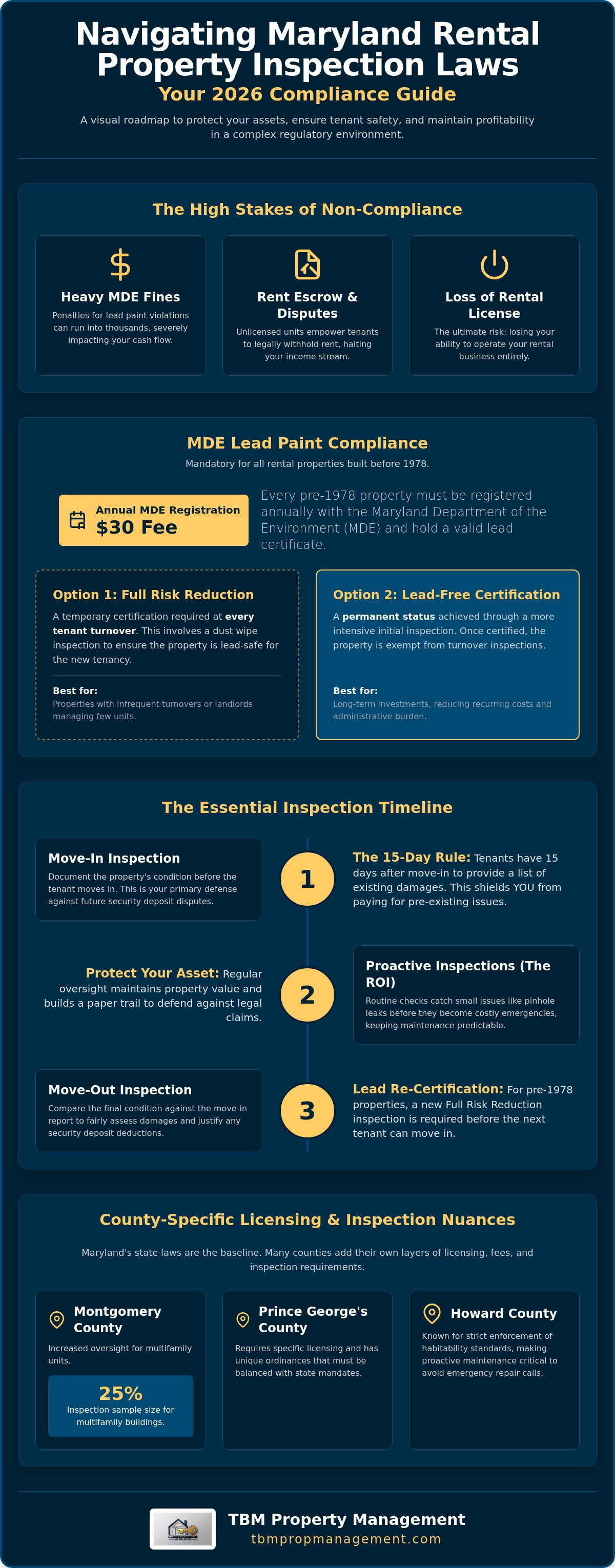
Maryland rental property inspection laws represent a complex set of mandatory safety and habitability checks established by both state and local authorities. These regulations exist to protect the legal framework of tenancy by ensuring that every resident has a safe, lead-free, and functional home. In 2026, the stakes for compliance have never been higher. With the Maryland Department of the Environment (MDE) maintaining strict oversight on lead risk reduction and local jurisdictions like Montgomery County increasing their inspection sample sizes for multifamily units to 25%, the margin for error is shrinking. Successful property management rests on three distinct pillars: lead paint certification for pre-1978 homes, the statewide warranty of habitability, and specific county licensing requirements.
The regulatory environment in 2026 prioritizes electrical safety and lead risk reduction more than ever. Landlords must pay an annual $30 MDE registration fee for non-exempt properties, a cost that underscores the state's commitment to lead paint oversight. If you own a property in areas like Prince George's or Howard County, you aren't just following one set of rules. You're balancing state mandates with local ordinances that can change annually. Staying ahead of these maryland rental property inspection laws isn't just about checking a box; it's about shielding your asset from the massive liability of a pro-tenant legal system.
The Legal Consequences of Non-Compliance
Failing to meet these standards does more than just trigger a fine. It creates a legal vulnerability that can halt your cash flow instantly. Under current maryland rental property inspection laws, an unlicensed or uncertified unit can empower a tenant to withhold rent through legal escrow. If your property isn't registered with the MDE or lacks the necessary local license, you might lose your right to file for eviction or collect past-due rent entirely. Because Maryland landlord tenant rights are robust, courts often side with the tenant when a landlord fails to provide documented proof of compliance. You could face thousands in MDE penalties and the potential loss of your rental license, effectively shutting down your business.
The ROI of Proactive Inspections
While inspections might feel like a hurdle, they're actually a stabilizer for your investment's long-term health. Proactive checks allow you to catch a small pinhole leak before it transforms into a costly Howard County emergency repair at midnight. This diligence builds a bulletproof paper trail that protects you during move-out disputes. By documenting the exact condition of your Laurel, MD property, you ensure its market value remains high while shielding yourself from "self-help" eviction claims. Routine oversight isn't just about avoiding fines. It's about running a professional, profitable business where maintenance costs are predictable rather than catastrophic.
Lead Paint Compliance: The MDE Risk Reduction Standard
Does your rental property pre-date 1978? If so, the Maryland Department of the Environment (MDE) requires you to meet specific Lead Risk Reduction Standards. This is often the most scrutinized portion of maryland rental property inspection laws because the penalties for non-compliance are severe. Every time a tenant moves out, you must have an accredited inspector perform a Full Risk Reduction check. This process ensures that no lead-based paint hazards exist before the next family arrives. You'll need to provide the resulting certificate to your new tenant as part of the Move-In and Move-Out Inspection documentation. Failing to provide this proof can invalidate your lease and expose you to significant legal risk.
While most landlords default to the turnover inspection, you have choices regarding how you classify your asset. A Full Risk Reduction certificate is a temporary fix that applies to a single tenancy. In contrast, Lead-Free certification is a permanent status that requires a more intensive initial inspection but offers massive long-term relief. You cannot navigate these requirements alone. You must hire an MDE-accredited Lead Paint Inspection Contractor to verify the property's status. If you're feeling overwhelmed by the technical requirements, our team specializes in property inspections that take the guesswork out of MDE compliance.
Achieving Lead-Free Status
The financial benefits of a Lead-Free certificate are clear. Properties certified as lead-free or limited lead-free are exempt from the annual $30 MDE registration fee. Instead, you pay a one-time processing fee of only $10 per unit. For long-term investors in Laurel or Prince George's County, the cost of permanent lead abatement or a one-time lead-free inspection pays for itself in just a few years. A Limited Lead-Free certificate is also an option if the interior is clear but the exterior still has lead paint, though this requires periodic re-certification of the exterior surfaces.
Ongoing Lead Risk Management
Compliance doesn't end once the lease is signed. You must conduct regular visual inspections to ensure there is no chipping, peeling, or flaking paint, as these conditions can trigger an MDE violation. If repairs are needed, you must use MDE-accredited contractors who follow lead-safe work practices. Keep your lead certificates and inspection records for at least three years. This documentation is your primary defense during state audits or tenant disputes. Maintaining a clean record ensures your property remains a high-value, low-liability asset in the competitive Maryland market.
The Move-In and Move-Out Inspection Dance
How do you prove that a hole in the drywall wasn't there when the tenant moved in? In the eyes of a Maryland judge, your word simply isn't enough. You need a documented, chronological record that follows the strict rhythm of maryland rental property inspection laws. This process is often called a "dance" because it requires precise timing and specific communication steps between you and your tenant. If you miss a beat, you risk losing your right to withhold a security deposit, even for legitimate damages. Maryland law grants tenants the right to request a mutual inspection within 15 days of moving in, provided they make the request via certified mail. Managing these requests promptly is your first line of defense against future disputes.
The "Written List of Damages" is perhaps your best friend in a 2026 court case. This document serves as the final word on the property's condition at the start and end of the lease. To remain compliant, you must coordinate the move-out inspection within a specific 5-day window before or after the tenant’s departure date. You are also legally required to notify the tenant of their right to be present during this walk-through. If you fail to provide this notification or conduct the inspection outside the legal timeframe, you could face "double damage" penalties in court, where a judge orders you to pay the tenant twice the amount of the security deposit you withheld.
The Move-In Inspection: Setting the Baseline
A successful tenancy starts with a comprehensive room-by-room checklist. Don't just rely on memory; take high-resolution photos of every corner, appliance, and flooring surface. It's vital to distinguish between "ordinary wear and tear," which the landlord covers, and actual damage caused by the tenant. For many self-managing owners, the emotional burden of these walk-throughs is significant. This is where What is a property manager? becomes a relevant question. A professional manager acts as a neutral third party, providing an objective baseline that protects both the owner's asset and the tenant's deposit from the very first day.
The Move-Out Inspection: Protecting the Security Deposit
In 2026, the logistical burden of the "certified mail" requirement remains the biggest trap for Maryland landlords. You must notify the tenant of the inspection date and time via certified mail at least 15 days before the inspection is scheduled to occur. Missing this deadline is a common mistake that can invalidate your damage claims. Using digital inspection tools allows you to generate a transparent, timestamped report that you can share instantly with the departing tenant. This level of professional detail often prevents disputes before they ever reach a courtroom, providing you with the relief of a clean, documented turnover.
County-Specific Licensing and Inspection Nuances
While mastering statewide mandates is vital, state law is only half the battle. In Maryland, local jurisdictions hold significant power to impose additional licensing requirements and safety standards that can vary wildly from one side of a county line to the other. If you own properties in multiple regions, you've likely felt the frustration of juggling different renewal dates and inspection criteria. Understanding these maryland rental property inspection laws at the local level is the only way to shield your investment from unexpected fines and the risk of a revoked rental license. Whether you're managing a single-family home in Bowie or a multi-family building in Annapolis, the local ordinance is your ultimate rulebook.
Prince George’s and Montgomery Counties represent two of the most regulated environments in the state. In these areas, the "Warranty of Habitability" isn't just a general concept; it's a strictly enforced set of codes that inspectors use to evaluate everything from the height of your deck railings to the age of your smoke detectors. Howard and Anne Arundel Counties also maintain their own nuances, particularly regarding the distinction between single-family rentals and multi-unit dwellings. For example, Anne Arundel requires a Multiple Dwelling License for any building with two or more units, even if you live in one of them.
Navigating Prince George’s County Rules
In Prince George’s County, you cannot legally collect rent or even move a tenant into your property without a valid rental license. This is a 2-year license that requires a rigorous safety inspection before issuance. Inspectors pay close attention to fire safety, including the specific placement of carbon monoxide detectors and the presence of interconnected smoke alarms. We understand that coordinating with the local licensing office can feel like a full-time job. Our team acts as your expert shield, handling the paperwork and pre-inspection walk-throughs so your PG County asset remains compliant without the personal headache. If you're ready to hand off the stress of local bureaucracy, contact our property management experts today.
Montgomery County’s High Standards
Montgomery County is known for its "Chapter 29" habitability standards, which are among the most stringent in the Mid-Atlantic. The Department of Housing and Community Affairs (DHCA) conducts regular inspections to ensure units remain in top condition. In 2026, the City of Rockville increased its required inspection sample for multifamily renewals from 20% to 25% of units, highlighting the trend toward more frequent oversight. Failing these inspections can lead to the "Rent Escrow" law, where tenants are legally permitted to pay rent into a court account rather than to you. Because the rules change so frequently, having full-service property management in Laurel, MD is critical for owners who want to ensure their multi-county portfolios meet every local benchmark with superlative ease.
Relief Through Professional Inspections: The TBM Approach
Are you tired of tracking MDE deadlines and county renewal windows on your own? Managing maryland rental property inspection laws shouldn't feel like a second career. At TBM Property Management, we believe that your role as a landlord should be defined by financial growth, not by the anxiety of a missed certified mail deadline. With over 12 years of local real estate mastery, our Laurel-based team acts as your dedicated partner, automating the entire inspection timeline from initial licensing to final move-out. We don't just identify problems; we solve them. By leveraging Property Meld, we coordinate instant repairs for any inspection failures, ensuring your units remain compliant and your tenants stay satisfied.
Our deep roots in the community provide a specialized advantage for investors in Prince George’s, Howard, and Montgomery Counties. We understand the hyper-local nuances that distant service providers often overlook. Whether it's navigating a complex DHCA audit in Montgomery County or ensuring fire safety compliance in PG County, our proactive approach shields your asset from liability. We treat your investment with the same diligence we apply to our own, providing a stabilized, calming force in a high-regulation environment.
Our Detailed Inspection Methodology
We go far beyond the legal minimums by conducting regular "Health Checks" on every property we manage. These internal assessments catch small maintenance issues before they escalate into the expensive emergency repairs discussed in previous sections. Our reporting is completely transparent, providing you with high-resolution photos and detailed notes delivered directly to your owner portal. We also take the lead on regulatory logistics, such as:
- Coordinating directly with MDE-accredited lead inspectors for turnover certifications.
- Scheduling and attending county-mandated licensing inspections.
- Maintaining a digital archive of all certificates for at least three years to satisfy state audits.
- Performing rigorous move-in and move-out walk-throughs to protect your security deposit claims.
Take the Stress Out of Maryland Landlording
How would it feel to transition from an "anxious landlord" to a truly "passive investor"? When you partner with us, that state of ease becomes your new reality. We invite you to experience our high-touch service starting with a complimentary rental analytical report. This report offers a clear look at your property's current standing and identifies any hidden compliance gaps that could lead to future fines. You don't have to navigate the complex web of maryland rental property inspection laws alone. Gain the relief you deserve today by choosing a partner who understands the law, values your time, and protects your future.
Secure Your Rental’s Future and Your Peace of Mind
Mastering the maryland rental property inspection laws is no longer just a best practice; it’s the foundation of a sustainable real estate business. By prioritizing MDE lead safety standards and staying ahead of rigorous local licensing in Prince George’s and Montgomery Counties, you protect your cash flow from the threat of rent escrow or heavy fines. You don't have to carry the weight of these regulations on your own. We understand the emotional burden of asset oversight, and we’re here to offer the stabilizing support you need to succeed.
With 12+ years of Maryland compliance expertise, our team at TBM Property Management acts as your dedicated partner to simplify the complex. We specialize in navigating the hyper-local nuances that keep your investment profitable and your liability low. It’s time to trade your administrative anxiety for the freedom of passive ownership. Take the first step toward a worry-free portfolio today with a team that treats your assets with the highest standards of care.
Request Your Complimentary Rental Analytical Report from TBM Property Management and let us shield your investment from the unexpected. We look forward to helping you thrive in the Maryland market.
Frequently Asked Questions
Do all Maryland rental properties need a lead paint inspection?
No, only residential rental properties built before 1978 are subject to the Maryland Department of the Environment’s lead paint regulations. If your property was built after 1977, you’re exempt from these specific requirements. However, for older units, you must obtain a lead paint certificate at every change in occupancy to stay compliant with maryland rental property inspection laws. This ensures your tenants are safe and your asset is protected from state-level penalties.
How often must a Maryland rental property be inspected for licensing?
Licensing intervals depend entirely on your local jurisdiction and the type of dwelling you own. For instance, Prince George’s County requires a renewal inspection every 2 years for single-family rentals. In contrast, the City of Rockville recently increased its inspection sample for multifamily renewals to 25% of units. It’s vital to check your specific city or county portal because missing a renewal date can lead to the immediate suspension of your right to collect rent.
Can a tenant refuse an inspection in Maryland?
Generally, a tenant cannot refuse a reasonable request for inspection if you provide proper notice as outlined in your lease agreement. Most Maryland leases specify a 24-hour notice period for entry. If a tenant consistently denies access for mandatory safety or licensing checks, they’re likely in breach of the lease. This situation can be stressful, but documented notice helps you resolve the conflict through legal channels if the tenant remains uncooperative.
What is the "Risk Reduction Standard" for Maryland rentals?
The Risk Reduction Standard is a set of lead safety protocols that landlords of pre-1978 properties must meet at every turnover. An accredited inspector must verify that there’s no peeling or chipping paint and perform dust swipe testing to ensure the unit is safe for new occupants. Meeting this standard is a core part of maryland rental property inspection laws and is required to receive the MDE certificate necessary for a legal lease.
Does Maryland require a carbon monoxide detector in every rental?
Yes, Maryland law requires carbon monoxide detectors in any rental unit that relies on fossil fuel heat, has fuel-burning appliances, or features an attached garage. These devices must be installed in a central location outside of each sleeping area. Failing to maintain functional detectors can result in significant fines during a local habitability inspection. It’s a simple safety measure that provides immense peace of mind for both you and your residents.
What happens if I forget to send the move-out inspection notice via certified mail?
If you fail to send the required notice via certified mail within the legal timeframe, you forfeit your right to withhold any portion of the security deposit for damages. Maryland courts are very strict about this procedural requirement. You might even be ordered to pay the tenant up to three times the withheld amount if they sue for the deposit’s return. This is why professional oversight is so valuable; we ensure these critical deadlines are never missed.
Are there specific inspection laws for rentals in Laurel, MD?
Yes, because Laurel spans multiple counties, your property may be subject to the specific rules of Prince George’s, Howard, or Anne Arundel County. Each has different licensing fees and safety checklists. For example, properties within the City of Laurel itself must adhere to local municipal codes which include regular fire safety assessments. Our team’s hyper-local expertise ensures you meet the exact requirements for your specific Laurel address without any confusion.
How much does a typical MDE lead paint inspection cost in 2026?
Costs for lead paint inspections in 2026 vary based on the size of the unit and the number of dust swipes required by the accredited inspector. While these are third-party fees, most landlords find that the price of a professional certification is a small investment compared to the thousands of dollars in potential fines. We coordinate these inspections on your behalf to ensure you get reliable results and maintain your property’s legal standing.