
Maryland Rental Property Tax Deductions: The 2026 Landlord’s Guide
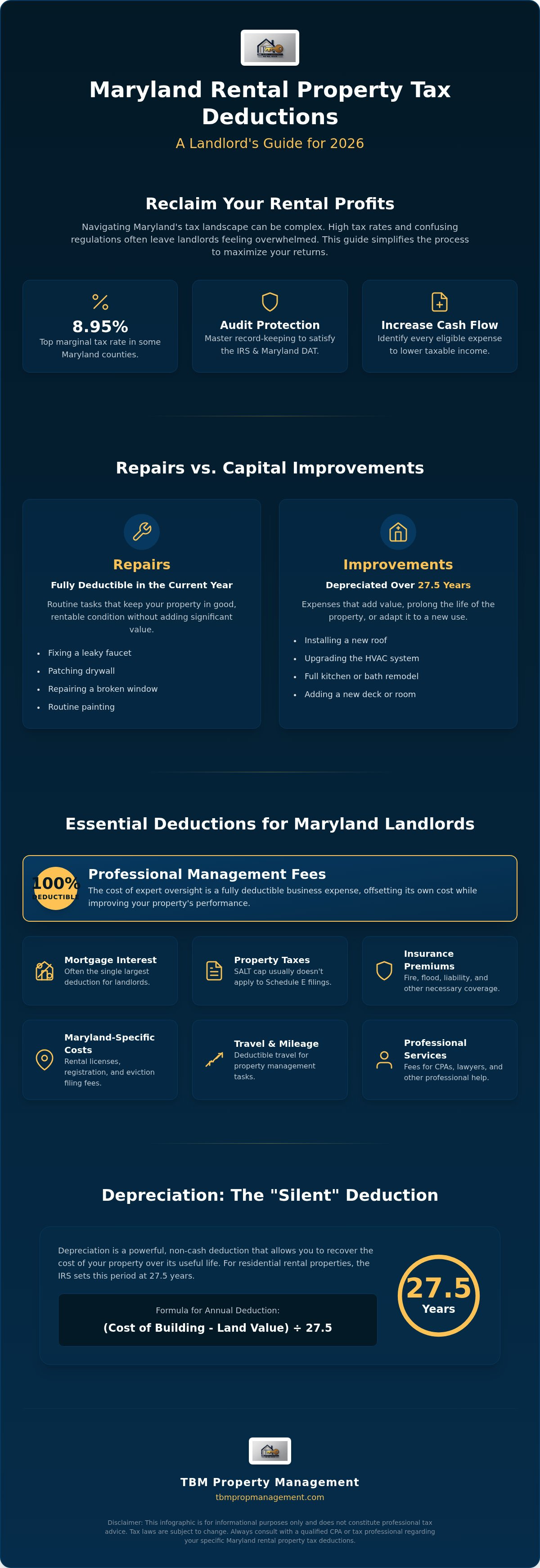
Are you tired of watching your rental profits disappear into the combined 8.95% top marginal tax rate found in some Maryland counties? It's a common frustration for landlords in high-tax areas like Prince George’s and Montgomery, where the pressure to stay profitable often clashes with the complexity of state and federal regulations. Between the fear of a Maryland DAT audit and the confusion of distinguishing a simple repair from a capital improvement, the financial burden of asset oversight can feel overwhelming. Mastering maryland rental property tax deductions is the most effective way to reclaim your peace of mind and protect your hard-earned equity.
We understand that you want to be a diligent investor without being buried in paperwork. That's why we've designed this comprehensive 2026 guide to simplify the process and provide the relief you deserve. You'll learn exactly how to lower your taxable income by identifying often-overlooked expenses, from the latest IRS mileage rates to the 100% deductibility of professional management fees. We'll walk you through a clear list of deductible expenses and the specific documentation needed to file your 2026 taxes with total confidence and professional-grade results.
Key Takeaways
- Identify every eligible state and federal expense to maximize your maryland rental property tax deductions and keep more of your rental income.
- Master the nuances of property depreciation and the 27.5-year rule to unlock significant long-term tax savings on your physical assets.
- Implement professional record-keeping standards that satisfy both the IRS and the Maryland DAT, ensuring you stay protected in the event of an audit.
- Leverage the fact that professional management fees are 100% tax-deductible, allowing you to offset the cost of expert oversight while improving your property's performance.
- Navigate regional tax complexities in counties like Howard and Anne Arundel with structured financial reporting that simplifies your 2026 tax season.
The Landscape of Maryland Rental Property Taxation in 2026
Understanding your taxable profit starts with a simple realization: your gross rent isn't what the government taxes. In Maryland, the Department of Assessments and Taxation (DAT) oversees your property's assessed value, but your income tax liability is a mix of state graduated rates and local county surtaxes. For 2026, these local "piggyback" rates range from 2.25% to 3.30%. When you combine these with state rates that climb up to 5.75%, your total tax burden can feel heavy. We're here to help you navigate these complexities and identify the maryland rental property tax deductions that protect your cash flow.
Federal IRS rules provide the baseline for what you can deduct, but Maryland requires specific adjustments on your state return. It's not just about the big expenses; it's about the diligent tracking of every dollar spent to maintain your investment. By focusing on the difference between gross income and net taxable profit, you can transition from a state of frustration to one of financial ease.
Maryland-Specific Tax Considerations for Landlords
If you own property in Laurel, Prince George’s County, or Montgomery County, you're familiar with high local property taxes. These are significant expenses but also powerful deductions. Beyond property taxes, you should track state-level costs like rental license fees and registration. Even the increase in eviction filing fees to $93 for failure-to-pay-rent filings is a deductible business expense. While the Maryland Renters' Property Tax Credit is for tenants, it requires accurate landlord reporting. Precise records ensure you're prepared for state inquiries while maximizing your maryland rental property tax deductions.
The Distinction Between Repairs and Improvements
Knowing when to deduct an expense immediately versus capitalizing it is vital for your ROI. Routine repairs, like fixing a leaky faucet or patching drywall, are fully deductible in the year you pay for them. These tasks keep your property in good condition without adding significant value. In contrast, improvements like a new roof or HVAC system add value or extend the property's life. These expenses fall under Depreciation, where the cost is spread over 27.5 years. For the 2026 tax year, IRS Safe Harbor rules may allow smaller landlords to deduct certain improvements immediately, providing much-needed financial relief.
Disclaimer: This article is for informational purposes only and does not constitute professional tax advice. Tax laws are subject to change. Always consult with a qualified CPA or tax professional regarding your specific maryland rental property tax deductions.
Essential Federal Deductions Every Maryland Landlord Must Claim
While state taxes are a significant factor, your primary path to a lower tax bill lies in maximizing federal deductions. These expenses directly offset your rental income, allowing you to keep more of your revenue from properties in Laurel or Silver Spring. Most Maryland investors find that mortgage interest is their single largest deduction. Since you're likely carrying a loan on your investment, every dollar of interest paid to your lender is a legitimate business expense. You'll find detailed guidance on these categories in IRS Publication 527, which remains the gold standard for residential rental reporting.
Property taxes are another major consideration. Many landlords worry about the $10,000 SALT (State and Local Tax) cap, but there's a silver lining for business owners. When you deduct property taxes for a rental on Schedule E, they aren't typically subject to the same limits as your personal residence deductions on Schedule A. This distinction is a vital part of your strategy for maryland rental property tax deductions. Additionally, don't forget to include your insurance premiums. Whether you're paying for fire, flood, or general liability coverage, these costs are fully deductible. Keeping your property in "rentable condition" through routine cleaning and maintenance also qualifies, ensuring your asset remains attractive to high-quality tenants.
Operating Expenses and Professional Services
Professional oversight isn't just a luxury; it's a deductible business necessity. You can deduct legal and accounting fees, including the costs for a CPA to prepare your filings or the $93 surcharge now required for failure-to-pay-rent eviction filings in Maryland. Marketing and advertising costs to find tenants in competitive areas like Laurel are also fully deductible. Perhaps most importantly, your property management fees are 100% deductible. This means you can enjoy the benefits of expert full-service property management while the IRS effectively subsidizes the cost through your tax savings. Using a professional team ensures you never miss these vital maryland rental property tax deductions while keeping your investment compliant.
Travel and Transportation Deductions
Do you find yourself driving between properties in Montgomery and Howard counties? Those miles add up to significant savings. For the first half of 2026 (January 1 to June 30), the IRS standard mileage rate is 72.5 cents per mile. This rate increases to 76 cents per mile for the remainder of the year (July 1 to December 31). Whether you're conducting a quarterly inspection or making a quick run to a local hardware store for maintenance supplies, tracking these trips is essential. We recommend using a dedicated app or a simple logbook to ensure your records are contemporaneous and audit-ready.
Disclaimer: This article is for informational purposes only and does not constitute professional tax advice. Tax laws are subject to change. Always consult with a qualified CPA or tax professional regarding your specific situation.
Depreciation: The "Silent" Deduction for Maryland Rentals
While most deductions require you to spend money upfront, depreciation is a unique "paper loss" that provides significant relief without a corresponding cash outlay. It's a cornerstone of any strategy for maryland rental property tax deductions. The IRS 27.5-year rule allows you to deduct a portion of your building's cost every year, reflecting the perceived wear and tear of the structure. To calculate this correctly, you must first separate the building value from the land value. Since land doesn't wear out, it cannot be depreciated. In high-demand areas like Prince George’s or Montgomery County, where land values are exceptionally high, getting this ratio right is critical to maximizing your annual claim.
For the 2026 tax year, Section 179 expensing remains a powerful tool for savvy investors. This rule allows you to deduct the full cost of certain items, like new appliances or furniture, in the year you buy them rather than spreading the cost over several years. When you calculate your Maryland business income tax, these federal depreciation benefits typically flow through to lower your state liability. However, you must be aware of the "recapture" trap. When you eventually sell your Maryland rental, the IRS will tax the depreciation you've claimed at a rate of up to 25%. Planning for this eventual cost is a vital part of long-term asset oversight.
Cost Segregation Strategies
Do you want to accelerate your tax savings? Cost segregation involves identifying specific components of your property, such as cabinetry, specialized lighting, or landscaping, and depreciating them over 5, 7, or 15 years instead of the standard 27.5. This strategy front-loads your deductions, which significantly boosts your short-term cash flow. While hiring a professional to conduct a cost segregation study involves an initial fee, the immediate tax relief often makes it a high-value investment for larger residential portfolios.
Maryland Personal Property Tax
It's easy to overlook the Maryland Personal Property Tax, but the DAT is diligent about its collection. If you hold your rental property within a business entity like an LLC, you're generally required to file Form AT3-45. This form reports the value of the furniture and equipment used in your rental. While some Maryland jurisdictions offer exemptions for residential rental property, you shouldn't assume you're exempt. Filing correctly ensures you avoid unnecessary penalties and maintain your standing as a professional, compliant landlord.
Disclaimer: This article is for informational purposes only and does not constitute professional tax advice. Always consult with a qualified CPA or tax professional regarding your specific maryland rental property tax deductions.
Maximizing Deductions through Professional Record Keeping
The IRS places a high premium on "contemporaneous" records. This means you should document expenses as they occur rather than trying to recreate your history during tax season. By maintaining a real-time log, you significantly strengthen your position for maryland rental property tax deductions. Whether you prefer digital folders or physical binders, the key is consistency. In 2026, digital storage is the gold standard for efficiency. It allows you to quickly search for specific receipts and share them with your tax preparer without the risk of losing paper documents to fire or water damage.
Keeping your personal and business finances separate is another non-negotiable practice. If you use your personal credit card for a repair in PG County, you make it harder to justify the expense as a business necessity. More importantly, mixing funds can lead to "piercing the veil," a legal situation where your personal assets are no longer protected from business-related lawsuits. Detailed property inspections also serve a dual purpose. They ensure your tenant is following the lease while providing visual proof that maintenance was necessary, which supports your deduction claims if the IRS ever asks for clarification.
A Checklist for Maryland Tax Preparation
Organizing your paperwork early provides a sense of security and trust in your final filing. Use this checklist to ensure you have the necessary documentation for your 2026 return:
- Collect all 1098 forms to verify mortgage interest paid on your Maryland properties.
- Issue 1099-MISC forms to any contractors or vendors you paid $600 or more during the calendar year.
- Summarize your Schedule E expenses by category, such as repairs, utilities, and taxes.
- Review the Maryland Landlord Tenant Rights guide to ensure your legal fee documentation for evictions or lease disputes is compliant with state law.
Leveraging Property Management Software
Modern technology simplifies the burden of asset oversight. We utilize specialized tools like Property Meld to track every maintenance request and repair cost with precision. This software creates a digital paper trail that is invaluable during tax season. Instead of digging through emails, you can generate comprehensive year-end financial statements that categorize every dollar spent on your investment. Automating your rent collection also ensures your income reporting is 100% accurate, leaving no room for error. If you want to experience this level of organization, consider how our full-service property management can streamline your financial reporting and maximize your maryland rental property tax deductions.
Disclaimer: This article is for informational purposes only and does not constitute professional tax advice. Always consult with a qualified CPA or tax professional regarding your specific situation.
How TBM Property Management Protects Your Rental ROI
Do you ever feel like the weight of managing your Maryland rental is starting to overshadow the financial rewards? One of the most significant advantages of partnering with a professional team is the way it transforms your tax strategy. While we’ve discussed various maryland rental property tax deductions, many landlords don't realize that our management fees are 100% tax-deductible as a business expense. From a zero-net-cost perspective, the tax savings you receive effectively subsidize the cost of our professional oversight. This means you get the benefit of our 12+ years of expertise while lowering your taxable income at the same time.
Beyond the fees, we provide the detailed monthly and annual financial reporting that makes tax filing a breeze. You won't have to scramble for receipts or reconstruct your ledger in April. We also coordinate maintenance with a focus on maximizing deductible repairs. By documenting every inspection and service call, we ensure you have the "contemporaneous" records the IRS requires. Our team also navigates the complex web of local Maryland compliance. This proactive approach helps you avoid non-deductible fines and penalties that can quickly erode your annual profits.
Stress-Free Management in Laurel and Beyond
Our 12+ years of local Maryland real estate expertise allows us to act as a stabilizing force for your investment. We understand the specific frustrations of self-management, especially when dealing with the high-pressure environments of Prince George’s and Montgomery counties. Our approach to Full-Service Property Management is designed to alleviate your emotional burden. We handle the difficult conversations, the midnight maintenance calls, and the meticulous financial tracking so you don't have to. If you've been searching for a way to simplify your life while protecting your assets, a dedicated partnership is the solution.
Ready to Maximize Your Maryland Investment?
Are you curious about the untapped potential of your rental portfolio? We offer a complimentary analytical report for new clients to help you understand your property's current performance and identify areas for improvement. We proudly serve investors throughout Prince George’s, Montgomery, Howard, and Anne Arundel counties, providing a high-touch, professional-grade experience. Don't let the complexity of maryland rental property tax deductions or tenant management keep you from reaching your goals. Request your free rental analysis from TBM today! and take the first step toward a more secure and profitable future.
Disclaimer: This article is for informational purposes only and does not constitute professional tax advice. Always consult with a qualified CPA or tax professional regarding your specific situation.
Take Control of Your Maryland Investment Strategy
Reclaiming your profitability in 2026 starts with a proactive approach to your finances. Success as a landlord requires more than just high occupancy; it demands a mastery of maryland rental property tax deductions to shield your income from heavy state and local surtaxes. By identifying every eligible federal expense and utilizing depreciation as a long-term wealth builder, you transition from the frustration of asset oversight to the ease of professional management. Meticulous record-keeping is your best defense against audits and your clearest path to a lower tax bill.
We're here to help you navigate these complexities with 12+ years of local Maryland expertise across PG, Montgomery, Howard, and Anne Arundel counties. Our team provides the detailed financial reporting and maintenance documentation that make tax season stress-free. If you're ready to protect your ROI and simplify your reporting, Get Your Free Rental Analysis and Tax-Ready Reporting Plan today. You don't have to carry the burden of financial oversight alone. With the right partner, your investment can finally deliver the security and relief you've worked so hard to achieve.
Frequently Asked Questions
Are property management fees tax-deductible in Maryland?
Yes, property management fees are 100% tax-deductible. The IRS considers these an ordinary and necessary business expense for the oversight of your investment. You'll typically report these costs on Schedule E of your federal return. This deduction effectively reduces the net cost of professional services like rent collection and tenant screening, making it a vital part of your maryland rental property tax deductions. Always consult with a qualified CPA regarding your specific tax situation.
What is the difference between a repair and an improvement for taxes?
Repairs maintain your property's current condition, such as fixing a leaky faucet or patching drywall. You can deduct these costs entirely in the year they occur. Improvements, like a total HVAC replacement or a new roof, add significant value or extend the property's lifespan. These must be depreciated over 27.5 years rather than deducted at once. Correctly categorizing these expenses is essential for accurate financial reporting. Please consult a tax professional for guidance.
Can I deduct my travel expenses to visit my Maryland rental property?
You can deduct local travel expenses for property inspections, maintenance runs, or meetings with vendors. For 2026, the IRS standard mileage rate is 72.5 cents per mile through June 30 and increases to 76 cents per mile starting July 1. It's important to keep a contemporaneous log of your trips to counties like Montgomery or Howard to support these maryland rental property tax deductions. Always verify your travel records with a qualified accountant.
Do I have to pay Maryland state tax on rental income if I live out of state?
You must pay Maryland state tax on any income sourced within the state, regardless of where you live. Maryland requires non-resident landlords to file Form 505 to report rental income. While this adds a layer of complexity to your filings, you may be eligible for a tax credit in your home state for taxes paid to Maryland. This ensures you stay compliant with the Comptroller of Maryland. Consult with a CPA to manage your multi-state tax liability.
What local Maryland licensing fees are tax-deductible?
Local government fees, such as rental licenses in Prince George’s County or registration fees in Laurel, are fully deductible. You should also include the $93 eviction filing surcharge and lead paint inspection fees in your records. These mandatory costs are necessary for the legal operation of your rental business and contribute to your overall maryland rental property tax deductions. Because local regulations vary by jurisdiction, you should always have a tax professional review your specific deductible fees.
How does the Maryland Renters Tax Credit affect me as a landlord?
The Renters' Property Tax Credit is a benefit for low-income tenants, not a direct deduction for landlords. Your role is typically limited to providing a Landlord’s Certification to verify the rent paid by the tenant. While this doesn't change your own tax liability, it's a necessary part of your administrative duties and tenant relations. It simply reinforces the rental income figures you already report on your own tax returns. Seek advice from a qualified CPA for more details.
Can I deduct the cost of tenant screening and marketing?
Marketing and tenant screening costs are legitimate business expenses that you can deduct. Whether you're paying for online listings or background checks, these expenditures directly offset your gross rental income. If you partner with a property manager, these costs are often included in your deductible placement fees. This allows you to find high-quality residents while reducing your total taxable profit. Always ensure your expense tracking is reviewed by a professional tax advisor to maintain compliance.
Is mortgage principal deductible for my Maryland rental?
Mortgage principal payments are not deductible, as the IRS views them as an increase in your equity rather than a business expense. Only the interest portion of your mortgage payment can be deducted on your tax return. However, you can still benefit from building depreciation, which allows you to recover the cost of the structure over 27.5 years. This distinction is a fundamental part of rental property accounting. You should always consult with a qualified CPA to ensure your mortgage data is handled correctly.