
Maryland Rental Property Wear and Tear Guide 2026: A Landlord’s Handbook
Could a simple misunderstanding about a scuffed baseboard really cost you three times the security deposit in a Maryland courtroom? As a property owner in cities like Baltimore or Frederick, you've likely felt that familiar knot in your stomach during a move-out inspection. You want to protect your investment, but the line between ordinary use and tenant damage often feels frustratingly thin. It's an emotional burden to manage these assets while staying on the right side of the law, especially with the strict 45-day return deadline looming over every turnover.
This maryland rental property wear and tear guide 2026 is designed to replace that uncertainty with professional clarity and relief. We want to help you master the critical differences between daily usage and actual neglect so you can avoid security deposit disputes and potential litigation. You'll learn exactly how to distinguish between fading paint and holes in the wall, gain confidence in your move-out process, and see a clear path toward a lower-stress turnover period. We'll also preview the life expectancy of common household items and the specific documentation you need to protect your financial interests under current state regulations.
Key Takeaways
- Understand the "substantially same condition" clause to ensure your security deposit deductions remain legally sound under Maryland law.
- If you are managing aging carpets or paint, use the "useful life" framework to calculate fair, prorated charges instead of guessing.
- Access a side-by-side comparison of common issues in Laurel and PG County to distinguish between a unit that is simply dirty and one that is truly damaged.
- Master the strict 45-day return window and specific documentation requirements detailed in this maryland rental property wear and tear guide 2026.
- Discover how professional property inspections and maintenance coordination can eliminate the emotional burden and legal risks of the move-out process.
Defining Ordinary Wear and Tear Under Maryland Law (2026)
Maryland law is clear yet nuanced about what happens when a tenant moves out. The term Ordinary Wear and Tear refers to the natural decline of a property that occurs through normal, everyday use. It isn't damage caused by abuse, accidents, or neglect. For example, a slightly worn carpet in a high-traffic hallway is expected. A large cigarette burn in the middle of that same carpet is damage. Understanding this distinction is the first step in using this maryland rental property wear and tear guide 2026 to protect your assets while maintaining a professional relationship with your tenants.
The legal burden of proof rests squarely on your shoulders as the landlord. If you decide to withhold any portion of a security deposit, you must be prepared to demonstrate that the condition of the item exceeds what would happen naturally over time. Maryland courts often view small nail holes for pictures as wear, while multiple large holes from a mounted television might cross into damage. If you can't prove the damage was avoidable or caused by the tenant's specific actions, you shouldn't deduct for it. This proactive approach saves you from the headache of a contested deposit later.
The 'Substantially Same Condition' Rule
This clause is the heart of your lease agreement. It requires the tenant to return the unit in the same state it was in when they arrived, minus the expected aging. It's a common mistake for landlords in Annapolis or Baltimore to expect a property to look brand new after a three-year tenancy. That's an illegal expectation. Instead, focus on a "first day vs. last day" visual comparison. If the walls were freshly painted at move-in and now have a few scuffs near the door, that's aging. If they have crayon marks or deep gouges from moving furniture, that's a failure to maintain the property's condition.
Maryland’s 2026 Legal Landscape for Landlords
The regulatory environment in 2026 remains focused on tenant protection. Recent updates to the Maryland Real Property Code emphasize habitability and fair deposit handling. For instance, current interpretations of mold laws mean that if a leak occurs due to structural aging rather than tenant neglect, any resulting damage is your responsibility to fix. You cannot deduct for these issues from the security deposit. Miscalculating these deductions carries heavy weight. If a court finds you wrongfully withheld funds, you could be liable for treble damages. This means paying back three times the original amount plus reasonable attorney fees. Staying informed is your best defense against these financial risks.
The Life Expectancy Framework: When Can You Charge?
One of the biggest frustrations for Maryland landlords is realizing that even if a tenant ruins something, you might not be able to charge them the full replacement cost. This is because of the "Useful Life" concept. In the eyes of the Maryland Attorney General's Office, every fixture in your rental has a predetermined lifespan. Once that lifespan ends, the value effectively drops to zero. If you try to charge a tenant for a 10-year-old carpet that they stained, you're likely to lose in court because that carpet was already due for replacement. This maryland rental property wear and tear guide 2026 helps you understand these timelines so you don't face a surprise lawsuit during the 45-day deposit return window.
The "Normal Living" test is your first line of defense. Does the item show signs of aging that are inevitable? Think about minor scuffs on a baseboard or slight fading of the carpet from sunlight. These are indentations of life, not damage. However, when you see deep gouges in hardwood or large holes in drywall, you've moved into the territory of tenant neglect. In 2026, we see more high-durability materials like Luxury Vinyl Plank (LVP) being used in rentals. These might have longer depreciation schedules than traditional materials, which can work in your favor if you've invested in quality upgrades.
Standard Life Expectancy for Common Rental Items
While Maryland statutes don't provide a rigid list, local court precedents in areas like Prince George's County generally follow these industry standards:
- Carpet and Flooring: Most courts expect carpet to last 5 years. If it's high-grade, you might push for 7, but 5 is the safe benchmark for disputes.
- Interior Paint: Expect a 2 to 3-year lifespan. If a tenant stays for three years and the walls need painting, that's almost always considered your maintenance cost, not their damage.
- Appliances: Stoves, refrigerators, and HVAC units typically have a 10 to 15-year lifespan. If a 12-year-old fridge breaks, it's likely reached its end of life.
Calculating Prorated Damages Correctly
When damage occurs, you must calculate the "remaining value" rather than the replacement cost. If a pet destroys a 2-year-old carpet that had a 5-year life expectancy, the tenant is only responsible for the 3 years of value you lost. You'd take the total replacement cost, divide it by 5, and multiply by 3. This math is your best legal defense in PG County because it shows you aren't trying to "better" your property at the tenant's expense. If you find these calculations overwhelming during a busy turnover, our team can assist with property maintenance coordination to ensure every deduction is fair and documented.
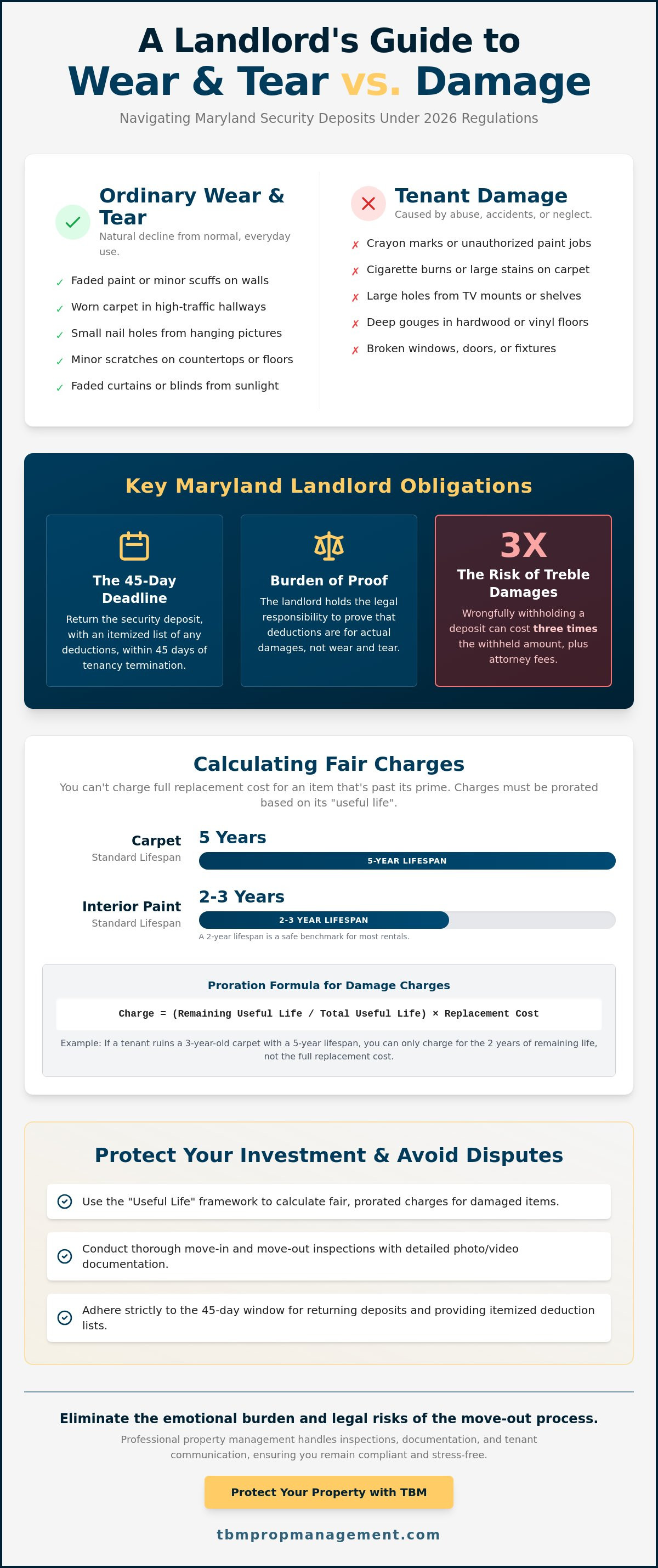
Wear and Tear vs. Tenant Damage: The Comparison Guide
Walking through a vacated unit in Laurel or Prince George's County can feel like a detective mission. You're constantly asking yourself if a mark on the baseboard is a sign of a well-lived-in home or a billable repair. This maryland rental property wear and tear guide 2026 aims to simplify those tough decisions. According to The Maryland People's Law Library, ordinary wear and tear is the expected result of normal use, while damage stems from negligence or abuse. It's vital to remember that "dirty" and "damaged" are not synonymous under Maryland law. You generally cannot withhold a security deposit for a dusty ceiling fan, but you can certainly charge for a broken blade. Distinguishing between these two states is the cornerstone of a fair move-out process.
One of the most significant grey areas involves odors. While a property might look pristine, pet urine or heavy tobacco smoke can linger in the walls and subflooring. In Maryland, these are almost always classified as damage rather than wear and tear. Remediation often requires specialized ozone treatments or oil-based primers that go far beyond a standard turnover cleaning. If you encounter these issues, document the smell through professional cleaning invoices that specify the cause. This proactive documentation provides a stabilizing force if a tenant disputes the deduction later.
Walls, Floors, and Ceilings
Walls are the most common battleground for deposit disputes. A few small nail holes from hanging pictures are universally accepted as wear. However, when you find large holes from wall-mounted televisions or heavy mirrors, you're looking at tenant damage. Similarly, paint that has slightly faded from sunlight is a maintenance cost for the landlord. If a tenant paints an unapproved "accent wall" in neon green, that's damage because it requires additional labor and materials to restore. On the floors, light traffic patterns on hardwood are expected. Deep scratches or gouges from dragging heavy furniture across the room cross the line into negligence.
Kitchens and Bathrooms
In high-use areas like kitchens, look for signs of impact rather than age. A faucet finish that has dulled over several years is a standard sign of use. A cracked porcelain sink or a broken floor tile is damage. Drains provide another clear distinction. If a drain is slow due to old pipes, it's your responsibility to fix. If the clog was caused by non-flushable items or grease poured down the kitchen sink, the tenant should bear the cost. Countertops follow the same logic. A dull finish is wear, but burn marks from hot pans or deep knife cuts from skipping a cutting board are clear examples of tenant abuse.
The 2026 Documentation Workflow for Maryland Landlords
The clock starts ticking the moment your tenant hands over the keys. In Maryland, you have exactly 45 days to return the security deposit or provide an itemized list of deductions via first-class mail. This deadline is unforgiving. If you miss it, you lose the right to withhold any part of the deposit, even for legitimate damage. This is why the maryland rental property wear and tear guide 2026 emphasizes a streamlined documentation workflow. While the move-out inspection gets all the attention, your move-in report is actually the most important document in your file. Without a clear "before" picture, your "after" evidence carries very little weight in a local district court.
2026 has brought new complexities with updated mold and habitability standards. Landlords are now expected to be more proactive in certifying that a unit is free of moisture issues during the turnover period. If a tenant requests an "initial inspection" before they vacate, particularly in Prince George's or Montgomery Counties, you must comply if the request is made within the proper timeframe. This allows the tenant to fix issues before the final walkthrough, which can actually reduce your administrative burden. To stay on top of these shifting requirements, many owners rely on our Maryland Landlord Tenant Rights: The Definitive 2026 Landlord Guide to ensure total legal compliance.
The Digital Paper Trail
Timestamped photos and videos are no longer optional extras. They are the backbone of a modern rental business. In 2026, we recommend using dedicated inspection software that generates a comprehensive condition report. This report should be signed by both parties at move-in. If a dispute arises over a stained floor or a broken cabinet, a high-resolution video with a verified date stamp provides the stabilizer you need to resolve the conflict quickly. It removes the "he-said, she-said" dynamic that makes self-management so draining.
Regional Nuances: PG vs. Montgomery vs. Anne Arundel
Local jurisdictions often add their own layers of rules. In Prince George's County, you must maintain a valid rental license and pass specific safety inspections before a new tenant moves in. Montgomery County is known for even stricter tenant protections, specifically regarding what they define as "reasonable" wear. If you own property in Laurel, you might find yourself navigating overlapping city and county regulations. This complexity is exactly why we offer full-service property management to handle these hyper-local details on your behalf, giving you back your peace of mind.
Eliminating the Stress of Move-Out Inspections
Self-managing the turnover process is often the single biggest source of friction between owners and tenants. It's the primary reason for security deposit litigation in Maryland courts today. When you're the one deciding whether a carpet stain is "wear" or "damage," it's easy for emotions to cloud your judgment. You've worked hard to maintain your property, and seeing it in a less-than-perfect state can feel personal. By following a structured maryland rental property wear and tear guide 2026, you can mitigate some risk, but the administrative burden of the 45-day deadline still remains a constant pressure. Transitioning to a hands-off investor model allows you to step away from these high-conflict moments while ensuring your asset is protected by seasoned professionals.
Our approach at TBM Property Management focuses on removing the guesswork from the inspection process. We utilize advanced systems like Property Meld to coordinate repairs and document every maintenance request throughout the tenancy. For owners in Laurel and surrounding areas, this means we have a complete digital history of the property's condition long before the tenant decides to move out. If a repair is needed, we can quickly determine if it's a result of a mechanical failure or tenant neglect. This level of detail transforms the move-out inspection from a stressful confrontation into a simple, data-driven verification.
Professional Property Management as Your Legal Buffer
One of the most valuable benefits of professional oversight is the creation of a legal buffer. If a deposit dispute ever reaches a judge, a third-party inspection report from a professional management firm carries significantly more weight than an owner's personal notes. We act as an expert witness for your property, providing the documentation and "reasonableness" standards that courts look for. You don't have to spend your weekends debating the "useful life" of a kitchen appliance with a frustrated tenant. Instead, you can Discover the relief of Full-Service Property Management in Laurel, MD: The Complete Landlord’s Guide and let us handle the difficult conversations for you.
Scaling Your Portfolio Without the Turnover Headache
Proactive maintenance is the key to reducing wear and preventing damage over time. When issues are addressed immediately through a structured system, they don't have the chance to snowball into major renovation projects during the turnover period. We've mastered the art of efficient maintenance to ensure your property stays in top-tier condition while keeping your costs predictable. You can Learn how we handle repairs with Property Meld: The 2026 Guide to Streamlining Maryland Rental Maintenance to see how we leverage technology for your benefit. If you're ready to stop worrying about scuffed walls and start focusing on your long-term investment goals, Get a Free Rental Analysis from TBM Property Management today and see how we can simplify your life.
Secure Your Investment with Professional Oversight
Managing a property transition doesn't have to be a source of anxiety. By using this maryland rental property wear and tear guide 2026, you've taken the first step toward protecting your assets and avoiding costly legal disputes. Success in this industry lies in meticulous documentation and a firm understanding of the "useful life" framework. When you move beyond the guesswork of security deposit deductions, you protect both your reputation and your bottom line. It's about shifting from a state of frustration to a state of ease through clear, data-backed processes.
If the emotional burden of self-management feels like too much, we're here to provide the stabilizing force you need. With over 12 years of Maryland real estate expertise, our team serves property owners across PG, Montgomery, and Howard Counties. We specialize in full-service management and tenant placement, ensuring every detail of the turnover process is handled with professional-grade precision. Request Your Stress-Free Property Management Proposal Today and experience the peace of mind that comes with expert partnership. You've built a valuable asset; let's work together to keep it that way.
Frequently Asked Questions
How long does a landlord have to return a security deposit in Maryland in 2026?
Landlords must return the security deposit within 45 days after the end of the tenancy. You're required to send the funds via first-class mail to the tenant's last known address. If you're withholding any portion, you must include a written, itemized list of damages and the actual costs incurred. Missing this strict deadline often results in forfeiting your right to keep any part of the deposit.
Can a Maryland landlord charge for carpet cleaning if the tenant didn't stain it?
No, you generally can't charge for routine professional carpet cleaning if the carpet only shows signs of ordinary use. Maryland law protects tenants from deductions related to the expected decline of a property. If the carpet is simply dusty or flattened in high-traffic areas, that's your cost as an owner. You can only deduct for cleaning if there are specific stains, pet odors, or excessive filth.
What is considered 'excessive' nail holes in a Maryland rental?
Excessive nail holes usually refer to large gouges from wall-mounted televisions or a high volume of holes that require professional patching rather than simple touch-ups. While a few small holes for hanging pictures are typically considered wear, dozens of holes in a single room often cross the line into damage. This maryland rental property wear and tear guide 2026 recommends using a reasonableness standard during your walkthrough.
Is painting considered normal wear and tear in Maryland?
Painting is considered normal wear and tear if the walls have developed minor scuffs or natural fading over a 2 to 3-year period. You shouldn't charge a tenant for repainting a unit that they've lived in for several years. However, you can deduct costs if the tenant painted an unapproved accent wall or caused significant damage that requires more than a standard coat of paint to fix.
Do I have to provide receipts for security deposit deductions in Maryland?
Yes, you must provide an itemized list of damages and the actual costs you've incurred to repair them. While you don't necessarily have to attach every physical receipt to the initial 45-day letter, you must have them available if the tenant disputes the charges. Providing clear documentation from the start acts as a stabilizing force and helps you avoid unnecessary conflict or potential lawsuits in a local district court.
What happens if I miss the 45-day deadline for returning the deposit?
If you miss the 45-day deadline, you forfeit your legal right to withhold any portion of the security deposit for damages. Even if the tenant clearly ruined the flooring or walls, you must return the full amount. Additionally, a landlord who fails to comply with this law may be liable for up to three times the wrongfully withheld amount plus reasonable attorney's fees. It's a high-stakes administrative error.
Can I deduct for light bulb replacement or smoke detector batteries?
You can typically deduct for missing or burnt-out light bulbs if your lease agreement explicitly states the tenant is responsible for their replacement. Most Maryland leases require the tenant to return the property with functioning consumables. These charges should be modest and reflect the actual cost of the items. It's a small detail, but clear lease language helps ensure the turnover process remains professional and predictable for both parties.
How does the new 2026 mold law affect my move-out inspection?
The 2026 mold law requires landlords to be more proactive in certifying that a unit is free of moisture issues during the turnover. During your inspection, you must distinguish between surface mildew caused by a tenant's failure to ventilate a bathroom and structural mold caused by aging pipes. If the issue stems from a failure in the building's envelope, you cannot deduct remediation costs from the tenant's security deposit.