
Maryland Tenant Screening Laws: The 2026 Guide for Landlords
In 2026, a single mistake during the application process can transform your rental property from a steady income stream into a legal nightmare. Are you confident that your current process aligns with the latest maryland tenant screening laws? We understand that staying ahead of shifting regulations feels like a full-time job, especially with the Fair Chance Housing Act now in full effect. It's frustrating to feel like you're one accidental Fair Housing violation away from a costly dispute, especially when you're just trying to protect your investment from "professional tenants" who know how to exploit the system.
You deserve the peace of mind that comes from a bulletproof screening workflow. This guide provides the clarity you need to master the 2026 landscape with confidence. We'll break down the new statewide "ban the box" requirements and the specific licensing hurdles in Prince George's, Montgomery, Howard, and Anne Arundel counties. From the $25 application fee cap to the updated security deposit limits, you'll learn exactly how to build a compliant, high-standard process that lowers your risk of eviction and secures the high-quality renters your property deserves.
Key Takeaways
- Master the nuances of Maryland's expanded protected classes, including critical 2026 updates on "Source of Income" to prevent accidental discrimination claims.
- Learn why a standard lease is insufficient and how to navigate the unique licensing, inspection, and "Tenant Bill of Rights" requirements for Prince George's, Montgomery, and Howard counties.
- Discover a step-by-step workflow for establishing legally-defensible minimum criteria that remain fully compliant with the latest maryland tenant screening laws.
- Understand the strict 2026 limits on application fees and security deposits to ensure your financial intake process doesn't trigger a costly regulatory audit.
- See how leveraging 12+ years of local property management expertise can shield your investment from "professional tenants" and the growing complexities of state rental mandates.
Navigating Maryland Tenant Screening Laws in 2026
In 2026, the definition of a "good tenant" hasn't changed, but the legal path to finding one certainly has. Successful property management in Laurel or Prince George's County now requires more than just a quick glance at a credit score. Modern maryland tenant screening laws demand a transition from "gut feeling" vetting to a data-driven, legally-defensible strategy. Relying on your intuition might have worked in the past, but it's a dangerous gamble in the current regulatory environment. You need a process that withstands scrutiny while protecting your valuable asset from the rising threat of "professional tenants."
The financial stakes are higher than ever. A single bad placement can lead to months of lost rent, property damage, and thousands in legal fees. When you compare those risks to the cost of professional tenant placement services, the choice becomes clear. Investing in a high-standard screening framework isn't just an expense; it's an insurance policy for your peace of mind and your ROI. It simplifies the transition from a state of frustration to a state of ease, ensuring you aren't left holding the bill for an avoidable mistake.
The Legal Landscape for Maryland Landlords
Understanding the hierarchy of rental regulations is your first line of defense. Your screening process must simultaneously satisfy federal mandates, state statutes, and hyper-local county ordinances. At the federal level, the Fair Credit Reporting Act (FCRA) governs how you handle applicant data, while Maryland's state laws add specific layers of protection for renters. Because Maryland is often viewed as a "pro-tenant" state, the burden of proof for compliance typically falls on the landlord. The Maryland Department of Housing and Community Development (DHCD) oversees these standards, ensuring that every landlord operates within a strict framework of fairness and transparency.
Addressing Landlord Anxiety
It's natural to feel a sense of anxiety when handing over the keys to your property. The "professional tenant" threat is a legitimate concern for many self-managed landlords in Montgomery and Howard counties. These individuals often understand legal loopholes better than the property owners themselves. A structured, professional screening framework acts as a stabilizing force, removing the emotional burden of oversight. By moving from uncertainty to a proven methodology, you gain the confidence that your investment is protected by 12+ years of local expertise. We treat your property with the same dedication we'd give our own, ensuring your screening process is bulletproof and your stress levels remain low.
Fair Housing and FCRA: The Foundation of Compliance
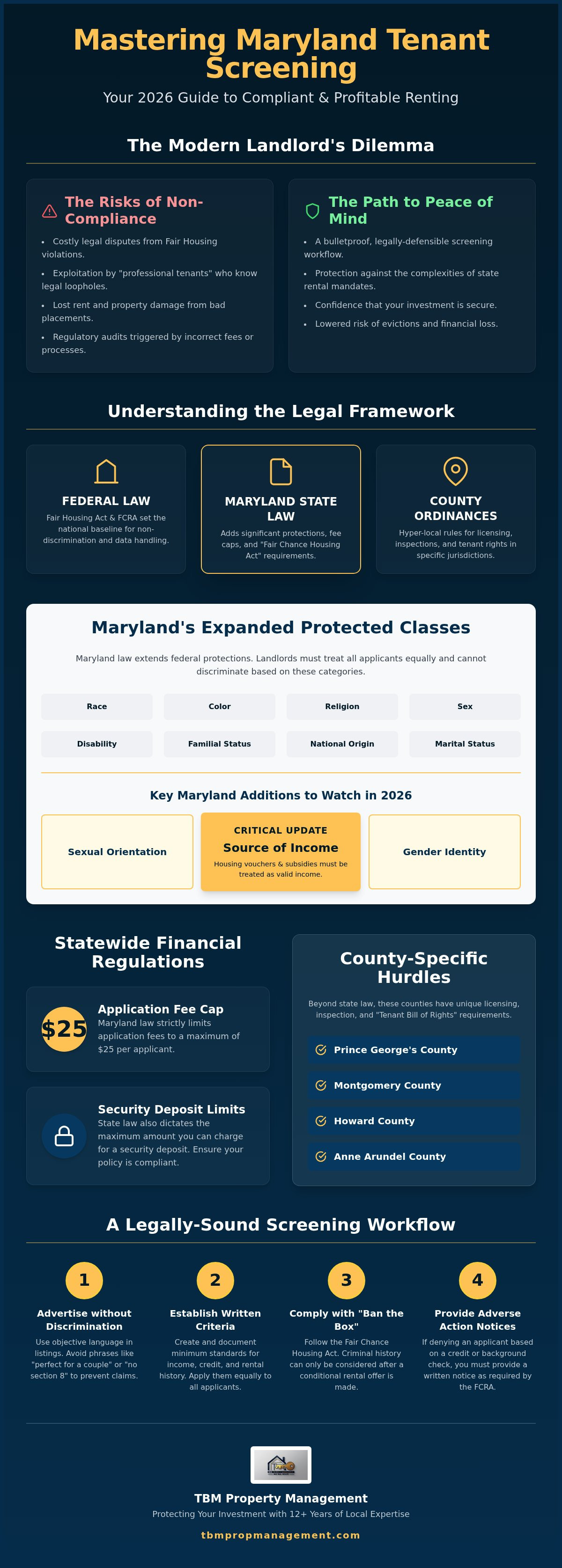
Compliance begins with a deep understanding of the legal protections afforded to every applicant. While federal law establishes the baseline through the seven protected classes, race, color, religion, sex, disability, familial status, and national origin, maryland tenant screening laws go much further. In 2026, Maryland landlords must also account for protections regarding sexual orientation, gender identity, and marital status. Perhaps most critical for your daily operations is the "Source of Income" protection. This mandate ensures that housing choice vouchers and other legal subsidies are treated with the same respect as traditional employment income.
The Maryland Attorney General's guide to landlord-tenant laws serves as a vital resource for understanding these state-level nuances. Beyond Fair Housing, you must strictly adhere to the Fair Credit Reporting Act (FCRA) when handling sensitive data. If you reject an applicant based on their credit report or background check, you're legally required to provide an Adverse Action Notice. This document must clearly state why the application was denied and provide the contact information for the reporting agency used. Failing to issue this notice is a common mistake that leaves landlords vulnerable to federal penalties and state-level lawsuits.
Avoiding Discriminatory Advertising
Your screening process actually starts the moment you post an ad on Zillow or Facebook. Using phrases like "perfect for a quiet couple" or "no section 8" can inadvertently trigger a discrimination claim. In Laurel and surrounding areas, it's essential to set objective, written qualification standards before you even list the property. This proactive approach acts as a stabilizing force, ensuring every lead is measured against the same high standards. If you find the complexity of these regulations overwhelming, our full-service property management team can handle the entire marketing and vetting process for you.
Income and Credit Verification Standards
Verification is where many self-managed landlords encounter friction. Under HB 315, effective October 1, 2026, you cannot use an applicant's income or credit history to screen them if they hold a housing subsidy and those checks cover a period before they received their voucher. This requires a specialized approach to vetting. For self-employed applicants in Howard County, you should request at least two years of tax returns or 1099s to establish stability. Whether you're using traditional credit reports or modern "ResidentScores," your criteria must be applied consistently to every applicant to remain 100% compliant with maryland tenant screening laws.
County-Specific Rules: PG, Montgomery, and Howard County
A one-size-fits-all lease is a recipe for disaster in the Maryland rental market. While state statutes provide a broad framework, local jurisdictions like Prince George's and Montgomery counties have layers of protection that often catch self-managed landlords off guard. Operating in Laurel means you're at the intersection of several different legal zones. If you're using a generic form found online, you're likely missing the specific "Tenant Bill of Rights" disclosures required in Prince George's County or the strict rent stabilization rules that limit annual increases to 7% for specific income brackets.
Montgomery County remains one of the most regulated areas for landlords in the country. You can't conduct a criminal background check until after you've made a conditional lease offer. This "ban the box" approach is a cornerstone of their housing policy and requires a specific two-step screening process. Meanwhile, in Howard County, the administrative burden includes a mandatory rental housing license. Failing to secure these licenses isn't just a minor oversight; it can legally prevent you from collecting rent or moving forward with an eviction warrant if a tenant stops paying.
Licensing and Lead Paint Compliance
Your compliance checklist must include the 2026 Maryland Lead Paint Certificate if your property was built before 1978. This isn't optional. You must document this compliance before the tenant move-in date to shield yourself from massive liability. In Howard County, the fee for a single-unit rental license is $93.50 as of 2026, and inspections are required every two years. These hyper-local requirements are why many owners find relief in professional tenant placement services that handle the paperwork for you. We ensure your property meets every local standard before the first showing.
Security Deposit Limitations
The financial landscape of maryland tenant screening laws shifted significantly on October 1, 2024. The maximum security deposit is now capped at one month's rent statewide for new leases. This is a major change from the previous two-month limit that many long-term landlords are used to. You also have a strict 45-day window to return the deposit or provide an itemized receipt of withholdings after a tenant vacates. In 2026, you must also stay mindful of local notice periods. For example, Howard County now requires 14 days of written notice for certain eviction-related warrants and 90 days of notice to terminate certain tenancies. Managing these differing timelines ensures you remain a stabilizing force in your rental business.
Step-by-Step: Conducting a Legally Sound Screening
Creating a consistent workflow is the most effective way to alleviate the pressure of property oversight. When you follow a structured path, you remove the guesswork that often leads to legal trouble. Maryland tenant screening laws require precision at every stage, starting with your minimum criteria. You must establish and publish these standards before accepting a single application. This ensures every applicant is treated with the same high standards, protecting you from claims of bias or inconsistency. It's a simple step that provides an immediate stabilizing force for your rental business.
Once your criteria are set, your next step is collecting the application fee. In Maryland, this fee is strictly capped at $25. Taking even a dollar more can trigger a regulatory headache you don't need. After receiving the application, you'll move into the multi-point background and credit check. Remember that under the Fair Chance Housing Act taking effect October 1, 2026, you cannot inquire about criminal history until after a conditional offer of housing has been made. This two-step process is a significant shift for many Laurel and Anne Arundel landlords, but it's essential for maintaining compliance. Finally, verify employment and rental history with local experts who can spot the subtle inconsistencies that DIY owners often miss.
The Screening Checklist
Your checklist should prioritize eviction history. A "no eviction" record remains the single best predictor of a successful tenancy. While you must navigate "Ban the Box" restrictions for criminal records, you can still maintain high standards for financial stability and previous landlord references. We look for "professional tenant" red flags, such as unexplained gaps in housing history or a refusal to provide contact info for previous property managers. These individuals often target self-managed owners who lack a rigorous framework. If you want to skip the stress of vetting, our tenant placement services provide a bulletproof alternative to the risks of DIY management.
Lease Execution and Onboarding
A compliant screening process ends with a legally sound lease. Your 2026 lease agreements must include specific Maryland clauses regarding late fees, which are capped at 5%, and security deposit handling. You are also required to provide the mandatory Maryland Landlord Tenant Rights disclosures. Before handing over the keys, conduct a thorough, documented move-in inspection. This protects your asset by establishing a clear baseline for the property's condition, ensuring that any future security deposit withholdings are backed by photographic evidence and detailed reports. This level of diligence provides the peace of mind you deserve as a dedicated property owner.
How TBM Property Management Bulletproofs Your ROI
Self-management often feels like a balancing act where the stakes are your financial security and personal time. Are you tired of the constant pressure to keep up with every legislative shift? At TBM Property Management, we believe that being a landlord shouldn't be a source of anxiety. Our 12+ years of local experience in Laurel and across Anne Arundel, Prince George's, Montgomery, and Howard counties allow us to act as your dedicated partner. We don't just provide reports; we offer a stabilizing force that protects your asset from the complexities of maryland tenant screening laws.
Our tenant placement services go far beyond a simple background check. We understand that in 2026, compliance requires a mastery of local nuances, such as the specific licensing requirements in Howard County or the strict "ban the box" timing in Montgomery County. By choosing professional property management, you're investing in a bulletproof alternative to the risks of accidental Fair Housing violations. We handle the legal stress, the documentation, and the vetting, so you can enjoy the returns of your investment without the administrative burden.
The Value of Local Management
Having "boots on the ground" in Prince George's and Montgomery County is your best defense against the rising threat of professional tenants. Our team is deeply rooted in these communities, providing a specialized, high-touch feel with professional-grade results. We maintain an extensive network of vetted maintenance contractors to handle repairs efficiently, preventing small issues from becoming expensive liabilities. Additionally, our regular property inspections ensure that your tenants are following every lease clause, maintaining the high standards you expect for your property's condition.
Get Your Complimentary Rental Analysis
Are you maximizing your income while staying within the 2026 rent stabilization limits? Determining the optimal rent for your Laurel property requires a strategic blend of market data and local insight. We offer a signature value proposition to help you start this journey with confidence. Our team will identify potential compliance gaps in your current process and provide a clear, action-oriented path toward better property oversight. Contact TBM Property Management for your free 2026 rental analysis! Let us show you how a dedicated local expert can transform your property management experience from a state of frustration to a state of ease.
Secure Your Investment with Confidence
Staying compliant with maryland tenant screening laws doesn't have to be an overwhelming burden. By understanding the shift toward data-driven vetting and the unique licensing requirements in Prince George's and Montgomery counties, you've already taken the first step toward protecting your asset. A structured screening process is your best defense against "professional tenants" and costly legal disputes. It's about moving from a state of uncertainty to a state of ease, knowing every disclosure is met and every applicant is vetted against high standards.
You don't have to navigate these complexities alone. With 12+ years of local Maryland expertise and a comprehensive 2026 screening protocol, TBM Property Management provides the stabilizing force your rental business needs. We specialize in PG and Montgomery County compliance, ensuring your investment remains profitable and protected. Secure High-Quality Tenants Today with TBM Placement Services and experience the relief of professional oversight. Your peace of mind is just a conversation away.
Frequently Asked Questions
What is the maximum application fee a landlord can charge in Maryland?
The maximum rental application fee you can charge in Maryland is strictly capped at $25. This limit applies statewide and ensures that the barrier to entry for housing remains reasonable for all applicants. If you're managing properties in Laurel or Howard County, taking even a small amount over this limit can lead to legal complications. It's best to keep your intake process simple and compliant to avoid unnecessary regulatory scrutiny or disputes.
Can I reject a tenant based on their credit score in Maryland?
You can reject a tenant based on their credit score, but you must follow specific rules under maryland tenant screening laws. If you use a credit report to deny an applicant, you're legally required to provide an Adverse Action Notice. Additionally, as of October 1, 2026, you cannot use credit history to screen voucher holders if the check covers a period before they received their housing subsidy. Consistency is your best defense.
Do I need a rental license to screen tenants in Prince George's County?
Yes, you absolutely need a valid rental housing license to legally operate or screen tenants in Prince George's County. Operating without one is a significant risk that can prevent you from collecting rent or pursuing evictions in court. The county requires regular inspections to ensure properties meet safety standards. Securing your license is a foundational step that provides the legal authority you need to manage your investment with total peace of mind.
What are the 2026 Maryland lead paint disclosure requirements?
For any Maryland property built before 1978, you must provide a valid Lead Paint Certificate to your tenants before they move in. This 2026 requirement ensures that older homes meet strict safety standards to protect residents from lead poisoning. You'll need to register the property with the Maryland Department of the Environment and have it inspected between every tenancy. Failing to meet these disclosure rules can result in heavy fines and significant liability.
How long do I have to return a security deposit in Maryland?
You have exactly 45 days to return a security deposit or provide an itemized list of damages in Maryland. This timeline starts the day the tenant vacates the property. Remember that as of late 2024, the maximum deposit you can collect is capped at one month's rent. Staying on top of this 45-day rule is essential for avoiding penalties that could cost you up to three times the original deposit amount.
Can a Maryland landlord refuse a Section 8 voucher in 2026?
No, you cannot refuse a tenant simply because they use a Section 8 voucher or other housing subsidies in 2026. Maryland law protects "Source of Income" as a protected class. This means you must treat voucher holders with the same professional standards as any other applicant. Rejecting someone solely based on their subsidy is a direct violation of fair housing rules and can lead to costly discrimination lawsuits that threaten your long-term ROI.
What is the 'Source of Income' protection in Maryland rental law?
"Source of Income" protection is a legal mandate that prevents landlords from discriminating against applicants based on how they pay their rent. This includes housing choice vouchers, social security, or disability benefits. When you're following maryland tenant screening laws, you must include these subsidies when calculating whether an applicant meets your income requirements. It's a stabilizing force in the market that ensures fair access to housing for all residents in Montgomery and Howard counties.
How do I legally reject an applicant without getting sued?
To reject an applicant legally, you must use a set of objective, written qualification standards applied consistently to everyone. If the rejection is based on a background check or credit report, you must issue a formal Adverse Action Notice. This document protects you by providing the applicant with the specific reasons for denial and the contact information for the reporting agency. Documenting every step of your decision process ensures you remain well-protected against claims of bias.