
Montgomery County Landlord-Tenant Regulations: The 2026 Compliance Guide
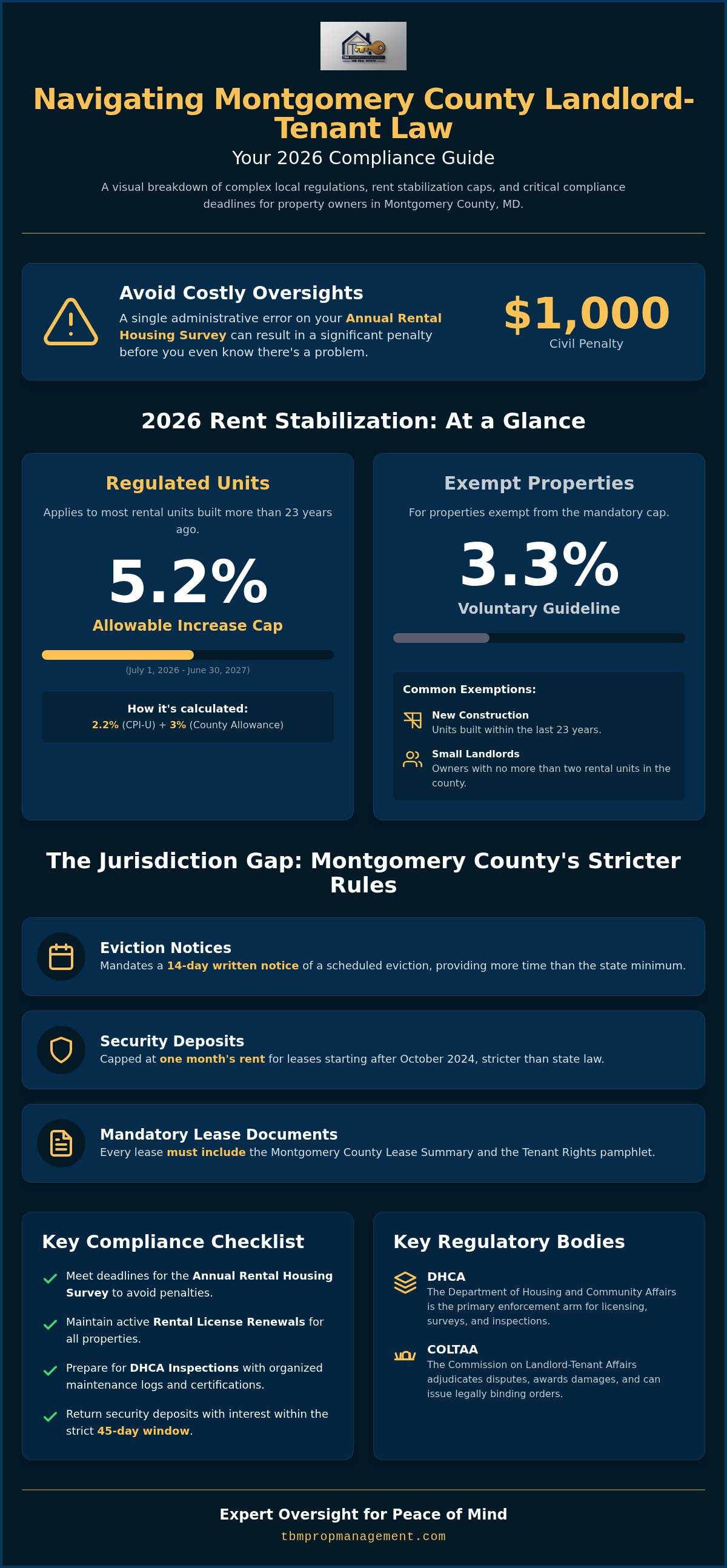
Did you know that a single administrative oversight on your Annual Rental Housing Survey could result in a $1,000 civil penalty before you even realize there's a problem? Managing property in Maryland is already a high-stakes endeavor, but the unique complexities of montgomery county landlord-tenant regulations add a layer of emotional and financial stress that can feel truly overwhelming. You want to provide a stable home for your tenants while protecting your long-term investment, yet the constant shifts in rent stabilization caps and mandatory notice periods make it difficult to feel secure in your compliance.
We understand the pressure you're under to get every detail right. This 2026 guide offers the professional relief you've been looking for by breaking down exactly how to handle these local laws with confidence and clarity. You'll gain a clear understanding of the current 5.2% rent increase limit, the mandatory 90-day notice requirements, and a practical checklist for legal leasing that ensures your business remains protected. We'll walk you through the latest legislative updates, from eviction notice extensions to energy benchmarking, so you can stop worrying about accidental violations and finally enjoy the peace of mind that comes with expert oversight.
Key Takeaways
- Master the 2026 rent stabilization rules, including the current 5.2% allowable increase cap for regulated units and the 3.3% voluntary guideline for exempt properties.
- Avoid costly civil penalties of up to $1,000 by meeting critical deadlines for the Annual Rental Housing Survey and mandatory rental license renewals.
- Ensure full compliance with montgomery county landlord-tenant regulations by serving the required Lease Summary and Tenant Rights pamphlets with every new agreement.
- Protect your investment through proactive DHCA inspection preparation and a documentation-heavy management system designed to withstand increased local oversight.
- Understand updated legal timelines for 2026, including the 14-day eviction notice requirement and the strict 45-day window for returning security deposits with interest.
Understanding Montgomery County's Unique Rental Landscape in 2026
Why are montgomery county landlord-tenant regulations so much more demanding than those in neighboring jurisdictions? Maryland provides a baseline of law, but Montgomery County operates as a "home rule" jurisdiction. This means the county has the authority to enact local ordinances that are significantly stricter than state defaults. In 2026, the focus has shifted heavily toward tenant stability and consumer protection. If you're a landlord, you've likely noticed that the margin for error has disappeared. The 2026 climate is defined by the Rent Stabilization Law, which limits rent hikes for most older units to 5.2% through June 2027. Relying on a standard Maryland lease is a recipe for legal trouble; you need a strategy built specifically for this county's rigorous standards.
The Jurisdiction Gap: Montgomery County vs. Maryland State
The gap between state and local law is where many self-managed landlords stumble. While Maryland state law might allow for more flexibility in notice periods or lease structures, Montgomery County mandates specific local documents. For instance, every lease must include the Montgomery County Lease Summary and the "Tenant Rights and Responsibilities" pamphlet. Failing to provide these doesn't just annoy your tenant; it can render your lease unenforceable in court. Local ordinances also override state defaults in critical areas:
- Eviction Notices: Bill 31-25 now requires a 14-day written notice of a scheduled eviction, providing more time than the state minimum.
- Security Deposits: For leases starting after October 2024, deposits are capped at one month's rent, despite state laws allowing more in other counties.
- Consumer Protection: Under Bill 6-25, the county can now pursue legal action for "deceptive trade practices," which includes misrepresenting lease terms or failing to disclose property issues.
Key Regulatory Bodies You Need to Know
You aren't just answering to the courts; you're answering to the Department of Housing and Community Affairs (DHCA). This agency is the primary enforcement arm for montgomery county landlord-tenant regulations. They handle everything from licensing and mandatory annual rental surveys to property inspections. If a dispute arises that can't be settled through DHCA mediation, it moves to the Commission on Landlord-Tenant Affairs (COLTAA). This body has the power to issue legally binding orders, award damages, and even rescind rent increases. Interacting with these bodies requires a professional, documentation-heavy approach. When an inspector arrives for a mandatory review, having your maintenance logs and lead-paint certifications organized isn't just helpful; it's a shield against "Habitability Freezes" that can legally block you from raising rent.
The 2026 Rent Stabilization Law: Caps, Calculations, and Compliance
How do you ensure your rental income keeps pace with rising costs while staying within the law? Under current montgomery county landlord-tenant regulations, specifically Bill 15-23, the calculation is no longer a guess. For the period of July 1, 2026, to June 30, 2027, the mandatory rent increase cap is set at 5.2%. This figure is derived from the Consumer Price Index for All Urban Consumers (CPI-U) of 2.2% plus the 3% allowance mandated by the county. If your property is regulated, exceeding this cap isn't just a mistake; it's a legal violation that could trigger a "Habitabilty Freeze" or significant fines. The Office of Rent Stabilization is also closely monitoring "junk fees" for parking or pets. If these fees increase faster than the rent cap, they might be flagged as illegal disguised rent increases.
Exemptions and Special Cases
Not every property falls under the 5.2% cap. If your building was constructed within the last 23 years, it's currently exempt from mandatory stabilization. For these units, the county suggests a voluntary rent increase guideline of 3.3%. Small landlords who own no more than two rental units in the county also qualify for exemptions. However, the documentation required to prove these exemptions is extensive. If you're planning substantial renovations, you might apply for a capital improvement surcharge to recoup costs, but this requires DHCA approval before any increase takes effect. Mastery of these nuances is what separates a protected asset from a legal liability.
The Notification Process: Avoiding Costly Errors
Timing is everything in Montgomery County. You must provide a minimum of 90 days' written notice for any rent increase. This notice must include specific, mandatory language informing the tenant of their rights and the basis for the increase. Errors in this document can reset the 90-day clock, costing you months of potential revenue. Beyond the notice, you must also comply with Mandatory Licensing and Inspection Requirements to remain eligible for any increase. A single oversight, like missing the May 15, 2026, Annual Rental Survey deadline, can lead to civil penalties of up to $1,000. If the administrative burden of tracking these dates feels overwhelming, partnering with a professional leasing service can provide the relief you need to ensure every calculation and notice is perfect.
Mandatory Licensing and Inspection Requirements
Managing a rental property is demanding enough without the looming threat of administrative deadlines. In Montgomery County, your rental license is the bedrock of your legal standing. Without a valid license, the protections and rent increases outlined in The 2026 Rent Stabilization Law are irrelevant because you lack the basic legal authority to operate. Licenses follow a strict annual cycle; they remain valid from July 1st to June 30th, with renewal payments due by July 31st each year. For properties built before 1978, you must also provide proof of lead-based paint compliance, a non-negotiable step to protect both your tenants and your asset from severe liability.
The Department of Housing and Community Affairs (DHCA) uses these licensing requirements to maintain a high standard of housing across the county. If you miss the May 15, 2026, deadline for the Annual Rental Housing Survey, you risk a $1,000 civil penalty. This documentation-heavy environment is designed to ensure transparency, but for the self-managed landlord, it often feels like a full-time job just to stay current. Understanding the nuances of montgomery county landlord-tenant regulations is the only way to avoid these expensive administrative traps.
Getting and Keeping Your Rental License
How do you navigate the county's online licensing portal without losing hours to technical frustration? The process requires you to register the property, pay the annual fee, and confirm your lead-paint status. It's vital to remember that you cannot legally collect rent in Montgomery County without a valid, current license. Perhaps more importantly, the courts will generally refuse to hear an eviction case if your licensing isn't in perfect order. This connection between licensing and your right to file for possession makes the renewal process a critical priority for your financial security.
DHCA Inspections: A Landlord's Survival Guide
DHCA conducts routine inspections to ensure every unit meets the county’s strict habitability standards. These aren't just "check-the-box" exercises; they are thorough reviews that can lead to "Habitabilty Freezes" if violations aren't corrected. Common failures often involve simple but overlooked items like missing 10-year sealed battery smoke alarms, loose handrails, or non-functioning GFCI outlets in kitchens and bathrooms. Peeling paint, even in small amounts, is a frequent trigger for a failed inspection in older homes.
To ensure a "pass" on the first visit, we recommend a proactive pre-inspection of your property. Walk through the unit with a critical eye, checking every window, outlet, and detector. For a broader look at how these local rules fit into the larger state framework, consult our Maryland Landlord Tenant Rights: The Definitive 2026 Landlord Guide. Taking the time to prepare now provides the relief of knowing your license renewal won't be stalled by a minor code violation.
The Leasing Process: Mandatory Documents and Disclosures
Does your current lease package feel like a mountain of paperwork? In Montgomery County, the lease itself is only the beginning. To stay compliant with montgomery county landlord-tenant regulations, you must provide a specific suite of documents at the time of signing. This isn't just a best practice; it's a legal requirement that protects your right to collect rent and eventually regain possession of your property. If you skip even one disclosure, you could be opening yourself up to deceptive trade practice claims under Bill 6-25, which gave the county expanded authority to pursue landlords for non-compliance starting in July 2025.
The Essential Lease Packet
You can't just use a generic lease found online. Montgomery County requires a Lease Summary that highlights key terms like the lease duration, rent amount, and utility responsibilities. If you don't use the County’s standard lease agreement, your alternative must be DHCA-approved to be valid. You're also required to serve the "Tenant Rights and Responsibilities" pamphlet at the start of every tenancy. Beyond the lease itself, you must include specific disclosures: radon testing results for ground-contact units, lead paint certificates for homes built before 1978, and clear utility ratios if you don't have individual meters. Documenting the move-in condition with a signed inspection report is your best defense against future security deposit disputes.
Security Deposit Management
One of the biggest traps for local landlords is the security deposit limit. While Maryland state law generally allows for two months' rent, Montgomery County regulations for leases starting on or after October 1, 2024, cap deposits at just one month's rent. You must place these funds in an interest-bearing account within 30 days of receipt. When the tenancy ends, the clock starts ticking immediately. You have exactly 45 days to return the deposit with accrued interest or provide a detailed, itemized list of damages. Missing this deadline by even one day can result in you losing the right to withhold any funds, and in some cases, you could be liable for triple damages. If the thought of compiling this documentation makes you anxious, our professional leasing services ensure every disclosure and deposit is handled correctly the first time.
Finally, 2026 brings stricter eviction prevention rules that you must factor into your management strategy. Bill 31-25, signed in late 2025, now requires a 14-day written notice of a scheduled eviction. This extra time is designed to allow tenants to access county resources, but for you, it means your legal filings must be flawless to avoid further delays in the court system. Managing these timelines requires a level of diligence that many self-managed landlords find exhausting, yet it remains the only way to protect your investment in this highly regulated environment.
How Professional Management Simplifies Montgomery County Compliance
Why carry the heavy weight of regulatory oversight alone? The sheer complexity of montgomery county landlord-tenant regulations has reached a point where a single clerical error can derail your entire investment strategy. From tracking the 5.2% rent cap to filing the Annual Rental Housing Survey by May 15th, the administrative burden is significant. Professional management transforms this chaotic list of chores into a streamlined, reliable system. By positioning ourselves as a stabilizing force for your portfolio, we offer the relief you need to focus on your long-term goals rather than your daily paperwork.
TBM’s Local Expertise in Montgomery County
We don't just manage properties; we act as dedicated partners who understand the hyper-local nuances of the Department of Housing and Community Affairs (DHCA). Our team handles the complex 2026 rent stabilization paperwork for you, ensuring every calculation is legally sound and every 90-day notice is served correctly. If an inspection reveals a code violation, we leverage a vetted network of licensed contractors to perform rapid repairs. This proactive approach prevents "Habitability Freezes" before they can impact your cash flow. While we specialize in the unique demands of this county, our expertise extends across the region, as detailed in our Full-Service Property Management in Laurel, MD: The Complete Landlord’s Guide.
High-regulation environments require expert tenant screening to minimize the risk of costly legal disputes. We use a diligent screening methodology to identify reliable residents who respect both the property and the lease terms. By automating rent stabilization tracking and maintenance coordination via Property Meld, we ensure your ROI is maximized within the strict legal limits of the law. You won't have to worry about missing a radon disclosure or miscalculating security deposit interest when you have a seasoned team watching every detail.
Taking the Next Step Toward Stress-Free Investing
Transitioning from the stress of DIY management to the stability of professional oversight is a game-changer for your peace of mind. Why spend your weekends worrying about the latest legislative update or the 14-day eviction notice rule? TBM’s monthly management provides a specialized, high-touch feel with professional-grade results that exceed standard expectations. It's about more than just staying legal; it's about building a sense of security and trust in your financial future. If you're ready to simplify your life, get your complimentary property analysis from TBM today! and see how we can protect your Montgomery County investment.
Securing Your Rental Future in Montgomery County
Mastering the 5.2% rent cap and navigating the strict DHCA inspection cycle are the keys to long-term profitability. You've learned that compliance isn't just about paperwork; it's about protecting your rights as a property owner. Staying current with montgomery county landlord-tenant regulations ensures you avoid the $1,000 penalties and 'Habitability Freezes' that catch so many DIY landlords off guard. By implementing these 2026 strategies, you aren't just following rules; you're building a documentation-heavy system that survives even the strictest local oversight.
Why shoulder the emotional burden of these complex laws when you can lean on a specialized Montgomery County regulatory team? With 12+ years of Maryland expertise and A+ rated maintenance coordination, TBM Property Management provides the stabilizing force your portfolio needs. Protect your investment with TBM’s Montgomery County compliance experts. You've got the tools to transform your rental business from a source of stress into a secure, passive asset.
Frequently Asked Questions
What is the maximum rent increase allowed in Montgomery County in 2026?
The maximum allowable rent increase for regulated units in Montgomery County is 5.2% for the period between July 1, 2026, and June 30, 2027. This cap is calculated using the Consumer Price Index (CPI-U) of 2.2% plus the 3% allowance mandated by local law. For units exempt from stabilization, such as those built within the last 23 years, the voluntary guideline is 3.3%. Always verify your property's specific status before issuing an official 90-day notice.
Do I need a separate rental license for a basement apartment in Montgomery County?
Yes, you must obtain a separate rental facility license for a basement or accessory apartment. Montgomery County requires all rental units, including single-family homes and accessory apartments, to be registered with the Department of Housing and Community Affairs (DHCA). Operating an unlicensed unit is illegal and prevents you from using the courts for eviction or rent collection. Ensure you apply for the correct license class to maintain full compliance with montgomery county landlord-tenant regulations.
How much notice must I give a tenant before entering the property for an inspection?
You're generally required to provide at least 24 hours' written notice before entering a rental property for a non-emergency inspection. While the law requires "reasonable notice," the 24-hour standard is the safest way to respect tenant privacy and avoid disputes. Always document your notice delivery to prove compliance if a tenant later claims unauthorized entry. Emergency entries, such as for active water leaks, don't require advance notice but should be handled professionally.
Are single-family homes exempt from Montgomery County rent stabilization?
Single-family homes aren't automatically exempt from rent stabilization. While there are exemptions for landlords who own only one or two rental units in the county, most single-family rentals must follow the 5.2% rent cap. If your home was built within the last 23 years, it qualifies for a temporary exemption from mandatory caps. It's critical to confirm your property's specific exemption status with the DHCA to avoid accidental non-compliance and potential civil penalties.
What happens if I forget to provide the Lease Summary to my tenant?
Failing to provide the mandatory Montgomery County Lease Summary can make your lease agreement unenforceable in a court of law. This document is a non-negotiable requirement under montgomery county landlord-tenant regulations and must be signed by both parties at the start of the tenancy. If you forget to include it, you may be unable to win an eviction case or collect back rent. It's best to serve the document immediately and have the tenant acknowledge receipt in writing.
Is radon testing mandatory for all rental properties in Montgomery County?
Radon testing is mandatory for all single-family homes and ground-contact multi-family units in Montgomery County. You must conduct a test at least once every three years and provide the results to the tenant before they sign the lease. If levels are at or above 4.0 pCi/L, you're responsible for mitigation. Providing these reports is a critical part of the legal leasing process and helps protect you from future liability claims or deceptive trade practice charges.
Can I charge a late fee if the rent stabilization law limits my income?
Yes, you can still charge late fees, but they're strictly regulated. In Maryland, late fees can't exceed 5% of the total monthly rent and can only be charged if the rent is more than five days late. While the rent stabilization law limits how much you can increase the base rent, it doesn't eliminate your right to enforce lease terms. However, ensure your late fee policy is clearly stated in your DHCA-approved lease to remain legally enforceable.
How does TBM Property Management stay updated on changing local regulations?
TBM Property Management leverages over 12 years of local real estate expertise to stay ahead of legislative shifts. Our specialized Montgomery County regulatory team monitors the DHCA and county council daily for new bills like the recent eviction notice extensions. We utilize automated systems to track deadlines for the Annual Rental Survey and license renewals. This proactive approach allows us to provide the stabilizing force and professional relief our clients need in a high-regulation environment.