Prince George's County Landlord Tenant Laws: The 2026 Compliance Guide
Did you know that a single technicality missing from your lease could leave you vulnerable to a costly lawsuit in Upper Marlboro or Bowie? Managing rental property in Maryland is already a full-time job, but Prince George’s County adds layers of local ordinances that can feel like a moving target. It’s completely natural to feel overwhelmed by the shifting requirements of Subtitle 13 or the latest rent stabilization updates. You aren't alone in your frustration, and the fear of being sued over a minor oversight is a burden no property owner should have to carry.
This guide is designed to replace that anxiety with total peace of mind by breaking down the prince george's county landlord tenant laws you need to know for 2026. We promise to help you master these complexities so you can protect your investment and ensure total legal compliance without the stress of second-guessing yourself. We will provide a clear roadmap through the 5.7% rent increase caps, specific security deposit interest rates, and the exact notice periods required to keep your business running smoothly. By the end of this article, you'll have a professional's understanding of how to manage tenant relations while staying firmly on the right side of the law.
Key Takeaways
- Understand how Subtitle 13 functions as the local foundation for rental regulations and how the 'Single Entity' rule impacts your specific property type.
- Learn the strict requirements for the 'Notice of Condition' report and why your late fees must never exceed 5% of the monthly rent to remain compliant.
- Stay ahead of the 2026 rent stabilization caps and ensure your leases align with the latest prince george's county landlord tenant laws to protect your ROI.
- Master the 24-hour notice standard for property entry and the specific maintenance warranties required to meet local construction and use codes.
- Discover how professional oversight can automate your legal obligations, transforming complex local regulations into a stress-free management experience.
Understanding Subtitle 13: The Foundation of PG County Rental Law
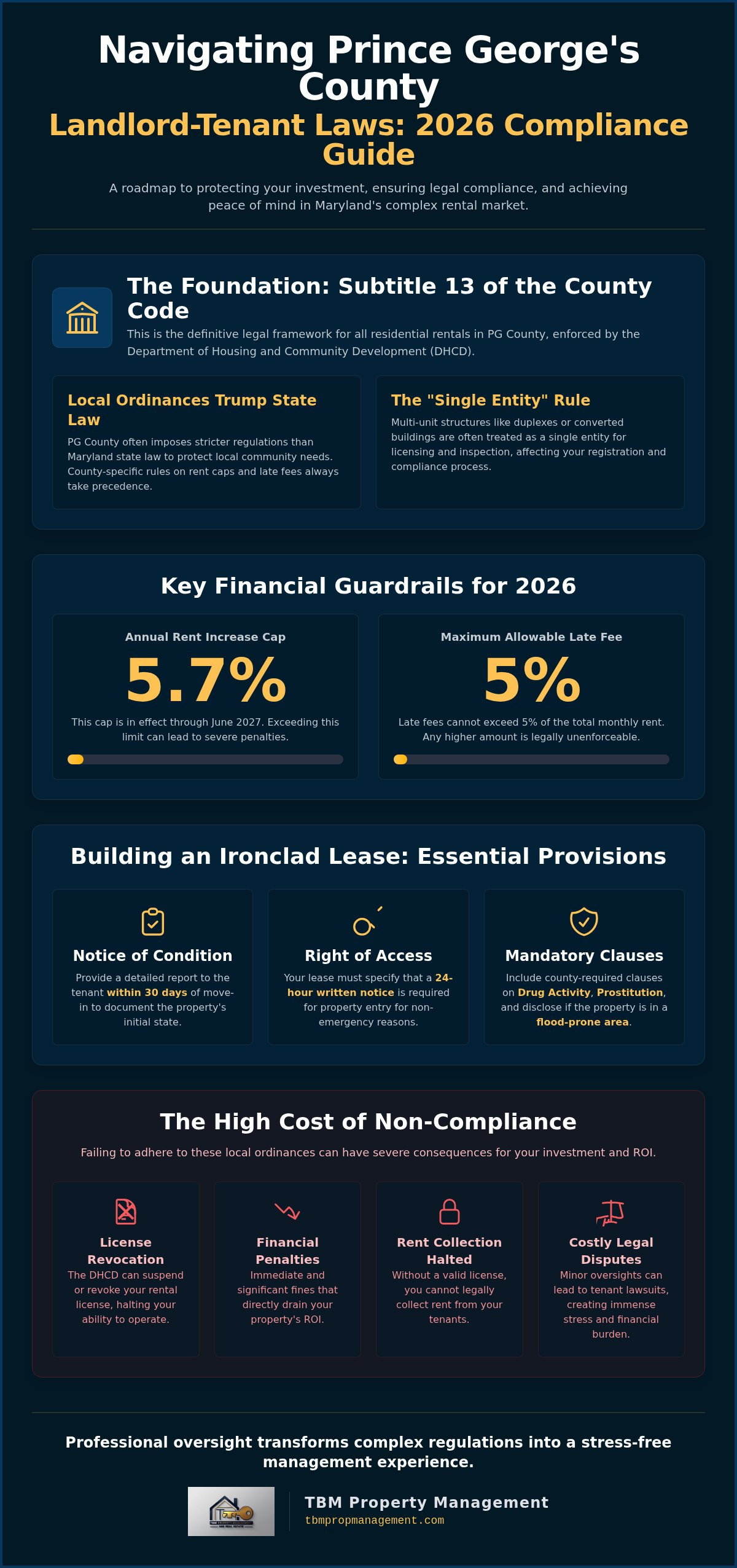
Subtitle 13 of the Prince George’s County Code serves as the definitive legal framework for every residential rental transaction within the county lines. While you might be familiar with general prince george's county landlord tenant laws, Subtitle 13 is the specific local engine that drives everything from lease requirements to habitability standards. It acts as a comprehensive rulebook that goes beyond the basics, ensuring that both parties understand their rights and obligations. The Department of Housing and Community Development (DHCD) is the primary body responsible for enforcing these codes, and they take their mandate seriously to maintain the safety and quality of the local housing stock.
One area where self-managed landlords often stumble is the "Single Entity" rule. This regulation dictates that for licensing and inspection purposes, certain multi-unit structures are treated as a single entity rather than a collection of independent apartments. If you own a duplex or a small building where you've converted spaces into rentals, this rule affects how you register your property and how inspectors evaluate your compliance. Understanding these nuances is the first step toward securing your investment and avoiding the red tape that often entangles well-meaning owners.
Why Local Ordinances Trump State Law
Maryland state law provides a broad foundation for property management, but in our region, local mandates often take precedence. While U.S. Landlord-Tenant Law establishes basic principles of fairness, Prince George’s County has implemented much stricter protections. For example, the county’s rent stabilization caps are far more rigid than state-level guidelines, limiting most annual increases to 5.7% through June 2027. If your property is located within an incorporated town like Laurel, you may encounter even more localized rules that add another layer of complexity to your operations. Local jurisdictions maintain the legal authority to impose stricter standards than state statutes to protect the unique needs of their specific community members.
The Cost of Non-Compliance in 2026
The stakes for legal errors have never been higher. In 2026, failing to properly register a rental property or missing a technical deadline can trigger immediate penalties that drain your ROI. The DHCD has the authority to suspend or revoke your rental license for persistent violations, which effectively halts your ability to collect rent legally. Beyond the financial hit, the emotional toll of a legal dispute can be devastating for DIY landlords. Managing a lawsuit over a technicality creates a level of stress that can make property ownership feel like a burden rather than a benefit. Professional oversight ensures these technicalities are handled with precision, giving you the freedom to focus on your long-term goals.
Required vs. Prohibited Lease Provisions in Prince George's County
Drafting a lease isn't just about picking a template and filling in the blanks. In our region, the fine print determines whether your investment is protected or exposed. Under prince george's county landlord tenant laws, you're required to provide a 'Notice of Condition' report to your tenant within 30 days of the lease start date. This document is a vital safeguard. It records the exact state of the property at move-in, preventing future disputes over security deposit deductions. You also need to be incredibly precise with late fees. While Maryland state law offers some general guidelines, our county is much stricter. You cannot charge a late fee that exceeds 5% of the total monthly rent. Even a minor overcharge can make your late fee provision legally unenforceable.
Essential Clauses for Landlord Protection
Clear rules for property access and maintenance requests save you from late-night headaches and legal friction. Your lease should define exactly how tenants report issues and how you'll provide the required 24-hour notice for entry. For properties with shared meters, including specific language for utility billing and meter reading is essential to avoid "hidden cost" accusations. Don't forget that the county requires specific clauses regarding 'Drug Activity' and 'Prostitution'. These aren't just suggestions; they're mandatory protections designed to help you maintain a safe environment for all residents. You must also include mandatory disclosures regarding flood-prone areas and lead paint. While lead paint is a state-level requirement, the county has specific ways these disclosures must be presented. If you're unsure if your current document meets these standards, our leasing services can help you audit your paperwork for total compliance.
Avoiding Illegal Lease Terms
It's tempting to include 'As-Is' clauses to limit your repair obligations, but these are generally unenforceable in residential leases. The county expects you to maintain a warrant of habitability regardless of what the lease says. Similarly, 'Confession of Judgment' clauses, which allow a landlord to enter a judgment against a tenant without a trial, are strictly prohibited. These illegal terms can jeopardize your entire agreement and leave you open to counter-suits. For a broader look at state-level expectations, check out our guide on Maryland Landlord Tenant Rights: The Definitive 2026 Landlord Guide.
Staying compliant requires constant vigilance and a deep understanding of local code. You can find more detailed breakdowns of these requirements in the Prince George's County Rental and Housing Laws. Missing these small details often leads to the technicalities that tenants use to win cases in rent court. If the complexity of managing these legal hurdles feels like too much, moving toward professional full-service property management can offer the relief and security you've been looking for.
Security Deposits and Rent Stabilization Caps
Managing the financial aspects of a rental shouldn't feel like walking through a minefield. Under the prince george's county landlord tenant laws, you can't collect more than two months' rent as a security deposit. While this aligns with Maryland state standards, the county adds specific layers of responsibility. You must place these funds in an interest-bearing account within 30 days of receipt. Failing to provide a proper receipt or mishandling the interest calculations can lead to significant penalties, including paying up to three times the deposit amount in damages. For the most up-to-date legal citations, you can reference the Prince George's County Landlord-Tenant Regulations provided by the local courts.
Managing Security Deposits Without the Headaches
One of the biggest points of friction between landlords and tenants is the move-out process. To justify any deductions, you must conduct a thorough move-in and move-out inspection. This documentation is your only shield when a tenant disputes charges for "normal wear and tear," which the law protects them from. A common mistake is withholding funds for faded paint or slightly worn carpets; these are costs of doing business, not tenant damages. You must return the security deposit, along with an itemized list of any deductions, within 45 days after the lease ends to remain in total compliance.
Understanding Local Rent Control Trends
The Permanent Rent Stabilization and Protection Act of 2024 changed the game for local investors. For the period between July 1, 2026, and June 30, 2027, the maximum rent increase for most regulated units is capped at 5.7%. If you manage age-restricted senior housing, that cap is even tighter at 2.7%. It’s vital to know if your property is exempt. New construction built on or after January 1, 2000, and landlords who own five or fewer units generally don't fall under these specific caps.
When you do plan an increase, timing is everything. You're required to provide 90 days' written notice for rent hikes in stabilized units. If you provide notice too late or attempt to increase rent as a response to a tenant's request for repairs, you could face "retaliatory eviction" claims. These legal battles are costly and exhausting. If you want to avoid these risks, our rent collection and management services ensure every increase is handled with professional precision and legal accuracy.
Maintenance Standards and the Right of Access
Maintenance shouldn't be a source of constant friction between you and your residents. Under the prince george's county landlord tenant laws, you have a legal obligation to maintain the property according to strict health and safety standards. This is known as the Landlord's Warranty, a promise that your rental complies with all local construction and use codes. While you're responsible for the heavy lifting, it’s a two-way street. Tenants have a duty to keep the unit clean, dispose of trash properly, and use all electrical and plumbing fixtures as intended. Except in true emergencies, you must provide a minimum of 24 hours’ notice before entering a tenant’s home. Respecting this boundary builds trust and keeps you in total compliance with privacy regulations.
If repairs fall through the cracks, the situation can escalate quickly. Tenants who feel their maintenance requests are being ignored may file for 'Rent Escrow'. This is a legal process where the tenant pays their rent into a court-managed account instead of to you until the repairs are completed. It’s a stressful, public, and time-consuming ordeal that you can easily avoid with a proactive approach. Addressing issues the moment they arise prevents these filings from ever reaching a courtroom, protecting both your reputation and your cash flow.
The Importance of Regular Property Inspections
Waiting for a tenant to report a leak is a reactive strategy that often leads to higher repair bills. Regular property inspections allow you to document the ongoing condition of your asset, which is your best defense against future disputes. These walkthroughs help you identify 'Seasonal Damage', like gutter clogs or HVAC strain, before they evolve into costly code violations. For more tips on protecting your investment, read our guide on Maximizing Your ROI: Property Maintenance & Care. Consistent oversight transforms maintenance from a burden into a predictable part of your business strategy.
Habitability and the Housing Code
Every resident in our county has a right to essential services, including heat, water, and electricity. If these services are interrupted, you must act with urgency to restore them. In Prince George's County, the implied warranty of habitability is an unwritten promise that the rental unit is safe, sanitary, and fit for living from the day the tenant moves in until the day they leave. If a County Inspector issues a 'Violation Notice', don't panic. View it as a roadmap to compliance and address the cited issues within the specified timeframe to avoid fines or license suspension.
Take the guesswork out of compliance by scheduling professional property inspections that identify risks before they become liabilities. Our team acts as your local expert, ensuring your property meets every standard of the 2026 housing code so you can enjoy true peace of mind.
The TBM Approach: Professional Compliance and Peace of Mind
Mastering the prince george's county landlord tenant laws is a significant undertaking for any property owner. While the regulations we've discussed are designed to protect both parties, the day-to-day execution of these rules can feel like a heavy burden. If you're tired of tracking legislative changes or worrying about a technicality in your lease, our team offers a stabilizing force. TBM Property Management specializes in automating Subtitle 13 compliance, transforming a complex legal landscape into a predictable, stress-free experience. With over 12 years of local real estate expertise, we've navigated every major shift in county code, ensuring our clients' investments remain protected regardless of new mandates.
Your first line of defense against legal friction is our in-depth tenant screening process. We go beyond basic credit checks to identify high-quality residents who respect your property and the terms of their agreement. By placing the right people from the start, we significantly reduce the risk of high-risk legal situations, such as rent escrow filings or eviction proceedings. This proactive approach allows you to step back from the role of an amateur legal expert and return to being a confident investor.
Full-Service Management as a Legal Shield
Our full-service property management acts as a comprehensive shield for your assets. We handle the meticulous task of lease drafting and prohibited clause auditing, ensuring your documents are airtight and compliant with 2026 standards. You don't have to worry about calculating the 5.7% rent stabilization caps or mailing out 90-day increase notices on time; we manage the entire timeline for you. This level of professional oversight is essential in a region where local ordinances often trump state law. If you're still weighing the benefits of self-management versus hiring a partner, explore our guide on Choosing Professional Property Management in Maryland.
Take Back Your Time and Your Peace of Mind
The true value of a dedicated partner isn't just in the paperwork; it's in the emotional relief you feel when you're no longer the primary point of contact for every tenant dispute or maintenance emergency. We handle all tenant relations with professional empathy and firm adherence to the law. This allows you to reclaim your weekends and focus on growing your portfolio instead of managing its problems. Are you ready to see how your current strategy stacks up against the latest regulations? Your next step is simple. Reach out today for a complimentary rental analysis and let TBM Property Management handle the legal complexities for you. We're here to provide the mastery and dedication your investment deserves.
Secure Your Rental Legacy in Prince George's County
Mastering the prince george's county landlord tenant laws doesn't have to be a source of constant anxiety. By understanding the specifics of Subtitle 13, adhering to the 5.7% rent stabilization caps, and maintaining rigorous property standards, you've already taken the first steps toward a more secure investment. Whether you're auditing your current lease for prohibited clauses or preparing for a move-out inspection, remember that precision is your best defense against legal friction. You deserve to enjoy the rewards of property ownership without the emotional burden of managing every technicality yourself.
If the weight of self-management is starting to feel overwhelming, it's time to partner with a local expert. With 12+ years of Prince George's County expertise, our team provides comprehensive Subtitle 13 compliance auditing and stress-free tenant placement and screening. We act as your stabilizing force, ensuring every notice is sent and every inspection is documented with professional mastery. Protect your investment with TBM Property Management and reclaim your peace of mind today. Your future as a successful landlord starts with the right support, and we're here to help you every step of the way.
Frequently Asked Questions
Is a rental license required in Prince George's County for a single-family home?
Yes, a rental license is mandatory for all residential rental properties in the county, including single-family homes. You must obtain this through the Department of Permitting, Inspections, and Enforcement (DPIE). Operating without a valid license can lead to heavy fines and prevents you from using the court system for evictions. Staying current with your registration is a fundamental part of prince george's county landlord tenant laws that protects your legal standing.
What is the maximum late fee a landlord can charge in PG County?
You cannot charge a late fee that exceeds 5% of the total monthly rent. Additionally, you must provide a five-day grace period, meaning the fee can only be applied starting on the 6th day of the rental period. It’s vital to ensure your lease explicitly states these terms. If your late fee provision exceeds this 5% limit, it becomes legally unenforceable in court, potentially costing you more in legal fees than the original payment.
How much notice must a landlord give before entering a rental property in Maryland?
Landlords are required to provide at least 24 hours’ notice before entering a rental unit for non-emergency reasons, such as repairs or inspections. While Maryland state law is less specific, Prince George’s County strictly enforces this 24-hour standard to protect tenant privacy. Emergency situations, like a burst pipe or fire, are the only exceptions where immediate entry is permitted without prior notification. Clear communication helps maintain a professional relationship with your residents.
Can a landlord in Prince George's County increase rent by any amount in 2026?
No, most rental units are subject to the Permanent Rent Stabilization and Protection Act. For the period of July 1, 2026, through June 30, 2027, the annual rent increase is capped at 5.7% for standard units and 2.7% for age-restricted senior housing. There are exemptions for new construction built after January 1, 2000, and landlords owning five or fewer units. You must also provide a 90-day written notice before any increase takes effect.
How long does a landlord have to return a security deposit in Prince George's County?
You must return the security deposit to the tenant within 45 days after the lease terminates. If you are withholding any portion for damages beyond normal wear and tear, you must include a detailed, itemized list of those costs. Failing to meet this 45-day deadline can result in a court awarding the tenant up to three times the original deposit amount. Precise documentation during the move-out inspection is essential to justify any deductions.
What happens if a landlord does not provide a 'Notice of Condition' report?
Providing a 'Notice of Condition' report within 30 days of the lease start date is a mandatory requirement under prince george's county landlord tenant laws. If you fail to provide this document, you lose the legal presumption that the property was in good condition at move-in. This makes it nearly impossible to successfully withhold security deposit funds for damages later. It’s a simple administrative step that prevents expensive disputes when a tenant eventually moves out.
Are there specific eviction laws only for Prince George's County?
Yes, the county has specific procedural requirements that go beyond state law. For instance, before you can file for an eviction due to non-payment of rent, you must provide the tenant with a formal 10-day notice of your intent to file. This gives the resident a final window to settle the debt. Following these hyper-local timelines is critical; skipping a single step in the county’s mandated process can lead to your case being dismissed.
Does Subtitle 13 apply to incorporated cities like Laurel and Bowie?
Subtitle 13 serves as the foundational housing code for the entire county, but incorporated cities like Laurel often have their own additional ordinances. While Bowie typically follows the county standards, Laurel has historically implemented its own specific rental licensing and inspection programs. You must comply with the stricter of the two sets of rules. Checking with both the county and your specific municipality ensures you don't miss a local requirement that could jeopardize your license.