
Prince George's County Rental License Process: The 2026 Landlord's Guide
What if your most reliable source of income suddenly became a legal liability because of a single missing document? In Maryland, failing to navigate the prince george's county rental license process doesn't just result in a fine; it strips away your ability to defend your property rights in District Court. It's a high-stakes requirement that often feels designed to frustrate even the most diligent property owners. Whether you're struggling with the Momentum portal or trying to determine if your property falls under county or municipal rules, the pressure of non-compliance is a heavy burden to carry alone.
We know that you want to be a successful landlord, not a full-time administrative clerk. It's completely normal to feel confused by the shifting digital requirements and the technical nuances of DPIE inspections. This 2026 guide provides a comprehensive, step-by-step roadmap to securing your valid 2-year license without the typical administrative stress. We'll break down exactly how to handle your application, pass your mandatory inspections, and maintain the legal shield your business requires. By the end of this article, you'll have a clear path to total compliance and the peace of mind that comes with professional asset oversight.
Key Takeaways
- Understand why a valid license is your essential legal shield for rent collection and eviction proceedings in District Court.
- Determine if your property falls under the jurisdiction of the county DPIE or a specific municipality like Laurel or College Park.
- Streamline the prince george's county rental license process by navigating the Momentum portal and organizing mandatory MDE lead paint documentation.
- Learn how to prepare for the DPIE habitability inspection to ensure your property passes the first time and avoids unnecessary fees.
Why the Prince George's County Rental License is Mandatory
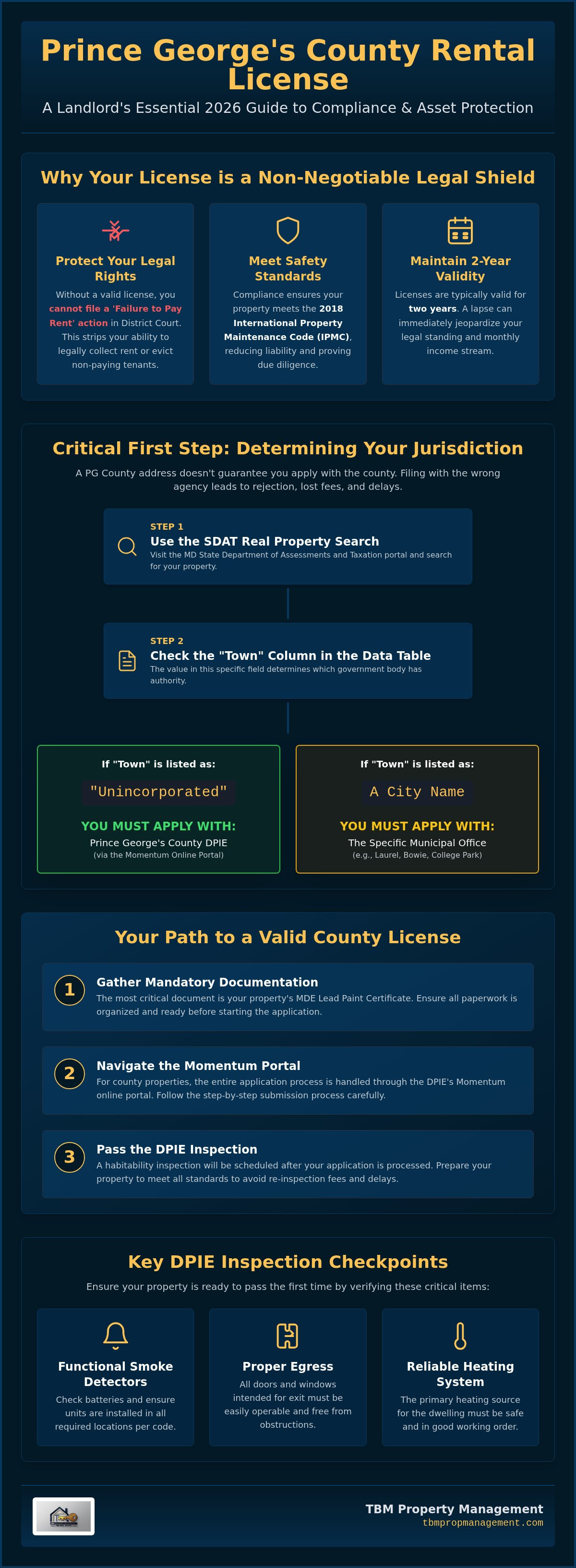
In Prince George's County, a rental license isn't a suggestion; it's a strict legal mandate for every single-family and multi-family dwelling. If you're renting out a basement apartment in Bowie or a townhouse in Upper Marlboro, you're bound by these regulations. The county utilizes the 2018 International Property Maintenance Code (IPMC) as its benchmark for safety and quality. While the prince george's county rental license process might feel like another layer of bureaucracy, it serves as the only legal bridge between owning a property and actually being allowed to profit from it. These licenses typically remain valid for two years, but letting one lapse can have devastating consequences for your investment.
The Legal Stakes: Protecting Your Right to Collect Rent
Landlords often overlook the judicial power of a license until they're standing in front of a judge. The landmark Maryland case McDaniel v. Baranowski established a clear precedent: a landlord cannot initiate a 'Failure to Pay Rent' action without a valid license. If your tenant stops paying, you can't legally use the court system to recoup those funds or regain possession if your paperwork isn't in order. For a non-paying tenant, your lack of a license is essentially a 'get out of jail free' card that allows them to remain in the property while you lose monthly income. A rental license is the legal foundation of Maryland landlord-tenant law.
Habitability and Safety Standards in PG County
The Department of Permitting, Inspections and Enforcement (DPIE) oversees the inspection phase of the prince george's county rental license process to ensure every home meets basic human habitability standards. They check for functional smoke detectors, proper egress, and reliable heating systems. By maintaining these standards, you aren't just checking a box for the county; you're significantly reducing your long-term liability. A licensed property is a documented proof of care, which protects you if a tenant ever claims negligence or unsafe living conditions. To understand how these local rules fit into the bigger picture, you should also review Maryland Landlord Tenant Rights. Staying proactive with these requirements ensures your asset remains a source of stability rather than a legal headache.
Determining Your Jurisdiction: County vs. Municipal Licenses
Did you know that a Prince George's County address doesn't always mean you follow the county's licensing rules? This is a frequent point of confusion that can derail the prince george's county rental license process before it even starts. If you submit your application to the Department of Permitting, Inspections and Enforcement (DPIE) but your property sits within the limits of an independent municipality, your request will be rejected. This error doesn't just cause frustration; it often leads to lost application fees and significant delays in your ability to legally lease the home. Understanding exactly where your property sits is the first step toward a stress-free licensing experience.
Using the SDAT Real Property Search
How can you be 100% certain where to file your paperwork? The Maryland State Department of Assessments and Taxation (SDAT) Real Property Search is the definitive resource for every landlord. To find your answer, simply visit the SDAT portal, select Prince George's County, and enter your property's street address. Once the record appears, look closely at the "Town" column in the primary data table. If this field lists your property as "Unincorporated," you are required to use the county's DPIE licensing system. If a specific city name appears, you must contact that local municipal office directly. This simple check ensures you don't waste resources on the wrong government agency.
Special Rules for the City of Laurel and Bowie
Major municipalities like Laurel, Bowie, and College Park manage their own independent rental licensing processes. These cities do not utilize the county's Momentum online portal. Instead, they maintain their own digital systems or paper applications, each with unique fee schedules and inspection windows. For example, if you are searching for Full-Service Property Management in Laurel, MD, you'll discover that the city has its own set of local ordinances that differ from county-wide standards. Failing to recognize these local boundaries can leave you legally unprotected. If the thought of managing these jurisdictional nuances feels like a headache, partnering with a local expert can provide the relief you need to focus on your investment rather than the paperwork.
Preparing Your Documentation: The Lead Paint and MDE Requirements
Have you ever spent hours filling out an online form only to realize you're missing a mandatory attachment at the very last step? It's a common frustration that can stall the prince george's county rental license process for weeks. Before you even think about opening the county's digital portal, you need to assemble a precise "pre-flight" dossier. Gathering these documents ahead of time transforms a potentially exhausting afternoon into a quick, successful submission. If you're managing this on your own, the burden of accuracy is entirely on your shoulders, but being organized is your best defense against delays.
Navigating the MDE Lead Law Compliance
The most significant hurdle for many local owners is Maryland's strict lead paint regulation. If your property was built before 1978, the Maryland Department of the Environment (MDE) requires you to register the home and obtain a lead inspection certificate. You'll need to decide between a "Lead-Free" certificate, which is a permanent status for properties with no lead paint, or a "Full Risk Reduction" certificate, which requires a new inspection every time the tenant changes. MDE compliance is a non-negotiable prerequisite for PG County licensing. Without a valid MDE tracking number and a current certificate uploaded to your application, the county will not issue your license. It's that simple.
The 'Momentum' Document Checklist
Once your lead paint status is verified, you must organize your ownership and safety records. The Momentum portal is picky about file formats, so we recommend preparing every document as a clear, high-resolution PDF. You will need to provide:
- Proof of Ownership: A copy of your recorded deed or a recent SDAT property printout.
- Valid Identification: Clear copies of government-issued IDs for every owner listed on the deed.
- Safety Certifications: Current certificates for smoke detector and carbon monoxide alarm compliance.
- Business License: If your property is held in an LLC or corporation, you'll need your Maryland business registration documents.
Don't forget to check your financial standing with the county before you start. If you have outstanding property taxes or unpaid county fees, the system may block your application entirely. Ensuring your ledger is clean and your PDFs are ready allows you to move through the prince george's county rental license process with the confidence of a professional. If this checklist feels overwhelming, remember that dedicated maintenance coordination and expert oversight can take these tasks off your plate entirely.
Step-by-Step Guide to the Momentum Online Application
The Momentum portal is the mandatory digital gateway for the prince george's county rental license process. While it replaces the slow; paper-based systems of the past, its high-tech interface can feel like a maze for those who aren't tech-savvy. This online system acts as your central hub for digital document submission, fee payments, and eventually; printing your official license from your home office. Understanding how to interact with this platform is the difference between a quick approval and a month of technical troubleshooting.
Creating and Verifying Your Momentum Account
Your first step is creating a comprehensive user profile. This account will serve as your permanent dashboard for all future renewals and property updates. During the registration phase; the most common pitfall is address formatting. The system is extremely sensitive. It requires your property address to match the county’s master database exactly. If you add "Street" instead of "St" or miss a suite number; the portal may fail to link your property to your account.
For those with a growing portfolio; you can manage multiple properties under a single login. This allow you to track expiration dates and inspection statuses across several jurisdictions from one screen. If you find yourself stuck; the portal offers a 'Save and Resume' feature. This is incredibly helpful if you realize a document is missing or if you need to double-check a specific deed date. Utilizing this feature prevents you from having to restart the entire application from scratch.
Submitting the Application and Paying Fees
Once your account is active; you'll select your specific license type. Most individual landlords will choose the "Single-Family/Townhouse" option, while larger buildings require the "Multi-Family" designation. After uploading the PDF dossier we discussed in the previous section; you'll move to the payment gateway to cover the two-year licensing fee. The payment gateway accepts major credit cards and electronic checks. It's vital to save your transaction receipt immediately; as this serves as proof of payment if the system experiences a glitch.
The real relief comes shortly after submission. Once the county performs an initial document check; they typically issue a temporary license via email. This document is a powerful tool. It allows you to legally rent the property and collect income while you wait for the final DPIE inspection. This bridge ensures your cash flow isn't interrupted by government scheduling backlogs. If the technical side of this portal feels like a burden; our team can manage the entire prince george's county rental license process for you; ensuring every digital box is checked correctly the first time.
Ensuring a Successful Inspection and Maintaining Your License
After you've navigated the digital hurdles of the Momentum portal, the DPIE inspection represents the final hurdle in the prince george's county rental license process. It’s natural to feel a bit of anxiety when a government official walks through your investment property with a clipboard. However, this visit isn't meant to be an interrogation. It's a verification that your home meets the safety standards required for human habitability. If you fail this initial visit, you'll face re-inspection fees and further delays in securing your final 2-year license. Professional maintenance coordination is your best defense against these unnecessary setbacks.
Common Inspection Failures to Avoid
Most inspection failures are entirely preventable with a bit of foresight. The most frequent culprit is the smoke detector. You must have functional, 10-year sealed battery smoke alarms on every level of the home and inside every bedroom. Additionally, every window must operate smoothly; if a window won't stay open on its own or is painted shut, it’s an automatic fail. Egress points, especially in basement units, must remain completely unobstructed to ensure a safe exit in an emergency.
We recommend using a structured system like Property Meld to track and resolve these maintenance items before the inspector ever sets foot on the property. This proactive approach ensures a 'one-and-done' experience, saving you both time and money. Once you pass, your official license is issued, but your responsibility doesn't end there. You must initiate your renewal through the Momentum portal before your current expiration date to maintain your legal standing in District Court. Letting a license lapse, even by a few days, can leave you legally vulnerable.
How TBM Property Management Simplifies Compliance
Managing the prince george's county rental license process alongside your daily life is a significant emotional and administrative burden. Seasoned local experts understand the nuances of DPIE bureaucracy and the specific rhythms of county inspectors. At TBM Property Management, we act as your dedicated partner, handling everything from Momentum account management to MDE lead paint renewals and on-site inspection coordination. We ensure you never miss a deadline or a code update, providing a stabilizing force for your investment.
Our team is deeply rooted in this community and possesses over 12 years of local expertise. We take the 'headache' out of compliance so you can enjoy the benefits of property ownership without the stress of constant oversight. If you're wondering how a partnership like this could transform your experience as a landlord, take a moment to read about What Is a Property Manager? and the total relief we provide. We're here to protect your assets and your peace of mind.
Securing Your Investment with Professional Confidence
Navigating the prince george's county rental license process is about more than just paperwork; it's about building a legal fortress around your rental business. You've learned how to identify your specific jurisdiction through SDAT, gather mandatory MDE lead paint certifications, and master the Momentum portal's technical requirements. These steps ensure you remain protected in District Court and that your property meets the highest safety standards for your tenants.
If the administrative burden of compliance feels like a weight on your shoulders, you don't have to carry it alone. With over 12 years of Maryland rental compliance expertise, we specialize in simplifying these complex local requirements. Our team provides automated renewal tracking for all managed properties and offers full coordination with DPIE and MDE inspectors to ensure your assets remain compliant without the stress of self-management.
Let TBM Property Management Handle Your PG County Licensing Stress so you can focus on the rewards of ownership rather than the hurdles of bureaucracy. Your peace of mind and the long-term security of your investment are just a partnership away.
Frequently Asked Questions
Do I need a rental license for a short-term rental like Airbnb in PG County?
Yes, short-term rentals require a specific license in Prince George's County. This is a separate requirement from the standard long-term housing license. You must register through the county's dedicated short-term rental portal and ensure your property meets specific zoning and safety criteria. Failing to secure this license before hosting guests can lead to significant daily fines. It's best to verify your property's eligibility before listing it on any platform.
How much does a Prince George's County rental license cost in 2026?
The total cost for a rental license depends on your property type and whether it's located in an unincorporated area or a specific municipality. Prince George's County adjusts its fee schedule periodically to cover administrative and inspection costs. You should check the Momentum portal for the most current pricing when you start your application. Remember that late renewals or failed inspections often trigger additional administrative charges that can increase your total investment.
Can I rent my house while waiting for the license inspection?
Yes, you can typically begin renting your property once the county issues a temporary license. The prince george's county rental license process is designed to allow owners to collect rent while the final DPIE inspection is being scheduled. This temporary status provides vital financial relief and ensures your cash flow isn't interrupted by government scheduling backlogs. However, you must pass the final inspection to convert this temporary status into a full 2-year license.
What happens if I forget to renew my rental license in Momentum?
Forgetting to renew your license can leave you in a vulnerable legal position. Once a license expires, you lose the legal right to file for rent collection or eviction in District Court. The Momentum portal requires proactive management, and missing a deadline often results in late fees or the need to restart the entire application from scratch. Most owners find that professional tracking is the only way to ensure they never miss these critical dates.
Is a lead paint certificate required for every rental property in the county?
No, the Maryland Department of the Environment (MDE) lead paint certificate is only mandatory for residential properties built before 1978. If your home was constructed in 1978 or later, you're exempt from this specific requirement. For older homes, however, this certificate is a non-negotiable part of the prince george's county rental license process. You must upload a current MDE Inspection Certificate to the Momentum portal to satisfy the county’s safety prerequisites.
Do I need a separate license for a basement apartment (accessory dwelling unit)?
Yes, an accessory dwelling unit like a basement apartment requires its own specific licensing and safety verification. The county treats these as separate rental units even if they're located within your primary residence. You must ensure the unit meets all egress, ceiling height, and fire safety codes defined by DPIE. Licensing these units correctly protects your income and ensures you're in full compliance with local zoning laws and habitability standards.
Can a tenant withhold rent if I don't have a valid rental license?
While Maryland law generally requires tenants to pay for their housing, your lack of a license means you cannot use the court system to enforce that payment. If a tenant stops paying, you'll be unable to file a 'Failure to Pay Rent' action without a valid license number. This effectively leaves you without a legal shield to protect your income. Maintaining a valid license is the only way to ensure your property rights remain fully enforceable.
How often does DPIE inspect licensed rental properties?
DPIE typically inspects licensed rental properties once every two years, usually coinciding with your license renewal cycle. These inspections verify that the home continues to meet the International Property Maintenance Code (IPMC) standards. The county may also perform unscheduled inspections if a tenant files a formal complaint regarding safety or habitability. Staying proactive with property maintenance ensures these visits remain a routine part of your business rather than a source of stress.