
Prince George's County Rental License Requirements: The 2026 Landlord's Guide
In Prince George's County, a rental license isn't just a bureaucratic hurdle; it's your primary legal shield against liability and tenant disputes. If you feel overwhelmed by the shifting maze of DPIE protocols and MDE requirements, you aren't alone. Most local landlords find the paperwork and inspection triggers more stressful than the actual property maintenance. It's frustrating to face the fear of heavy fines simply because you missed a technical update in the online application portal.
We understand that the emotional burden of asset oversight can be heavy. That's why we've designed this guide to help you master the prince george's county rental license requirements, ensuring your investment stays compliant, legal, and profitable through 2026. You deserve the peace of mind that comes from knowing your property is fully protected by the law and shielded from unnecessary risk.
We'll provide a clear checklist for licensing, break down the specific 2026 fee schedules for single-family and multi-family units, and explain how the Permanent Rent Stabilization and Protection Act impacts your bottom line. This guide offers a straightforward path to navigate the bureaucracy with confidence; allowing you to focus on growing your portfolio instead of chasing paperwork.
Key Takeaways
- Understand why a valid housing license is your most essential legal protection against rent withholding and liability in 2026.
- Identify which prince george's county rental license requirements apply to your specific investment, from single-family homes in Laurel to multi-family complexes.
- Learn how to navigate mandatory housing inspections and MDE lead paint compliance to keep your property legally habitable.
- Master the DPIE Momentum portal with a clear, step-by-step guide for gathering documentation and submitting applications without delays.
- Discover how a dedicated management partner can automate the renewal process and remove the stress of government bureaucracy.
Understanding Prince George's County Rental Licensing in 2026
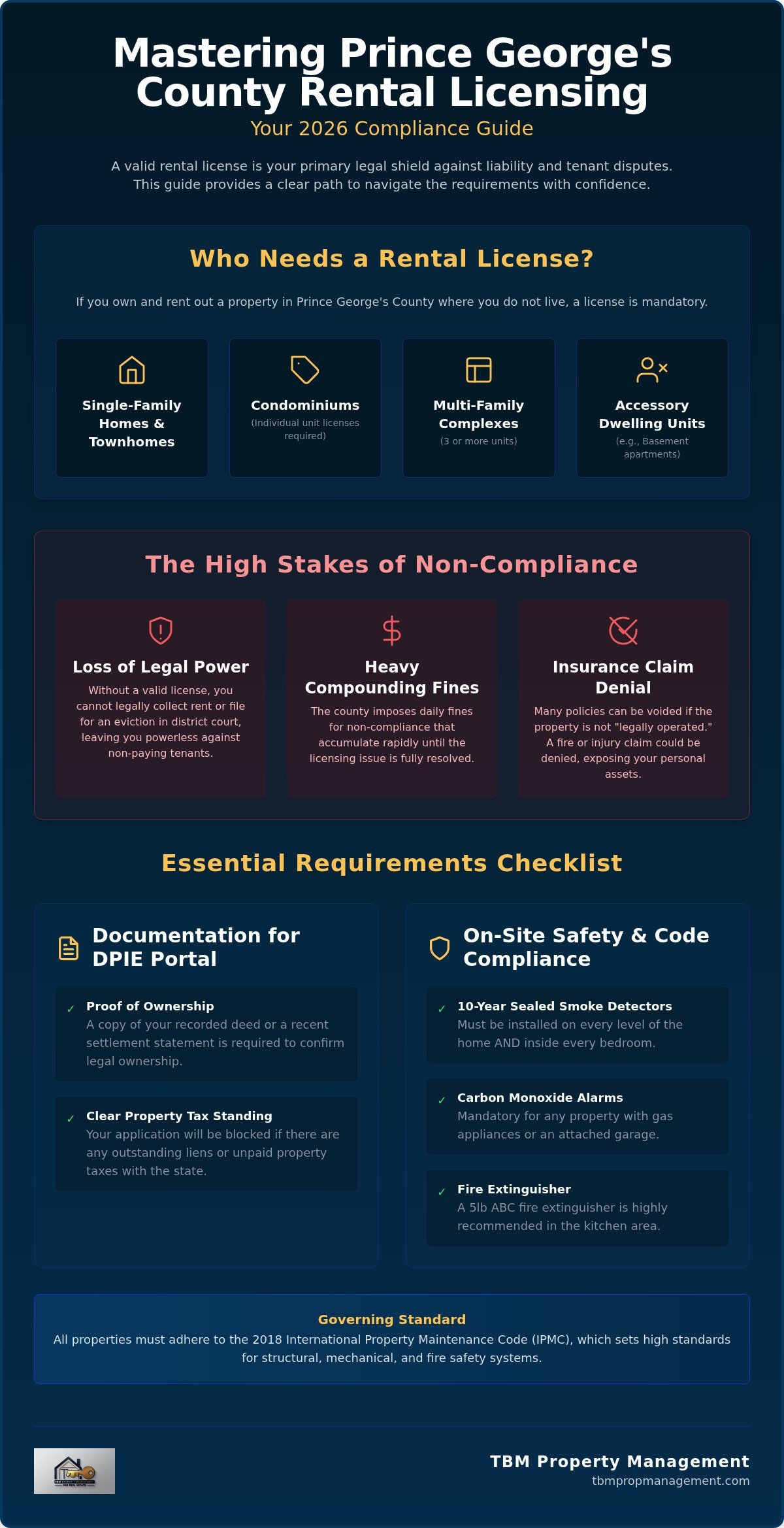
A Prince George's County Rental Housing License is more than just a piece of paper; it's your formal authorization to operate a residential business. This document serves as proof that your property meets the safety and health standards set by the Department of Permitting, Inspections, and Enforcement (DPIE). In 2026, the county has stepped up its oversight to ensure that every tenant lives in a safe environment, which means the prince george's county rental license requirements are more rigorous than they were even two years ago. By adhering to the 2018 International Property Maintenance Code, the county now requires more frequent check-ins on electrical systems, fire safety, and structural integrity.
Managing these expectations alone can feel like a full-time job. We see many landlords in Prince George's County struggle with the shift from paper-based filings to the digital Momentum portal. It's a complex system that demands precision. If you're feeling the pressure of these evolving standards, remember that these regulations are designed to protect both you and your residents. A licensed property is a validated asset, and meeting these benchmarks is the first step toward a stable, long-term investment.
Who Needs a License in PG County?
The rule of thumb is simple: if you don't live in the property but someone else does in exchange for rent, you need a license. This applies to a wide range of housing types across the region:
- Single-family homes and townhomes: These are the most common rentals requiring individual licenses.
- Condominiums: Even if the building has its own management, your specific unit needs its own rental license.
- Multi-family complexes: Any building with three or more units must have a multi-family license.
- Accessory Dwelling Units (ADUs): Basement apartments or "in-law suites" that are rented out separately require their own compliance checks.
There are rare exceptions for owner-occupied dwellings where the owner resides in the same unit as the tenant. However, the moment you move out and turn that home into a full-time investment, the licensing clock starts ticking.
The Consequences of Operating Without a License
Operating without a valid license is a gamble where the house always loses. The county doesn't take non-compliance lightly. You could face daily fines that compound until the issue is resolved, but the financial hit is only the beginning. Legal protections are the real concern. In Maryland, a landlord who lacks a valid license cannot legally collect rent or file for an eviction in the district court. If a tenant stops paying, you're left without the primary legal tool used to regain possession of your property.
Beyond the courtroom, your insurance policy might be at risk. Many providers include clauses that require the property to be "legally operated." If a fire or injury occurs and an investigation reveals you've ignored the prince george's county rental license requirements, your claim could be denied. This leaves your personal finances vulnerable to lawsuits and repair costs that should have been covered. Don't let a lack of paperwork turn your investment into a liability.
Essential Requirements for a Valid PG County Rental License
Securing your license requires more than just a fee; it's a test of your property's readiness. Proof of ownership is the first hurdle you'll face in the digital portal. You'll need to upload a copy of your recorded deed or a settlement statement to confirm you're the legal owner. DPIE also checks your property tax standing with the state. If you have outstanding liens or unpaid taxes, your application won't move forward.
Safety equipment is the most common reason for a failed inspection. You must have 10-year sealed battery smoke detectors on every level and in every bedroom. If your home has gas appliances or an attached garage, carbon monoxide alarms are mandatory. We also recommend mounting a 5lb ABC fire extinguisher in the kitchen. These small details are central to the prince george's county rental license requirements, and missing just one can delay your ability to rent the property by weeks.
The 2026 Housing Code Standards
The county follows the 2018 International Property Maintenance Code, which sets high bars for structural and mechanical health. Inspectors will look for peeling exterior paint, cracked windows, and secure handrails on all stairs. They'll also verify that your plumbing, electrical, and HVAC systems are in peak condition. The 'Minimum Livability Code' is defined as the set of basic standards for health, safety, and sanitation that every residential property must meet to be considered fit for human occupancy. If you're unsure if your home meets these benchmarks, we offer property maintenance coordination to ensure everything is up to code before the official walk-through.
Lead Paint Certification (MDE Integration)
If your rental was built before 1978, you can't ignore the Maryland Department of the Environment (MDE). You'll need to register your property with the MDE and obtain a tracking number before you apply for your county license. There's a big difference between certificates: a 'Lead Free' certificate is a permanent exemption, while 'Full Risk Reduction' requires a new inspection every time a new tenant moves in. The Maryland People's Law Library notes that these state-level rules are strictly enforced at the county level. Without a valid MDE certificate, your prince george's county rental license requirements simply won't be met, and your application will be denied.
Different License Types: Single-Family, Multi-Family, and Short-Term
Understanding which category your property falls into is the first step toward a successful application. While the core prince george's county rental license requirements remain consistent regarding safety, the administrative path varies significantly depending on the unit type. For many of our clients in Laurel and Bowie, the process begins with a Use and Occupancy (U&O) permit. This permit is a prerequisite that proves the structure is legally zoned for its intended use. Without a valid U&O on file, DPIE will pause your rental license application before the inspection is even scheduled.
Multi-family licenses are reserved for buildings containing three or more separate dwelling units. These licenses are issued for a two-year term, and the fee is currently $50 per unit, plus the county's technology fee. It's vital to remember that multi-family licenses terminate immediately upon a change of ownership. If you're purchasing an apartment building, you must submit a new application before the closing date to avoid penalties and ensure you can continue collecting rent without interruption.
Single-Family vs. Townhome Licensing
Single-family detached homes and townhomes are the most common rentals we manage. While they share a similar application process, detached homes often face more scrutiny regarding exterior maintenance and yard setbacks. If your property is part of a homeowners association, you'll need to verify that your rental plans don't conflict with community bylaws. Some HOAs require a copy of your county license before they'll approve your tenants. For a deeper look at managing these local nuances, see our guide on Full-Service Property Management in Laurel, MD: The Complete Landlord’s Guide. We find that proactive coordination with both the county and the HOA prevents the legal headaches that often plague self-managed properties.
Short-Term Rental Compliance
The rules for "hosting" through platforms like Airbnb have changed dramatically. In 2026, the prince george's county rental license requirements for short-term rentals (STRs) include strict duration caps. You're limited to 180 nights per year for hosted stays and only 90 nights for unhosted stays. These two limits cannot be combined to extend your calendar. To qualify, you must provide a primary residence affidavit, proving the property is your permanent home through the Maryland Homestead Tax Credit.
The application process for STRs also requires a higher level of transparency with your community. You're required to notify all adjacent neighbors and your HOA of your intent to operate a short-term rental. Additionally, you must maintain a liability insurance policy of at least $1,000,000. These layers of regulation are designed to preserve the character of local neighborhoods while allowing homeowners to earn extra income. If these requirements feel like too much to juggle, we're here to help simplify the process and protect your interests.
Step-by-Step: How to Apply for and Renew Your Rental License
Converting your property into a legal rental shouldn't feel like a battle with bureaucracy. While the DPIE Momentum portal is the official gateway, it's frequently where simple clerical errors lead to weeks of delays. We've seen applications rejected simply because a document scan was slightly blurred or the name on the deed didn't perfectly match the applicant's ID. To help you succeed, we've broken down the prince george's county rental license requirements into a manageable, five-step process.
Success begins with organization. Follow these steps to secure your certificate:
- Step 1: Gather your documentation. You'll need a clear digital copy of your recorded deed, your MDE lead certificate (for pre-1978 homes), and a valid government-issued ID.
- Step 2: Submit via the Momentum portal. Create your account and upload your files. Double-check that every field matches your legal documents exactly to avoid immediate rejection.
- Step 3: Schedule the inspection. Once your application is processed, you'll be prompted to pick a date for your housing inspection. This is the most critical hurdle in the process.
- Step 4: Pay your fees. After passing the inspection, you'll receive an invoice. Once paid, the county will issue your digital license.
- Step 5: Record-keeping and display. You must keep a copy of your license on-site or available for 2026 audits. We also recommend keeping a digital backup in case of tenant disputes.
The Inspection Scheduling Process
Preparing for the inspector requires clear communication with your residents. You must provide your tenant with proper legal notice before the visit. To avoid a "quick-fail," check that your smoke detectors aren't expired and your fire extinguisher is fully charged and visible. If you fail the first visit, you'll have to pay a re-inspection fee and wait for a new opening in the county's busy schedule. If the thought of managing these moving parts feels overwhelming, let us handle your property inspections to ensure you pass the first time.
Renewals and Updates
For most single-family homes, your license follows a standard two-year renewal cycle. Don't wait until the last minute; the county recommends starting the renewal process at least 60 days before expiration. You must also report any changes in ownership or management within 30 days. Staying on top of these dates is essential for maintaining your legal standing. For more information on your obligations, read our guide on Maryland Landlord Tenant Rights: The Definitive 2026 Landlord Guide. Keeping your license active is the only way to ensure you retain your right to collect rent and manage your property effectively.
Why Professional Management is the Key to Stress-Free Compliance
Managing an investment property shouldn't feel like a second full-time job. Between screening tenants and tracking rent, the intricate prince george's county rental license requirements often become the breaking point for self-managed landlords. Do you really want to spend your Saturday morning troubleshooting smoke detector wiring or arguing with a county inspector about a handrail? We believe you deserve a partner who carries that weight for you. TBM Property Management acts as a stabilizing force, turning a chaotic bureaucratic process into a streamlined, automated system.
We don't just provide you with a checklist; we execute the entire strategy. Our team handles the "empathetic partner" role by standing in your place during inspections and communicating directly with county officials. This proactive approach eliminates the friction that typically leads to frustration and delays. By leveraging our professional-grade property inspections, you reduce your liability and ensure your asset remains a profitable, legal entity without the emotional drain of self-management.
Beyond Licensing: Full-Service Compliance
True compliance goes beyond the initial application. It requires a dedicated approach to property health that lasts throughout the tenancy. Our team provides property maintenance coordination that catches minor issues before they trigger a major inspection failure. We also maintain meticulous digital records for your tax and legal protection, ensuring you're never caught off guard by a 2026 audit. If you're still weighing your options, our guide on Choosing Professional Property Management in Maryland: The 2026 Landlord’s Guide explains how these services pay for themselves through long-term risk reduction.
TBM’s Local Edge in Prince George's County
Experience matters when you're dealing with local government agencies. With over 12 years of local Maryland real estate expertise, we've built professional relationships with inspectors in Laurel and throughout the region. We understand the specific nuances of PG County DPIE protocols because we navigate them every single day. This local mastery allows us to offer a level of service that distant national firms simply can't match. You can finally enjoy the relief of knowing your asset is in the hands of seasoned professionals who care about your success as much as you do.
Are you ready to trade frustration for total peace of mind? Contact TBM Property Management for a free rental analysis today! We'll help you master the prince george's county rental license requirements and ensure your investment stays protected for years to come.
Secure Your Investment with Confidence
Navigating the 2026 landscape of prince george's county rental license requirements doesn't have to be a source of constant anxiety. You now understand that a valid license is your strongest legal defense; it ensures you can collect rent and protects your asset from unnecessary liability. From mastering the DPIE Momentum portal to coordinating complex lead paint certifications, the path to compliance is clear when you have the right local expertise by your side.
With over 12 years of Maryland management experience, we specialize in the specific DPIE regulations that keep landlords protected. We provide full-service maintenance and in-house inspection coordination to handle every detail so you don't have to. Why carry the emotional burden of government bureaucracy alone? Let us act as your stabilizing partner, turning complicated paperwork into a streamlined system for success.
Get a Free Rental Analysis & Compliance Check from TBM and let us transform your property management into a stress-free experience. Your success as a landlord starts with a property that is legally sound and professionally managed. We're here to help you every step of the way.
Frequently Asked Questions
How much does a rental license cost in Prince George's County in 2026?
In 2026, the fee for a multi-family rental license is $50 per unit for a two-year term, plus the county technology fee. Short-term rental hosts face a higher entry cost of $198, accompanied by a $66 administrative fee and a 10% technology fee. Single-family homeowners should verify their specific costs through the DPIE Momentum portal, as these fees are non-refundable and essential for meeting the prince george's county rental license requirements.
Do I need a rental license if I'm only renting to a family member?
You are generally exempt from the single-family rental license requirement if the tenant is a close relative of the landlord. This typically applies to immediate family members like parents or children. However, if the arrangement shifts toward a standard commercial lease or if you no longer reside in a shared unit, you should consult with DPIE. Maintaining safety standards remains vital even when a formal license isn't required by law.
How long does it take to get a rental license from DPIE?
The timeline for receiving your license depends on how quickly you can schedule and pass the mandatory housing inspection. After submitting your documentation through the Momentum portal, it often takes several weeks to secure an inspector's visit. We suggest beginning the application process at least 60 days before your target move-in date. This buffer helps you avoid the stress of a vacant property while waiting for government approval.
Can a tenant stop paying rent if I don't have a rental license?
Yes, Maryland legal precedent established in McDaniel v. Baranowski means you cannot collect rent or evict a tenant if the property isn't licensed. If you don't meet the prince george's county rental license requirements, you lose your standing in the district court system. This leaves you with no legal path to recover unpaid rent or regain possession of your home, making compliance your most important financial safeguard.
What is the penalty for renting without a license in PG County?
Landlords who operate without a license face heavy daily fines and the immediate loss of legal protections. Beyond the inability to use the court system for evictions, you risk having your insurance claims denied. Most providers won't cover incidents in an "illegal" rental unit. The financial risk of a single lawsuit or a non-paying tenant far outweighs the cost and effort of obtaining a valid county license.
Do I need a separate license for a basement apartment?
Any accessory dwelling unit (ADU), such as a basement apartment with a separate kitchen and entrance, must meet specific licensing and zoning standards. Even if you live in the upstairs portion of the home, the rental unit is subject to the 2018 International Property Maintenance Code. You'll need to ensure the space has proper fire exits and safety equipment before the county will issue a permit for the unit.
How do I check if a property in Prince George's County has a valid rental license?
You can check the status of a rental license by using the Prince George's County DPIE online search tool or the Momentum portal. These public records allow you to verify if a property is currently compliant or if a license has expired. It's a standard step for professional managers and diligent tenants to ensure the property is being operated legally and has passed its most recent safety inspections.
Does a rental license expire if the property is sold?
For multi-family properties, the rental license terminates automatically upon a change of ownership. The new owner can avoid penalties by submitting a new application before the sale is finalized. For single-family homes, you must notify the county of any change in ownership or management within 30 days. Keeping these records updated ensures you remain in good standing and that the county knows who is responsible for the property.