
Rental Application Red Flags: A 2026 Guide for Maryland Landlords
Have you ever felt a knot in your stomach while reviewing a seemingly perfect application, wondering if you're missing a small detail that could lead to a year-long legal battle? For many property owners in areas like Baltimore or Prince George's County, the fear of a "professional tenant" who knows how to exploit the system is a constant source of anxiety. Spotting rental application red flags for landlords is no longer just about checking a credit score; it's about navigating a complex landscape of $25 application fee caps and the strict 2025 eviction process changes.
We understand that managing your own assets can feel overwhelming, especially when Maryland's tenant protections continue to expand. You deserve a screening process that offers security rather than stress. It's possible to maintain high standards and protect your investment without feeling buried under inconsistent documentation or the mandatory eight-page Tenants' Bill of Rights.
This 2026 guide will teach you how to identify high-risk patterns early and implement a professional-grade screening framework. You'll learn which inconsistencies in reusable screening reports to watch for and how to stay compliant with criminal history regulations while extending conditional offers. By the end, you'll have the clarity needed to lower your vacancy rates with high-quality tenants and finally enjoy true peace of mind.
Key Takeaways
- Understand why a multi-layered screening process is your best defense against the rising costs and complexities of Maryland's 2025 eviction laws.
- Learn how to spot subtle rental application red flags for landlords, including unverifiable cash income and frequent employment gaps that often precede payment issues.
- Identify behavioral warning signs, such as "urgent move-in" requests or uncooperative attitudes during showings, that signal high-risk applicants.
- Stay compliant with Maryland’s strict 2026 regulations, from the $25 application fee limit to the mandatory distribution of the Tenants' Bill of Rights.
- Discover how professional tenant placement provides relief from the emotional burden of screening by managing difficult rejections and detailed verifications for you.
Why Thorough Tenant Screening is Your Best Asset Protection Strategy
Many self-managing owners in Maryland view tenant screening as a simple hurdle to clear before collecting rent. In reality, it's the foundation of your entire investment strategy. A comprehensive tenant screening goes far beyond a three-digit credit score. It's a rigorous, multi-layered verification process designed to confirm an applicant's identity, history, and reliability. Without this depth, you're essentially leaving your asset's future to chance. When you treat screening as a casual check, you open the door to risks that can haunt your portfolio for years.
The Real Cost of a "Nightmare Tenant" in 2026
The stakes have never been higher for local property owners. With the recent changes to Maryland's eviction process, a single bad placement can become a heavy financial anchor. You aren't just losing monthly rent; you're facing rising filing fees, legal representation costs, and potential property damage that often exceeds a standard security deposit. The time-drain is equally punishing. Spending your weekends coordinating with lawyers or attending court hearings in Baltimore or Upper Marlboro takes you away from your family and your career.
A "Professional Tenant" is someone who uses legal loopholes to avoid paying rent. These individuals specifically look for gaps in DIY screening processes to gain entry to a property. Once they're in, they know exactly how to delay the legal process, often living rent-free for months while the landlord struggles to navigate complex state laws. The emotional toll of managing such a high-conflict relationship is often more draining than the financial loss itself.
Asset Oversight: Moving from Anxiety to Security
Creating a standardized screening framework is about more than just finding a good tenant; it's about removing the anxiety from your decision-making process. When you have a clear list of rental application red flags for landlords, you can make objective choices based on data rather than gut feelings. This consistency reduces personal bias and ensures you're following Fair Housing laws in jurisdictions like Prince George's County.
Thoroughness protects the physical condition of your property. Applicants who respect the application process are statistically more likely to respect your home. If you're feeling overwhelmed by the complexities of modern regulations, our Full-Service Property Management in Laurel, MD: The Complete Landlord’s Guide provides deeper insights into how professional oversight can stabilize your portfolio. By identifying rental application red flags for landlords early, you transition from a state of constant worry to one of professional security. You deserve the relief that comes from knowing your investment is in safe hands.
Financial Red Flags: Spotting Inconsistencies in Income and Credit
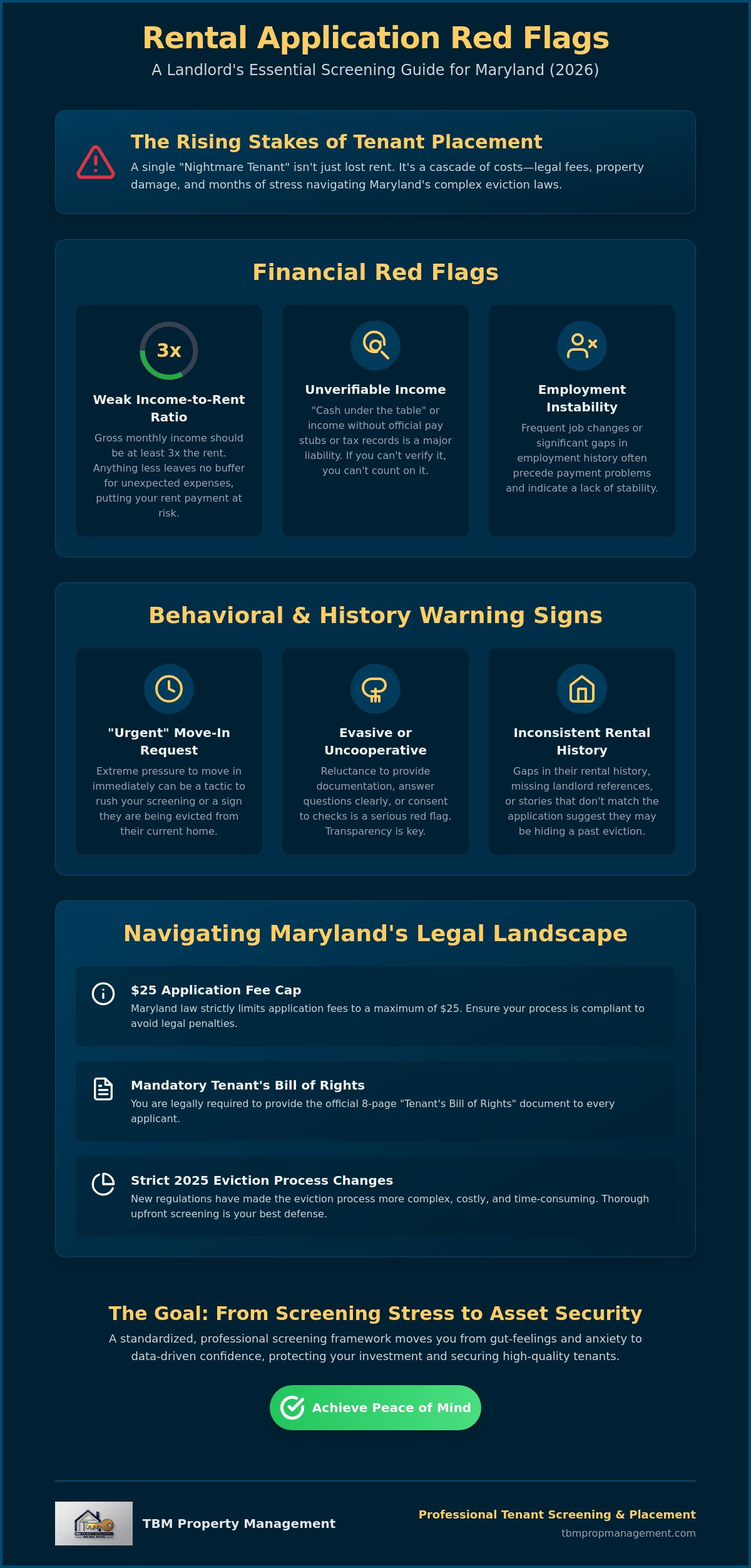
When you're reviewing a stack of paperwork, the financial data usually tells the most honest story, provided you know how to read between the lines. Spotting rental application red flags for landlords often begins with the income-to-rent ratio. We generally recommend that an applicant's gross monthly income be at least three times the monthly rent. This 3x rule isn't just a hurdle; it's a non-negotiable baseline that ensures the tenant has enough breathing room for life's emergencies without sacrificing your rent payment. If they're hovering right at the limit, any small car repair or medical bill could lead to a late payment.
Unverifiable income sources are a major liability that many DIY landlords overlook. While "cash under the table" might sound like liquid wealth, it's impossible to track or garnish if things go wrong. If a tenant can't prove their earnings through tax records or official pay stubs, they'll likely struggle to meet the requirements of Maryland landlord-tenant laws during a dispute. Similarly, watch for job hopping. A pattern of jumping between unrelated fields every few months suggests a lack of financial stability that could leave you with a sudden vacancy in the middle of a lease term.
Detecting Fraudulent Documentation
Checking pay stubs requires a sharp eye for detail. Look for rounded numbers; real net pay is rarely an even $3,000.00. You should also verify that tax withholdings are present and that year-to-date totals align with the current date. 2026 sees a rise in digital document tampering, making direct employer verification essential. Don't just take a PDF at face value. Cross-referencing bank statements with stated income ensures the money is actually being deposited and isn't just a number on a forged document. This extra layer of verification provides the security you need to move forward with confidence.
Credit Score vs. Credit Character
A credit score is a helpful metric, but it doesn't tell the whole story. You must distinguish between "medical debt," which is often a low-risk indicator of a one-time crisis, and "eviction or utility debt," which is a massive red flag. If an applicant owes money to a previous property manager or a utility provider like BGE, they're demonstrating a history of prioritizing other expenses over their housing obligations. A high credit score can sometimes hide a history of late rental payments if those previous landlords didn't report to the credit bureaus. Partnering with tenant placement services can offer the relief of having a professional team handle this technical financial vetting, ensuring your investment remains protected by high-quality tenants.
Rental History and Behavioral Warning Signs You Can’t Ignore
While financial data provides a snapshot of an applicant's ability to pay, their rental history reveals their willingness to follow the rules. Some of the most critical rental application red flags for landlords appear before you even run a background check. For instance, have you ever encountered an applicant who needs to move in tomorrow? While it's tempting to fill a vacancy quickly, an "urgent move-in" request is a major warning sign. Stable tenants in Maryland typically plan their moves 30 to 60 days in advance. A sudden rush often indicates that the individual is trying to outrun an impending eviction or a deteriorating relationship with their current property manager.
Pay close attention to how an applicant conducts themselves during a showing in Baltimore or Prince George's County. If they're disrespectful to you, show up significantly late without notice, or treat the property poorly during the walk-through, they're showing you how they'll treat your investment. Similarly, be wary of significant gaps in rental history. While "living with family" is a common explanation, it's often a cover for periods where they were unhoused due to legal disputes or property damage. If an applicant refuses to provide contact information for previous landlords, it's a clear signal that they're hiding a history of conflict.
The Art of Reference Checking
Don't rely solely on the current landlord's word. It's a known industry reality that a current manager might give a glowing review just to encourage a "nightmare tenant" to move out of their property. To get the truth, you should prioritize speaking with the previous landlord. They have no "skin in the game" and are much more likely to provide an honest assessment of the tenant's behavior. When you call, keep your questions direct and professional:
- Did the tenant provide a proper notice to vacate?
- Was the rent consistently paid on time?
- Was the security deposit returned in full, or were there deductions for damages?
- Most importantly: Would you rent to this person again?
Communication Red Flags Pre-Application
The way an applicant communicates can predict future compliance issues. Watch out for individuals who try to negotiate the rent or the security deposit before they've even seen the home. This suggests they'll continue to challenge your policies throughout the lease. Another common tactic is providing "too much information" (TMI) or elaborate sob stories. While we all feel empathy for difficult situations, professional tenants often use emotional appeals to distract you from their failure to meet your established screening criteria. Finally, if an applicant can't follow simple instructions during the application process, don't expect them to follow the complex terms of a Maryland lease agreement. These subtle rental application red flags for landlords are your best early warning system for maintaining a peaceful, profitable property.
Navigating Maryland’s Legal Landscape During the Application Process
Did you know that in Maryland, your screening process is now subject to some of the strictest regulations in the country? Identifying rental application red flags for landlords is only half the battle; you must also ensure your methods don't inadvertently violate state or local laws. For instance, landlords in Prince George’s County and Laurel must be extremely careful with "source of income" protections. You cannot legally reject an applicant simply because they use a housing voucher or other public assistance to pay their rent. This is a common pitfall for self-managing owners who aren't staying current with evolving fair housing mandates.
The financial limits on what you can charge are now very specific. For owners with five or more units, the rental application fee is strictly capped at $25. Even the security deposit itself is now limited to one month's rent, a significant change from previous years when two months was the standard. If you're managing a property in Montgomery County, you may find even more localized nuances that differ from the rules in Upper Marlboro or Bowie. Attempting to self-manage without a standardized, written set of screening criteria creates a massive legal opening for litigious applicants to claim discrimination. You need a process that is as legally sound as it is thorough.
Staying Compliant with Maryland Landlord-Tenant Rights
When you decide to reject an applicant based on rental application red flags for landlords, how you communicate that decision matters. You must issue a formal denial letter that clearly states the reasons for the rejection without crossing into discriminatory territory. This is especially vital when navigating "source of income" protections, which are a cornerstone of Maryland’s fair housing landscape. If you're unsure about how to phrase these communications, our Maryland Landlord Tenant Rights: The Definitive 2026 Landlord Guide offers deeper compliance info to keep you protected.
Documenting the Process to Prevent Liability
Protection comes through meticulous documentation. You're required to keep all applications and screening reports for a state-mandated duration to prove your decisions were based on objective data. Implementing a "First Qualified Applicant" policy is one of the most effective ways to demonstrate fairness; it simply means you accept the first person who meets your written standards rather than "cherry-picking" based on gut feelings. If this legal minefield feels overwhelming, partnering with real estate management Maryland experts can shield you from costly errors and provide the professional distance you need to stay compliant. We handle the paperwork so you can enjoy the relief of a secure investment.
Eliminating Screening Stress with Professional Tenant Placement
Why carry the heavy burden of asset oversight alone when you can partner with a local expert? As we've explored, identifying rental application red flags for landlords requires a combination of technical data analysis and a keen eye for behavioral inconsistencies. It’s a full-time commitment that often results in significant emotional stress for self-managing owners. By choosing professional tenant placement, you shift that pressure onto a team that has spent over 12 years mastering the Maryland rental market. We act as your protective shield, ensuring that only the highest quality residents gain access to your investment property.
The true value of our service lies in the "relief" factor. We understand that the human element of property management is often the most draining. Have you ever felt guilty about rejecting a tenant with a sympathetic "sob story," even when their paperwork didn't add up? We handle the showings, the persistent follow-ups, and the difficult rejections on your behalf. Our team remains objective and professional, allowing you to maintain a healthy distance from the daily complexities of the leasing process. You get the peace of mind that comes from a secure placement without the personal conflict.
Our comprehensive 7-point screening process is designed to catch what DIY software often misses. We don't just pull a credit report; we dive deep into several layers of verification:
- In-depth credit history and debt-to-income analysis
- Multi-state criminal background checks
- National eviction database searches
- Direct employment and salary verification
- Previous landlord reference interviews
- Identity and document fraud detection
- Pre-application behavioral assessment
The TBM Difference in Laurel, MD
Our expertise is deeply rooted in the communities we serve, including Laurel, Anne Arundel, and Howard Counties. We don't just place a tenant and walk away; we set the stage for a successful, long-term relationship. By utilizing advanced tools like Property Meld, we ensure that maintenance coordination is seamless from day one, which significantly increases tenant satisfaction and retention. This hyper-local focus allows us to spot rental application red flags for landlords that are specific to our region, providing you with a level of protection that generic, national platforms simply can't match.
Ready for a Stress-Free Rental Experience?
Reclaiming your time and protecting your financial future shouldn't be a source of anxiety. Professional tenant placement is the ultimate way to lower your legal risk while securing tenants who respect your property and pay on time. If you're ready to transition from a state of frustration to a state of total ease, we're here to help. Contact us for a complimentary report on your property’s potential and see how our mastery can work for you. Get Your Free Rental Analysis and Expert Tenant Placement Today!
Secure Your Asset with Professional Confidence
Protecting your Maryland rental investment in 2026 requires more than just a gut feeling. It demands a rigorous, data-driven approach to identifying rental application red flags for landlords, from unverifiable income to the subtle behavioral cues of professional tenants. By staying compliant with the latest state regulations and maintaining a standardized screening framework, you can transform your property from a source of anxiety into a stable, high-performing asset.
You don't have to navigate these complexities alone. With over 12 years of local Maryland real estate expertise and a comprehensive 7-point tenant screening process, our team provides the dedicated local support you need in Laurel and the surrounding counties. We handle the hard conversations and the technical verifications so you can enjoy the relief of a truly passive investment. Let TBM Handle the Vetting—Protect Your Maryland Investment Today!
Your peace of mind is within reach, and we're ready to help you achieve the security you deserve for your portfolio.
Frequently Asked Questions
Can I legally reject a tenant for a low credit score in Maryland?
Yes, you can reject an applicant for a low credit score as long as you apply the same financial standards to every person who applies. Maryland law allows landlords to set objective credit requirements, but you must avoid discriminatory practices that target protected classes. If you use credit as a basis for denial, you're required to provide an adverse action notice to the applicant under federal law.
What is the most common red flag on a rental application?
The most frequent rental application red flags for landlords are unverifiable income and a sudden, urgent request to move in immediately. Stable tenants typically plan their housing transitions at least 30 days in advance and can provide official documentation of their earnings. When an applicant lacks pay stubs or pushes for a same-day move-in, they're often trying to bypass the thorough verification process that protects your asset.
How do I verify a rental applicant’s income if they are self-employed?
You should request at least two years of federal tax returns, specifically the Schedule C, and the last three to six months of business bank statements. Look for consistent deposits that align with the income stated on their application. Since 1099s only show gross pay, bank statements offer a more accurate picture of their actual cash flow and ability to meet monthly rent obligations in Maryland.
Is it a red flag if an applicant wants to pay the full year of rent upfront?
Yes, offering a full year of rent upfront is often a significant warning sign that requires deeper investigation. While it sounds like a financial win, it's a common tactic used to discourage landlords from performing a deep background check or to hide unverifiable income sources. In Maryland, accepting large sums upfront doesn't waive your legal responsibilities or your duty to follow strict state security deposit laws.
What should I do if an applicant has a previous eviction on their record?
You should carefully evaluate the timing and the context of the eviction before making a final leasing decision. While an eviction from a decade ago might be a past mistake, a recent filing is one of the most serious rental application red flags for landlords. Because Maryland's eviction process is complex and costly, most owners find that a recent history of non-payment represents an unacceptable risk for their property.
How much can I legally charge for a rental application fee in Maryland?
Maryland law caps the rental application fee at $25 for landlords who own five or more units. If you own four or fewer units and charge more than $25, you're required to return any amount exceeding your actual out-of-pocket costs within 15 days. Staying within these strict limits is essential to avoid legal penalties and maintain a professional reputation in local jurisdictions like Laurel or Bowie.
How do I know if a landlord reference is fake?
You can verify a landlord reference by cross-referencing the property owner's name with local Maryland tax records. If the name provided by the applicant doesn't match the public record, they might be using a friend or family member as a fake reference. Additionally, ask the reference specific questions about the property's layout or local utility providers to see if their answers are consistent with the actual location.
What are the Fair Housing rules for screening tenants in Prince George’s County?
Prince George's County follows federal Fair Housing laws while adding local protections for "source of income" and marital status. This means you cannot reject a tenant simply because they use housing vouchers or are unmarried. It's vital to have a written, standardized screening policy that focuses on objective financial and behavioral data to ensure you're treating every applicant with the same level of professional fairness.