Rental Property Inspection Checklist for Maryland Landlords (2026)
A rental property inspection checklist Maryland landlords can use helps turn a walkthrough from guesswork into a manageable routine. Review each room, note visible safety or maintenance concerns, and record what needs follow-up.
It’s understandable to wonder whether you’re checking the right things, documenting them clearly, or missing a rule that applies to your property. This guide offers a repeatable process for reviewing interior spaces, visible systems, and safety items, then organizing findings by priority. It also explains why Maryland lead-related rules and local registration, licensing, or inspection requirements may depend on the property’s age, location, and rental setup. Use the checklist to complete a clearer walkthrough, keep a useful record, and identify which current requirements apply to your rental. For owners in Anne Arundel, Prince George’s, Montgomery, and Howard counties, regular inspections and maintenance coordination can help make property oversight more consistent.
Key Takeaways
- Use a rental property inspection checklist Maryland landlords can repeat to review rooms, building systems, and exterior areas consistently.
- Record each concern’s location, condition, date, and needed follow-up, then prioritize issues for action.
- Keep Maryland lead-risk rules separate from local rental registration, licensing, and inspection requirements, which may vary by property and location.
- For pre-1978 rental dwellings, review how Maryland’s lead-risk standards may apply and verify the steps required for the property.
- Build inspections into ongoing oversight: TBM Full Service includes semi-annual inspections and maintenance coordination.
Why Maryland Landlords Need a Rental Property Inspection Checklist
A rental property inspection is a documented review of a home’s visible condition, safety concerns, and maintenance needs. A consistent walkthrough gives you a record to compare over time, rather than relying on memory or scattered notes. For example, noting the location and condition of a stain beneath a sink helps you track whether it changes or is addressed.
A rental property inspection checklist Maryland landlords can use also adds structure to decisions. It guides you through the property in a repeatable order, helps identify concerns that need attention, and records next steps. A routine property check is not the same as an inspection required for government approval or a local rental process. A routine property check documents condition; a jurisdiction-specific approval inspection evaluates whether a property meets that jurisdiction’s requirements. The two may cover related issues, but one doesn’t automatically replace the other.
That distinction matters because landlord-tenant rules are state-specific, and local procedures can add another layer. A general Landlord-tenant law overview explains why requirements differ across jurisdictions. Maryland landlords need to identify the rules that apply to their own property.
What a rental property inspection checklist should cover
Think of your checklist as a repeatable guide, not a substitute for official forms used in a required inspection or approval process. It can prompt you to review interior spaces, visible building systems, exterior areas, and the condition record. What you observe will depend on the property’s age and layout, as well as its condition on inspection day. Record observations rather than diagnosing hidden problems.
Why Maryland property location and age matter
Registration, licensing, and inspection procedures can differ by local jurisdiction, so a checklist alone can’t establish whether every local requirement is met. TBM Property Management serves residential property owners in Anne Arundel, Prince George’s, Montgomery, and Howard counties. For homes built before 1978, make a separate lead-risk compliance review using current Maryland Department of the Environment (MDE) guidance. MDE identifies pre-1978 rental dwellings as subject, at minimum, to the Risk Reduction Standard.
Keep these questions in mind as you prepare for a walkthrough:
- Which areas and visible systems should you review based on the property’s layout?
- Which observations need maintenance follow-up, and how will you record progress?
- Does the property’s location or age trigger a separate compliance process?
Answering these questions helps you maintain a dependable condition record without confusing it with a local approval form or lead-related compliance review. Next, apply that framework room by room.
Maryland Rental Property Inspection Checklist: Rooms, Systems, and Exterior
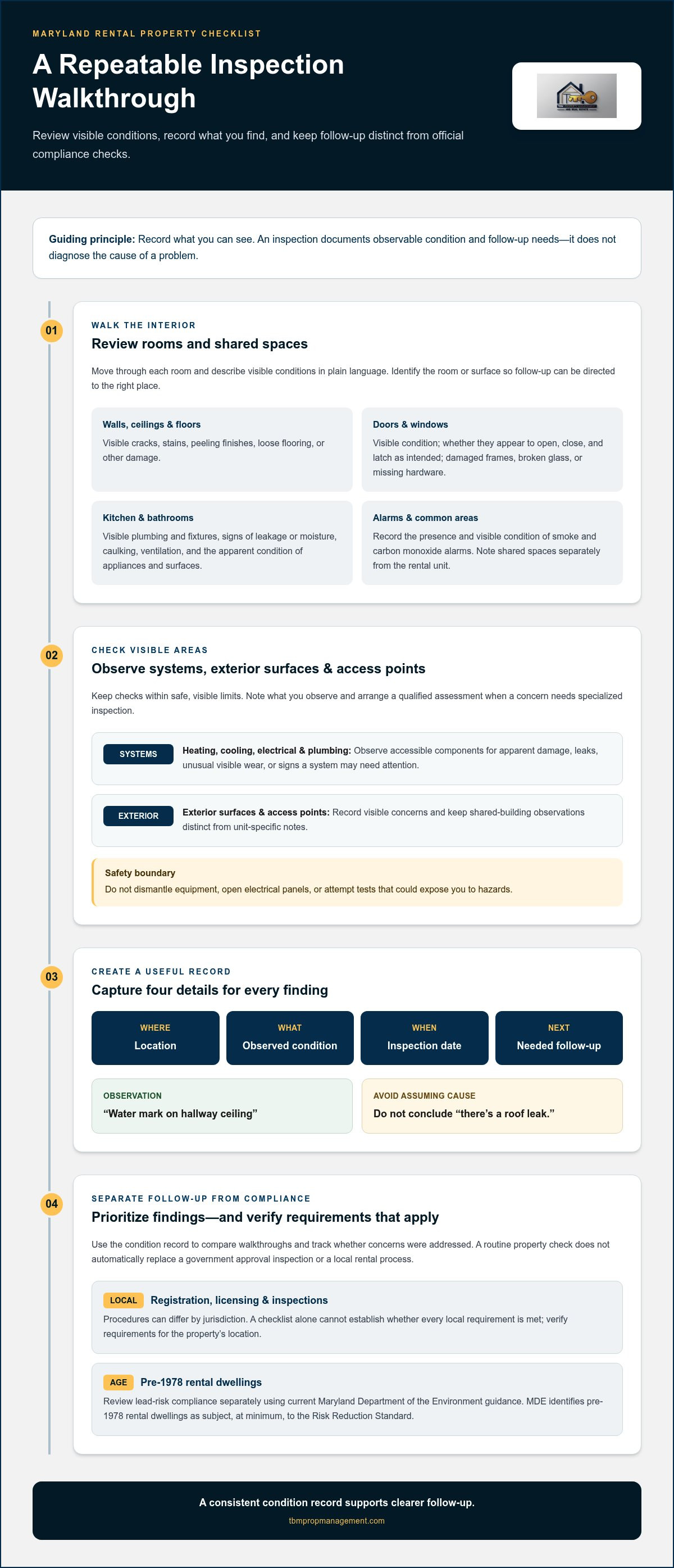
Walk through the property in a consistent order, looking for visible conditions rather than trying to diagnose their causes. A ceiling stain is an observation; identifying the source of a leak may require further assessment. An inspection records observable condition and follow-up needs, not a diagnosis of what caused a problem.
For every checklist item, note its location, observed condition, inspection date, and needed follow-up. This makes it easier to compare notes at the next walkthrough and track whether an issue was addressed. A rental property inspection checklist Maryland landlords can adapt should cover each area below. Any required official inspection may call for a separate form.
Interior rooms and common areas
Check each room, including shared spaces, and describe what you see in plain language. Note damage or missing items without assuming how they occurred. For example, record “water mark on hallway ceiling” rather than concluding there’s a roof leak. Identify the specific room or surface so follow-up can be directed to the right place.
- Walls, ceilings, and floors: Look for visible cracks, stains, peeling finishes, loose flooring, or other damage.
- Doors and windows: Note their visible condition and whether they appear to open, close, and latch as intended. Record damaged frames, broken glass, or missing hardware.
- Kitchen: Check visible plumbing and fixtures for signs of leakage. Note the apparent condition of appliances, cabinets, counters, and ventilation.
- Bathrooms: Look for moisture marks, visible leaks, damaged caulking, and the condition of sinks, toilets, tubs, showers, and ventilation.
- Alarms: Record the presence and visible condition of smoke and carbon monoxide alarms, then verify the requirements that apply to the property.
- Common areas: Document concerns in hallways or shared rooms separately from issues inside the rental unit.
Visible systems, exterior areas, and access points
Keep checks within safe, visible limits. Don’t dismantle equipment, open electrical panels, or attempt tests that could expose you to hazards. Note what you can observe and arrange a qualified assessment when a concern calls for specialized inspection. Separate shared-building observations from unit-specific notes to keep responsibility and follow-up clear.
- Heating, cooling, electrical, and plumbing: Observe accessible components for apparent damage, leaks, unusual visible wear, or signs that a system may need attention.
- Exterior surfaces: Record visible damage to siding, paint, or other surfaces, along with areas that appear to need maintenance.
- Steps and railings: Note visible deterioration, loose-looking components, or other apparent concerns along routes to the property.
- Drainage and access: Look for pooling water or blocked drainage. Observe the condition of entry locks and doors without forcing them.
For owners who want help organizing inspections and maintenance follow-up, property inspection and maintenance coordination can support ongoing rental oversight in TBM’s Maryland service counties.
Maryland Lead Rules and Local Rental Inspection Requirements
Maryland’s lead-risk requirements and local rental procedures are separate compliance tracks. A routine walkthrough can help you document a home’s condition, but it doesn’t replace lead-related steps or a county or municipal inspection. Local rental inspection rules should never be assumed uniform across Maryland.
Use the comparison below to distinguish their purposes. The property’s age, rental arrangement, and exact location help determine which requirements to investigate.
| Area | What it addresses | What to verify |
|---|---|---|
| Statewide lead guidance | MDE identifies rental dwellings built before 1978 as subject, at minimum, to the Risk Reduction Standard. | Review current MDE guidance for the applicable risk-reduction pathway, inspection, certification, and registration details. |
| Local requirements | County or municipal registration, licensing, inspections, and approval procedures. | Check requirements for the property’s specific county and municipality with the relevant local authority. |
| Routine condition checks | Owner records of visible condition, safety concerns, and maintenance needs. | Use a consistent walkthrough record, but don’t treat it as an official approval or lead inspection. |
What landlords should know about pre-1978 rental housing
For a pre-1978 rental dwelling, treat lead compliance as its own review, not simply another item on a general condition checklist. MDE’s certification categories include Full Risk Reduction, Modified Risk Reduction, Lead-Free, and Limited Lead-Free certificates. The applicable pathway depends on the property and its circumstances. Verify current qualification and inspection details in MDE guidance before relying on a certificate type.
As of October 1, 2026, the definition of a rental dwelling also includes rooms rented in an owner-occupied home, even when tenants share a kitchen or bathroom. Owners renting rooms in a pre-1978 property should review the applicable MDE registration and certification requirements. MDE requires annual registration of pre-1978 rental properties unless certified lead-free. A Limited Lead-Free certificate expires after two years and requires recertification, including confirmation that exterior paint isn’t chipping, peeling, or flaking.
How to check county and municipal inspection rules
Start with the property’s actual county and municipality, not a form found for a different location. Confirm current registration, licensing, inspection, and approval steps with the local authority. A Baltimore County form or procedure is specific to that jurisdiction; it shouldn’t be applied automatically to Anne Arundel, Prince George’s, Montgomery, or Howard counties, which TBM serves.
Keep the relevant local instructions with your property records, and distinguish official requirements from routine maintenance follow-up. For related legal context, review this guide to Maryland landlord-tenant rights. Checking the property’s location and age helps you build a rental property inspection checklist Maryland owners can use without mistaking a condition review for regulatory approval.
How to Conduct, Document, and Follow Up on a Rental Inspection
A clear process turns a walkthrough into a useful maintenance record, rather than a set of notes that gets misplaced. Use the same sequence each time, then track every finding until it’s resolved or assessed further. If the inspection is part of a local approval process, use the applicable official form as well as your own property records.
Prepare for the walkthrough and record observations
Before you begin, gather the previous inspection record, available maintenance history, and any relevant local form. Use consistent room labels and date each entry. Photographs can help document visible conditions where appropriate. Keep notes factual: describe what you see rather than guessing at the cause or declaring that an item meets a specific standard.
- Set up the record. Identify the property and inspection date, and use the same room names and order as in prior records. This makes changes easier to spot during later reviews.
- Walk through systematically. Follow your room-by-room checklist, noting each observation’s location and condition. Add a dated photo when it clarifies the issue, such as showing where a stain appears or the extent of visible damage.
- Separate observation from diagnosis. Write “moisture visible below bathroom sink,” not “pipe is leaking,” unless the cause has been established. If you can’t determine what’s behind an issue through a safe visual check, note that further assessment may be needed.
- Sort findings by next step. Flag apparent safety concerns for prompt attention, routine maintenance for scheduling, and issues that need a qualified assessment. This helps distinguish a loose cabinet handle from a concern that could affect safe use of the home.
- Assign and track follow-up. Note the responsible next step, maintenance coordination, completion date, and any concern that remains. Keep the inspection record and related updates together by property and inspection date.
Prioritize findings and track completion
An open item can be easy to overlook unless it has an owner and a status. For each finding, record whether it needs urgent attention, routine maintenance, or specialized assessment, then note what happened next. When a repair is completed, update the record with the completion date. If the concern remains, keep it visible for continued follow-up. This creates a practical history rather than a checklist that ends at the walkthrough.
Consistent notes also help connect inspection observations to Maryland rental maintenance coordination. For broader oversight context, see full-service property management in Laurel.
Want help organizing inspections and maintenance follow-up? Explore property management support for rental owners in Anne Arundel, Prince George’s, Montgomery, and Howard counties.
Make Regular Maryland Rental Inspections Easier with Ongoing Management
A dependable inspection routine works best when it connects to what happens next. Scheduled reviews create consistent condition records, while maintenance coordination helps keep observations from getting lost between a walkthrough and a repair. For owners balancing tenant needs, upkeep, and local requirements, ongoing management can bring those tasks into a steadier process.
TBM Property Management’s Full Service includes semi-annual inspections and maintenance coordination. Full Management includes everything in Full Service plus eviction coordination and handling. Full Service costs 7%-9% of monthly rent, with a minimum of $99 per month. Full Management costs 9%-11% of monthly rent, with a minimum of $150 per month. Tenant Placement & Leasing Only is available for a fee of 1st Month’s Rent. Property Management Service currently includes a 1st Month FREE promotion.
When professional inspection coordination can help
Management support can help when you want inspection notes and maintenance follow-up to fit into an ongoing plan, rather than handling each concern in isolation. TBM serves residential property owners in Anne Arundel, Prince George’s, Montgomery, and Howard counties. Owner/operator Tanika Belfield-Martin is a licensed associate broker with over 13 years of real-estate experience and local market knowledge.
A rental property inspection checklist Maryland owners use can guide a consistent walkthrough, but follow-through keeps the record useful. For example, a maintenance concern can be tracked through coordination and completion, with any remaining issue carried forward for review. Scheduled inspections provide recurring opportunities to update condition records and note follow-up needs, without replacing any official inspection or approval process that applies to the property.
If you’re considering what ongoing support could look like for your rental, this guide to choosing professional property management in Maryland offers broader context for weighing your needs.
Next steps for Maryland rental property owners
Before setting up your next inspection or considering management support, gather a few essentials. Having the details in one place makes it easier to understand what’s been reviewed, what needs attention, and which property-specific questions remain.
- Organize the property’s age, layout, county, and municipality.
- Gather prior inspection records and notes on open or completed maintenance.
- List questions about local registration, licensing, or inspection procedures that apply to the property.
- Separate condition concerns from lead-related or other compliance questions so each can be followed up appropriately.
For a separate look at rental-return planning, TBM also offers a free rent-analysis report. It’s distinct from an inspection: the report supports rental planning, while inspection records focus on property condition and maintenance follow-up.
Ready to make inspections and maintenance coordination part of a more consistent oversight routine? Explore TBM’s property management support for residential rentals in its four Maryland counties.
Turn Your Inspection Routine into Steadier Oversight
Your next step can be simple: keep inspection records together, note the follow-up each finding needs, and review unresolved items regularly. A rental property inspection checklist Maryland landlords use consistently becomes more valuable when observations connect to ongoing property care.
If you’d like support with that process, TBM Property Management’s Full Service includes semi-annual inspections and maintenance coordination. Owner/operator Tanika Belfield-Martin brings over 13 years of licensed real-estate experience. The current Property Management Service promotion is 1st Month FREE.
Ready to explore a management approach for your rental? Explore TBM Property Management or call 240-547-9945. With a clear routine and the right support, you can approach property care with greater confidence.
Frequently Asked Questions
How often should a landlord inspect a rental property in Maryland?
There isn’t one inspection schedule that applies to every Maryland rental. Check the property’s local requirements, lease terms, and any applicable state rules, and distinguish routine condition reviews from required compliance inspections. TBM Full Service includes semi-annual property inspections. For your own calendar, choose a repeatable interval and record the date and any changes since the last review, while separately tracking official inspection deadlines.
Is a rental property inspection required before renting in Maryland?
It depends on the property’s location, type, and any applicable local program. A rental in one municipality may face a different approval process from a similar home elsewhere, so verify current steps with the authority for that exact address. For pre-1978 housing, review Maryland lead-risk requirements separately. An owner’s walkthrough can help document condition, but it doesn’t automatically satisfy a required local inspection or approval.
What does Maryland require for a rental property built before 1978?
The Maryland Department of the Environment says rental dwellings built before 1978 must meet at least the Risk Reduction Standard. Lead-Free and Limited Lead-Free certificates have distinct qualifications and conditions, so don’t rely on an old form or assume a certificate applies to every property. Check current MDE instructions for registration and certification details, and use appropriately accredited professionals for applicable lead inspections or risk-reduction work.
Can a Maryland landlord enter a rental property to conduct an inspection?
Yes, but entry must follow Maryland’s notice and timing rules unless the landlord and tenant agree otherwise. Since October 1, 2025, landlords generally must give at least 24 hours’ notice and enter between 7 a.m. and 7 p.m., Monday through Saturday, unless otherwise agreed with the tenant. Communicate the purpose and proposed time, retain a record of notice, and verify how the rule applies to the circumstances.
What should tenants do before a rental property inspection?
Tenants can help the visit go smoothly by securing pets, making relevant areas accessible, and listing concerns they’d like noted. For example, they can identify when they first noticed a ceiling stain without trying to determine its cause. Landlords should explain the visit’s purpose and timing in line with applicable entry rules. Clear observations help create a useful record and give both parties a practical basis for follow-up.
Should landlords give tenants a copy of the rental inspection checklist?
Whether a tenant must receive a checklist or report depends on the inspection and applicable rules. Keep a dated copy in the property’s records, and share it when required or useful for coordinating repairs. If an official inspection is involved, follow the authority’s reporting process and forms. A private checklist can support communication and recordkeeping, but it shouldn’t be presented as proof of government approval or lead compliance.