
Rental Property Inspection Laws Maryland: The 2026 Landlord Compliance Guide
Did you know that failing to update your lead paint certificate before a 2026 tenant turnover could cost you far more than just a $75 MDE registration fee? Keeping up with the shifting landscape of rental property inspection laws Maryland requires can feel like a full-time job. You're likely balancing the stress of new emergency safety plans in Montgomery County with the 5.7% rent increase caps in Prince George’s County, all while worrying about a surprise inspection. It's frustrating to feel like the rules change the moment you finally have your paperwork in order.
We understand the emotional and financial burden of managing these local nuances. That's why we've created this expert compliance roadmap to help you protect your assets and eliminate the fear of legal penalties. You'll gain a clear understanding of the 2026 lead paint updates, the Strengthening Renters' Safety Act in Baltimore City, and a specific list of required inspections for your area. Whether you're managing new "priority dwelling" designations or annual fire code permits, this guide provides the clarity you need to move from a state of frustration to one of total confidence.
Key Takeaways
- Understand the critical hierarchy between statewide mandates and local rules to ensure your property remains fully compliant across different Maryland jurisdictions.
- Identify the essential 2026 lead paint risk reduction standards required at every tenant turnover to protect your investment from costly MDE fines.
- Navigate the specific licensing hurdles and new emergency safety plan requirements unique to Prince George’s, Montgomery, and Howard Counties.
- Learn how to use a professional pre-inspection checklist to catch maintenance issues before they trigger a failed inspection or a "priority dwelling" designation.
- Discover how partnering with a local expert simplifies rental property inspection laws maryland by automating your compliance calendar and managing complex paperwork for you.
Maryland Rental Property Inspection Laws: A 2026 Overview
Owning a rental property in Maryland shouldn't feel like a constant battle with red tape. While the state provides a foundational set of rules, the reality of rental property inspection laws maryland landlords face is often determined at the county or city level. This hierarchy creates a layered compliance environment where state mandates act as the absolute minimum, but local jurisdictions frequently impose much stricter standards. For instance, while the Maryland Department of the Environment (MDE) oversees lead paint safety across the entire state, your specific local housing department manages the structural and safety licenses required to operate.
Are you clear on when you can actually enter your unit? Maryland law requires you to give a tenant reasonable notice, which is widely defined as at least 24 hours, before entering for a routine inspection. This requirement remains a cornerstone of any professional lease agreement and helps maintain a respectful, legal relationship with your residents. If you fail to respect these boundaries, you risk legal friction that can complicate future inspections.
State-Level Mandates vs. Local Jurisdiction Rules
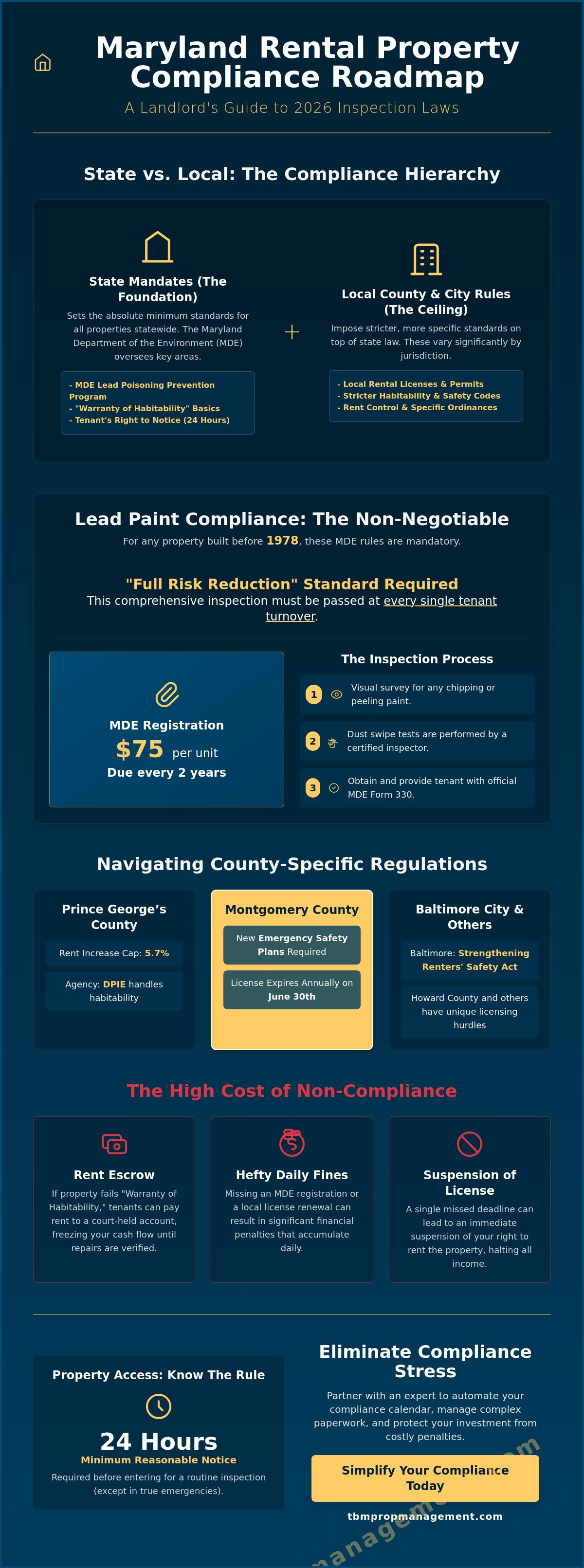
State law sets the floor for safety, but suburban counties like Montgomery and Prince George’s often add a much higher ceiling. The MDE focuses strictly on the Lead Poisoning Prevention Program, requiring a $75 registration fee per unit every two years. However, local agencies like the Prince George’s County Department of Permitting, Inspections, and Enforcement (DPIE) handle the actual habitability of the structure. We've seen a clear shift in 2026 toward more frequent, rigorous inspections in these regions to ensure aging housing stock meets modern safety codes. You must provide a minimum of 24 hours' notice before entering for an inspection, except in true emergencies.
The Legal Consequences of Non-Compliance in 2026
The stakes for ignoring rental property inspection laws maryland have never been higher. If a property fails to meet the "Warranty of Habitability," tenants may legally petition the court for a Rent Escrow. This means your rent payments are diverted into a court-held account until repairs are verified. Beyond losing your monthly cash flow, failing to register with the MDE or missing a local license renewal can result in hefty daily fines. In jurisdictions like Montgomery County, where licenses expire annually on June 30th, a single missed deadline can lead to the immediate suspension of your right to rent the property, leaving your investment unprotected and your income stalled.
Lead Paint and Safety: The Non-Negotiables for MD Landlords
For many owners, the most stressful aspect of rental property inspection laws maryland enforces is lead paint compliance. If your investment was built before 1978, you're legally bound by the Maryland Lead Risk Reduction Act (Title 6, Subtitle 8). This isn't a one-and-done requirement. You must meet the "Full Risk Reduction" standard at every single tenant turnover. This process involves a certified inspector conducting a visual survey for any peeling paint and performing a dust swipe test. If even one sample fails, you'll need to remediate the area and re-test before a new lease can begin. Staying current with the rental property inspection laws maryland mandates ensures your property remains a safe, profitable asset rather than a legal burden.
Maryland’s Lead Risk Reduction Act (MDE Requirements)
Are you struggling to keep track of which units need dust testing this month? Properties built after 1978 are generally exempt, but for older homes, the documentation is your only shield. You must obtain Form 330, the official Inspection Certificate, and provide a copy to your tenant. In 2026, the MDE registration fee remains $75 per unit, due every two years. While some owners seek a "Lead-Free" certification to gain a permanent exemption, most rely on the "Limited Lead-Free" status, which requires a renewal every two years. If you're feeling overwhelmed by the paperwork, remember that these steps are designed to shield you from liability.
Defining 'Habitability' Under Maryland Code
Safety extends far beyond paint. To remain compliant with Maryland landlord-tenant laws, your property must satisfy the "Big 5" habitability requirements. These include reliable heat, potable water, functional electricity, structural integrity, and a home free from pest infestations. Under the Maryland Public Safety Code 9-102, you're also strictly required to maintain dual-path smoke detectors and carbon monoxide alarms on every level of the home. These aren't just suggestions; they're essential protections for your residents.
Mold remediation has also become a focal point for 2026 inspections. If moisture issues lead to mold growth, the burden of remediation falls squarely on the landlord's shoulders. Addressing these issues early through routine property inspections prevents minor leaks from turning into major legal liabilities. By proactively managing these non-negotiables, you protect both your residents' health and your long-term financial stability. It's about moving from a state of constant worry to a place of professional security.
Regional Variations: Prince George’s, Montgomery, and Howard County Rules
If you've ever tried to manage properties in both Laurel and Bethesda, you know that a "one-size-fits-all" strategy is a recipe for a failed inspection. The rental property inspection laws maryland enforces are a patchwork of local codes that change the moment you cross a county line. While state law provides the foundation, your actual compliance checklist depends on whether you're reporting to the DPIE in Largo or the DHCA in Rockville. This regional complexity often leads to unnecessary stress for self-managed landlords who just want to keep their investments safe and legal. We understand that keeping track of these moving targets is a heavy lift, which is why focusing on your specific jurisdiction is essential.
Licensing and Inspections in Prince George’s County
In Prince George’s County, the Department of Permitting, Inspections and Enforcement (DPIE) takes a proactive stance on property oversight. You cannot simply apply for a license; you must first pass a mandatory safety inspection. Inspectors here pay meticulous attention to exterior property maintenance, checking for everything from peeling porch paint to overgrown vegetation. If your property doesn't meet these standards, your license application remains stalled, which can delay your ability to collect rent or place a new tenant. It's a rigorous process, but it ensures that the local housing stock remains a point of pride for the community.
Montgomery County’s Strict Rental Housing Standards
Montgomery County operates on a biennial inspection cycle, but don't let the two-year gap lull you into a false sense of security. The Department of Housing and Community Affairs (DHCA) maintains one of the most detailed checklists in the state. Beyond standard fire safety, certain rentals in Montgomery County are uniquely required to undergo radon testing. If your property accumulates repeated violations, you risk being designated as a "Troubled Property." This label triggers more frequent inspections and higher oversight fees, which can quickly erode your profit margins. As of February 26, 2026, you must also submit emergency safety plans for multifamily units as part of your fire code permit.
Howard County and Local Jurisdictions at a Glance
In Howard County, the process is slightly different. Rental licenses are valid for two years, with a single dwelling unit application fee currently set at $93.50. To help you visualize these differences, here is a quick comparison of the rental property inspection laws maryland counties require:
- Prince George’s County: Requires a safety inspection before a license is issued; licenses are valid for 1 to 2 years.
- Montgomery County: Biennial inspection cycle; requires specific radon testing and emergency safety plans for larger buildings.
- Howard County: Two-year license validity; requires a lead certificate for all pre-1978 properties at the time of application.
Understanding these hyper-local nuances is how we help you find relief from the burden of self-management. By grounding your strategy in regional expertise, you can ensure that your property remains a stable, high-performing asset regardless of where it's located in the corridor.
Preparing for Success: A Professional Pre-Inspection Checklist
The secret to a stress-free inspection day isn't luck; it's a proactive "pre-inspection" of your own. Waiting for a county official to point out a defect often leads to failed scores, re-inspection fees, and delayed licensing. By walking through your unit with the same critical eye as a state inspector, you can catch minor issues before they become legal hurdles. This preparation is the most effective way to comply with the rental property inspection laws maryland enforces while protecting your reputation as a high-standard provider. We recommend conducting this walkthrough at least 30 days before your license renewal date to allow ample time for any necessary repairs.
Interior Safety and Systems Check
Inside the home, inspectors focus on life-safety items that often go overlooked during casual visits. Every window in the property must open, close, and lock securely. If a window requires a stick or a prop to stay open, it's an immediate safety violation. You should also verify that all GFCI outlets in high-moisture areas, such as kitchens and bathrooms, trip and reset correctly. Don't forget the mechanical room; ensure your water heater has a proper pressure-relief valve with piping that extends to within six inches of the floor. These small details are frequently the difference between a pass and a fail.
Exterior and Structural Integrity Standards
The exterior of your property is your first line of defense against rental property inspection laws maryland violations. Inspectors will look for stable handrails and guardrails on any set of stairs with more than three risers. If they wiggle, they need to be tightened or replaced. You must also examine all exterior surfaces for peeling or flaking paint. Even on a shed or a fence, peeling paint can trigger a lead-based paint violation for older homes. Finally, check that your gutters and downspouts are clear and directing water away from the foundation to prevent the moisture issues that lead to mold.
It's also vital to distinguish between landlord responsibilities and tenant-caused issues. While you are responsible for structural integrity and system functionality, a tenant might have blocked an egress window or removed a smoke detector battery. Identifying these issues early allows you to address them with the resident before the official inspector arrives. If you want to ensure your property is truly ready for the state's scrutiny, our team can provide professional property inspections to identify every potential red flag before it costs you time or money. This dedicated partnership allows you to move forward with the peace of mind that your investment is fully protected.
Navigating Maryland Inspections with TBM Property Management
Do you find yourself constantly checking the calendar for the next MDE registration deadline? The weight of rental property inspection laws maryland enforces can feel like a shadow over your investment success. It's one thing to understand the rules, but it's another entirely to execute them perfectly across different jurisdictions like Prince George’s and Montgomery County. We believe that property ownership should provide financial freedom, not a second full-time job. By acting as a stabilizing shield between you and the complex regulatory environment, we transform compliance from a source of stress into a streamlined, automated process.
Choosing professional property management allows you to step back from the minutiae of inspection dates and licensing renewals. Our team utilizes a sophisticated tracking system that automates your compliance calendar. You'll never have to worry about a missed biennial lead paint renewal or an annual fire safety permit again. We don't just tell you what's wrong; we deploy our vetted network of certified MDE lead inspectors and licensed contractors to resolve issues immediately. You simply receive a comprehensive digital report while we handle the boots-on-the-ground coordination with local officials.
How Professional Management Eliminates Compliance Stress
Our commitment to your peace of mind starts during the initial "Leasing and Placement" phase. Before a single tenant moves in, we verify that every safety standard is met, from functional GFCI outlets to compliant smoke detector placement. This proactive approach prevents the "Impaired Warranty of Habitability" claims that can lead to rent escrow and legal friction. We also stay deeply rooted in the latest updates to Maryland Landlord Tenant Rights to ensure every interaction with your residents is legally sound. When we coordinate maintenance, we're not just fixing a leak; we're protecting your license and your reputation.
Protecting Your ROI Through Diligent Oversight
Neglecting a small repair today can lead to a failed inspection and a "Troubled Property" designation tomorrow. We focus on preventing deferred maintenance from eroding your profits by conducting regular, detailed walkthroughs. Every owner receives a high-quality digital inspection report, complete with photos and clear action items. This diligent oversight ensures your property remains a high-value asset in the competitive Maryland corridor. If you're ready to trade the stress of rental property inspection laws maryland for professional-grade results, Contact TBM Property Management today for a complimentary rental analysis!
Secure Your Rental Investment for 2026 and Beyond
Mastering the rental property inspection laws maryland requires isn't just about avoiding fines; it's about building a stable foundation for your financial future. You've seen how local variations in Prince George’s or Montgomery County can complicate your schedule. By utilizing a proactive pre-inspection checklist and staying ahead of lead paint renewals, you can protect your assets from unnecessary legal risks. You don't have to carry this burden alone.
With over 12 years of local Maryland expertise, we specialize in helping owners in PG, Montgomery, and Howard Counties navigate these shifting regulations with ease. Our team uses Property Meld for certified maintenance coordination, ensuring your repairs are handled by licensed professionals before the inspector ever knocks. If you're ready to move from a state of constant worry to a place of total confidence, it's time to partner with a dedicated local expert. Get Your Stress-Free Rental Compliance Analysis from TBM today and experience the relief of professional oversight. Your investment deserves the highest standard of care, and we're here to provide it.
Frequently Asked Questions
Do I need a new lead paint inspection for every new tenant in Maryland?
Yes, if your property was built before 1978, you must obtain a new lead paint risk reduction certificate every time there is a change in occupancy. This ensures the unit meets the "Full Risk Reduction" standard before a new family moves in. It's a critical step in complying with rental property inspection laws maryland enforces to protect both your residents and your long-term investment.
How much does a rental license inspection cost in Prince George's County?
While the specific fee for a private inspector varies based on the size of the unit, you must also account for the county's licensing fees. Prince George's County requires a successful safety inspection before a license is issued for single-family or multi-family facilities. We coordinate these visits with vetted professionals to ensure your property passes the first time, saving you from the frustration of repeated delays.
Can a tenant refuse a landlord's inspection in Maryland?
Tenants generally cannot refuse a landlord's request for an inspection if you provide "reasonable notice," which is typically defined as 24 hours. Maryland law balances a tenant's right to privacy with your right to protect and maintain your asset. If a tenant consistently blocks access for required safety checks or licensing inspections, it may be a violation of their lease agreement.
What happens if my rental property fails a lead paint dust swipe test?
If a sample fails, you must perform specialized cleaning or repainting and have the area re-tested by a certified professional. You cannot legally move a new tenant into a pre-1978 unit until it passes the dust swipe test and you receive a new certificate. Failing a test is stressful, but it's a necessary safeguard to eliminate lead-contaminated dust before a new lease begins.
Are smoke detector requirements the same in every Maryland county?
No, safety requirements can vary significantly between local jurisdictions. While the state Public Safety Code 9-102 sets a high bar for smoke and carbon monoxide alarms, counties like Montgomery now require additional emergency safety plans for multifamily units as of 2026. Keeping track of these hyper-local nuances is how we provide relief and security to the owners we partner with.
Does Maryland require a professional home inspector for rental licensing?
Yes, most Maryland jurisdictions require a certified third-party inspector to verify that your property meets safety and habitability codes. For lead paint specifically, the inspector must be accredited by the MDE. Using a professional ensures that your rental property inspection laws maryland documentation is accurate, complete, and legally defensible against potential future claims or fines.
How often does Montgomery County inspect rental properties?
Montgomery County typically operates on a biennial cycle, meaning properties are inspected once every two years. However, this frequency can increase if your property is designated as a "Troubled Property" due to repeated maintenance violations. Maintaining a proactive maintenance schedule helps you avoid these designations and keeps your licensing status in good standing with the Department of Housing and Community Affairs.
What is the MDE registration fee for rental units in 2026?
The registration fee for the Maryland Department of the Environment (MDE) lead poisoning prevention program is $75 per unit. This fee is collected every two years for all rental units built before 1978. Staying current with this payment and your biennial registration is a simple but vital part of your overall compliance roadmap to avoid hefty MDE fines.