
Renting Out an Inherited House in Maryland: The 2026 Landlord’s Roadmap
What if the home you just inherited could become a reliable source of wealth rather than a mountain of paperwork and maintenance stress? You're likely balancing the emotional weight of a loss with the sudden pressure of managing a physical asset. It's completely normal to feel lost in the maze of the Maryland probate process or anxious about the state's strict landlord-tenant regulations when you're considering renting out an inherited house in maryland.
We understand that the transition from heir to landlord is filled with complex hurdles, especially if you're managing things from out of state. This roadmap provides the clarity you need to transform that family home into a high-performing investment. We'll explore the essential legal and financial steps, including the 2026 lead paint registration fee updates and specific licensing requirements in Prince George’s or Montgomery counties. You'll gain a clear plan to protect your legacy and maximize your property's value without the daily operational headaches.
Key Takeaways
- Navigate the Maryland probate process by understanding the Personal Representative's role and the necessity of clearing the title before leasing.
- Leverage the "Step-Up in Basis" and regional tax exemptions to minimize capital gains and maximize the financial value of your inheritance.
- Stay ahead of 2026 legal mandates, including updated MDE lead paint registration fees and specific licensing rules for renting out an inherited house in maryland.
- Learn the secrets to setting competitive rental rates in local hubs like Laurel while preparing your property to meet modern tenant expectations.
- Discover how professional oversight can alleviate the stress of maintenance and out-of-state ownership, turning a complex asset into a passive income stream.
Navigating the Maryland Probate Process for Rental Success
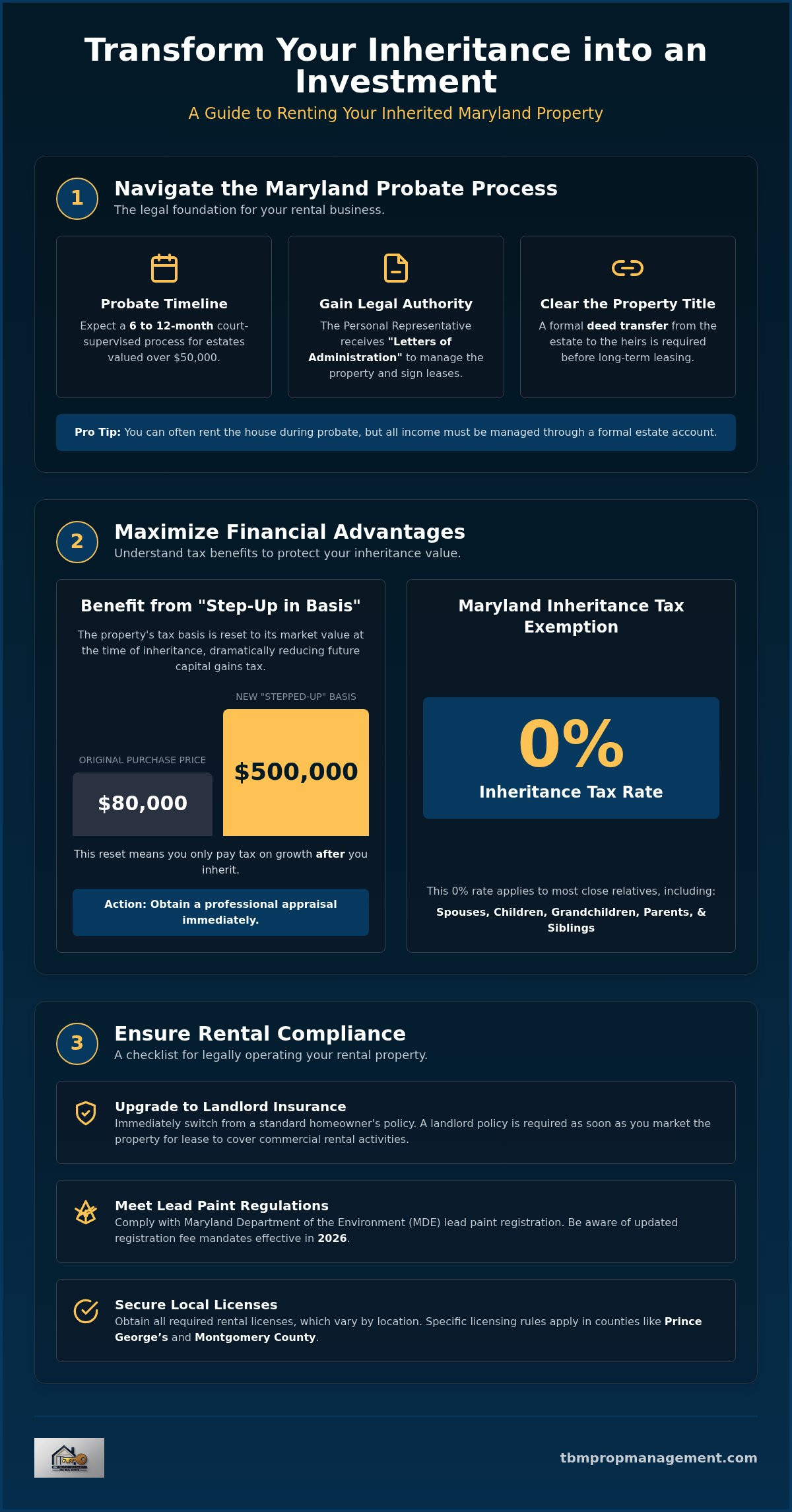
Inheriting a property often feels like taking on a second, unexpected career. Before you can focus on finding the right tenants, you must navigate the legal probate process. In Maryland, this court-supervised procedure validates the will and ensures all estate debts are settled before assets officially transfer to heirs. For any property valued over $50,000, this cycle typically takes between 6 and 12 months. Understanding your legal standing during this window is the first step toward a profitable investment.
Understanding the Personal Representative’s Authority
The court grants management power to a Personal Representative (PR) through a document known as "Letters of Administration." This paperwork is essential for renting out an inherited house in maryland because it proves you have the legal right to sign contracts on behalf of the estate. The PR has a fiduciary duty to maintain the home’s value, which often includes keeping the property occupied and productive. You can technically rent the house while it's still in probate, but the income must be managed through an estate account until the final distribution. This proactive approach prevents the home from sitting vacant and deteriorating while the court finishes its work.
Clearing Title and Ownership Transitions
Clear ownership is a prerequisite for any long-term lease. You must execute a formal deed transfer to move the property from the estate’s name into the names of the heirs. If you're sharing the inheritance with siblings or other relatives, this stage often reveals differing opinions on whether to sell or rent. Resolving these disputes early is vital to avoid future litigation. In the context of Maryland rental law, probate clearance is defined as the moment the Register of Wills approves the final account, allowing the title to pass legally to the beneficiaries without encumbrance.
Transitioning to a Rental Asset
The moment you decide to lease the home, its status changes in the eyes of the law and your insurance provider. You must transition from a standard homeowner’s policy to a landlord policy immediately. Most residential policies don't cover claims if the owner isn't the primary resident or if the property is used for commercial rental purposes. The house officially becomes a rental asset the day it's marketed for lease. This shift triggers a new set of responsibilities, including local safety inspections and tax reporting requirements that we'll cover in the following sections. Taking these steps early ensures your transition from heir to landlord remains stable and legally sound.
Tax Implications: Maryland Inheritance Taxes and the Step-Up in Basis
Managing the financial side of an inheritance doesn't have to be overwhelming. When you're considering renting out an inherited house in maryland, the tax code actually offers several powerful advantages designed to protect your family's legacy. While you're already navigating the Maryland probate process, you should also be preparing for your first tax filing as a property owner to ensure you aren't leaving money on the table.
The Financial Advantage of the Step-Up in Basis
One of the most significant benefits for heirs is the "step-up in basis." Instead of using the price the original owner paid decades ago, the IRS and the state of Maryland reset the property's value to its fair market value (FMV) on the date of the owner's death. This reset can save you thousands in future capital gains taxes. For example, if a house was bought for $80,000 in the 1990s but is worth $500,000 today, your new tax basis is $500,000. This means you could eventually sell the property and only pay taxes on the appreciation that happens after you inherited it.
To secure this benefit, you must obtain a professional appraisal as soon as possible. This document serves as your definitive baseline for all future tax calculations. Holding the property as a rental often provides a better long-term ROI when renting out an inherited house in maryland because you're building equity on a high-value asset while collecting monthly income. For your 2026 filings, always consult with a Maryland tax professional to ensure you're meeting every specific state requirement.
Maryland Inheritance Tax Exemptions
Maryland is unique because it's one of the few states with both an estate tax and an inheritance tax, but most close relatives are protected. Spouses, children, grandchildren, parents, and siblings all qualify for a 0% inheritance tax rate. If you fall into this group, you can transition the home into a rental without an immediate state tax bill on the transfer. However, "collateral" heirs such as cousins, nieces, nephews, or friends must pay a flat 10% inheritance tax on the property's value.
Once your rental is active, the income it generates is taxed at state and federal levels. You can offset this by deducting legitimate business expenses. Most operating costs are fully deductible, including property maintenance, repairs, and professional management fees. Working with a dedicated local partner can help you maximize these deductions while ensuring the property remains in top condition. By documenting every expense, you transform your inheritance into a high-performing investment that builds wealth for years to come.
Maryland Rental Licensing and Safety Compliance Requirements
Ensuring your property is legally compliant is the most critical step in protecting your inheritance from liability. While the financial side is about growth, compliance is about security. You must align your property with Maryland landlord-tenant laws to avoid costly fines or legal disputes. If you're renting out an inherited house in maryland, you'll find that regulations often vary significantly between jurisdictions like Laurel, Bethesda, or Columbia.
Lead Paint Compliance (MDE Requirements)
Does your inherited home date back before 1978? If so, you must comply with the Maryland Department of the Environment (MDE) lead poisoning prevention mandates. Effective January 1, 2026, the registration and renewal fee for lead rental properties has increased from $30 to $75. This fee now covers a two-year period, streamlining the administrative process for owners. You're required to register the property, distribute educational materials to tenants, and meet specific lead risk reduction standards between every tenancy.
To remain compliant, you'll need to obtain either a "Lead Free" or "Full Risk Reduction" certificate from a certified inspector. A "Lead Free" certificate is often the gold standard for inherited homes, as it permanently exempts you from future registration fees. Failing to maintain these records can lead to severe penalties and may prevent you from using the Maryland court system for rent collection or evictions. It's a high-stakes requirement that demands strict attention to detail.
County-Specific Licensing Procedures
Maryland doesn't have a single statewide rental license. Instead, your requirements depend entirely on the property’s physical location. In Prince George’s County, for instance, you must secure a specific rental license and pass a safety inspection that checks for working smoke detectors, carbon monoxide alarms, and proper egress in bedrooms. Montgomery County introduces even more layers, requiring landlords to follow strict "Landlord-Tenant Affairs" guidelines that dictate everything from lease terms to dispute resolution. Even in Takoma Park, you'll find unit-specific licensing fees that must be paid annually.
How can an out-of-state heir keep up with these shifting local rules? Many owners find that choosing professional property management in Maryland is the most effective way to guarantee compliance across multiple counties. A local partner handles the inspection scheduling, registration renewals, and safety upgrades on your behalf. By delegating these technical tasks, you can focus on the long-term value of renting out an inherited house in maryland while resting easy knowing your asset is fully protected and legally sound.
Marketing and Tenant Screening in the Local Maryland Market
Once you've cleared the legal hurdles of probate and compliance, your focus shifts to the most practical part of renting out an inherited house in maryland: finding the right occupant. This isn't just about filling a vacancy; it's about protecting a property that often holds decades of family memories. Preparing an inherited home for the 2026 market requires a shift in perspective. You must move from seeing it as a family residence to viewing it as a competitive product. Is the home in "rent-ready" condition? Modern tenants in areas like Prince George’s County expect updated appliances, neutral aesthetics, and responsive maintenance coordination.
Setting the Right Rent in Laurel and PG County
How do you determine a price that balances high returns with low vacancy? Pricing an inherited home can be tricky, especially if the last time it was on the market was decades ago. As of August 2026, the average rent for an apartment in Maryland sits around $1,897, but single-family homes in desirable hubs like Laurel often command a premium. Relying on generic online estimators often leads to long vacancies or lost revenue. Professional property management in Laurel, MD provides the hyper-local data needed to set a price that reflects current demand. We analyze seasonal trends and local comps to ensure your asset stays occupied by reliable tenants who value the property as much as you do.
Rigorous Tenant Screening Standards
The emotional weight of renting a family home makes the screening process feel even more high-stakes. You need someone who will respect the history of the house while following the rules of the lease. In Maryland, you must follow the Renters’ Rights and Stabilization Act, which limits security deposits to two months’ rent and caps late fees at 5% of the monthly rent. Are you prepared to verify income and credit while staying strictly compliant with Maryland Fair Housing laws? Avoiding discriminatory practices is essential to protect yourself from legal liability. Utilizing professional tenant placement services ensures that every applicant is vetted through a consistent, objective lens. High-quality leasing services take the guesswork out of the process, providing you with peace of mind and a steady income stream. If you're ready to see how your property stacks up against the current market, request a complimentary analytical report to start your journey on the right foot.
Turning Your Inheritance into a Stress-Free Investment with TBM
Does the thought of managing a property from hundreds of miles away keep you up at night? For many heirs, the logistical hurdles of renting out an inherited house in maryland feel like a full-time job they never applied for. Between coordinating emergency repairs and ensuring the rent arrives on time, the pressure to protect your family legacy is immense. TBM Property Management acts as your stabilizing force, transforming that emotional burden into a streamlined, high-performing investment. We understand that this house is more than just sticks and bricks; it’s a piece of your history that deserves expert care.
Comprehensive Oversight for Out-of-State Heirs
Managing a rental shouldn't mean spending your weekends on the phone with plumbers or driving across state lines for routine inspections. We utilize Property Meld to revolutionize how maintenance is handled. This specialized platform allows for rapid, automated coordination between tenants and our vetted vendors, ensuring repairs are completed before small leaks become costly structural disasters. This proactive approach keeps your tenants happy and your maintenance costs predictable.
Our team conducts regular, thorough property inspections to verify that your asset is being treated with respect. You'll have access to transparent financial portals that track every penny, making your annual tax preparation simple and stress-free. By providing professional rent collection and 24/7 maintenance coordination, we ensure you enjoy the financial rewards of ownership without the daily operational friction. If a tenant has an emergency at 2:00 AM, we’re the ones who answer the call, not you.
The TBM Advantage: 12+ Years of Local Mastery
Maryland’s regulatory environment is notoriously complex, and a single misstep regarding notice periods or security deposit interest can lead to significant legal setbacks. Having a seasoned local partner is your best defense against Maryland landlord-tenant rights complications. We bring over 12 years of specialized real estate expertise to Anne Arundel, Prince George’s, Montgomery, and Howard counties. We don't just manage buildings; we build dedicated partnerships with owners who need a reliable, detail-oriented advocate on the ground.
Are you ready to stop worrying about compliance and start seeing the real value of your inheritance? We're here to guide you through every phase of renting out an inherited house in maryland, from the initial probate transition to long-term wealth building. Our proactive approach ensures that your property remains a source of pride rather than a source of anxiety. Get your complimentary rental analysis from TBM Property Management today!
Securing Your Family’s Legacy Through Smart Property Management
Transforming a family home into a high-performing rental asset is a journey that requires both legal precision and local expertise. You've learned how to navigate the Maryland probate process, leverage the step-up in basis for tax advantages, and meet the strict 2026 compliance standards for lead paint and county licensing. While the road to renting out an inherited house in maryland can feel steep, you don't have to walk it alone. Proper preparation today ensures that your inheritance becomes a source of long-term wealth rather than an ongoing administrative burden.
With over 12 years of Maryland real estate expertise, TBM Property Management provides the specialized support heirs need to succeed in PG, Howard, and Montgomery counties. We offer the local mastery required to handle complex regulations while protecting your asset’s value through diligent oversight. Are you ready to see the true potential of your property? Request Your Complimentary Rental Analysis for Your Inherited Property to start your transition with total confidence. We're here to help you turn a complex transition into a rewarding investment.
Frequently Asked Questions
Do I have to pay inheritance tax on a house in Maryland?
You won't pay Maryland inheritance tax if you're a spouse, child, parent, or sibling of the deceased. These close relatives qualify for a 0% rate. However, if you're a friend or a more distant relative like a cousin, Maryland imposes a flat 10% tax on the property's value. It's vital to identify your status early in the probate process to avoid unexpected tax bills when renting out an inherited house in maryland.
Can I rent out an inherited house before probate is finished in MD?
Yes, you can rent the property before probate concludes, provided the court has appointed a Personal Representative. This individual uses their Letters of Administration to sign the lease on behalf of the estate. All rental income must be deposited into a dedicated estate account until the final distribution. This strategy prevents the home from sitting vacant while the legal process moves forward over several months.
What is the "step-up in basis" and how does it help heirs?
The "step-up in basis" resets the property's tax value to its fair market value on the date of the previous owner's death. This is a massive financial win for heirs because it virtually eliminates capital gains tax on any appreciation that happened during the decedent's lifetime. If you eventually sell the home after renting out an inherited house in maryland, you'll only pay taxes on the value gained after you inherited it.
What are the rental licensing requirements in Prince George’s County?
Prince George’s County requires all landlords to secure a formal rental license before a tenant moves in. This process involves a mandatory safety inspection to verify that the home meets current building codes. Inspectors specifically look for working smoke detectors on every level and carbon monoxide alarms near sleeping areas. You'll also need to ensure all bedrooms have proper egress windows to pass the certification successfully.
How do I register an inherited house with the Maryland Department of the Environment (MDE)?
You must register through the MDE's online tracking system if the home was built before 1978. As of January 1, 2026, the registration fee is $75, which now covers a two-year period. You'll need to provide proof of a lead inspection and distribute the required lead educational pamphlets to your occupants. Keeping these records updated is essential to remain legally compliant with state environmental laws and protect your investment.
Is it better to sell or rent an inherited house in Maryland in 2026?
Renting is often the superior choice in 2026 because Maryland's rental market remains strong with average rents reaching $1,897. By keeping the property, you benefit from the step-up in basis while building long-term equity. Selling provides immediate cash but forces you to walk away from a high-performing asset. Many families choose to rent to preserve the legacy while generating consistent monthly cash flow for years to come.
How much does property management cost for an inherited home in Laurel?
Property management fees in Laurel typically depend on whether you need full-service oversight or just tenant placement. While we don't quote specific industry averages, these costs are generally tax-deductible as business expenses. For heirs, the cost of professional management is often offset by the time saved and the prevention of legal mistakes. A local partner ensures your property stays compliant with all regional mandates and safety rules.
What happens if I inherit a house with a mortgage in Maryland?
If the house has a mortgage, you generally inherit the responsibility for the monthly payments. Federal law usually prevents lenders from calling the loan due just because the owner passed away, especially when a relative inherits the home. You'll need to contact the loan servicer to provide the death certificate and Letters of Administration. This ensures the transition is smooth so you can focus on the rental's long-term performance.