
Setting the Right Rent Price in Howard County: A 2026 Guide
Could the rent price that looks right online be wrong for your property? Setting the right rent price in Howard County takes more than copying an estimate or matching a nearby asking price. Those figures may not show what renters choose or what a comparable home ultimately leases for. An area average provides context, but it can’t account for the details that make your property different.
It’s easy to feel caught between pricing high and risking a longer vacancy, or pricing low and leaving income on the table. A stronger starting point is to compare relevant local rentals, account for your home’s location, layout, condition, and amenities, then review how renters respond.
This guide explains how to build a defensible rent estimate, identify which property details may support a different asking rent, and interpret inquiries, showings, and leasing outcomes when deciding whether to hold or adjust your price. Howard County neighborhoods and property types don’t all move alike, so a careful local review can replace guesswork with a clearer pricing decision.
Key Takeaways
- Compare several relevant Howard County rentals instead of relying on one high or low asking price.
- Record each property’s location, type, size, condition, amenities, listing date, and rent to make comparisons more useful.
- When setting the right rent price in Howard County, distinguish inquiry volume from qualified applications, showing attendance, and renter feedback.
- Follow a repeatable process: document your property, gather comparable rentals, assess differences, set a price, and review the response.
- Tenant placement, leasing, screening, rent collection, and inspections can support the broader rental process beyond pricing.
Setting the Right Rent Price in Howard County Starts With the Right Evidence
Balancing rental income against tenant demand and vacancy risk can feel like a high-stakes decision. A well-supported asking rent gives you a locally grounded starting point, not a promise that a tenant will sign at that price. Setting the right rent price in Howard County means combining comparable rentals, your property’s specific features, and the response it receives.
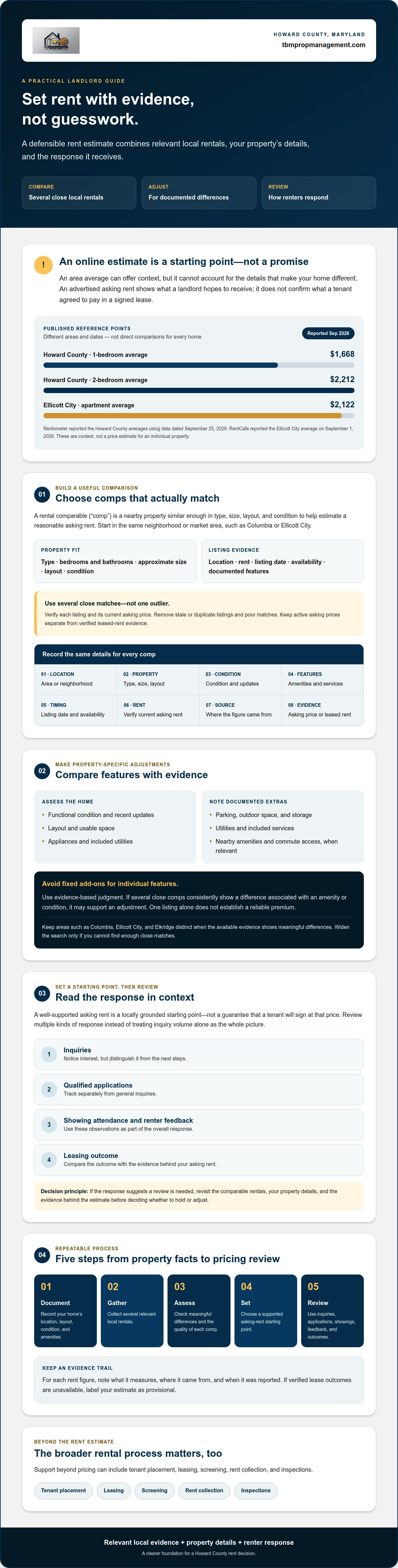
County averages offer context, but they can’t price an individual home. Rentometer reported Howard County averages of $1,668 for a one-bedroom and $2,212 for a two-bedroom in September 2026, based on data dated September 25. RentCafe reported an Ellicott City apartment average of $2,122 on September 1, 2026. These figures cover different areas and dates, so treat them as reference points rather than direct comparisons for every property. A townhouse in Columbia and an apartment in Ellicott City may differ in layout, location, and condition. The county’s geography and communities add further context, as outlined in this overview of Howard County, Maryland.
What counts as a useful Howard County rental comparable?
A rental comparable, or comp, is a nearby property similar enough in type, size, layout, and condition to help estimate a reasonable asking rent. Compare like with like: align property type, bedrooms and bathrooms, approximate size, and overall condition as closely as possible. Start in the same neighborhood or market area, such as Columbia or Ellicott City, before widening your search.
For each example, record the rent, listing date, and availability. Remove stale or duplicate listings, along with properties that are poor matches. Use several close comparisons rather than letting one unusually high or low listing set your target.
Why listing price is not the same as market rent
An advertised rent shows what a landlord hopes to receive. It doesn’t confirm what a tenant agreed to pay in a signed lease. If you have reliable leased-rent evidence, record its source, date, location, and relevant property details so you can judge whether it applies to your home. Don’t combine achieved rents and active asking prices as if they were equivalent.
If verified lease outcomes aren’t available, label your estimate as provisional. That’s more useful than treating an online estimate or asking price as certain. As you assess options for setting the right rent price in Howard County, keep a clear evidence trail: note what each figure measures, where it came from, and when it was reported. This creates a sound basis for property-specific adjustments and market-response checks.
How to Compare Howard County Rentals and Adjust for Property Differences
Once you’ve identified possible comps, put them side by side. A simple comparison can show whether a rent difference reflects a meaningful property feature or an outlier. Verify each listing and its current asking price before relying on it.
| Location | Property type | Size | Condition | Amenities | Listing date | Rent |
|---|---|---|---|---|---|---|
| Record area | Record type | Record size | Note condition | List included features | Record date | Verify current asking rent |
| Record area | Record type | Record size | Note condition | List included features | Record date | Verify current asking rent |
Which property features can justify a different asking rent?
Compare functional condition, layout, usable space, recent updates, and included appliances. Also note parking, outdoor space, storage, utilities, and included services, but only when listings clearly document them. For example, a property with included utilities is not directly equivalent to one where tenants pay utilities separately.
Adjust your estimate through evidence-based judgment, not a fixed dollar add-on for each feature. If several close comps consistently show a difference associated with an amenity or condition, that may support an adjustment. A single listing doesn’t establish a reliable premium.
How location within Howard County affects the comparison
Keep Columbia, Ellicott City, Elkridge, and other relevant areas distinct when the available evidence shows meaningful differences. Start with nearby properties, then widen your search if you can’t find enough close matches. Consider commute access and nearby amenities when they matter to likely renters, but don’t assume they raise rent without supporting comparisons.
A ZIP code or neighborhood name alone isn’t a pricing method. Focus on the property and its documented alternatives. As you compare included features and services, consult the Howard County Landlord-Tenant Relations Act for local landlord-tenant information, and verify current requirements rather than relying on assumptions.
Before setting the right rent price in Howard County, check that every figure is current and labeled as an asking rent or confirmed lease outcome. Remove stale or duplicate examples, and leave out properties that differ substantially in type, size, condition, or included features. For help with the leasing process, learn about TBM’s Howard County property management services.
Is Your Howard County Rent Too High or Too Low? Read the Market Signals
The highest nearby asking rent may catch your eye, but it doesn’t prove renters will choose your property at the same price. A listed home may differ in condition, features, or lease terms, and its advertised rent doesn’t confirm what a tenant ultimately agrees to pay. Treat comparable listings as context, then assess the response to your own rental.
Market feedback has several parts. Few inquiries may point to limited exposure, an unclear listing, or a price that gives renters pause. Inquiries without qualified applications suggest a different issue from steady showing attendance followed by no applications. Renter comments about layout, condition, or included features can also reveal friction that a rent change alone won’t solve.
What weak inquiry or showing activity may indicate
Check the listing before assuming the price is the problem. Does it accurately describe the property and included features? Do the photos clearly show its condition and usable space? Is the listing reaching renters likely to consider this type of home, and are showing times workable? Review the application steps and note recurring questions.
Then refresh your comparison set. Howard County listings change, so older examples may no longer reflect the alternatives renters see today. If current, close matches are priced below yours, that may support a review. First consider differences in property features and listing quality.
When and how to reconsider the asking rent
Choose a review date before marketing begins. At that point, compare actual activity with your expectations rather than reacting to a quiet day or feeling pressured by vacancy risk. Track inquiries, qualified applications, attended showings, and renter feedback separately. Each signal can help diagnose a different part of the leasing process.
If you make a change, record what changed and why. You might correct a listing detail, improve the photos, adjust showing availability, or revisit the asking rent after checking current competition. Avoid changing several things at once if you want to understand which factor affected the response.
| Observed signal | Possible next check |
|---|---|
| Few inquiries | Review exposure, listing accuracy, photos, and asking rent against current competition. |
| Inquiries, but few qualified applications | Check whether the listing reaches the intended renter audience and whether application steps are clear. |
| Showings, but little follow-up | Review showing feedback, property presentation, and recurring renter questions. |
| Qualified interest and applications | Continue monitoring the full response; don’t assume one positive signal confirms the asking rent. |
For setting the right rent price in Howard County, a measured review is more defensible than choosing the highest advertised figure or lowering rent out of anxiety. Keep notes on the evidence, your decision, and the next review point. No signal guarantees a particular lease result, but a clear process helps you respond thoughtfully.
A Step-by-Step Howard County Rent-Setting Process for Landlords
A repeatable process makes pricing decisions easier to manage and explain. For setting the right rent price in Howard County, keep property facts, comparable evidence, and market response together instead of relying on memory or one online estimate.
Prepare a rent-pricing worksheet before advertising
Start one worksheet for your property and its comps. Record the source and date for every rent figure, note assumptions, and describe how closely each example matches. Keep documented facts separate from judgments, such as whether an update may support a different asking rent. Don’t use hopes about future appreciation or demand as evidence of today’s rental value.
- 1. Prepare the property facts. Record bedrooms, bathrooms, approximate size, condition, included features, and the date the property will be available. Note details renters may compare, such as appliances or parking.
- 2. Gather current comparable rentals. Choose several relevant properties and document their location, type, size, rent, listing date, and source. Mark examples that are stale, incomplete, or less similar.
- 3. Assess the differences. Compare each comp with your property. Note relevant differences in condition, layout, amenities, or included utilities, and explain whether each difference makes the comp more or less useful. Avoid automatic dollar adjustments without supporting evidence.
- 4. Set a supported starting price. Use the strongest available comparisons to choose an asking rent. Record your reasoning and label the estimate provisional if you can’t verify achieved lease outcomes.
- 5. Review the response. Set a review point that fits your leasing timeline. Track inquiries, qualified applications, showings, and renter feedback consistently, then note what the signals suggest before making a change.
Keep this pricing record separate from your compliance checklist. Rental requirements can change and may differ between Maryland and Howard County, so check current official guidance and verify legal details before acting or publishing advice. For related context, review the Maryland landlord-tenant rights guide.
A clear record won’t guarantee a particular lease result, but it can show how you reached your asking rent and what evidence would justify revisiting it. If you’d like help with tenant placement or leasing in Howard County, explore tenant placement and leasing support.
When Howard County Landlords May Benefit From Local Leasing Support
A supported asking rent is a strong starting point, but pricing is only one part of leasing a property. The listing must reach prospective renters, inquiries and applications need attention, and lease steps must be handled. Screening, rent collection, and inspections also form part of managing a rental. If coordinating these tasks feels like too much to carry alone, local leasing support may help organize the process.
TBM Property Management serves Howard County and offers tenant placement, leasing, rent collection, tenant screening, property inspections, and maintenance coordination. These services address different stages of rental oversight, so clarify what’s included and what you’ll continue to manage yourself. For an overview of finding tenants and leasing, read the tenant placement services guide. If you’re considering broader support, the full-service property management guide provides additional context.
What to ask before choosing leasing or management help
Ask how the provider selects local comparable rentals and documents any pricing guidance. Find out who handles marketing, inquiries, showing coordination, tenant screening, and lease steps, and clarify which tasks are included in the service you’re considering. For ongoing management, confirm the scope of rent collection, property inspections, and maintenance coordination. Clear answers help you compare support based on your needs, not just the service label.
Turn the pricing plan into a smoother leasing process
Before settling on the advertised rent, review the property’s readiness and make sure the listing accurately describes its condition and included features. Once it’s available, keep a consistent record of inquiries, applications, showings, and renter feedback. Use that response alongside current local comparisons to revisit your assumptions rather than adjusting the rent based on guesswork.
That’s the practical value of setting the right rent price in Howard County: a clear starting point, supported by evidence, that you can review as the market responds. If you’re weighing your pricing approach or the leasing tasks involved, contact TBM Property Management to discuss your Howard County rental and questions about local leasing support.
Make Your Next Rent Decision With Confidence
Setting the right rent price in Howard County isn’t about matching the boldest nearby asking price. It’s about making a reasoned decision based on relevant local comparisons, your property’s condition and features, and the response your listing receives. Keep asking prices distinct from confirmed lease outcomes, and treat renter activity as feedback to investigate, not an automatic instruction to change the rent.
A clear record of your sources, assumptions, and review points can help you adjust thoughtfully as conditions change. If leasing tasks feel like too much to manage alongside pricing, local support may help you organize the process.
TBM Property Management is based in Laurel and serves Howard County, with services that include tenant placement, leasing, rent collection, and property inspections. Have questions about your property or pricing approach? Discuss your Howard County rental with TBM Property Management. With sound evidence and a practical plan, you can move forward with greater clarity.
Frequently Asked Questions
How do I determine the right rent for a house in Howard County?
Start by comparing your house with several similar rentals in the same or nearby area. Match property type, bedrooms, bathrooms, approximate size, condition, and included features, then check each listing’s date and availability. Separate advertised asking rents from confirmed lease outcomes, and record each figure’s source. This evidence gives you a defensible starting estimate for setting the right rent price in Howard County, not a guaranteed lease result.
What should I compare when setting rent in Columbia, Maryland?
Focus first on Columbia rentals that resemble your property in type, bedroom and bathroom count, size, condition, and included features. Check listing dates and availability too, since stale or duplicate examples can distort your view of current competition. Consider parking, outdoor space, utilities, or updates only when listings document them. A countywide average or neighborhood label can offer context, but close, current comparisons are more useful.
Should I use online rent estimates to price my Howard County rental?
Use an online estimate as a reference point, not as the final asking price. It may not reflect your home’s condition, layout, included features, or immediate competition, and the tool may not clarify whether it uses advertised rents or achieved lease data. Check its source and date, then compare the estimate with current, relevant rentals. If reliable lease outcomes aren’t available, treat your estimate as provisional.
How often should I review my rental asking price?
Set a review date before advertising, then reassess based on meaningful activity and your leasing timeline. Track inquiries, qualified applications, attended showings, and renter feedback separately to identify where interest changes or stalls. Also check whether comparable rentals have changed. There’s no single review schedule for every property, but a planned checkpoint helps you avoid reacting to one quiet day or changing the price without evidence.
What happens if my Howard County rental gets few inquiries?
Few inquiries don’t automatically mean the rent is too high. First check whether the listing accurately describes the property, uses clear photos, reaches the intended renters, and allows practical showing access. Review application steps and note recurring questions from prospects. Then compare your asking rent with current, similar rentals. These checks can help distinguish a pricing concern from a listing or access issue before you decide what to change.
Can property condition affect the rent I can ask in Howard County?
Yes. Condition can affect how renters assess a home compared with alternatives, so compare properties with similar upkeep and functional features. Note significant differences, such as recent updates, worn finishes, or included appliances, and make sure comparable listings document them. Use those differences to inform your pricing judgment, not to make automatic dollar adjustments. A well-presented listing should also describe the property accurately rather than overstate its condition.
Do advertised rents show what tenants actually pay in Howard County?
No. An advertised rent shows what a landlord is asking, not necessarily the rent agreed to in a signed lease. If you can access reliable lease outcomes, note their source, date, location, and how closely those properties match yours. Don’t combine asking prices and achieved rents as though they measure the same thing. Without verified lease data, describe your pricing estimate as provisional and keep monitoring market response.
When should a landlord ask a property manager for rent-pricing help?
Consider asking for help if you’re unsure which rentals are valid comparisons, how to interpret listing feedback, or how pricing fits into the leasing process. TBM Property Management serves Howard County from its Laurel, Maryland base and offers tenant placement, leasing, rent collection, tenant screening, and property inspections. Ask how a provider supports pricing decisions and clarify which services are included so you can determine whether the support fits your needs.