Tenant Placement Services in Maryland: Fees and Screening
A tenant placement fee in Maryland may be structured as a portion of the rent or as a flat charge, and the amount depends on the service scope and rental terms. There isn’t one standard fee for tenant placement services in Maryland, so understanding what leasing tasks are included matters as much as comparing the fee structure.
It’s reasonable to want a clear picture before handing over the search, screening, and lease preparation. This guide explains how placement fees are commonly structured, what screening and verification can involve, and which leasing tasks may be part of the service. You’ll also see how local rental requirements can affect the process, so you can make a more informed decision and know what to expect from tenant placement.
Key Takeaways
- Compare placement-only help with ongoing management by looking closely at which leasing and follow-up tasks each option covers.
- Understand how credit, criminal, and eviction screening fit into a consistent review process and applicant protections.
- See how income, employment, and rental history checks can help assess an application, while local rental rules vary across Maryland.
- Identify the leasing tasks a placement service may handle, from marketing the vacancy to preparing the lease.
What is a typical tenant placement fee?
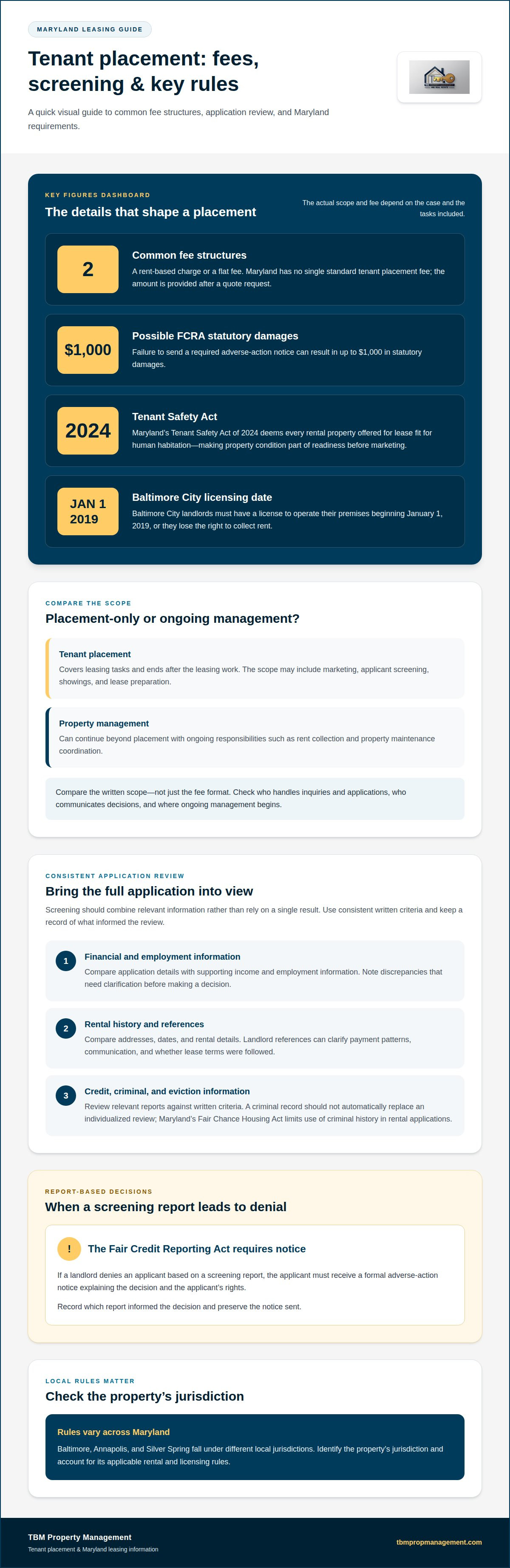
Maryland tenant placement fees may use a rent-based charge or a flat-fee structure. The fee depends on the case and is provided after a quote request; factors include marketing, screening, showings, lease preparation, and the division of responsibilities. Compare the actual tasks included, not just the fee structure. A placement-only arrangement ends after leasing tasks, while property management can cover ongoing responsibilities such as rent collection and property maintenance coordination.
When choosing a Maryland tenant placement service, compare the written scope: marketing, applicant screening, showings, lease preparation, and the point at which ongoing management begins. Check how inquiries and applications are handled and who communicates decisions. These details show whether the service covers the leasing work you want to delegate or leaves key tasks to you.
Property management companies and leasing firms offer tenant placement services in Maryland, but their scopes differ. Some focus on marketing and securing a renter; others combine placement with ongoing management. Compare the company’s stated process with your needs, including screening, lease preparation, and what happens after placement. TBM Property Management offers Tenant Placement & Leasing Only, Full Service, and Full Management.
Marketing starts with accurate rental property details, clear listing information, and a plan for handling inquiries. A placement service can coordinate showings by arranging access, confirming appointments, and collecting applicant interest. For example, a landlord can define available showing times in advance, helping reduce scheduling back-and-forth while keeping the property accessible to prospective renters.
How long does it typically take to place a tenant in Maryland? Timing depends on the property’s condition, marketing response, applicant readiness, and showing schedules. A practical sequence is to prepare the rental property, publish accurate advertising, respond to inquiries, hold showings, and review completed applications. Maryland’s Tenant Safety Act of 2024 establishes that every rental property offered for lease is deemed fit for human habitation, making property condition a key part of readiness before marketing begins.
Credit, criminal, and eviction screening
A screening review should bring together relevant information rather than rely on one result. TBM Property Management’s tenant screening includes credit and background checks, along with employment verification. These checks help landlords assess an applicant’s financial and employment information; review rental history and other relevant information against consistent written criteria as well.
A complete application can help organize the information needed for screening. Review the results against written rental criteria, such as income documentation, payment history, and applicable occupancy requirements. Keep notes on the information considered and how it relates to the criteria. A criminal record should not automatically replace an individualized review: Maryland’s Fair Chance Housing Act limits the use of criminal history in rental applications.
Credit and eviction reports require careful handling, especially when a report affects a decision. Under the Fair Credit Reporting Act, landlords who deny an applicant based on a screening report must send a formal adverse-action notice explaining the decision and the applicant’s rights. Failure to send the required notice can result in up to $1,000 in statutory damages. A clear process records which report informed the decision and preserves the notice sent.
Income verification works alongside those checks. Compare the application with supporting income and employment information, then note discrepancies that need clarification before making a decision. For rental history, review prior addresses and landlord references consistently; for eviction records, distinguish a reported record from the broader application rather than treating a single data point as the full picture. Keep applicants informed about application progress and record each major step. For a structured review, professional tenant screening can organize the checks and reporting process.
Income, employment, and rental history verification
Use consistent verification steps to assess an applicant’s financial information and rental record. Local rental regulations also matter in Maryland, so consider the property’s jurisdiction before approving an application.
Income and Employment Verification
Compare the income details on the application with supporting documents and employment information. Check that names, dates, and work details align, then note any discrepancy for follow-up. For example, if the employer listed on an application differs from the supporting records, resolve the mismatch before evaluating the full file. Apply the same written criteria to each applicant for a consistent review.
Rental History and Landlord References
Review the addresses and landlord references on the application, then compare dates and rental details for consistency. A reference conversation can clarify payment patterns, communication, and whether the applicant followed lease terms. Record the questions asked and information received so you can compare rental histories using a clear record rather than memory or a single comment.
Requirements can differ across Maryland cities and counties. Baltimore, Annapolis, and Silver Spring fall under different local jurisdictions, and rental rules vary by county and municipality. Baltimore City landlords must have a license to operate their premises beginning January 1, 2019, or they lose the right to collect rent. Owners should identify the property’s jurisdiction and account for its applicable licensing rules.
Maryland screening also involves limits on criminal-history use. The Fair Chance Housing Act limits the use of criminal history in rental applications. Under the Fair Credit Reporting Act, when a screening report leads to a denial, the applicant must receive a formal notice explaining the decision and their rights. Consistent written criteria also help landlords apply screening decisions fairly.
For listings and leases, provide accurate property information and consider the rules that apply to the specific rental. Maryland and federal lead-paint laws address residential housing built before 1978. Property age is therefore a practical detail to identify when preparing rental materials. Local regulations may also affect licensing and required notices, so organize those requirements by property jurisdiction.
Tenant placement services and leasing tasks
A placement agreement should spell out the work from vacancy preparation through lease signing. The scope may cover marketing, inquiry responses, applicant coordination, showings, screening, and lease preparation. Confirm who answers prospective renters’ questions and follows up on incomplete applications. A clear process assigns each task and states when responsibility returns to the landlord.
The leasing sequence usually starts with preparing accurate listing details, then advertising the rental and arranging access for showings. After an applicant submits materials, screening and verification help inform the landlord’s decision. The final steps can include preparing the lease, collecting signatures, and coordinating move-in details. In Baltimore, as elsewhere in Maryland, clarify who communicates with the selected renter and keeps the landlord updated at each stage.
Marketing and showing coordination affect how efficiently prospective renters can assess a property. Listing details should describe the rental accurately, and scheduled showings give applicants a chance to view it before applying. Set out how appointment requests are handled, who provides access, and how feedback reaches the owner. If several applicants express interest, a defined process helps organize applications and keeps decisions tied to consistent screening criteria.
What risks and guarantees should Maryland landlords ask about in a tenant placement agreement? Some placement guarantees cover a replacement tenant if the original renter leaves or is evicted within the first 6 to 12 months. Read the agreement for the events covered, any conditions for replacement, and the tasks excluded from the guarantee; distinguish a limited replacement commitment from a promise that a tenant will stay.
Before signing, compare the written scope with the work you want handled. If you want support coordinating leasing tasks, explore rental leasing support as a next step.
TBM Property Management: Full-Service Property Management
TBM Property Management can help rental owners throughout Anne Arundel, Prince George's, Montgomery, and Howard counties, plus Laurel, who want placement support or ongoing oversight. Its Tenant Placement and Leasing Services cover the work of finding and securing a renter, while Full-Service Property Management supports owners who want broader property oversight. Rent Collection can also be part of that ongoing arrangement.
If you’re handling a vacancy yourself, tenant placement can take leasing tasks off your plate. If you also want help after the lease begins, Full Service or Full Management may better fit your needs. Choose based on the responsibilities you want covered, from leasing and placement to rent collection, inspections, and maintenance coordination.
To discuss tenant placement or ongoing management with TBM Property Management, visit tbmpropmanagement.com.
Set up a smoother plan for your next vacancy
Start your leasing decision by identifying which responsibilities you want to keep and which you would rather delegate. That distinction can help you choose tenant placement services in Maryland for a vacancy or broader support for ongoing property oversight. Write down the tasks you want covered, then use that list to compare service scopes.
TBM Property Management offers Tenant Placement, Leasing Services, and Full-Service Property Management. These options give Maryland owners a path to support focused on securing a renter or extending to broader management. The right fit depends on how involved you want to be after a lease begins, and which responsibilities you want handled as part of your rental plan.
When you’re ready to discuss the next step, contact TBM Property Management. A clear plan can make your next vacancy easier to manage.
Frequently Asked Questions
What do tenant placement services in Maryland include?
Tenant placement covers the vacancy-to-lease process, with specific tasks set by the agreement. For example, a landlord might delegate listing preparation and applicant coordination while handling repairs personally. Map each task from the first inquiry through the signed lease and move-in handoff. This makes it easier to decide whether you need help with one vacancy or ongoing oversight.
How much do Maryland tenant placement services cost?
There isn’t one statewide fee structure; placement charges may be calculated as a portion of rent or as a flat fee. The total depends on the work included, such as advertising, showings, application review, and lease preparation. Compare proposals by matching each charge to specific deliverables. A placement-only arrangement and a broader management plan cover different responsibilities, so compare the scope before assessing value.
How do Maryland tenant placement fees compare with full-service property management fees?
Placement fees cover leasing work for a vacancy, while full-service management includes ongoing oversight and recurring charges. That distinction matters if you want rent collection, inspections, or maintenance coordination after the lease begins. For a practical comparison, list placement tasks separately from monthly management duties, then identify which responsibilities you’ll keep. The right structure depends on how involved you want to be after move-in.
What steps do Maryland tenant placement services follow to find and screen tenants?
A typical workflow moves from preparing the rental listing to coordinating inquiries and showings, reviewing applications, and completing lease paperwork. Set written rental criteria before advertising and apply them consistently as applications arrive. Keep a record of application status and the basis for decisions. This creates a clear handoff from marketing to tenant selection and lease signing.
How do tenant placement services differ across Maryland cities such as Baltimore, Annapolis, and Silver Spring?
Rental rules vary by county and municipality, so account for the property’s jurisdiction. Baltimore City landlords need a license to operate their premises to retain the right to collect rent; Annapolis and Silver Spring fall under different local jurisdictions.