
Tenant Placement Services in Maryland: Typical Fees and Costs
Tenant placement fees in Maryland are commonly based on a share of one month’s rent or a flat charge, depending on the services included. When comparing tenant placement services in Maryland, look beyond the fee format and check what the service covers, such as tenant screening, lease preparation, and move-in coordination.
It’s reasonable to compare costs carefully, especially when balancing a timely rental with confidence in the tenant and lease. This article explains common fee structures, what placement services typically do, how tenant screening works, and how placement-only support differs from ongoing property management. You’ll also see how tenant placement services in Maryland fit into the leasing process and which rental requirements may need attention.
Key Takeaways
- Compare percentage-based and flat-fee pricing by looking at which leasing tasks each fee covers, not just the headline cost.
- Income, employment, and rental-history checks help reveal whether an applicant’s information supports their ability to meet lease obligations.
- Placement-only help focuses on finding and onboarding a tenant, while full-service management can continue with tasks such as rent collection.
- Maryland lease requirements can affect how landlords prepare agreements and manage a tenancy.
- Understand the difference between screening, leasing, and ongoing management to choose support that fits your property’s needs.
What is a typical tenant placement fee?
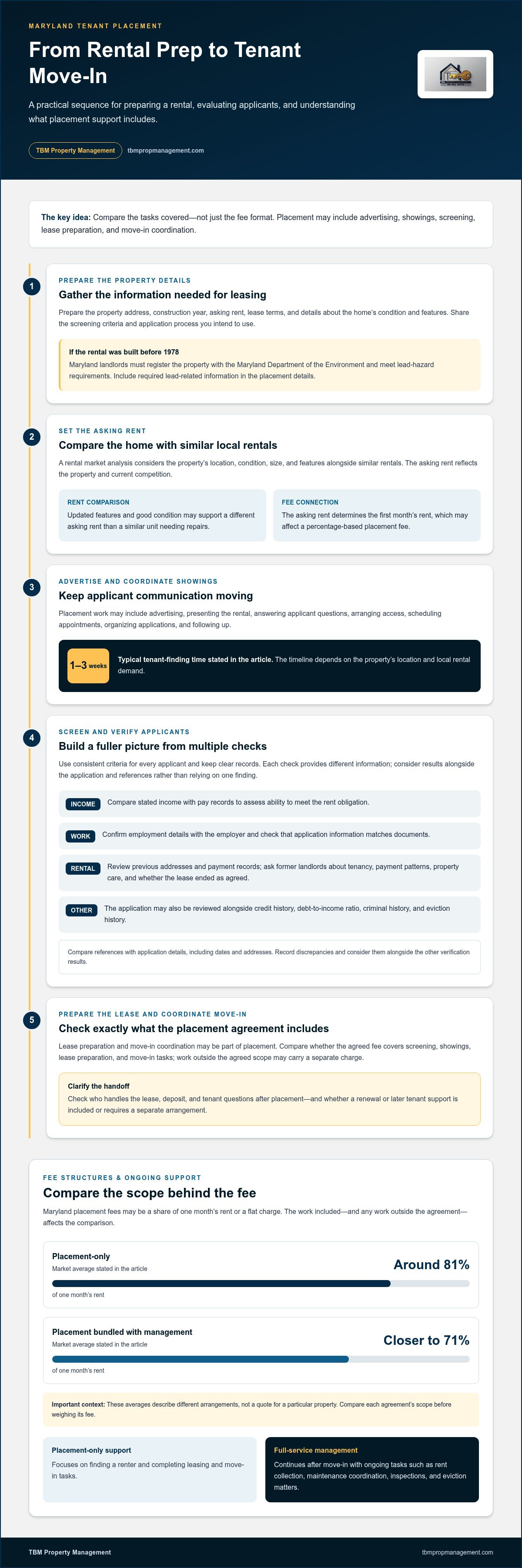
In Maryland, tenant placement fees are commonly based on a share of one month’s rent or a flat charge. The fee depends on the work included, which may cover advertising, showings, tenant screening, lease preparation, and move-in coordination. Compare the scope, not just the fee format: a placement service that includes thorough verification and a completed lease covers more than one focused only on advertising.
Income and employment verification help assess whether an applicant can meet the rent obligation. A screening process may compare stated income with pay records and confirm employment details with the employer. For example, if an application lists a current job, verification can establish whether the information matches the applicant’s documents. Rental history adds context: previous addresses and payment records can help show how the applicant handled earlier rental obligations.
A rental application may also be reviewed alongside credit history, debt-to-income ratio, criminal history, and eviction history. Each check offers different information, so consider the results with the application and references rather than relying on one finding. Landlords can use consistent criteria for every applicant and keep clear records of what they reviewed. A complete file makes it easier to explain how the application was assessed.
References from previous landlords can help verify rental history. Ask about the applicant’s tenancy, payment patterns, care of the property, and whether the lease ended as agreed. Compare the answers with the application, including dates and addresses. If details differ, record the discrepancy and consider it alongside the other verification results. This creates a more useful picture than relying on a reference alone.
Setting the rent also affects placement. A rental market analysis compares the property’s location, condition, size, and features with similar local rentals. This helps set an asking rent that reflects the property and current competition. For example, a well-maintained unit with updated features may warrant a different asking rent from a similar unit that needs repairs. The asking rent also determines the first month’s rent, which may affect a percentage-based placement fee.
Placement costs depend on the property, included services, and work needed to prepare and lease it. When comparing a percentage-based fee with a flat fee, check whether each covers screening, showings, lease preparation, and move-in tasks. A separate charge may apply to work outside the agreed scope, so the contract should clearly describe included tasks and responsibilities.
Lead paint obligations matter for Maryland rental housing built before 1978. Landlords must register those properties with the Maryland Department of the Environment and meet lead-hazard requirements. Include the property’s construction year in the placement information so the leasing process accounts for this responsibility. Lead compliance is separate from tenant screening, but it remains part of preparing a rental property for occupancy.
What documents and information do Maryland landlords need to provide for tenant placement? Prepare the property address, construction year, asking rent, lease terms, and details about the home’s condition and features. Share any required lead-related information for housing built before 1978, plus the screening criteria and application process you intend to use.
Property managers, real estate agents, and online services
Maryland landlords can use property managers, real estate agents, or online services to place tenants. Tenant placement services in Maryland differ in how they handle applicant communication, leasing tasks, and support after move-in. Compare the responsibilities in each agreement so you know whether the service ends at signing or continues throughout the tenancy.
Placement and Full-Service Management
Tenant placement focuses on finding a renter and completing the leasing and move-in process. Full-service property management continues after move-in, handling ongoing tasks such as rent collection, maintenance coordination, inspections, and eviction matters. This distinction matters if you need help only during a vacancy or want continued oversight. Check the agreement for the handoff point, including who handles the lease, deposit, and tenant questions after placement.
For example, a landlord comfortable arranging repairs may want help with marketing and leasing alone. An owner managing a rental from another county may value ongoing coordination. Choose a service based on the work you want to retain, not just the provider’s label.
Placement-Only and Bundled Fees
Placement-only fees cover tenant-finding work, while bundled fees combine placement with property management. Market averages are around 81% of one month’s rent for placement-only services and closer to 71% when placement is bundled with management. These averages describe different arrangements, not a quote for a particular property. Compare the agreement’s scope, including application handling, leasing tasks, and ongoing management, before weighing the fee structure.
Also check how the agreement covers work beyond the placement period. If the tenant later renews or needs support, find out whether that falls within the original scope or requires a separate arrangement. This makes it easier to compare the responsibilities each service covers.
Showings and Applicant Coordination
Showings involve presenting the rental property, answering applicant questions, and coordinating access and follow-up. A service may schedule appointments, organize applications, and keep communication moving through the leasing process. Clear coordination can reduce missed appointments and help applicants understand what comes next. Finding a tenant typically takes 1-3 weeks, depending on the property’s location and local rental demand.
The timeline can vary with the property’s condition, listing details, and applicant response. An organized process connects each inquiry to the right showing and application, whether the rental is in Baltimore or another Maryland community.
Choosing a Placement Service
When comparing tenant placement services in Maryland, look for a written agreement that identifies screening, showings, lease preparation, deposit handling, and when ongoing duties begin. Consider how applications are reviewed and how the service coordinates with prospective tenants. Providers include property managers, real estate agents, and online placement services across Baltimore, Montgomery County, and other Maryland areas.
Choose the arrangement that fits your involvement after move-in. If you want help coordinating a vacancy and continued oversight, full-service management may suit your needs. If you prefer to manage the tenancy yourself, placement-only support may fit better. For ongoing property oversight alongside leasing, explore full-service property management.
When landlords may need professional placement services
Professional placement support from TBM Property Management can help when a vacancy, screening workload, or lease preparation becomes difficult to manage. Maryland’s lease and application requirements also make organized records valuable from application through signing.
What are Maryland landlord-tenant laws for tenant screening and application fees? Maryland landlords may keep application fees of $25 or less, and the Maryland General Assembly says they must refund any unused portion above $25 within 15 days. Apply the same screening criteria to each applicant and keep a record of the information reviewed.
What risks or guarantees do Maryland tenant placement services offer? Placement agreements define which tasks the service handles, while some agreements provide a replacement tenant at no additional charge if the original tenant leaves or is evicted within the first 6 to 12 months. Such a clause addresses replacement placement, not every risk connected with a tenancy.
Approval Rights and Screening Consistency
Approval rights explain how landlords retain the decision to accept or reject an applicant after screening. A placement service can gather and organize information, while the landlord chooses the tenant. Set written criteria before reviewing applications, then apply them consistently. For example, assess every application using the same income, employment, rental-history, and reference checks.
Consistent screening supports clear decisions and a traceable record. Keep the application, verification notes, reference responses, and decision rationale together. Avoid changing criteria midway through the review or treating similar applicants differently without a documented reason. A clear process helps landlords explain a decision if an applicant questions the outcome.
Placement Services for Laurel and Surrounding County Landlords
For landlords in Laurel, Anne Arundel County, Prince George's County, Montgomery County, and Howard County, professional placement services can coordinate marketing, applications, showings, screening, and lease preparation. Local requirements matter throughout these regional areas, and ensuring proper rental registration or licensing status is vital before a tenant moves in. Confirming the property's compliance belongs in vacancy preparation, not as an afterthought after an applicant is approved.
Professional help may be useful when landlords manage several vacancies, have limited time for applicant coordination, or need support preparing a lease. Maryland landlords who own five or more rental units must provide written leases, and written leases are required for tenancies lasting one year or longer. TBM Property Management can organize lease information and signing, but landlords remain responsible for their housing obligations.
Lease terms should also reflect Maryland rules. According to the Maryland General Assembly, a valid Maryland lease cannot impose late fees exceeding 5% of the rent owed. Reviewing the contract before signing helps prevent a placement process from moving forward with a term that exceeds that limit.
Placement records can also help if a disagreement arises. Keep the signed lease, application, screening notes, rent-collection records, and written communications together. A placement service handles leasing tasks, not every landlord-tenant dispute. Organized documents make the timeline and agreed terms easier to understand if a disagreement develops.
Tenant screening and background verification
A thorough screening file combines an application with independent checks. Reviewing credit, income, employment, rental history, and eviction history gives landlords a fuller basis for evaluating an applicant.
Credit, Criminal, and Eviction Checks
Credit, criminal, and eviction checks cover different aspects of an applicant’s background. A credit report can show payment patterns and debt, while eviction records may reveal past rental disputes. Criminal history provides another category of information, not a substitute for reviewing the full application.
Use the same review process for every applicant. Match reports to the person’s identity, note relevant findings, and compare them with the stated rental history. A record may not explain its circumstances, so consider it alongside references, income, and other screening results.
Income Verification
Income verification compares an applicant’s stated earnings with supporting information. Employment verification can confirm the employer and job details on the application, while income documents help assess the ability to pay rent.
Keep a clear record of the sources reviewed and any details that need clarification. For example, if the employer listed on the application differs from the employment record, resolve the mismatch before completing the file. A debt-to-income ratio can also add context alongside income and rent obligations.
Applications and Background Checks
A tenant application gathers information needed to begin screening, including identity, employment, rental addresses, and landlord references. Check that required fields are complete before ordering background reports. Missing addresses or inconsistent dates can make rental-history verification harder.
Organize each applicant’s application, reports, and verification notes together. That record helps show which information informed the decision. The Fair Credit Reporting Act violations can result in up to $1,000 in statutory damages per violation, so handle consumer reports carefully and use them only for the screening process.
Rental references can clarify details that reports may not. Contact previous landlords to compare the applicant’s stated tenancy dates and payment history with the landlord’s account. Record the source and response, then weigh that information alongside employment and income verification rather than treating one reference as decisive.
A consistent screening sequence makes comparisons clearer: review the application, verify employment and income, assess credit and background information, then record the decision. For example, apply the same review criteria to two applicants with similar rental histories. Keep notes factual, focused on the information collected, and linked to the relevant application.
Tenant screening brings several information sources together, but no single report tells the whole story. An organized file helps landlords distinguish verified details from applicant statements and keep the selection process focused on relevant rental and payment information.
Tenant placement services and their leasing tasks
A tenant placement service manages the work between a rental vacancy and a new tenant’s move-in. In Maryland, this can include marketing, showings, application coordination, screening, lease preparation, and move-in documentation. Knowing which tasks are included helps landlords understand where placement ends and ongoing property management begins.
Marketing starts with presenting the rental property clearly to prospective tenants. Useful listing details include the location, features, condition, and asking rent. For example, a Baltimore listing should accurately describe the unit and make its availability clear. The property’s location and local rental demand can affect how quickly suitable applicants come forward. The typical time to find tenants is 1-3 weeks, depending on location and local rental demand.
Showings let prospective renters assess a property in person, while coordinated follow-up keeps applications moving. A placement service may schedule access, respond to questions, collect applications, and organize screening. Once an application arrives, the landlord can review identity, income, employment, credit, rental history, and references as part of the decision. Clear records connect each report and verification step to the right applicant.
Once an applicant is approved, leasing tasks can include preparing the agreement, coordinating signatures, and arranging move-in. The lease should clearly identify the rental, agreed terms, and responsibilities. For a property in another county, local details and the property’s condition still need to be recorded accurately. A placement service may also collect the security deposit and rent and document the property’s condition at move-in.
Move-in documentation gives both parties a record of the rental’s starting condition. For example, notes and photographs can record existing damage before the tenant takes possession. The deposit also requires careful handling: Maryland’s one-month-rent maximum applies only to deposits paid on or after October 1, 2024. Maryland landlords must return security deposits within 45 days after a lease ends, according to the Maryland General Assembly.
These tasks have a clear boundary. Finding and onboarding a tenant addresses the vacancy; rent collection, maintenance issues, inspections, and eviction matters continue during the tenancy. Landlords who want help only with filling a vacancy can focus on placement tasks. Those who want assistance after move-in need an agreement that separately describes ongoing responsibilities.
Before signing, compare the placement agreement with the actual handoff: who prepares the lease, records the move-in condition, and handles the deposit and rent? If you want help coordinating a vacancy from marketing through leasing, explore tenant placement support.
TBM Property Management: Full-Service Property Management
TBM Property Management can help when leasing a rental feels like a second job or you want support beyond finding a tenant. Its Tenant Placement and Leasing Services cover the transition from vacancy to a signed lease. Full-Service Property Management continues with ongoing oversight, including rent collection, maintenance coordination, and inspections.
If you need placement alone, focused leasing support may suit your needs. If you also want help managing responsibilities after move-in, full-service management brings those needs together. The right option depends on how much of the rental process you want to handle yourself.
Ready to discuss support for your rental property? Contact TBM Property Management to explore the option that fits your needs.
Make Your Next Rental Decision With Confidence
The next step is deciding how much responsibility you want to carry after a tenant signs. If you prefer to manage the ongoing details yourself, focused leasing support may suit your approach. If you want help beyond move-in, consider how Full-Service Property Management could fit your plans.
TBM Property Management offers Tenant Placement and Leasing Services, as well as Full-Service Property Management. The right level of support can make the rental process easier to organize, from preparing for a vacancy to handling responsibilities during a tenancy. As you compare tenant placement services in Maryland, focus on the workload you want to delegate and the oversight you need over time.
Take a practical next step: contact TBM Property Management to discuss support for your rental property. A clear plan can help you move forward with greater ease and confidence.
Frequently Asked Questions
What tenant placement services do Maryland property managers offer?
Maryland placement services commonly coordinate the tasks involved in moving from a vacancy to an occupied rental. Depending on the agreement, that may include preparing the listing, managing inquiries, arranging showings, organizing applications, screening applicants, and preparing lease documents. Clarify who communicates the final decision and handles the handoff after signing. This division helps you plan remaining tasks, such as preparing keys and documenting possession.
How much do tenant placement services cost in Maryland?
The cost depends on whether the arrangement covers placement alone or combines placement with ongoing management. Scope also matters: marketing, showing coordination, screening, lease preparation, and move-in administration can all affect the fee structure. Compare the responsibilities included rather than treating two differently scoped services as equivalent. For a property-specific amount, the fee depends on the case and is given after a quote request.
What is the typical tenant placement fee in Maryland?
Placement fees are commonly based on a portion of rent or a flat charge, with the total reflecting the agreed work. Compare what each fee covers, not just how it is calculated. Check whether the agreement includes applicant coordination, lease signing, and move-in documentation. If you’re comparing packages, distinguish one-time placement work from ongoing management charges.
How do Maryland tenant placement companies screen prospective tenants?
Screening generally combines an applicant’s information with independent verification. A landlord can compare the application with employment and income records, rental references, credit information, and relevant background reports. Keep the review tied to consistent, written criteria, and record the sources used to make the decision. For example, if an applicant’s stated rental dates differ from a reference, document the discrepancy and assess it alongside the rest of the file.
How do Maryland tenant placement services compare with full-service property management?
Tenant placement centers on filling a vacancy and completing the leasing handoff; full-service property management continues during the tenancy. For example, an owner who wants help finding a renter but plans to handle routine issues independently may choose placement. An owner who also wants rent collection, maintenance coordination, and inspections may prefer ongoing management. TBM Property Management offers both Tenant Placement and Full-Service Property Management, so the choice can match the support you need.