
The Complete Tenant Screening Process in Maryland: A 2026 Landlord’s Guide
What if your next rental applicant has a glowing personality but a hidden history of unpaid rent and legal disputes? For property owners in Laurel and across the state, the fear of choosing the wrong person is a heavy emotional burden that can keep you up at night. You want a reliable tenant who respects your investment, but the complex tenant screening process maryland mandates can feel like a legal minefield. It's frustrating to balance your need for security with the strict $25 application fee caps and the specific criminal background check timing required in Montgomery County.
We understand that you're looking for more than just a list of names; you're looking for the relief that comes with a documented, compliant strategy. This guide will show you how to master the essential steps of Maryland tenant screening to find high-quality renters while staying 100% aligned with the Renters’ Rights and Stabilization Act. We'll preview the new 2026 voucher non-discrimination rules, explain the one-month security deposit limit, and provide a clear roadmap to help you transition from management anxiety to total property oversight confidence.
Key Takeaways
- Implement a structured five-step tenant screening process maryland landlords use to secure reliable renters while adhering to the $25 application fee cap.
- Stay ahead of 2026 legal shifts, including the Renters’ Rights and Stabilization Act and new protections for housing subsidy holders.
- Learn to distinguish between common applicant red flags and protected legal classes to ensure your selection process is both rigorous and fair.
- Discover how localized expertise in Prince George’s and Montgomery counties can help you navigate specific "Ban the Box" restrictions and criminal background timing.
- Explore how professional tenant placement services offer relief by managing compliance risks and providing access to high-level verification tools.
Maryland Tenant Screening: Process and Importance
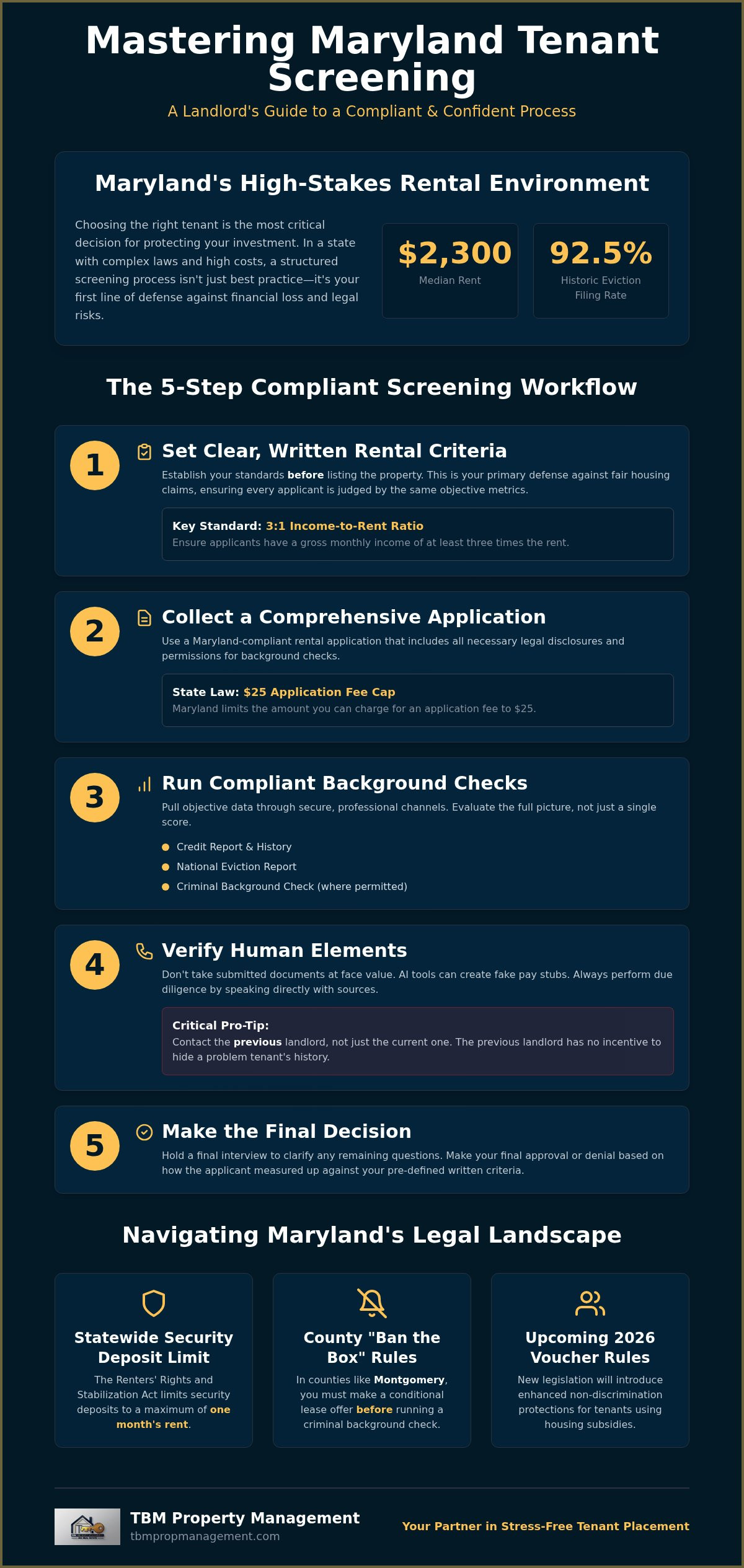
Tenant screening is the systematic evaluation of a prospect's financial and behavioral history. It's the most critical filter between your property and a potential financial disaster. Without a structured tenant screening process maryland landlords risk more than just a late payment. They risk months of lost income, expensive legal fees, and significant property damage. With Maryland's median rent reaching $2,300 as of June 2026, even a single month of vacancy or non-payment can derail your annual ROI.
The cost of a "bad" tenant in this state is exceptionally high. Maryland has historically seen eviction filing rates as high as 92.5%, among the highest in the country. If you don't have a rigorous defense, you're essentially leaving your asset's future to chance. Professional screening acts as your first line of defense, filtering out applicants with a history of evictions or insufficient income before they ever hold a key. It's about protecting your peace of mind as much as your pocketbook.
The Difference Between a Tenant and a Tenet
It's common to see these terms used interchangeably in online searches, but they carry very different weights in property management. A "tenet" is a principle or belief that guides your actions. A "tenant" is the individual who occupies your rental space. Understanding the core tenets of professional management, such as consistency, transparency, and legal compliance, is what allows you to find reliable tenants. By setting a high standard for your management principles, you naturally attract applicants who value and respect those same standards. We aim to set that professional tone from the very first interaction.
Maryland's High-Stakes Rental Environment
The rental landscape here is a complex patchwork of state and local regulations. While the Renters' Rights and Stabilization Act of 2024 set a statewide one-month limit on security deposits, counties like Montgomery and Prince George's often have additional layers of protection for renters. For example, Montgomery County requires a conditional lease offer before you can even look at a criminal background check. TBM Property Management brings over 12 years of local expertise to this high-stakes environment. Our "Stress-Free" tenant placement approach ensures you stay 100% compliant with the $25 application fee cap while still securing the high-caliber renters your Laurel or PG County property deserves.
The 5-Step Maryland Tenant Screening Workflow
A repeatable tenant screening process maryland landlords can trust is the only way to move from management anxiety to total confidence. This workflow ensures no detail is overlooked, from the first inquiry to the final lease signing. By following a structured path, you remove the guesswork and replace it with a professional standard that protects your investment.
- Step 1: Set clear, written rental criteria before you even list the property to ensure consistency.
- Step 2: Collect a comprehensive Maryland rental application that includes all necessary legal disclosures.
- Step 3: Run the data phase by pulling credit, criminal, and eviction reports through secure, compliant channels.
- Step 4: Conduct the human phase by verifying employment details and speaking with past landlord references.
- Step 5: Hold a final interview to confirm details and make your final decision based on your established criteria.
Crafting Your Maryland Rental Criteria
Why put your standards in writing? Written criteria act as your primary defense against Fair Housing claims. If an applicant feels they were treated unfairly, your documented standards prove the decision was based on objective financial and behavioral metrics. Most local experts in Prince George’s and Anne Arundel counties look for an income-to-rent ratio of at least 3:1 and a stable credit history. Rental Criteria is a legally binding standard for all applicants that ensures every prospect is evaluated against the same high-quality benchmarks.
Verifying the Data: Beyond the Credit Score
In 2026, technology has made it easier for dishonest applicants to bypass traditional checks. AI-powered tools can generate convincing pay stubs or employment letters in seconds. You must be diligent; always verify income through bank statements or direct contact with an employer's HR department. Don't stop at the current landlord reference, either. A current landlord might give a glowing review just to encourage a problem tenant to leave. The previous landlord is often the one who will give you the unvarnished truth about how the tenant treated the property.
If you find this level of investigation daunting, our guide on tenant placement services explains how we handle these high-stakes verifications for you. Following this structured workflow reduces the emotional burden of property management. If you're looking for a dedicated partner to handle these complexities, professional management can provide the security you need to grow your portfolio without the stress.
Navigating Maryland Compliance: State vs. County Laws
Compliance can feel like a heavy burden when you're managing properties on your own. While the Federal Fair Housing Act sets a national standard, the tenant screening process maryland landlords must follow is significantly more detailed. Maryland extends protections to classes that aren't always covered federally, including sexual orientation, gender identity, and marital status. As of October 1, 2026, House Bill 315 also prohibits discrimination against those using income-based housing subsidies. If you aren't staying updated on these legislative shifts, a simple mistake in your screening criteria could lead to a costly legal dispute.
The "Ban the Box" movement has also fundamentally changed how we evaluate criminal history. It's no longer acceptable to have a blanket policy that excludes anyone with a record. Instead, landlords must consider the nature of the offense and how much time has passed. This shift ensures a fairer evaluation but adds another layer of complexity to your daily operations. Balancing these protections with your need for a safe, reliable renter requires a steady, professional hand.
Prince George's and Montgomery County Nuances
Operating in Prince George’s and Montgomery counties requires a specialized approach that goes beyond state-level requirements. In Montgomery County, you're prohibited from conducting a criminal background check until after a conditional offer to lease has been made. This timing is critical. If you run the report too early, you've already violated county code. Prince George’s County also has specific limitations on how criminal history can be used to deny an applicant. We maintain a deep presence in these local jurisdictions, ensuring our clients stay protected while we handle the intricate lease disclosure requirements and screening fee limits that vary by community.
Security Deposit Laws and Screening Fees
Financial regulations have seen major updates that every landlord must respect to avoid penalties. Under the Renters' Rights and Stabilization Act of 2024, the maximum security deposit you can charge is now limited to one month's rent. This is a significant change that took effect in October 2024. Additionally, Maryland law caps application fees at $25. If you manage five or more units and charge more than this amount, you're legally required to refund the portion that exceeds your actual out-of-pocket costs. For a complete understanding of these rules, you can review the Maryland Landlord Tenant Rights for full legal context. Our tenant screening process maryland strategy is built to handle these moving targets, providing you with the relief of knowing your property is managed by experts who understand the rules in Laurel, Bowie, and beyond.
Identifying Red Flags and Evaluating Maryland Prospects
A successful tenant screening process maryland requires a sharp eye for detail and a commitment to objective data. While most applicants are honest, a small percentage may attempt to hide past financial or behavioral issues that could put your asset at risk. Recognizing these red flags early protects you from the emotional and financial strain of a future eviction. You're looking for patterns, not just isolated incidents. Inconsistent employment history or long gaps that an applicant cannot explain often signal instability. While everyone faces hardships, a tenant who cannot provide a logical narrative for their work history may struggle to meet the monthly $2,300 median rent seen across the state.
Prior evictions are another critical area where context matters. Maryland courts provide records, but you should look deeper into the "why" behind the filing. Was it a one-time medical emergency from five years ago, or is it a recurring pattern of non-payment? Similarly, negative references from previous property managers are a major warning sign. If a professional peer reports property damage or consistent lease violations, it's a strong indicator of future behavior. Finally, any form of dishonesty on the initial application should be a zero-tolerance red flag. If a prospect lies about their pet status or income at the start, you cannot trust them to be transparent during the tenancy.
The 'Gut Feeling' vs. The Data
Empathetic landlords often find themselves in difficult positions because they let a "sob story" override their established criteria. It's natural to want to help someone in a tough spot, but your rental property is a significant investment that requires professional boundaries. Relying on a "gut feeling" rather than data often leads to the exact stress you're trying to avoid. When you must deny an applicant, do so legally and professionally by using an Adverse Action letter. This document clearly states the reason for the denial, such as a low credit score or insufficient income, which protects you from claims of bias and provides the applicant with necessary transparency.
Income Verification in the Gig Economy
The rise of remote work and freelance services in areas like Laurel means more applicants are self-employed. Screening these tenants requires a different set of tools than verifying a traditional W-2 employee. You should request at least two years of 1099s, recent tax returns, and 12 months of consecutive bank statements to see a true picture of their cash flow. Stable income for 2026 gig workers is calculated by averaging the net profit from the last two years of tax returns or the most recent 12 months of bank deposits to account for seasonal fluctuations. If you're feeling overwhelmed by the emotional weight of these decisions, our tenant placement experts are here to provide the professional distance and expertise you need to secure a reliable renter.
Why Professional Screening is the Ultimate Landlord Relief
Self-managing a rental property often feels like a second full-time job. The emotional burden of verifying every detail while fearing a legal misstep can be overwhelming. When you partner with a professional manager, you experience a significant liability shift. We take on the compliance risk, ensuring that every step of the tenant screening process maryland mandates is followed to the letter. This means you no longer have to worry about accidentally violating the specific timing of background checks in Montgomery County or the evolving non-discrimination laws in Prince George's County.
Professional management provides access to elite databases that DIY landlords simply can't reach. While basic software might show a credit score, our systems cross-reference nationwide eviction records, criminal databases, and employment histories with much higher precision. We see the patterns that basic reports miss. With over 12 years of local expertise in Laurel and surrounding jurisdictions, we know exactly what to look for in a Maryland rental application. Transitioning from a stressed landlord to a confident investor starts with letting experts handle the heavy lifting of prospect evaluation.
TBM’s Full-Service Approach to Placement
Our full-service property management includes an elite screening protocol designed to protect your asset from day one. You gain the peace of mind that comes from knowing your property is in the hands of dedicated partners who treat your investment like their own. Our rigorous process has real-world results. For instance, we recently helped a Howard County owner who was ready to sign a lease with a seemingly perfect applicant. Our deep-dive screening uncovered a history of property damage in a neighboring state that a standard credit check had completely overlooked. We prevented what would have likely been a costly and emotional eviction process, saving the owner thousands in potential losses.
Get Started with a Complimentary Property Analysis
Experience the "signature" relief that TBM Property Management offers. We don't just screen tenants; we help you position your property for success. This begins with setting the right rent price to attract the highest quality applicants. A property priced correctly attracts stable, long-term renters who value a professionally managed home. We invite you to reach out for a complimentary analytical report to see how your property compares to the current market. Contact TBM Property Management today for a stress-free screening experience. It's time to stop worrying about your rentals and start enjoying the rewards of being a property owner. We're here to be your stabilizing force in the Maryland rental market.
Securing Your Investment with Confidence
Finding a reliable tenant shouldn't feel like a gamble. By mastering the tenant screening process maryland requires, you protect your property from the high costs of evictions and legal disputes. We've explored the essential 2026 compliance updates, from the one-month security deposit limit to the specific background check timing in Montgomery County. You now have the roadmap to identify red flags and verify income in a gig-economy world while staying firmly within the law.
If the weight of legal compliance and reference checking still feels like too much, remember that you don't have to do this alone. TBM Property Management brings over 12 years of local expertise to every placement. We serve landlords across Laurel, Prince George's, Montgomery, Howard, and Anne Arundel Counties with a comprehensive, legally-compliant screening process. Let TBM Property Management handle your tenant screening for total peace of mind. You deserve the stability of a well-managed asset and the freedom to focus on your future as an investor. Your journey toward stress-free property management starts here.
Frequently Asked Questions
Is it legal to ask for a criminal background check in Maryland?
Yes, it's legal to conduct a criminal background check, but you must follow federal and state guidelines. In certain areas like Montgomery County, you can't run this check until after a conditional offer is made. You must also avoid blanket policies that exclude all applicants with a record. Instead, you should evaluate the nature and age of any offenses to ensure your selection remains fair and legally compliant.
How much can I charge for an application fee in Maryland?
Maryland law caps the non-refundable application fee at $25 per applicant. If you manage five or more units and charge more than this, you're required to refund any amount that exceeds your actual out-of-pocket costs for the background check. Keeping your fees within this limit is a simple way to maintain compliance and avoid unnecessary disputes with prospective renters during the initial application phase.
What is the 'Ban the Box' law in Prince George's County?
The 'Ban the Box' law in Prince George's County restricts when and how you can ask about an applicant's criminal history. You generally cannot inquire about a criminal record until after the initial interview. This legislation aims to provide everyone with a fair chance at housing. For landlords, it means your tenant screening process maryland must be carefully timed to ensure you don't ask these questions too early in the cycle.
Can I reject a tenant for having a low credit score in Maryland?
Yes, you can reject an applicant for a low credit score, provided this is a pre-established part of your written rental criteria. You must apply this standard consistently to every applicant to avoid discrimination claims. If the credit score is the reason for denial, you're legally required to provide the applicant with an Adverse Action letter explaining the decision and the source of the credit report used.
How long does the tenant screening process usually take?
A thorough screening usually takes between 24 and 72 hours to complete. While data-driven reports like credit and criminal checks are often instant, the "human phase" of verifying employment and speaking with past landlords takes more time. We prioritize accuracy over speed because a rushed decision can lead to long-term headaches. Having a dedicated partner can help streamline this timeline without sacrificing the quality of the investigation.
Do I have to accept Section 8 or housing vouchers in Maryland?
Yes, effective October 1, 2026, Maryland House Bill 315 prohibits landlords from refusing to rent to prospective tenants solely because they use housing vouchers or other subsidies. You must treat voucher holders the same as any other applicant. While you can still screen for credit and rental history, you cannot reject someone simply because their source of income includes federal or state assistance.
What should I do if a tenant lies on their rental application?
If you discover an applicant has lied on their application, you should deny the tenancy immediately. Dishonesty is a zero-tolerance red flag that suggests future transparency issues. Whether they lied about their income, pet status, or past evictions, it's safer to move on to a more honest prospect. Document the specific lie and provide a formal denial to protect yourself from any potential claims of unfair treatment.
What is an Adverse Action letter and when do I need one?
An Adverse Action letter is a formal notice you send to an applicant when you deny them based on information in a consumer report. This is a requirement under the Fair Credit Reporting Act. It tells the applicant why they were rejected and gives them the contact information for the credit bureau. Using these letters is a vital part of a professional tenant screening process maryland because it ensures you remain transparent and legally protected.