The True Cost of a Bad Tenant in Maryland: A 2026 Landlord’s Financial & Legal Guide
What if the real cost of a bad tenant in Maryland isn't just the missing rent check, but the compounding legal liabilities and property damage that follow? You likely started your rental journey to build long-term wealth, yet you might find yourself stuck navigating a pro-tenant legal landscape that limits late fees to just 5% and caps application fees at $25. It is exhausting to balance your professional life while worrying about a Right of Redemption that allows a tenant to stop an eviction at the very last second. We understand that your property is more than just a building; it's a vital asset that requires protection.
This guide helps you quantify the true cost of a bad tenant maryland landlords face in 2026, from the $35 bounced check fees to the hundreds spent on sheriff's fees and warrants of restitution. You'll learn how to navigate current regulations like the Renters' Rights and Stabilization Act while protecting your bottom line. We'll also explore how professional tenant screening and maintenance coordination provide a path to the stress-free passive income you originally envisioned. By the end, you'll have the data needed to secure your investment against the hidden drains of a difficult tenancy.
Key Takeaways
- Learn how Maryland's 5% late fee cap and court filing costs create a compounding financial burden that directly impacts your investment's ROI.
- Understand your mandatory maintenance obligations under the 2024 Tenant Safety Act, which remain in effect even when a tenant stops paying rent.
- Discover why the true cost of a bad tenant maryland includes the significant emotional toll of managing hostile interactions and emergency repair requests.
- Identify the critical milestones in the Maryland eviction timeline to avoid common procedural errors that could force you to restart the legal process.
- Explore how professional tenant screening and local management expertise can help you reclaim your time and achieve a state of passive income.
Quantifying the Direct Financial Hit: Lost Rent and Legal Fees
A "bad tenant" is often more than someone who simply stops paying rent. It's the chronic late payer who waits until the eleventh hour to settle their balance, or the individual who repeatedly violates lease terms, forcing you into a cycle of constant oversight. When you calculate the total cost of a bad tenant maryland landlords often overlook the "Rent Escrow" trap. In this scenario, a tenant can legally withhold rent by paying it into a court-administered account during a dispute over property conditions. This leaves you with zero cash flow to cover your mortgage or property taxes while the legal process drags on for months. Understanding the complexities of U.S. landlord-tenant law is essential, but local Maryland statutes add layers of specific financial risk that can quickly drain your reserves.
The Maryland Late Fee Ceiling
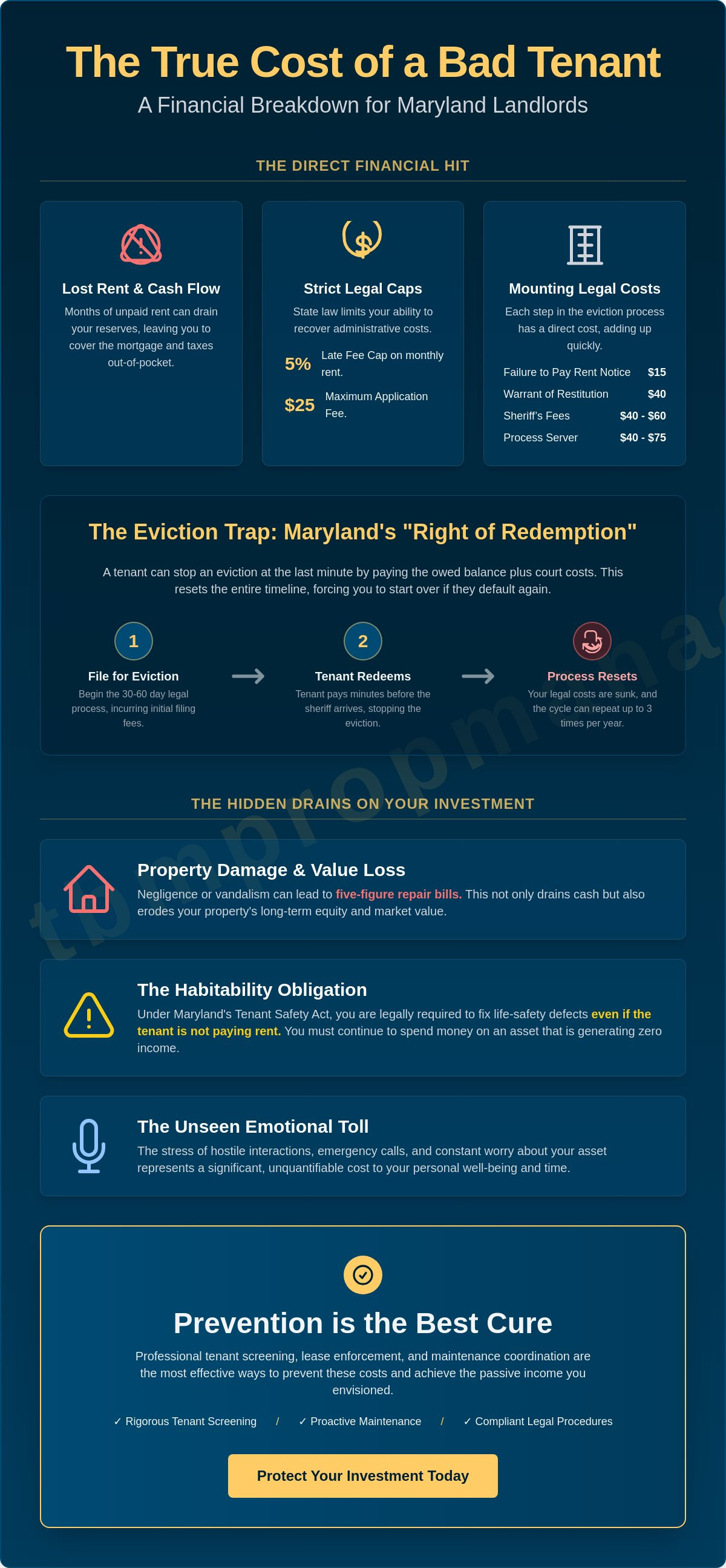
Maryland law is very specific about how much you can charge for late payments. The state caps late fees at exactly 5% of the monthly rent. If your tenant pays $2,000 a month, the most you can collect is $100. This small amount rarely covers the administrative time spent sending notices, making phone calls, and coordinating with legal counsel. If you operate in Laurel or Prince George’s County, you must also ensure you provide proper written notice before even starting the filing process. You should also remember that "confessed judgments" are strictly illegal in Maryland leases. You can't include clauses that allow you to skip the court process and automatically win a judgment for unpaid rent. These protections ensure a fair process for tenants but place a heavy administrative and financial burden on you as the property owner.
Filing Costs and Attorney Fees
The literal price of seeking justice in the Maryland District Court adds up faster than many expect. A Failure to Pay Rent (FTPR) notice costs $15, while filing for a Warrant of Restitution is $40. If the case proceeds to an actual eviction, you'll face sheriff’s fees ranging from $40 to $60 and potential process server costs between $40 and $75 per attempt. The real drain occurs with "stale" filings. Because Maryland grants a "Right of Redemption," a tenant can pay their balance plus court costs minutes before the sheriff arrives, effectively resetting the entire 30 to 60-day eviction timeline. If this happens three times in a year, you may finally be able to request a judgment with "No Right of Redemption," but by then, you've spent thousands in legal fees and lost months of potential income. Handling these filings yourself often leads to procedural errors, such as missing a required rental license or lead paint registration, which can result in the court dismissing your case entirely. We've seen how these delays multiply the cost of a bad tenant maryland owners must endure, making professional rent collection and tenant screening vital safeguards for your investment.
The Hidden Costs: Property Damage and Habitability Risks
While missing rent is a visible financial wound, physical property destruction is often the hidden infection that cripples your long-term investment. In the competitive Laurel real estate market, your home’s value depends heavily on its condition. A bad tenant can quickly turn a profitable asset into a liability through negligence or outright vandalism. The cost of a bad tenant maryland owners face frequently extends into five figures when you account for the loss of market appreciation. If your property falls into disrepair, you aren't just losing today's rent; you're losing the future equity you've worked so hard to build. Maryland is strict, and the consequences of neglect are high.
The Warranty of Habitability in 2026
Maryland law dictates that a property must be fit for human habitation from the very first day of the lease. Under the 2024 Tenant Safety Act, your obligation to maintain a safe environment doesn't stop just because a tenant is behind on payments. You're legally required to fix life-safety defects even during an active eviction process. This creates a challenging scenario where you must spend money on a tenant who isn't paying you. You should also be aware of the "actual notice" rule. If you see a leak during a walkthrough, you are legally liable to repair it, regardless of whether the tenant officially reported it. For a deeper dive into staying compliant, review our Maryland landlord tenant rights guide.
Security Deposit Disputes and Triple Damages
The financial risk doesn't end when the tenant finally moves out. Maryland maintains an aggressive stance on security deposit mishandling. You have a strict 45-day window to return the deposit or provide a detailed, written list of damages. If you miss this deadline or fail to follow the procedures outlined in the Maryland Attorney General's guide on landlord-tenant law, a judge can award the tenant up to three times the deposit amount as a penalty. This is why professional inspections are your only real defense. Without clear, documented evidence of the property's condition before and after the lease, the cost of a bad tenant maryland landlords pay can triple overnight. Utilizing a dedicated partner for Property Maintenance Coordination ensures these legal traps are avoided, keeping your investment secure and your stress levels low.
Navigating the Maryland Eviction Timeline
The legal process for removing a non-paying tenant in Maryland is a marathon, not a sprint. Every day the property remains occupied by a delinquent resident, your potential for recovery shrinks while your expenses grow. The cost of a bad tenant maryland owners experience is often compounded by the sheer length of the state's eviction timeline. It begins with a mandatory 10-day notice for non-payment of rent. If the tenant fails to pay within this grace period, you must file a Failure to Pay Rent (FTPR) complaint in the District Court. This isn't just a paperwork exercise; it's the start of a formal legal battle that requires precision and patience.
During the trial, you might encounter sophisticated defenses. Under the 2024 Tenant Safety Act, a tenant can request "Rent Escrow," claiming the property has serious defects that threaten life or safety. This can halt the eviction process until a court-ordered inspection is completed. If you successfully navigate the trial and receive a judgment, you must then file a Warrant of Restitution. This warrant is your legal permission to involve the Sheriff's Department, but it comes with its own set of logistical hurdles. The actual eviction involves the physical removal of possessions and rekeying the property, which typically costs between $75 and $150 for a professional locksmith. An Urban Institute study on eviction costs highlights how these procedural delays and associated fees create a significant financial vacuum for property owners.
The "Right to Redeem" in Maryland
One of the most frustrating aspects of Maryland law is the "Right to Redeem," often called the "pay to stay" rule. This allows a tenant to stop the eviction at any point before the sheriff arrives by paying all back rent and court costs. For many landlords, this creates a "revolving door" scenario where a tenant remains chronically delinquent, only paying at the final hour to reset the clock. While this keeps the tenant in the home, it leaves you in a state of perpetual financial instability. You should note that local timelines vary; getting a court date in Montgomery County may look very different than the process in Prince George’s County, where high case volumes often lead to longer wait times.
Sheriff Delays and Scheduling Hassles
Winning your case in court is only half the battle. Once you have your Warrant of Restitution, you're at the mercy of the local Sheriff’s Department schedule. In areas like Laurel, the wait for a scheduled eviction date can stretch for weeks. This is a critical period because a Warrant of Restitution expires after 60 days. If the Sheriff cannot execute the eviction within that window, you may have to start the filing process all over again. During this entire wait, your property remains "off-market," meaning you're losing out on fresh rental income while still paying for property taxes and insurance. The cost of a bad tenant maryland landlords endure is heavily weighted by this period of forced vacancy, where you're essentially providing free housing while the legal system slowly turns.
The Emotional Burden: Stress, Liability, and Opportunity Cost
Have you ever stared at your phone at 2:00 AM, dreading a text from a tenant who owes you thousands but still demands immediate attention for a minor repair? The psychological cost of a bad tenant maryland owners endure is often more draining than the financial loss itself. Managing emergency repairs for a hostile resident who refuses to follow lease terms creates a state of chronic anxiety. This emotional weight isn't just about lost sleep; it's about the constant distraction from your career, your family, and your personal peace. We believe your investment should serve your life, not consume it.
Beyond the stress, self-managed landlords face significant liability exposure. In Maryland’s pro-tenant legal environment, a single heated exchange can be twisted into a claim of "retaliatory eviction" or a fair housing violation. If a tenant reports a habitability issue and you move to evict shortly after, you must prove your actions weren't a response to their complaint. The legal fees to defend against these claims can dwarf the original unpaid rent. When you factor in the opportunity cost, the numbers become even more staggering. Industry data suggests landlords spend upwards of 20 hours dealing with a single problematic tenancy. If your professional time is valuable, those hours represent a massive hidden expense. Choosing property management in Laurel, MD restores your peace of mind by placing a professional buffer between you and the conflict.
The Risk of Self-Management in 2026
DIY landlords are statistically more likely to miss the frequent regulatory updates that define the 2026 rental market. It's easy to make emotional decisions when you feel taken advantage of, but emotional responses in court are a liability. Professional tenant placement services act as a vital filter, using data-driven screening to prevent high-risk individuals from ever entering your property. This proactive approach eliminates the friction that leads to landlord burnout.
Calculating Your Hourly Rate as a DIY Landlord
To understand the true value of your time, compare your professional hourly rate against the cost of management. If you spend 20 hours on court filings, inspections, and hostile phone calls, you're likely "paying" yourself far less than you're worth. Utilizing professional maintenance coordination ensures repairs are handled efficiently without your direct involvement. "Stress-free" management is an investment in your quality of life, allowing you to focus on growing your portfolio while we handle the daily complexities. For a clear path to relief, learn more about our Full-Service Property Management solutions.
Prevention is the Best Cure: The TBM Property Management Solution
Why wait for a financial crisis to realize your screening process was insufficient? We believe that the most effective way to eliminate the cost of a bad tenant maryland landlords fear is to prevent them from ever signing a lease. At TBM Property Management, we've spent over 12 years navigating the specific legal nuances of Prince George’s and Montgomery County. We don't just hope for the best; we use a rigorous 7-point Tenant Screening process that verifies credit, criminal history, past evictions, and employment. By confirming every detail before the keys are handed over, we protect your property from the chronic delinquency and physical damage discussed earlier in this guide.
Our approach to property oversight is proactive rather than reactive. Instead of waiting for a tenant to report a major leak or for a neighbor to complain about a lease violation, we conduct regular Property Inspections. These visits allow us to catch small issues before they evolve into expensive habitability claims or structural damage. We also implement professional Rent Collection systems that establish clear expectations from day one. This consistency significantly reduces delinquency rates and ensures your cash flow remains steady, even in a state with strict late fee caps. When you partner with us, you aren't just hiring a service; you're gaining a dedicated partner who treats your investment as if it were our own.
Our Proven Tenant Placement Strategy
Finding a high-quality applicant in the Laurel area requires more than a simple listing. We use targeted marketing strategies to attract responsible professionals who value their credit and their living environment. While many DIY landlords skip the tedious step of calling previous landlord references, we consider it a mandatory part of our process. This helps us identify "revolving door" tenants before they become your problem. We also handle all aspects of Fair Housing compliance. This protects you from the massive legal liabilities and "retaliatory eviction" claims that can arise from even a single administrative mistake.
Comprehensive Management for Total Relief
The transition from a state of frustration to a state of ease begins when you hand over the daily friction of management. From coordinating maintenance to navigating the 2024 Tenant Safety Act, we handle the complexities so you don't have to. We understand the emotional burden of asset oversight, and our goal is to provide the stabilizing force you need to achieve true passive income. You deserve a partner who is protective, detail-oriented, and deeply rooted in the local community. If you're ready to stop worrying about the cost of a bad tenant maryland laws might impose, we're here to help. Request your complimentary rental analysis today and discover how our expertise can secure your financial future.
Secure Your Investment and Reclaim Your Peace of Mind
The 2026 Maryland rental market demands more than just a standard lease; it requires a proactive strategy to avoid the compounding legal and financial risks we've explored. From strict 5% late fee caps to the complexities of the 2024 Tenant Safety Act, the true cost of a bad tenant maryland owners face is simply too high to leave to chance. You've seen how a single delinquent tenancy can drain your bank account, damage your property, and steal your time through endless court dates and midnight emergencies. Managing these challenges alone often leads to burnout and lost appreciation on your most valuable assets.
It's time to shift from a state of constant worry to a state of total relief. With over 12 years of local Maryland expertise, our team acts as your dedicated partner in asset protection. We utilize a comprehensive 7-point tenant screening process to find reliable residents and leverage specialized systems for dedicated maintenance coordination. This ensures your property remains in peak condition while you focus on your career and family. Stop the stress and protect your investment with TBM Property Management today. Your path to a truly passive, high-standard rental experience is just a conversation away.
Frequently Asked Questions
How much does an eviction cost in Maryland in 2026?
An eviction in Maryland typically costs between $200 and $350 in direct administrative fees, though lost rent and property damage often push the total much higher. You'll pay $15 for the Failure to Pay Rent notice and $40 for a Warrant of Restitution. Additional expenses include $40 to $60 for the sheriff's fee and $75 to $150 for a locksmith to rekey the property. These costs don't include the value of your time spent in court.
Can a tenant in Maryland withhold rent for repairs?
Yes, a tenant can legally withhold rent through a process called Rent Escrow if there are serious defects that threaten their life, health, or safety. Instead of paying you, the tenant pays the rent into a court-administered account. This continues until the court determines the repairs are complete. It's a challenging situation that stops your cash flow while you're still responsible for all property expenses and mortgage payments.
What is the maximum late fee a landlord can charge in Maryland?
Maryland law strictly caps late fees at 5% of the monthly rent amount. If your monthly rent is $2,000, the maximum fee you can charge is $100. For weekly rent payments, the fee cannot exceed $3 per week or $12 per month. It's vital to include these specific terms in your lease agreement to ensure they are enforceable during a Failure to Pay Rent hearing.
How long does the eviction process take in Prince George’s County?
The average timeline for an eviction in Prince George’s County is 30 to 60 days from the initial filing. This duration can fluctuate based on the court's current caseload and the availability of the Sheriff’s Department to execute the warrant. If a tenant exercises their Right of Redemption by paying the balance at the last minute, the cost of a bad tenant maryland owners face includes the time lost to these repeated delays.
Does the Tenant Safety Act of 2024 apply to all Maryland landlords?
Yes, the Tenant Safety Act applies to all residential landlords across the state. This legislation expanded tenant protections, particularly regarding the right to live in a property free from serious defects. It makes it easier for tenants to win rent escrow cases if the property doesn't meet specific safety standards. Staying compliant requires diligent maintenance and a thorough understanding of these updated statutory requirements to avoid costly legal penalties.
What can I deduct from a security deposit in Maryland?
You can deduct for unpaid rent, damage due to a breach of lease, or physical damage that exceeds normal wear and tear. You must provide the tenant with a written list of these damages and the remaining deposit within 45 days of the lease termination. Failing to meet this strict deadline can result in you being sued for triple the amount of the security deposit in Maryland court.
Is it worth hiring a property manager for just one rental property?
Hiring a manager for a single property is often the best way to mitigate the cost of a bad tenant maryland self-managed landlords encounter. The expense of a single bad placement, including legal fees and lost rent, frequently exceeds years of management fees. A professional team provides the screening and legal expertise needed to protect your investment, allowing you to enjoy truly passive income without the stress of daily operations.
What happens if a tenant refuses to leave after the lease expires in MD?
If a tenant stays past their lease end date, they are considered a holdover tenant. You cannot simply change the locks or remove their belongings; you must follow the formal eviction process. For month-to-month tenancies, you're required to give a 60-day written notice before filing a holdover action in court. Accepting rent after the lease expires can inadvertently create a new month-to-month agreement, so proceed with caution.